

If you have just encountered Yellapragada Subbarow’s name and are wondering why it was not already familiar, that gap is part of the answer. He is remembered within scientific circles as a Bharatiya researcher whose work changed modern medicine, yet his life never became common public knowledge on the scale of his claimed contribution.
To understand his legacy well, you need more than heroic adjectives. You need to distinguish scientific influence from celebrity, firm biographical facts from sweeping estimates, and legitimate civilizational pride from mythology. That approach does not diminish Subbarow. It makes the case for remembering him more durable.
Scientific influence and public fame are different measures

Public memory usually favors the person whose achievement can be reduced to one familiar object, formula, institution, or dramatic event. Biomedical research is harder to remember. Its influence passes through laboratories, clinical development, manufacturing systems, physicians, and finally patients. Once a discovery becomes part of ordinary medicine, the scientist behind it can disappear from view.
Subbarow’s reputation presents exactly this problem. His contributions have been described as having transformed modern medicine and helped save tens of millions of lives, while he remains largely unknown beyond scientific circles. The contrast is the central fact to notice: recognition is not a reliable measure of consequence.
When you assess a scientist’s legacy, therefore, do not begin by asking how often the name appears in films, textbooks, or commemorations. Ask what changed downstream. Did the work alter how disease could be investigated, treated, or prevented? Did later researchers and medical institutions build upon it? Did its effects continue after the scientist’s death? These questions measure scientific inheritance rather than publicity.
This distinction also explains why calling Subbarow an “unsung” scientist is not enough. That label describes the failure of memory, not the content of his achievement. A useful account must reconnect the name to the medical transformation for which he is remembered, then support each specific attribution with an appropriate scientific or institutional record.
Begin with the person, not a patriotic silhouette

Subbarow was born on 12 January 1895 in Bhimavaram, then part of the Madras Presidency and now in the West Godavari district of Andhra Pradesh. He came from a Telugu Brahmin family, and his father was a Sanskrit scholar.
Those details matter because they return him to a particular Bharatiya setting. They prevent the vague treatment of an Indian scientist as merely a name attached to work performed elsewhere. Place, language, family background, and intellectual inheritance all belong in a truthful biography.
They should not, however, be asked to prove more than they establish. A Sanskrit scholar in the family does not by itself demonstrate that a later laboratory result came from an ancient text. Nor does Subbarow’s community identity make his scientific achievement the possession of only one community. The honest civilizational claim is both stronger and simpler: a son of Bharat entered modern scientific life and contributed to medical advances whose benefits crossed national and religious boundaries.
If you are introducing him in a classroom, community event, or publication, start with four anchors: his full name, his birth date, Bhimavaram, and the medical importance attributed to his work. Spell out the geographical context instead of replacing it with the imprecise phrase “born in India.” This gives a student enough information to place him in history without turning the introduction into legend.
Measure a great legacy without manufacturing a legend

The phrase “tens of millions of lives” communicates the claimed scale of Subbarow’s medical influence. It is not the same thing as a directly counted patient total. Medical discoveries spread across decades, countries, treatment systems, and later refinements, so a sweeping lives-saved figure requires a stated method before it can be treated as a precise statistic.
You do not need to discard the larger claim. You do need to repeat it accurately: describe it as an estimate or an expression of scale, not as an audited count. This small change protects a strong historical case from becoming vulnerable to an avoidable challenge.
The same discipline applies to scientific credit. Modern medicine is collaborative. A person may perform decisive experiments, devise a method, lead a research program, identify a promising compound, or make later development possible. These roles are all important, but they are not interchangeable. Saying that one scientist was “behind” a breakthrough can be a useful introduction; it should not become a claim that nobody else contributed.
Before you repeat a specific claim about Subbarow’s work, test it with five questions:
- What exact discovery, method, compound, or research program is being attributed to him?
- What was his role: experimenter, originator, collaborator, research leader, or enabler of later development?
- What dated scientific paper, patent, laboratory record, or institutional history supports that role?
- How did the work travel from the laboratory into medical use?
- Is the stated human impact directly counted, modeled, or offered as a broad estimate?
This checklist is particularly important when preparing school materials or social-media tributes. If you cannot verify the name of a medicine or the nature of Subbarow’s role, do not fill the gap from memory. Use the broader, supportable statement that his contributions helped transform modern medicine, then return to the specific claim when you have a primary scientific or institutional record.
Accuracy is not timidity. Within a Dharmic outlook, it is an expression of satya. Pride that depends on exaggeration is fragile; pride grounded in careful attribution can survive scrutiny and teach the next generation how knowledge is actually made.
Key takeaways for restoring Subbarow to public memory
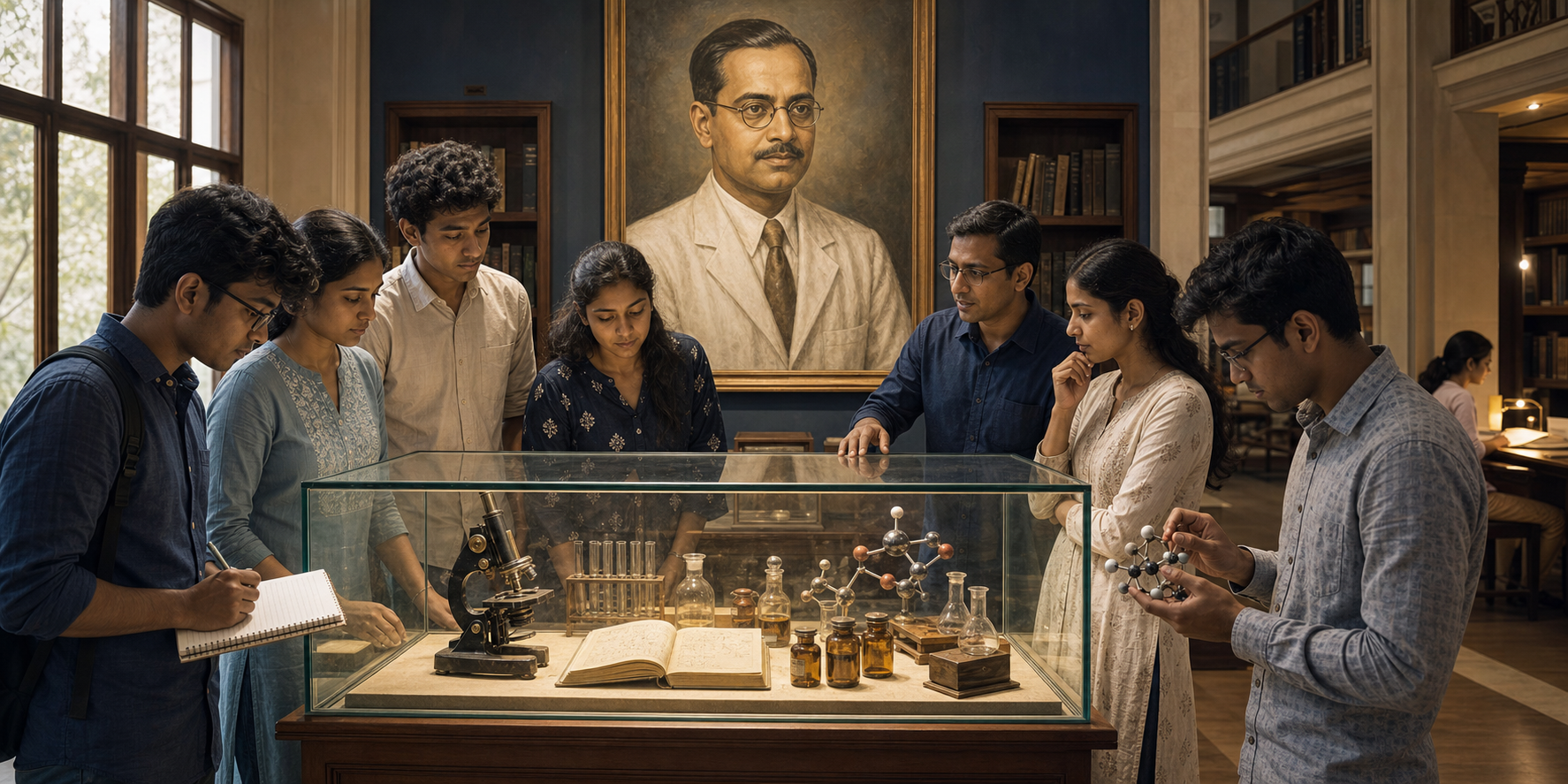
- Teach the contrast that makes his case important. His medical influence is described as immense, but his name remains unfamiliar outside scientific circles. That is a lesson about how poorly fame can track human consequence.
- Use exact biographical anchors. Name 12 January 1895, Bhimavaram, the Madras Presidency, present-day Andhra Pradesh, his Telugu background, and his father’s Sanskrit scholarship when the context requires them.
- Separate fact, attribution, and estimated impact. A birth record, a scientific role, and a lives-saved estimate are different kinds of claims and require different kinds of evidence.
- Do not replace neglect with mythology. Verify each named medical contribution and define Subbarow’s role before publishing it. Careful credit honors him more effectively than an inflated list.
- Place him in Bharatiya history as well as scientific history. His story belongs wherever students learn how people from Bharat entered global institutions and contributed knowledge with worldwide consequences.
- Create one accurate point of remembrance. Add a verified profile to a school lesson, library display, community reading list, or 12 January program. Include references so the next reader can continue beyond the introductory account.
Choose one place in your own educational or cultural circle where Subbarow’s name is absent, and add a concise, carefully sourced entry. Public memory is rarely repaired by one grand tribute. It returns when a name is used accurately, taught repeatedly, and connected to the work that made it worth remembering.
References
