
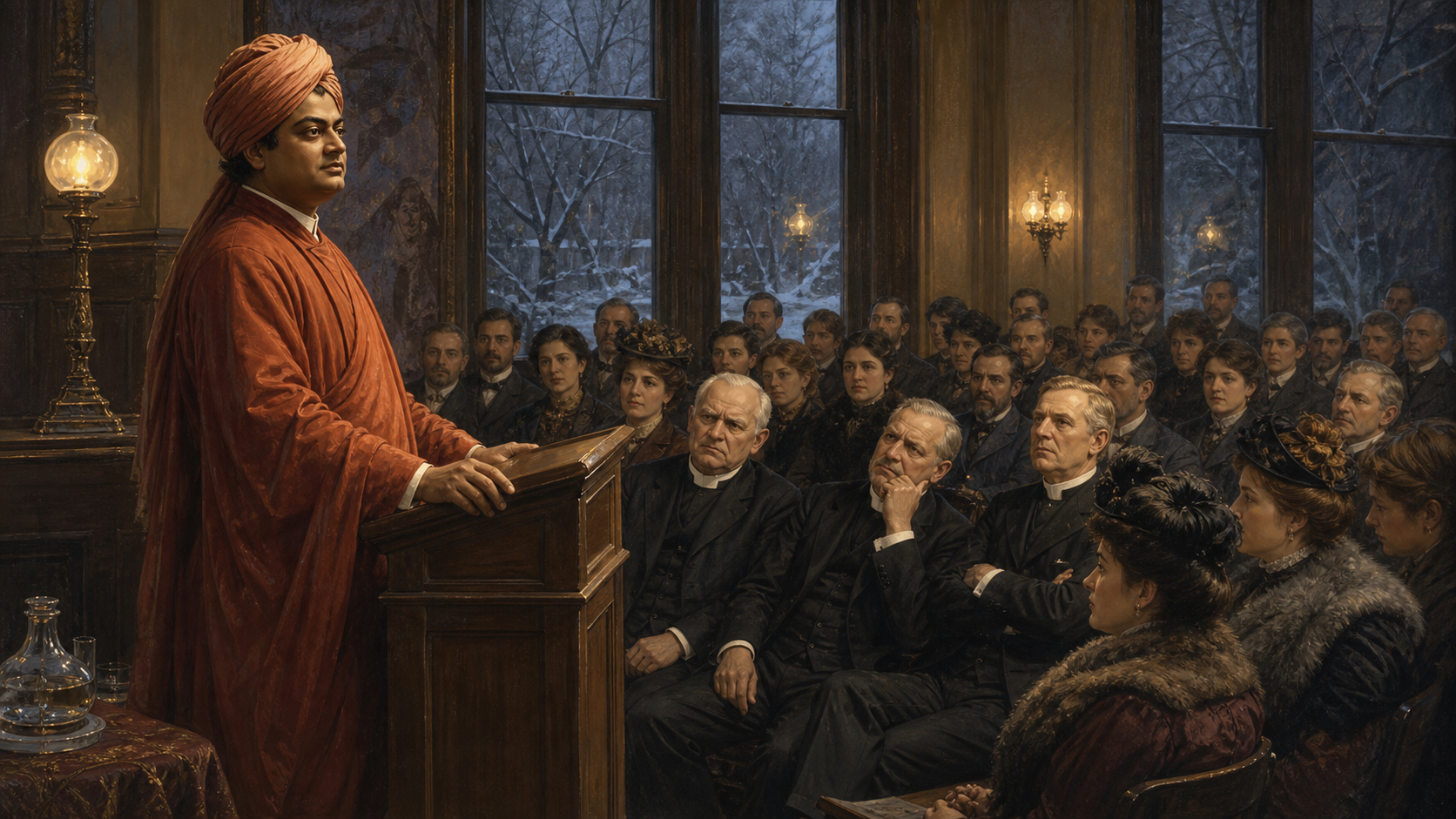
If Chicago is the episode you already know, Detroit is the one you need to understand. Fame was no longer the issue. The harder question was whether Vivekananda could defend Hindu civilisation after a Christian audience’s curiosity turned into organised clerical resistance.
Across eight Detroit lectures in February and March 1894, he refused both available traps. He did not make Hinduism plead for approval, and he did not answer religious condescension with personal abuse. Instead, he challenged the assumption beneath the missionary project: why should material power be treated as proof of spiritual authority?
Detroit turned hospitality into public controversy
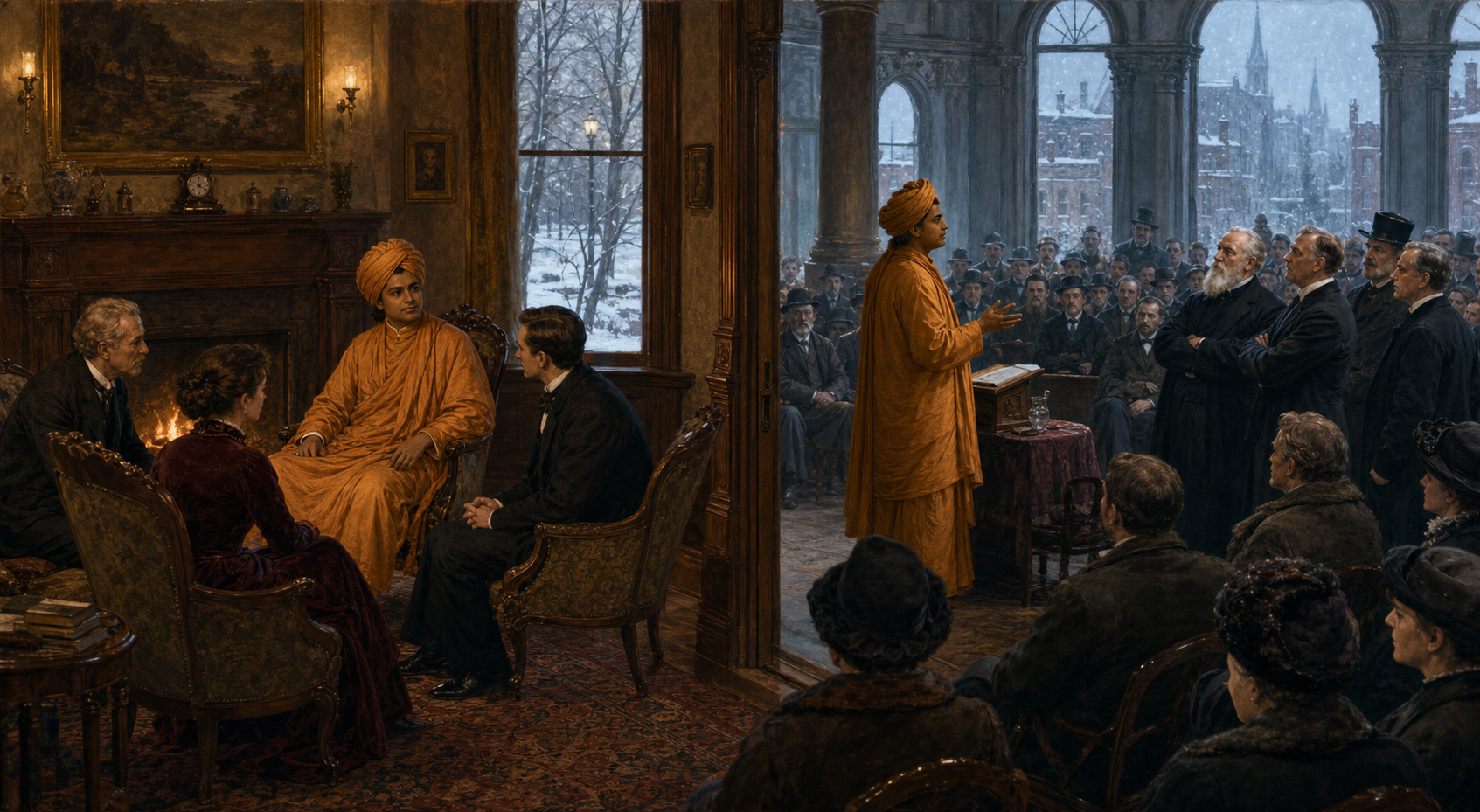
The confrontation began on 14 February at Detroit’s Unitarian Church. Bishop Ninde, a Methodist Episcopalian, introduced Vivekananda. Ninde expected nothing offensive to Christian listeners. The surrounding expectation appears to have been equally comfortable: the Indian monk might describe unfamiliar customs and perhaps acknowledge the benefits of Christian missions.
Vivekananda did something more consequential. He presented India as the bearer of a durable spiritual and moral inheritance, not as a passive field awaiting religious rescue. He argued that Indian religion had cultivated gentleness, consideration and affection toward human beings and animals. Missionaries who presumed to bring India its first serious moral ideas, he maintained, had misunderstood the civilisation they proposed to teach.
The reaction came quickly. On 16 February, Ninde wrote to the editor of the Detroit Free Press to explain his role. He objected that Vivekananda had elevated Hindu virtues while diminishing the moral standing of Christian nations. Letters and editorials both defending and opposing the Swami then carried the dispute into Detroit’s public life.
Notice the sequence, because it explains why Detroit matters:
- A Hindu teacher was welcomed within a frame established by Christian hosts.
- He rejected the premise that India stood before them as a spiritually deficient civilisation.
- The reversal embarrassed an influential host, who publicly distanced himself from it.
- The argument expanded beyond the lecture hall, even though Vivekananda did not turn his later appearances into personal retaliation.
Chicago had demonstrated his ability to command a great audience. Detroit tested whether his method could survive sustained opposition. It did, because his case did not depend on the goodwill of the people who introduced him.
He changed the measure of civilisational achievement
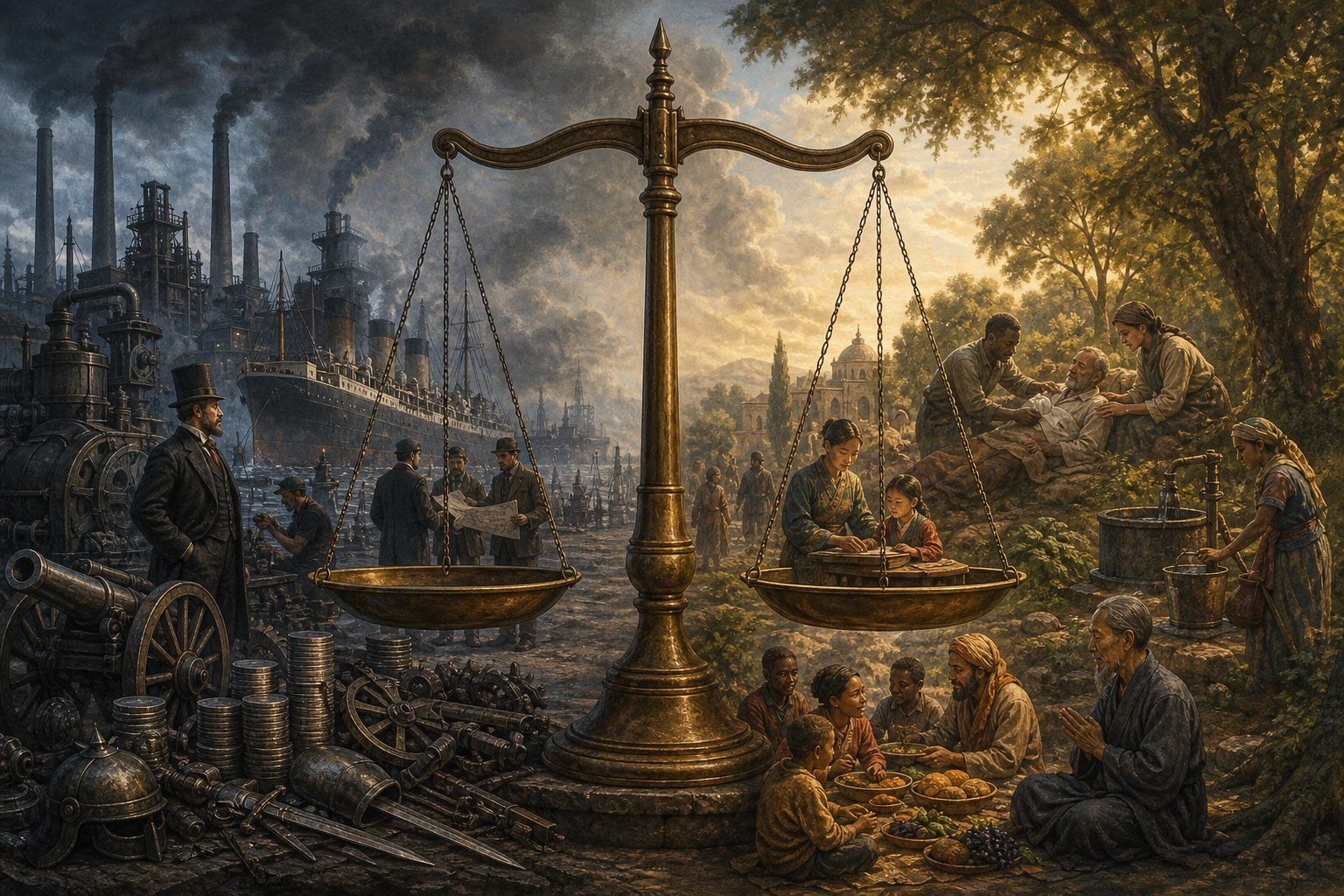
Vivekananda’s decisive move was to separate material dominance from spiritual worth. Political conquest can reveal military capacity. It cannot, by itself, establish moral superiority. A conquered people may retain a spiritual inheritance that their conquerors neither possess nor understand.
Detroit listeners encountered this contrast through his account of an Indian renunciation of bloodshed around 260 BCE: armies of instructors were sent abroad in place of armies of soldiers. Whether a civilisation spread its influence through force or teaching was therefore not a side issue. It was part of the moral test.
This shifted the burden of proof. Vivekananda was no longer answering, “Why has India failed to become like the West?” His audience had to confront another question: “What does Western power prove about the moral and spiritual fitness of Western nations to instruct India?”
His reasoning can be followed in three steps:
- Reject the false proxy. Wealth, empire and military victory are not reliable measurements of spiritual attainment.
- Name a moral criterion. Judge religion by the character it forms: restraint, compassion, humility and regard for living beings.
- Apply the criterion symmetrically. A missionary who judges India must accept the same examination of Christian societies and missionary conduct.
This is stronger than simply insisting that Hinduism deserves tolerance. Tolerance can leave the hierarchy untouched: one civilisation remains the judge while another asks to be admitted. Vivekananda questioned the judge’s qualifications.
At the same time, historical care is necessary. Detroit readers received a press paraphrase attributing to him the sweeping assertion that India stood morally above the United States and every other nation. The available lecture reports were not verbatim transcripts. You can responsibly identify the argument and its unmistakable direction, but you should not treat every reported sentence as stenographic quotation.
His target was missionary certainty, not Christian virtue
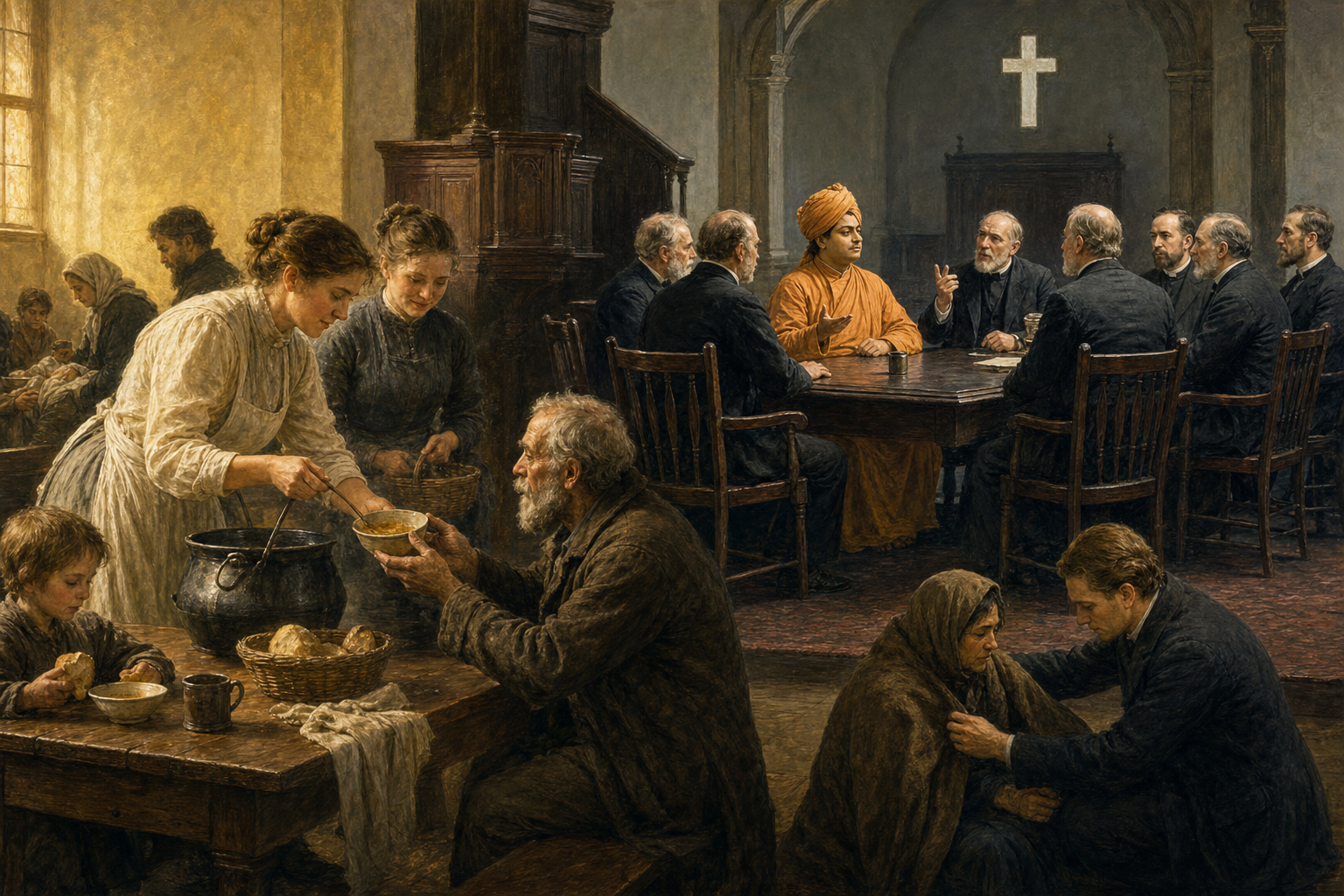
It is easy to flatten the Detroit dispute into Hinduism against Christianity. Vivekananda’s own framing resists that simplification. He described something Christlike in the humility with which Indians endured misfortune. He could honour a Christian moral ideal while rejecting the claim that Christian missionaries possessed a monopoly on spiritual light.
That distinction gave his criticism precision. He did not need to deny every Christian virtue in order to question missionary institutions. Nor did he need to insult individual Christians to expose the civilisational presumption behind a project that classified India as benighted.
If you are speaking about Dharma in a sceptical or hostile setting, keep four levels separate:
- A religious ideal: the ethical or spiritual teaching a tradition professes.
- A society’s conduct: what people and states actually do while identifying with that tradition.
- An institution’s claim: the authority a church, mission or organisation asserts over others.
- An individual interlocutor: the particular person in front of you, who should not be reduced to every historical failure associated with the institution.
Confusing these levels weakens a Dharmic case. An attack on every Christian merely reproduces the same indiscriminate thinking used against Hindus. A precise argument is harder to dismiss: acknowledge a worthy ideal, identify the institutional claim being challenged, and test that claim against knowledge and conduct.
Vivekananda’s restraint also prevented his opponents from choosing the battlefield. Much of the hostility appeared in letters and editorials, while his lectures continued to centre religion’s essence. He did not have to win every newspaper quarrel. He had to prevent the quarrel from displacing his affirmative account of India.
Five disciplines for Dharmic advocacy today

Detroit offers a method, not a script to imitate word for word. When you face an audience carrying inherited assumptions about Hinduism or Bharat, these five disciplines are more useful than a catalogue of rebuttals.
- Identify the hidden premise before answering the visible question. The Detroit premise was not merely that Indians followed unfamiliar customs. It was that Christian society possessed the standing to classify India as spiritually deficient. Ask who defined the standard, what qualifies them to apply it, and whether they accept it when directed toward themselves.
- Refuse measurements borrowed from political power. Do not allow conquest, wealth or technological advantage to become automatic evidence of moral rank. If the subject is religion, return the discussion to the kind of person and society a religious vision seeks to form.
- Present Dharma affirmatively. Vivekananda did not stop after exposing hypocrisy. He named the qualities India’s spiritual culture cultivated. A defence that consists only of complaints leaves the audience with no positive understanding of Hindu civilisation.
- Do not mirror your opponent’s contempt. Personal retaliation may satisfy supporters for a moment, but it allows the original civilisational question to disappear beneath a fight over tone. Criticise the premise, the institution and the historical conduct with specificity.
- Preserve the evidence and its limits. Christine Greenstiedel, later known as Sister Christine, and Mary C. Funke attended the first Detroit lecture and the later lectures. In 1908, Funke sent preserved newspaper clippings to Swami Brahmananda at Belur Math. Their care helped later readers reconstruct the episode, but newspaper summaries still should not be converted into invented verbatim transcripts.
The last discipline is especially important for a tradition defending itself against distortion. Accuracy is not a concession to hostile critics. It is part of the defence. If we exaggerate a victory or repeat an uncertain quotation because it sounds effective, we make the durable argument dependent on a vulnerable detail.
What you can responsibly say about the Detroit lectures
Dharmic history loses credibility when admiration hardens into unsupported precision. We can establish the sequence more firmly than the exact language, and we can distinguish documented controversy from later claims about its effects.
| Point | What the record supports | Responsible wording |
|---|---|---|
| Number and period | Eight Detroit lectures in February and March 1894, apart from appearances in nearby towns | State the number and period directly. |
| Opening controversy | The first lecture took place on 14 February at the Unitarian Church; Bishop Ninde publicly objected on 16 February. | Use these dates to show how rapidly the dispute developed. |
| Exact lecture language | What survives here includes newspaper summaries rather than verbatim transcripts. | Use “reported,” “paraphrased” or “argued”; do not place reconstructed wording inside quotation marks. |
| Effect on missionary income | A later observer claimed that missionary income fell by more than one million dollars a year. | Identify this as an observer’s claim, not an audited consequence of Vivekananda’s speeches. |
| Meaning of his victory | He continued speaking, attracted committed listeners and provoked a public debate despite clerical resistance. | Say that he sustained and reframed the argument, not that every adversary was persuaded. |
Key takeaways
- Detroit was a sustained test of Vivekananda’s method, not merely an encore to his reception in Chicago.
- His central move was to deny that material dominance automatically confers spiritual authority.
- He challenged missionary presumption without denying Christian ethical ideals or descending into personal abuse.
- The lecture language should generally be presented as reported paraphrase, not exact quotation.
- The claim of a million-dollar annual decline in missionary income belongs to the history of his reception, not to a verified financial calculation.
If you are preparing a talk, lesson or essay on Detroit, build it around four anchors: the 14 February lecture, Ninde’s 16 February response, Vivekananda’s reversal of the missionary standard, and the distinction between Christian virtue and missionary certainty. Label paraphrases honestly. Omit the donation figure unless you are specifically examining how later admirers remembered his impact.
Then bring Detroit’s real question to your own audience: what entitles one civilisation to declare another spiritually inferior? Ask it calmly, apply the test equally, and be ready to give a positive account of Dharma after the inherited hierarchy has been cleared away.
References
