

You probably know what the Constitution allows you to demand from the State. The harder question is what it asks of you when no official is watching and no court order compels you.
That question matters because public life becomes lopsided when every disagreement is framed as an entitlement and every obligation is assigned to someone else. In Bharatiya civic discussion, duties receive far less attention than rights. Article 51A gives you a practical way to correct that imbalance without weakening the rights that protect liberty and dignity.
The complete duty-set, in plain language

The Fundamental Duties sit in Part IV-A of the Bharatiya Constitution under Article 51A. The 42nd Constitutional Amendment inserted the original set, while the responsibility concerning a child’s education was added later. The constitutional duty-set expected of citizens can be understood as follows:
- Respect the constitutional order. Abide by the Constitution and respect its ideals, institutions, the National Flag and the National Anthem. Respect here means disciplined conduct under constitutional institutions, not unquestioning agreement with every government decision.
- Carry forward the ideals of the freedom struggle. Learn what moved people to sacrifice for independence, and test present conduct against ideals such as courage, public service, self-rule and resistance to injustice.
- Protect sovereignty, unity and integrity. Do not knowingly assist efforts that fracture the country, compromise its independence or turn legitimate differences into organised hostility against Bharat.
- Defend the country and render national service when called. This is a duty to respond through lawful institutions when the nation requires service. It is not permission to form a private force or appoint yourself as an enforcer.
- Promote harmony and uphold the dignity of women. Rise above religious, linguistic, regional and sectional divisions; cultivate fraternity; and reject customs or behaviour that degrade women. Harmony does not require silence about wrongdoing. It requires truthful disagreement without collective hatred.
- Preserve Bharat’s composite cultural heritage. Value and transmit the civilisation’s languages, arts, sacred traditions, philosophies, sites, memories and diverse local expressions. Preservation demands knowledge and care, not merely slogans about pride.
- Protect nature and show compassion for living beings. Improve the condition of forests, lakes, rivers and wildlife, and treat other living beings with consideration. The duty joins ecological responsibility with an ethical disposition rather than treating the environment as an unlimited store of resources.
- Develop scientific temper, humanism, inquiry and reform. Ask for evidence, examine causes, correct error and remain willing to reform harmful practices. This does not require contempt for tradition. It requires intellectual honesty when any claim, modern or ancient, is tested.
- Protect public property and reject violence. A bus, school, road, railway facility or government hospital is not an enemy’s possession. Damaging it during anger or protest transfers the loss to the public, including people who had no part in the dispute.
- Strive for excellence. Improve the quality of your own work and the institutions in which you participate. Excellence here is not celebrity or personal status; it is the steady raising of individual and collective standards.
- Provide educational opportunity to a child or ward. A parent or guardian is responsible for providing an opportunity for education to a child or ward between six and fourteen years of age. The duty makes education a household responsibility as well as a public commitment.
Read sequentially, these are not unrelated moral wishes. They move from loyalty to the constitutional framework, through national and social responsibility, toward culture, ecology, reason, nonviolence, competence and the formation of the next generation.
What legal force these duties do and do not carry
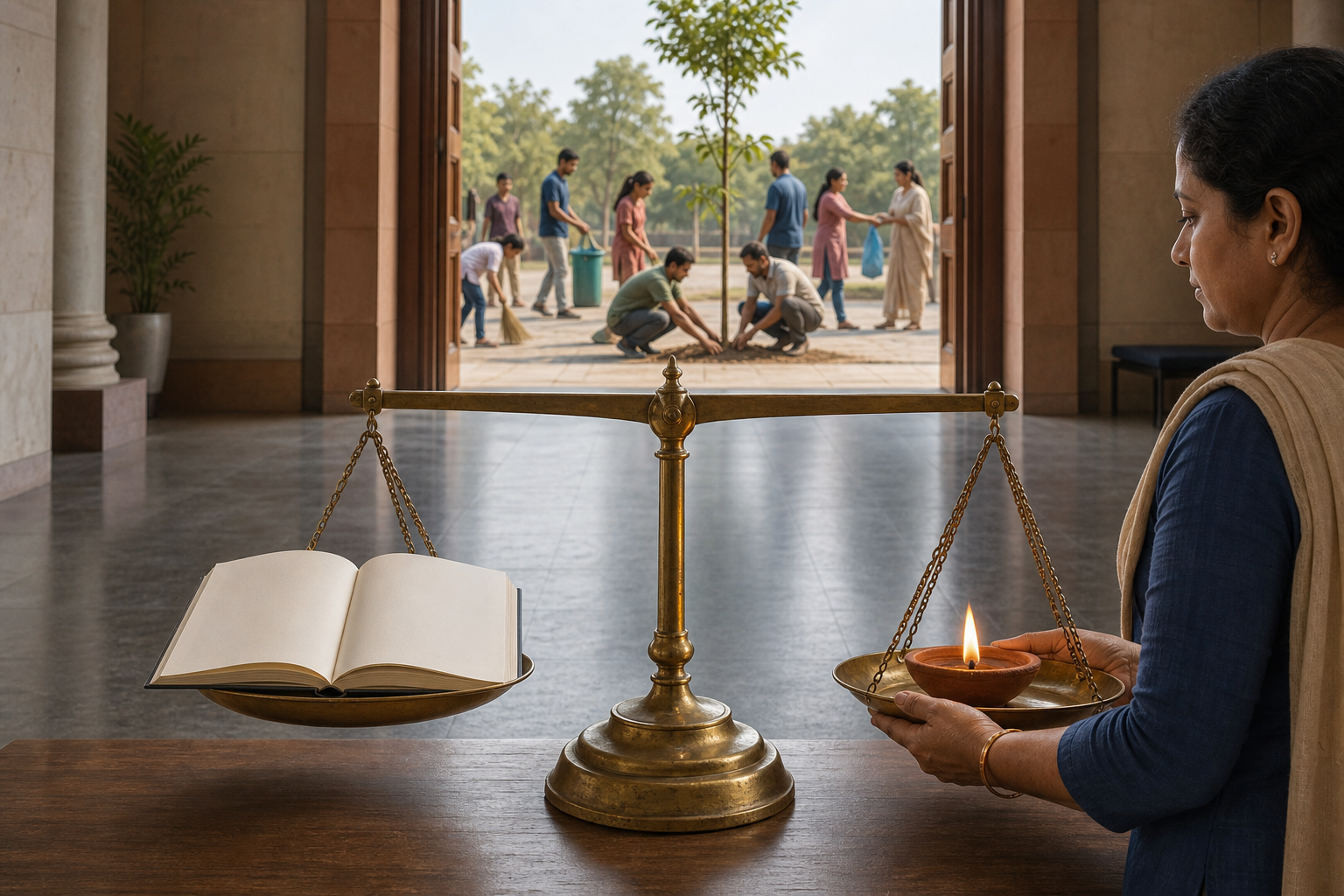
A Fundamental Duty is constitutional, but its inclusion in Article 51A does not by itself turn every failure into a criminal offence. If particular conduct is prohibited or required by an applicable law, that law supplies the procedure, definition and possible consequence. The constitutional duty supplies the larger civic principle.
This distinction protects you from two common errors. The first is treating the duties as decorative because they are not framed exactly like enforceable claims against the State. The second is using them as a licence for private punishment. Neither approach is sound. Legislatures can make laws connected with the subjects covered by the duties, and courts can consider constitutional duties when interpreting laws and public interests. But a citizen cannot invent a penalty, threaten a neighbour or suppress lawful disagreement merely by invoking Article 51A.
Rights and duties are also not a barter arrangement. You do not have to demonstrate flawless civic conduct before enjoying constitutional protection. A lawful restriction on a right requires a constitutional and legal basis; another person’s accusation that you neglected a duty is not enough. At the same time, possessing a right does not answer whether every possible use of it is responsible, truthful or conducive to social trust.
If a specific dispute could expose you to arrest, a financial penalty, loss of employment, disciplinary action or school consequences, obtain advice from a qualified lawyer familiar with the relevant facts and current law. A general appeal to Fundamental Duties cannot settle the legal question on its own.
A practical Article 51A audit for everyday decisions

You do not need a ceremonial occasion to practise these duties. Use them as a decision filter at the moments when civic damage usually begins: forwarding a claim, joining an angry crowd, dismissing a local tradition, ignoring public neglect or deciding that poor-quality work is good enough.
- Before sharing inflammatory information: trace the claim to its original context, distinguish evidence from edited commentary and correct a false claim you have circulated. That puts scientific temper and social harmony into the same action.
- During political or religious disagreement: criticise the decision, argument or conduct precisely. Do not assign guilt to an entire religious, linguistic, caste or regional community. Precision lets you oppose adharma without manufacturing collective enmity.
- When protesting: decide in advance that public property, emergency access and uninvolved people are outside the field of confrontation. Record misconduct, preserve evidence and use lawful complaint, electoral and judicial channels instead of vandalism or threats.
- When encountering conduct degrading women: do not hide behind the claim that every inherited practice is sacred. Refuse participation, support the affected person, intervene when it is safe and use the appropriate institutional or legal reporting channel when needed.
- For cultural preservation: choose one tradition you can actually transmit. Learn the meaning of a local festival, support instruction in a Bharatiya language, document family history responsibly, study a primary text with context or help protect a heritage site through lawful means.
- For environmental responsibility: connect personal restraint with public follow-through. Reduce avoidable waste and water misuse, but also report dumping, damage to a water body or cruelty through the competent local authority rather than assuming private virtue alone will solve a shared problem.
- For national symbols and security: follow applicable protocol and law, especially in formal settings. During a crisis, do not circulate unverified claims or sensitive operational information merely because a dramatic message appears patriotic.
- For education: a parent or guardian should monitor attendance, learning conditions and barriers to access rather than treating enrolment as the end of the duty. If documents, disability access, discrimination or financial constraints obstruct education, take the issue to the school and the relevant public authority.
- For excellence: identify one recurring failure within your control: inaccurate records, unsafe shortcuts, poor teaching preparation, habitual delay or careless public service. Set a visible standard and review whether the work actually meets it.
This audit prevents constitutional vocabulary from becoming performative. A citizen who praises unity while forwarding communal falsehoods, celebrates heritage while knowing little about it, or invokes patriotism while destroying public property has separated speech from duty.
Reading constitutional duty through a Dharmic lens

Dharma asks what conduct sustains a just order in light of one’s role, relationships and circumstances. That makes it a fruitful lens for reading civic duty. It does not make constitutional wording irrelevant, nor does it allow any group to substitute its private definition of dharma for the law.
The Constitution’s duties form a common civic floor for citizens with different metaphysical beliefs. Dharma can deepen the motive: you preserve a river not only because regulation commands it, but because restraint, gratitude and care for life are part of right conduct. You protect another community’s dignity not as a reluctant concession, but because social order collapses when power is severed from responsibility.
Unity is not uniformity
Bharat’s unity has never depended on making every language, sampradaya, region or custom identical. The constitutional duty is to prevent difference from becoming disintegration or hatred. You can defend a particular inheritance strongly while recognising that another community’s lawful continuity is not an injury to your own.
Scientific temper is not civilisational amnesia
A claim does not become true merely because it is ancient, and it does not become false merely because it emerges from a traditional knowledge system. Apply the same habits in both directions: identify what is actually claimed, examine the evidence, distinguish symbolic or spiritual meaning from empirical assertion and revise the conclusion when the evidence requires it. Inquiry protects a civilisation from both credulity and fashionable contempt.
Service is not vigilantism
Defending the nation, preserving order and opposing wrongdoing must remain bounded by lawful authority. Dharma is not self-appointment to coercive power. If you see a possible offence, protect immediate safety where you lawfully can, document what happened and alert the competent authority. A mob claiming noble motives can still commit adharma.
This Dharmic reading also corrects a false choice between rights and duties. Rights restrain arbitrary power and protect human agency. Duties direct that agency toward conduct capable of sustaining a free society. Weakening either side eventually weakens the other.
Key takeaways
- Article 51A addresses citizens and sets a constitutional standard for responsible civic conduct.
- A Fundamental Duty is not automatically a penal offence; an applicable law must supply any enforceable prohibition, procedure or penalty.
- Fundamental rights do not depend on another citizen’s judgement that you have performed your duties well enough.
- Harmony requires precise, truthful disagreement, not silence about injustice or the erasure of difference.
- Scientific temper and cultural preservation belong together when tradition is studied with evidence, context and intellectual honesty.
- The most reliable test is behavioural: identify what you will verify, protect, preserve, improve or refuse to damage.
Choose one setting you control this week: your family group, workplace, school, temple committee, neighbourhood or public platform. Name the relevant duty, define one observable action and carry it out without waiting for a national occasion. Constitutional culture is built when responsibility becomes ordinary.
References
