
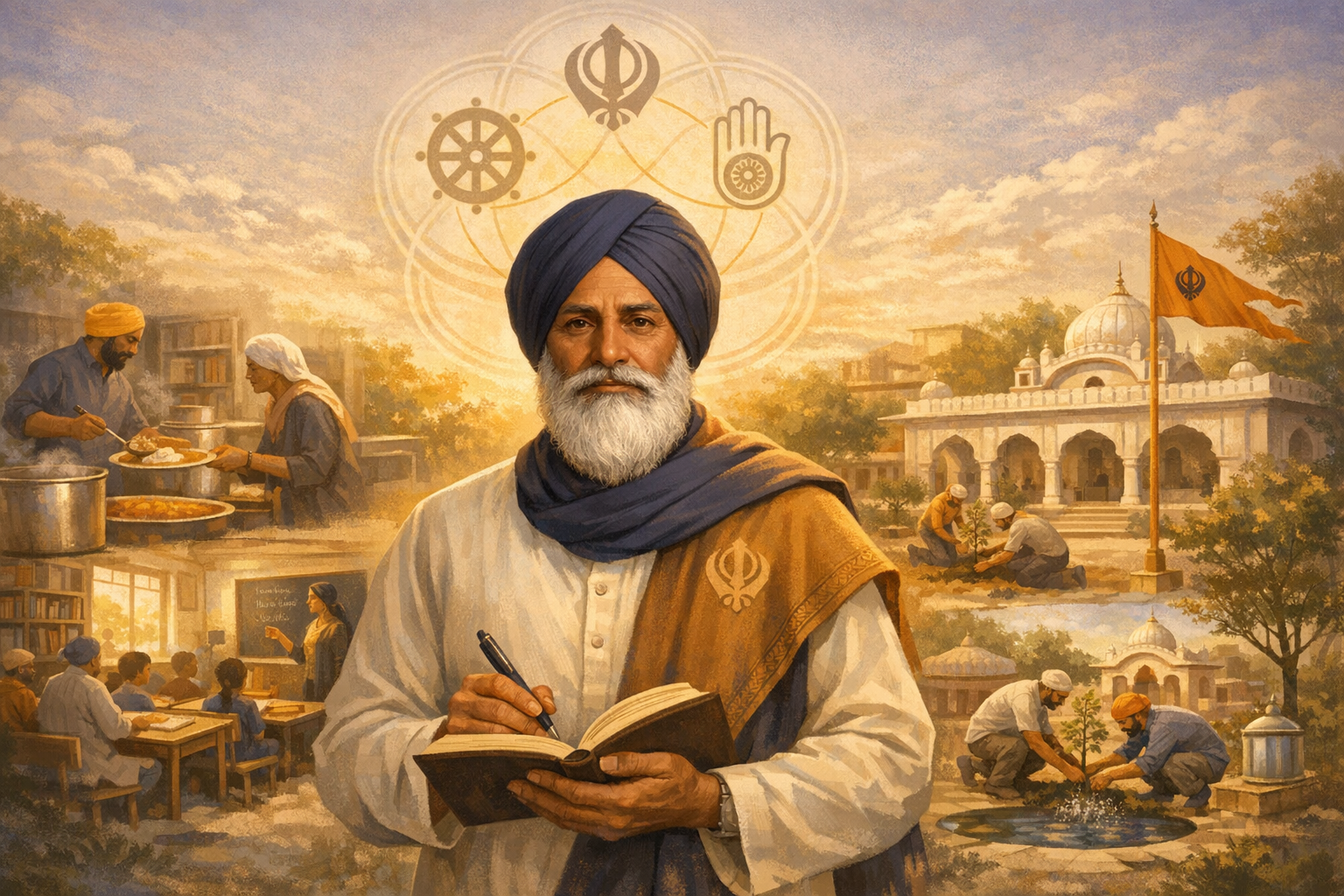
In Sikh historical memory, the epithet Zinda Shaeed (often rendered as Zinda Shaheed, “living martyr”) signifies an ethical horizon rather than a single event of death; it denotes a life consecrated to truth, service, and fearless responsibility. The name Bhai Takhat Singh appears in regional narratives with this honorific, and the association invites a broader inquiry into what Zinda Shaeed means within Sikh thought and how this living ideal resonates with the dharmic traditions of Hinduism, Buddhism, Jainism, and Sikhism.
Etymologically, “shaheed” (witness) connotes testimony to truth; “zinda” (living) insists that the witness is continuous and embodied. Zinda Shaeed, therefore, does not valorize death, but sanctifies a mode of living that neither yields to fear nor abandons compassion. In Sikh vocabulary shaped by Gurmat, it denotes steadfastness under hukam (the cosmic order), practiced through simran (remembrance), seva (selfless service), and adherence to rehit (discipline).
The saint-soldier (sant-sipahi) synthesisarticulated powerfully in the Khalsa formed at Anandpur Sahib and renewed through Amrit Sancharanchors this ethic. Courage is yoked to humility, action to inner discipline, and resistance to injustice to the protection of the vulnerable. This alignment reframes martyrdom away from spectacle toward a grammar of everyday responsibility.
Historical anchors clarify this grammar. Guru Arjan’s martyrdom (1606) presents the witness of composure and spiritual sovereignty under duress; Guru Tegh Bahadur’s sacrifice (1675), remembered for defending freedom of conscience, manifests Sikh commitment to “sarbat da bhala” (welfare of all), cutting across communal boundaries. These exemplars frame shaheedi as a universal ethic of rights and duties, not a sectarian badge.
The eighteenth century further diversified the shaheedi repertoire through lives remembered for spiritual resilience and social guardianship. From organized community defense to collective care practices like langar, the Khalsa’s public ethic resisted tyranny with both principled force and healing hospitality. In this matrix, Zinda Shaeed signifies a lifelong vow to hold the line for dignity, justice, and compassion.
Equally significant is the social-reform arc that Sikh memory preserves. The Singh Sabha movement emphasized education, ethical reform, and institution-building as instruments of dharmic renewal. Figures bearing the name Takht/Takhat Singh appear in accounts linked to educational uplift and community service, underscoring that the “living martyr” ideal also includes those who devote entire lifetimes to transforming social realities through schools, publications, and welfare initiatives.
Theologically, the Zinda Shaeed stance is grounded in a fearless interioritynirbhau, nirvairthat refuses both hatred and passivity. It privileges truthful speech, just conduct, and readiness to bear personal cost for public good. This is neither quietism nor vengefulness; it is disciplined moral agency in alignment with hukam.
Viewed alongside allied dharmic philosophies, the Sikh Zinda Shaeed ethic converges with the Hindu ideal of the sthitaprajña (steady in wisdom) and jivanmukta (liberated-in-life), with the Buddhist bodhisattva’s compassionate vow to alleviate suffering, and with the Jain emphasis on unflinching vows, ahiṁsā (non-violence), and tapas (austerity). Each tradition articulates a life-affirming duty to protect the vulnerable and serve the whole, even at personal cost. The common thread is ethical fearlessness rooted in spiritual clarity.
Ethically, Zinda Shaeed can be interpreted as a principled doctrine of public service. It is civic as much as it is spiritual: it summons communities to institutionalize compassion (through langar, relief work, education, and health services), to practice transparent stewardship of resources, and to cultivate shared security without diminishing the dignity of adversaries. Such an ethic helps transmute grievance into constructive responsibility.
Within Sikh praxis, this ethic is ritually nurtured. Amrit Sanchar inaugurates rehit-centered living; kirtan and ardas cultivate humility and resolve; sangat (community) embeds accountability; and sewa operationalizes compassion. Through these practices, the “living martyr” remains a lived vocation, not a rhetorical ornament.
Conceptually, Zinda Shaeed aims to resolve a perennial moral tension: how to resist evil without becoming a mirror of it. Sikh dharam-yudh (just resistance) is bounded by necessity, last resort, protection of non-combatants, proportionality, and the absence of malicenormative constraints that echo classical Indian reflections on righteous warfare as well as Buddhist and Jain cautions regarding harm.
Social memory keeps this ethic alive through shaheedi sakhiyan (martyrdom narratives), annual commemorations, and pedagogies that transmit values across generations. When communities recount lives of integritywhether on the battlefield, in classrooms, or in kitchens serving langarthey rehearse the civic virtues that sustain plural societies.
Public history and museum practice can further anchor this ethic by curating archives of letters, community records, and oral histories, with careful attention to provenance and context. As narratives around figures such as Bhai Takhat Singh circulate, critical methodssource triangulation, attention to regional variants, and sensitivity to hagiographic embellishmentensure that reverence and rigor remain companions rather than rivals.
Importantly, the “living” dimension resists romanticizing suffering. Sikh ethics insist that the goal is life, welfare, and flourishingnever the pursuit of death. The gravitas of shaheedi lies in dignified endurance and principled action, not in spectacle or despair. This insight protects communities from the spiral of retaliatory violence and keeps service at the center.
Service is where the Zinda Shaeed ideal touches everyday life most concretely. Disaster relief, food security initiatives, farmer support, community education, healthcare camps, and environmental stewardship are contemporary arenas for fearless, compassionate responsibility. Each undertaking operationalizes “sarbat da bhala” in visible, measurable ways.
Environmental seva merits special attention. From conserving Punjab’s aquifers to reforesting commons and greening gurdwara precincts, ecological responsibility is an urgent form of living witness. It harmonizes Sikh ideals with broader dharmic ecological consciousness and provides a shared platform for inter-tradition collaboration.
Education remains a signature pathway of this ideal. Schools and universities shaped by dharmic values can cultivate integrity, scientific temper, and civic virtue together. Curriculum design that integrates Sikh history, comparative dharma, ethics, and social entrepreneurship produces graduates capable of translating spiritual clarity into social innovation.
Digital humanities create new possibilities for preservation and pedagogy. Digitizing manuscripts, codifying oral histories with metadata, and building multilingual repositories allow communities to share trustworthy sources globally. Such work, undertaken in a spirit of seva, prevents distortion and supports nuanced public understanding of Sikh history and allied dharmic traditions.
At the level of inter-dharmic relations, Zinda Shaeed provides a language of solidarity rather than separation. The Sikh defense of religious freedom historically protected the rights of others to worship in their own ways, a stance that resonates with Hindu pluralism, Buddhist compassion, and Jain restraint. Collaborative service projectswomen’s safety, literacy, rural resilience, and public healthembody unity without erasing difference.
In comparative ethics, the Zinda Shaeed paradigm can be framed as a “virtue of steadfast care” that blends courage (virya), compassion (karuṇā), truthfulness (sat), and self-discipline (tapas). Such a framework is legible across dharmic philosophies, providing a shared vocabulary for contemporary policy, education, and community leadership.
Historically informed humility is essential. Honorifics can shift across time and place; regional narratives sometimes ascribe titles like Zinda Shaeed to different figures, including Bhai Takhat Singh in particular locales. Responsible scholarship treats these attributions with care, clarifying contexts while honoring the moral message they carry.
Practically, communities can nurture the Zinda Shaeed ethic through five commitments: truthful speech in public life; transparent stewardship in institutions; non-derogatory dialogue across differences; readiness to protect the vulnerable; and a bias for constructive service over performative outrage. These are scalable at household, congregation, and civic levels.
Read in this light, the invocation of Bhai Takhat Singh as Zinda Shaeed functions as a call to embody resilient compassion in every sphereeducation, governance, economy, ecology, and culture. It re-centers Sikh history as a living resource for plural, democratic flourishing and invites allied dharmic traditions into mutually enriching collaboration.
In conclusion, Zinda Shaeed is not a relic of the past but a renewable ethic of fearless service. It aligns Sikh sant-sipahi ideals with the broader dharmic aspiration to harmonize spiritual insight and social responsibility. As communities honor names associated with this honorific, including Bhai Takhat Singh in regional remembrance, the deeper challenge remains constant: to live as luminous witnessesundaunted, compassionate, and dedicated to sarbat da bhalaso that unity in spiritual diversity becomes a daily practice rather than a distant slogan.
Inspired by this post on SikhNet – News.
