
If you first met Alluri Sitarama Raju as the name of an airport, you encountered the end of a long journey through public memory, not its beginning. The useful question is not simply whether he has finally been honoured. It is what the honour asks you to remember.
Raju’s place in history becomes clear when you hold together three parts of his life: spiritual discipline, organized resistance among Janajati communities, and the creation of local institutions. Separate them, and he becomes either a romantic ascetic or a one-dimensional armed rebel. Keep them together, and you see a leader who challenged colonial power while trying to restore agency to the people around him.
Start with the community whose grievance he carried
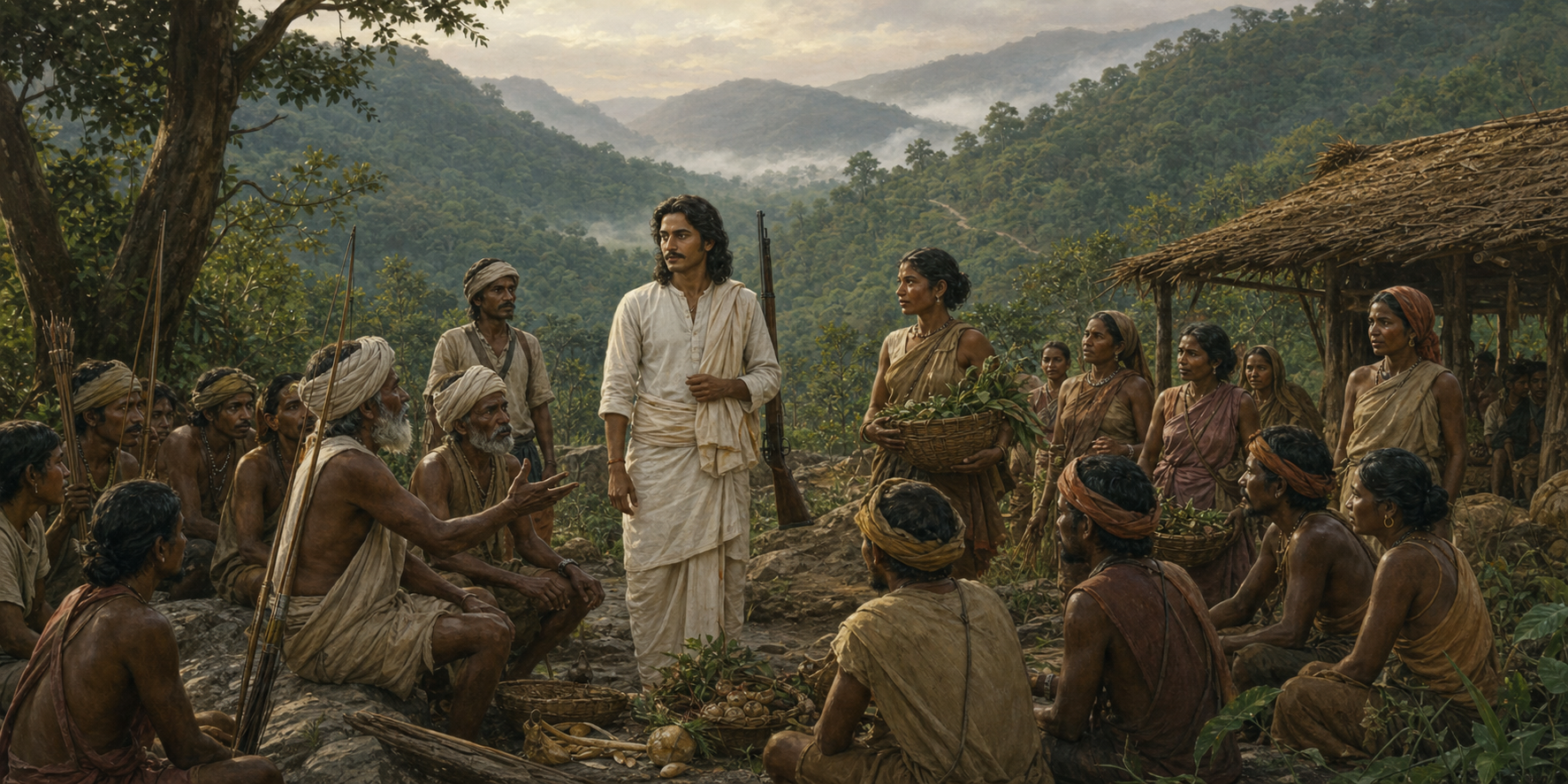
Alluri Sitarama Raju was born in 1897 in Mogallu village in the forested Godavari region of Andhra Pradesh. Alongside his school education, he studied traditional healing and astrology. He then spent two years in spiritual practice in a cave on Sitamai Hill, living with the discipline associated with a rishi rather than pursuing an ordinary public career.
That period of sadhana should not be treated as decorative colour in his biography. It placed him close to the forest communities whose condition would define his life’s work. He came to understand British officials and missionary activity as forces involved in the oppression of Janajati society. His response was not withdrawal from the world after spiritual practice, but entry into public duty.
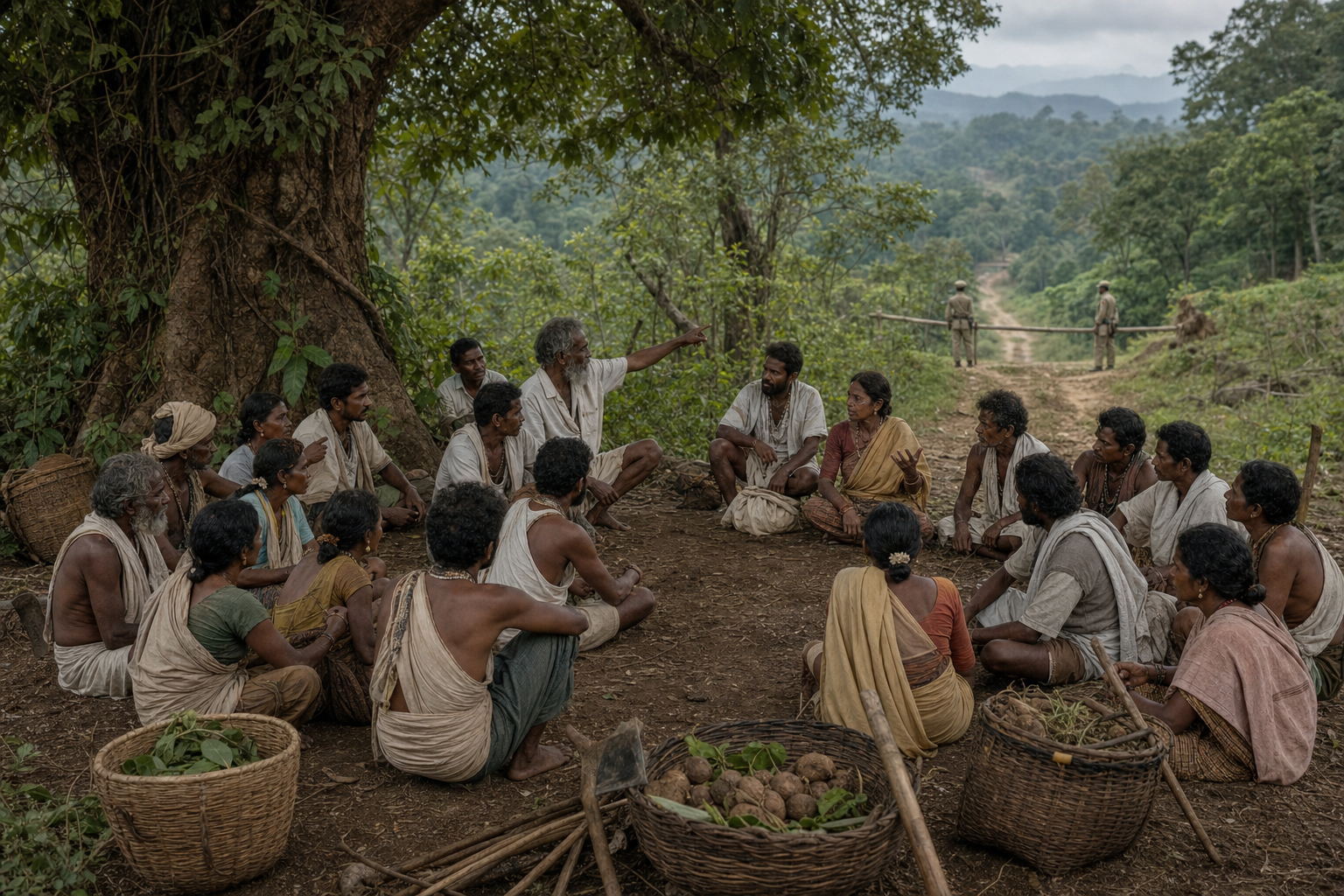
This gives you the first test of responsible recognition: does the telling place the affected community at the centre, or use it merely as scenery for a heroic individual? Raju did not become historically important in isolation. His importance came from awakening, organizing and defending people whose suffering rarely received equal space in elite accounts of the freedom struggle.
When you introduce Raju to someone unfamiliar with him, therefore, do not begin with the manner of his death. Begin with the question that produced his leadership: what had happened to the forest communities that made organized resistance necessary? That order keeps the people he served visible instead of allowing the hero’s image to eclipse them.
See the whole leader: seeker, organizer, fighter and institution-builder
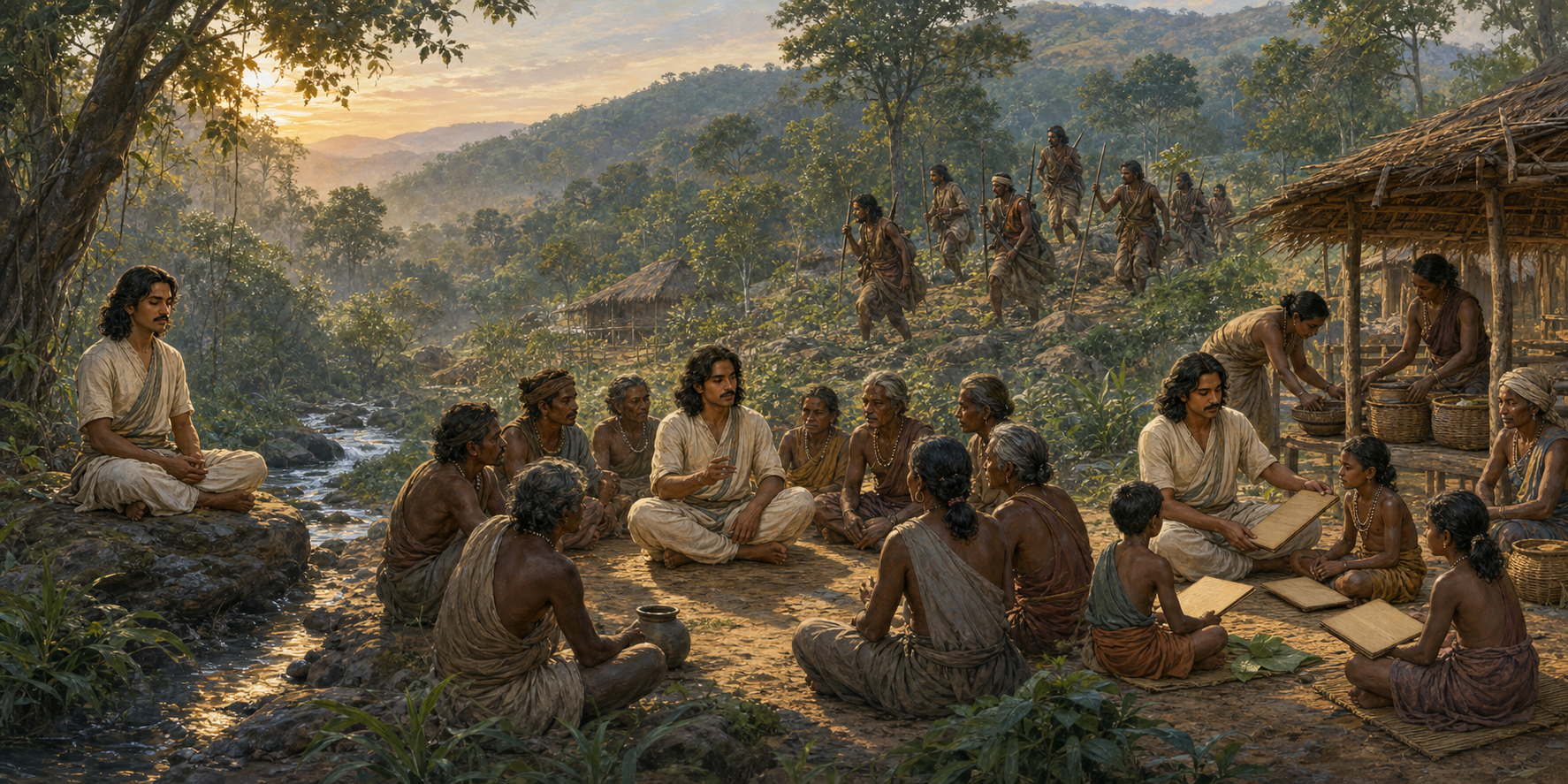
After completing his spiritual discipline, Raju moved into organization and preparation. The forested hills adjoining the Godavari became places of refuge and military training for his companions. Police stations were raided to obtain weapons and ammunition. The colonial administration placed a reward of Rs 10,000 on him, yet it was unable to make local people reveal his whereabouts.
The silence of the surrounding community matters as much as the size of the reward. A fighter can hide for a time through geography; a sustained movement also requires trust. Raju’s ability to operate in that terrain indicates that his leadership was rooted in relationships, not merely in personal daring.
With associates such as Mallu Dora and Veerayya, he began coordinated attacks against the colonial apparatus. He also attempted to free Prithvi Singh, a Ghadar Party revolutionary imprisoned at Rajahmundry. These actions place him within a wider anti-colonial struggle while preserving the local Janajati foundation of his movement.
Yet armed action is only half the story. Raju established village-level panchayats so that people could obtain accessible justice and maintain an orderly local system. He did so when even discussing such autonomous arrangements could be treated as a grave offence by the colonial regime.
This is the detail most likely to disappear when his history is reduced to guns, raids and martyrdom. A raid denies an unjust administration the security it claims for itself. A functioning panchayat answers the harder question: what should take the administration’s place? Raju’s movement contained both resistance to an imposed order and an attempt to recover local capacity for justice.
Four verbs will help you remember the complete figure: he sought, organized, resisted and governed. The first connects him to sadhana, the second to Janajati awakening, the third to armed struggle, and the fourth to the panchayats. Any commemoration that omits one of these dimensions leaves you with a diminished Raju.
Popular memory carried his name before a landmark did
On 6 May 1924, Raju and his companions faced an organized colonial force. Many of his fighters died. Raju was captured while fighting, subjected to torture, tied to a tree and shot.
The violence of his death explains why martyrdom became central to his public image, but death should not be allowed to consume the life that preceded it. If you remember only the final scene, you miss the patient work that made the colonial administration fear him: years of community organization, training, trust-building and local institution-making.
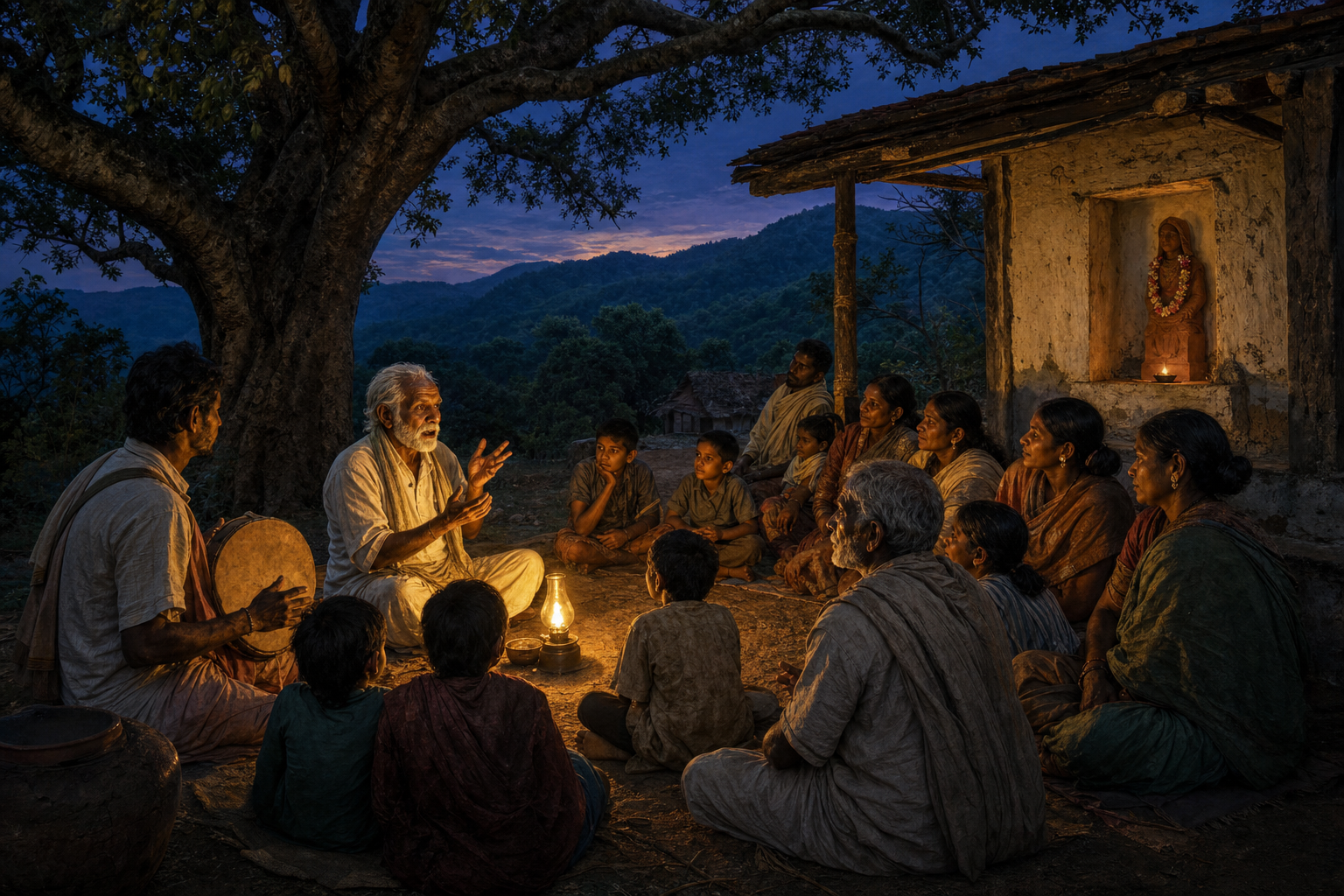
Formal recognition was also not the beginning of remembrance. Folk songs preserved Raju as a people’s hero. Communities carried the name through culture before a major public institution placed it before a much wider audience.
That distinction helps you read historical recognition more carefully. Memory from below and recognition from above are not the same thing. Folk memory can preserve affection, moral meaning and local detail without official approval. A state honour can expand reach, confer public status and bring a regional figure into national circulation. The latter does not create the former; at its best, it acknowledges and amplifies it.
Whenever a leader long honoured in songs receives institutional recognition, ask who kept the memory alive during the intervening years. A plaque that names the hero but ignores those cultural custodians tells only half the history.
The airport gives Raju national reach, but the name needs context

The inauguration of the new Alluri International Airport at Bhogapuram by Narendra Modi transformed Raju’s name into part of everyday public infrastructure. An airport name appears on maps, tickets, signs and announcements. It can prompt people far beyond Andhra Pradesh to ask who the person was.
The ceremony did more than unveil a name. Thirteen thousand Janajati girl students, wearing traditional attire, performed the Dimsa dance in 433 concentric circles. The performance entered the Guinness Book of World Records. Their presence connected the public honour to the communities and cultural life with which Raju’s memory is associated.
Modi framed the naming as a departure from a period when public institutions were repeatedly associated with members of one family, and as part of a broader effort to remember important figures from different regions and social groups. Whatever your view of that political framing, the underlying question is legitimate: whose names does a nation place in its shared spaces, and whose contributions become invisible when the range remains narrow?
Naming can correct an imbalance in visibility, but it cannot by itself teach history. For recognition to become useful public memory, it needs three layers. First comes identification: the correct name attached to a prominent place. Second comes explanation: accessible material that tells visitors why the person matters. Third comes participation: a meaningful place for the communities whose experience shaped that history.
The inauguration visibly supplied identification and participation. The continuing task is explanation. A traveller should be able to learn that Raju was not merely a generic freedom fighter, but a spiritually formed organizer who mobilized forest communities, obtained arms through attacks on police stations, attempted to aid another imprisoned revolutionary, established village panchayats and died under colonial violence.
This is also how you can distinguish commemoration from branding. Branding repeats a famous name. Commemoration preserves the relationship between a person, a cause and a community. The airport will fulfil its historical purpose most fully when the name regularly leads travellers, students and residents into that larger relationship.
Key takeaways for recognizing Raju responsibly
- Place Janajati society at the centre of the account. Raju’s courage matters because it was exercised in service of a community facing oppression.
- Keep sadhana and resistance in the same portrait. His spiritual discipline preceded public organization; it was not an unrelated footnote.
- Teach the police-station raids and the village panchayats together. One shows his challenge to colonial force; the other shows his attempt to provide accessible justice.
- Credit folk songs with carrying his memory before major institutional commemoration widened its reach.
- Judge a public naming by what people can learn after encountering the name, not simply by the prominence of the landmark.
If you teach this history, build the lesson around a sequence rather than a string of heroic adjectives: formation, community awakening, organized resistance, local justice and sacrifice. If you write a caption or programme note, include at least one sentence on the panchayats; that single detail prevents the armed struggle from being mistaken for violence without a political alternative.
If you are a parent or reader encountering his name in public, ask one concrete question: what did Raju build as well as oppose? Following that question will take you from the airport sign to the panchayats, from martyrdom to community agency, and from a solitary hero to the people who sustained his movement and memory.
A fitting honour does not end when a landmark receives a name. Let the next encounter begin a conversation, then pass on one accurate part of the story that the name alone cannot tell.
References
