
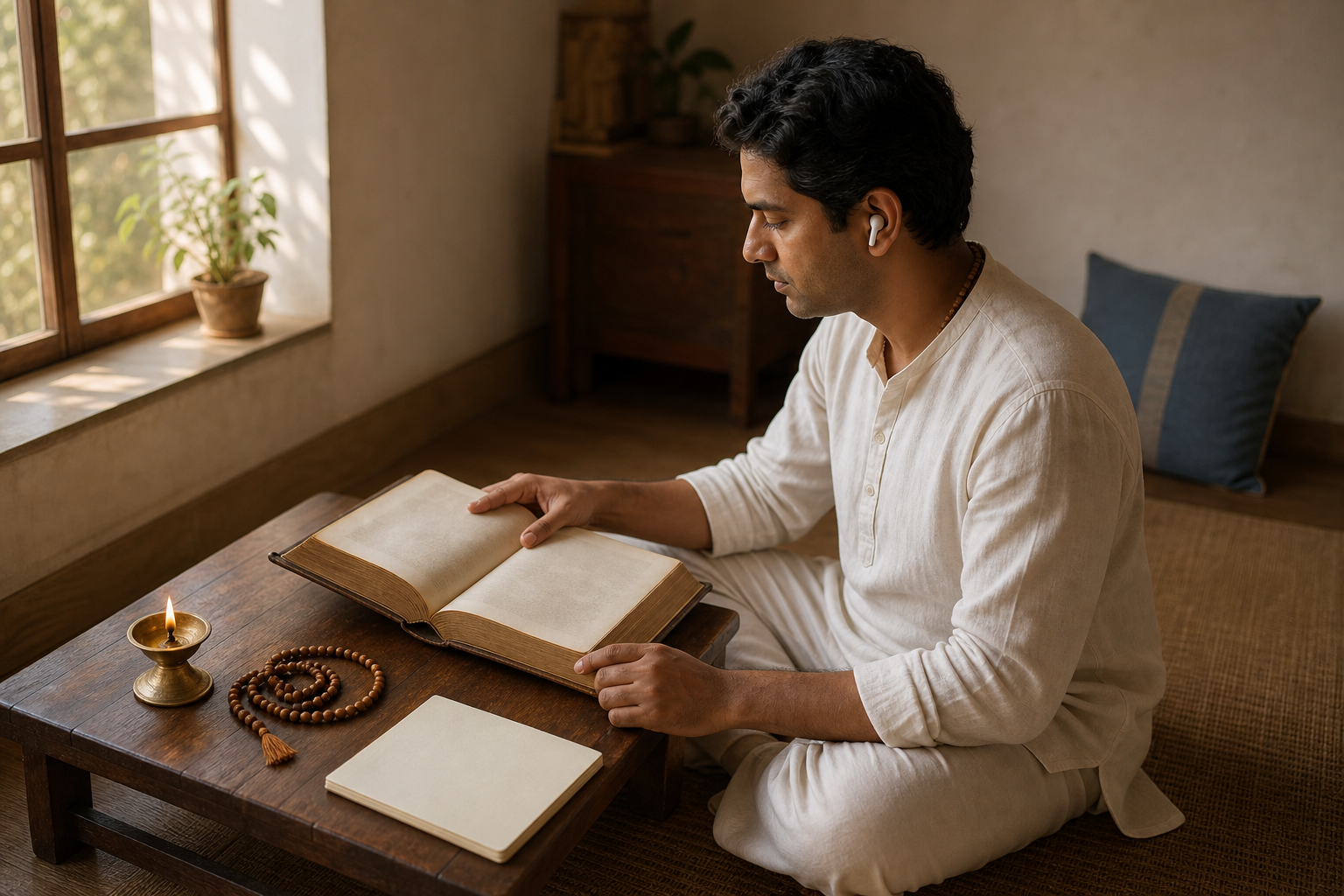
You have found more Srimad Bhagavatam talks than you can realistically hear. The harder question is no longer where to find a discourse. It is how to listen without turning sacred speech into background audio, collecting disconnected quotations, or mistaking a speaker’s illustration for the meaning of the verse.
A good method should return you to the Bhagavatam with a clearer question and send you into daily life with one faithful practice. You do not need an elaborate study system. You need to preserve the textual reference, distinguish what you are hearing, and resist the urge to extract more conclusions than the discourse can support.
Begin with the verse reference, not the recommendation

Contemporary discourse streams can move quickly across the Bhagavatam. One recent sequence went from SB 3.30.6 with HG Ramprasad das on 10 August 2026, to SB 4.9.4 with Dina-bandhu Prabhu in a video labelled 8-11-26, and then to SB 11.3.40 with HH Bhakti Dhira Damodara Swami Maharaj, labelled 12-08-2026. These are three different cantos, chapters, verses, and speakers. They should not be treated as consecutive lessons in a single argument unless an organiser explicitly presents them that way.
The reference SB 3.30.6 identifies Canto 3, Chapter 30, Verse 6. That coordinate is not administrative clutter. It locates the verse inside a chapter, a narrative situation, and the Bhagavatam’s larger movement. A memorable application detached from that setting can become a slogan that the passage was never meant to carry.
Spend five minutes preparing before you press play:
- Copy the exact reference. Preserve the canto, chapter, and verse numbers. Normalise punctuation in your notes so that SB 11.03.40 and SB 11.3.40 do not become separate entries.
- Read the verse in the edition you actually use. Then read at least the preceding and following verses. If the sentence or exchange clearly continues, widen the window until the thought is complete.
- Identify the immediate scene. Ask who is speaking, who is listening, and what question, event, or difficulty prompted the speech. If you cannot answer yet, make that your first listening question.
- Record the edition or translation. Translations and accompanying commentaries can organise or render a passage differently. This detail matters when you later compare your notes with another talk.
- Write one real question. Use a question such as, “What does this verse add to the surrounding passage?” or “Which part of the practical advice comes directly from this verse?” A precise question gives your attention somewhere to stand.
This preparation changes the role of the recording. The teacher is no longer supplying an isolated spiritual message while you remain passive. The discourse is helping you enter a particular passage with its relationships intact.
Listen in layers and preserve the chain of context

A discourse often moves smoothly between scriptural wording, inherited explanation, related teachings, personal analogy, and present-day application. That movement can be illuminating. It can also disappear in your notes unless you label it.
Divide a page into three parts, whether you use paper or a digital notebook:
- Text: the verse, translated wording, Sanskrit term, or surrounding narrative detail explicitly under discussion.
- Interpretation: the explanation of what the passage means, including definitions, doctrinal connections, commentary, and reasoning supplied by the speaker.
- Application: the conduct, attitude, devotional practice, warning, or contemporary example proposed for the listener.
Add a question mark beside anything you want to verify. A question mark does not mean rejection. It means you have not yet established whether a statement is a quotation, a paraphrase, a commentarial conclusion, or an illustrative extension.
This distinction is especially important when an example is emotionally powerful. A modern analogy can make a teaching vivid without being part of the verse’s literal wording. Keep it under “Application” or “Interpretation,” not “Text.” You can value the example fully without retroactively placing it in scripture.
The Bhagavatam frequently communicates through conversations situated within larger conversations. Your context note should therefore preserve a chain rather than merely a topic. Write down, as far as the passage makes clear:
- the speaker and listener within the scriptural scene;
- the concern being answered at that moment;
- the larger narrative or dialogue containing the exchange;
- the particular word, image, or claim on which the discourse turns;
- the speaker’s stated bridge from the ancient setting to your present circumstances.
Do not guess a teacher’s lineage, institutional affiliation, or intended audience from an honorific alone. Record such information only when it is actually identified. A careful blank is more trustworthy than a confident assumption.
At the end of the recording, test your notes with one sentence: “The practical conclusion follows from this passage because…” If you cannot finish that sentence without relying only on the speaker’s modern illustration, return to the textual and interpretive layers. You may still keep the illustration, but you should not confuse its persuasive force with textual proof.
Compare discourses without manufacturing disagreement

Different teachers speaking on different verses do not yet constitute a doctrinal comparison. SB 3.30.6, SB 4.9.4, and SB 11.3.40 begin from different textual locations. If one discourse emphasises a subject that another does not mention, silence is not disagreement. Each speaker may simply be answering the demand of a different passage.
Before you write that two speakers agree or disagree, check four things:
- Are they answering the same question? Similar vocabulary can conceal different problems, while different vocabulary can serve the same conclusion.
- Are they using the same textual basis? A claim drawn directly from the selected verse is not the same kind of claim as a cross-reference, commentary, analogy, or pastoral recommendation.
- Are they speaking at the same level? A description of a character’s condition, a universal theological claim, and an instruction for practice must not be collapsed into one category.
- Are their conclusions logically incompatible? A different emphasis, tone, example, or level of detail is not a contradiction. Mark disagreement only when the speakers make opposing claims about the same proposition.
If you want a meaningful comparison, choose two talks on the same verse or follow one clearly identified Sanskrit term across several passages. For each discourse, paraphrase the central claim in one short sentence and attach the evidence used for it. Then compare claim with claim and evidence with evidence. Do not compare the emotional effect of one talk with the doctrinal content of another.
Lineage also matters. The Srimad Bhagavatam is heard through living Vaishnava traditions whose teachers may use particular commentaries, theological vocabulary, and methods of application. You do not need to erase those commitments to seek a broader Dharmic understanding. You do need to name them accurately when they are stated and avoid presenting one teacher’s emphasis as the only possible reading unless the case has actually been established.
When a comparison turns on a Sanskrit word, write down the word exactly as displayed or spoken and check it against your printed text. Do not reconstruct an unfamiliar term from memory. A small transcription error can produce a large interpretive dispute that no speaker actually created.
Turn one discourse into one week of abhyasa

The value of hearing is not measured by the number of recordings completed. A long queue can create the sensation of spiritual movement while leaving your attention and conduct untouched. The remedy is not to extract ten resolutions from every talk. It is to choose one application that remains faithful to what you heard and small enough to repeat.
Use this seven-day loop as a practical discipline, not as a sacred numerical rule:
- Write a two-sentence summary. The first sentence states what the passage is doing in its immediate context. The second states the application you understood from the discourse.
- Select one application actually supported by your notes. Do not manufacture an austerity, promise, or formal vow merely to make the talk feel consequential.
- Attach the practice to an existing cue. You might read the verse once before your next listening session, recall its reference during an established daily practice, or note one moment when the discussed tendency appeared in your conduct.
- Make the action observable. “Become more spiritual” cannot be reviewed. “Read the verse before playing another discourse” can. Precision exposes whether intention became practice.
- Review after seven days. Ask whether the action sharpened your understanding of the verse, distorted it, or became mechanical. Keep it, revise it, or release it on the basis of that review.
A sound practice passes three tests. It is faithful to the passage and explanation you heard. It is observable enough for honest review. It is proportionate, so that a single illustration does not become a sweeping rule for yourself or others.
Keep the record compact: verse reference, speaker, date label, link, edition, two-sentence summary, one open question, and one practice. That is enough to make your listening searchable and cumulative. After several weeks, you will be able to see which passages you have actually studied, which questions recur, and which applications survive contact with daily life.
Key takeaways
- Treat each online discourse as an encounter with a specific canto, chapter, and verse, not as interchangeable devotional content.
- Read the selected verse and its immediate neighbours before listening, and identify who is speaking to whom.
- Separate scriptural text, interpretation, and present-day application in your notes.
- Do not infer disagreement from different emphases, especially when the speakers are discussing different passages.
- Record lineage, edition, and audience only when they are identified; do not guess from titles or honorifics.
- Carry one proportionate application for seven days, then review whether it deepened your understanding or merely became routine.
For your next discourse, do not begin by clearing more space in the queue. Choose the verse, read its setting, and arrive with one question. When the recording ends, leave with one accountable practice. That small cycle can turn digital abundance into sustained scriptural hearing.
References
- Dandavats – Mon 10 Aug 2026 – SB 3.30.6 by HG Ramprasad das.
- Dandavats – Today’s Featured Video: Dina-bandhu Prabhu- SB 4-9-4 – 8-11-26
- Dandavats – HH Bhakti Dhira Damodara Swami Maharaj || SB-11.03.40 || 12-08-2026
