
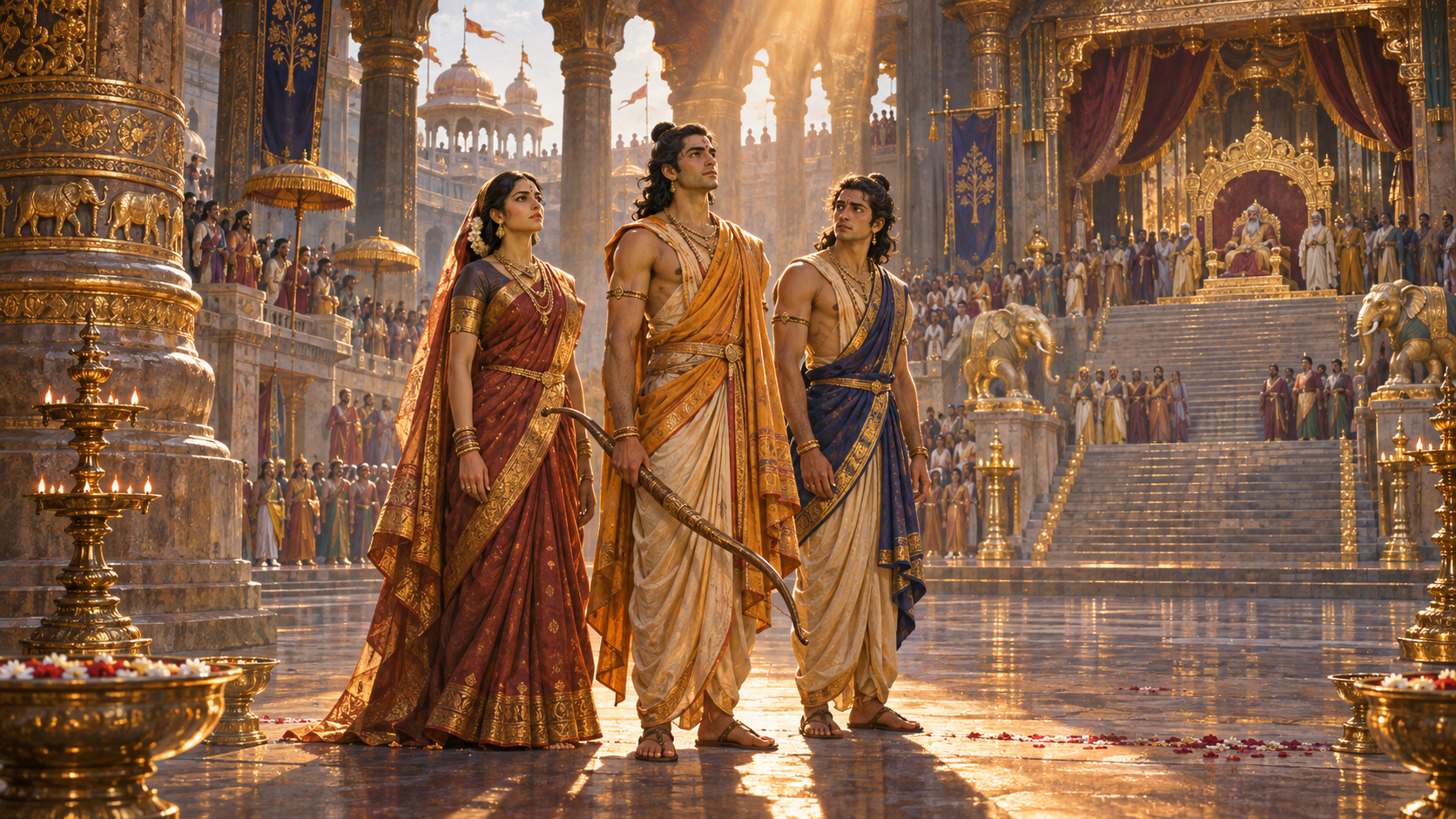
If you are deciding whether Ramayana: Part 1 deserves your time, the important question is not whether it looks expensive. You want to know whether it understands why Sri Ram, Sita, Lakshman, Bharata and their relationships matter to a Dharmic audience.
Our answer is mixed but firm. The film has a commanding Ravana, an imaginatively presented Lanka and enough visual scale to hold attention. Yet it repeatedly mistakes solemnity for spiritual depth, iconography for cultural understanding and size for grandeur. The result is an adaptation that can display the Ramayana without consistently conveying its inner order.
The central failure is not spectacle but moral emphasis
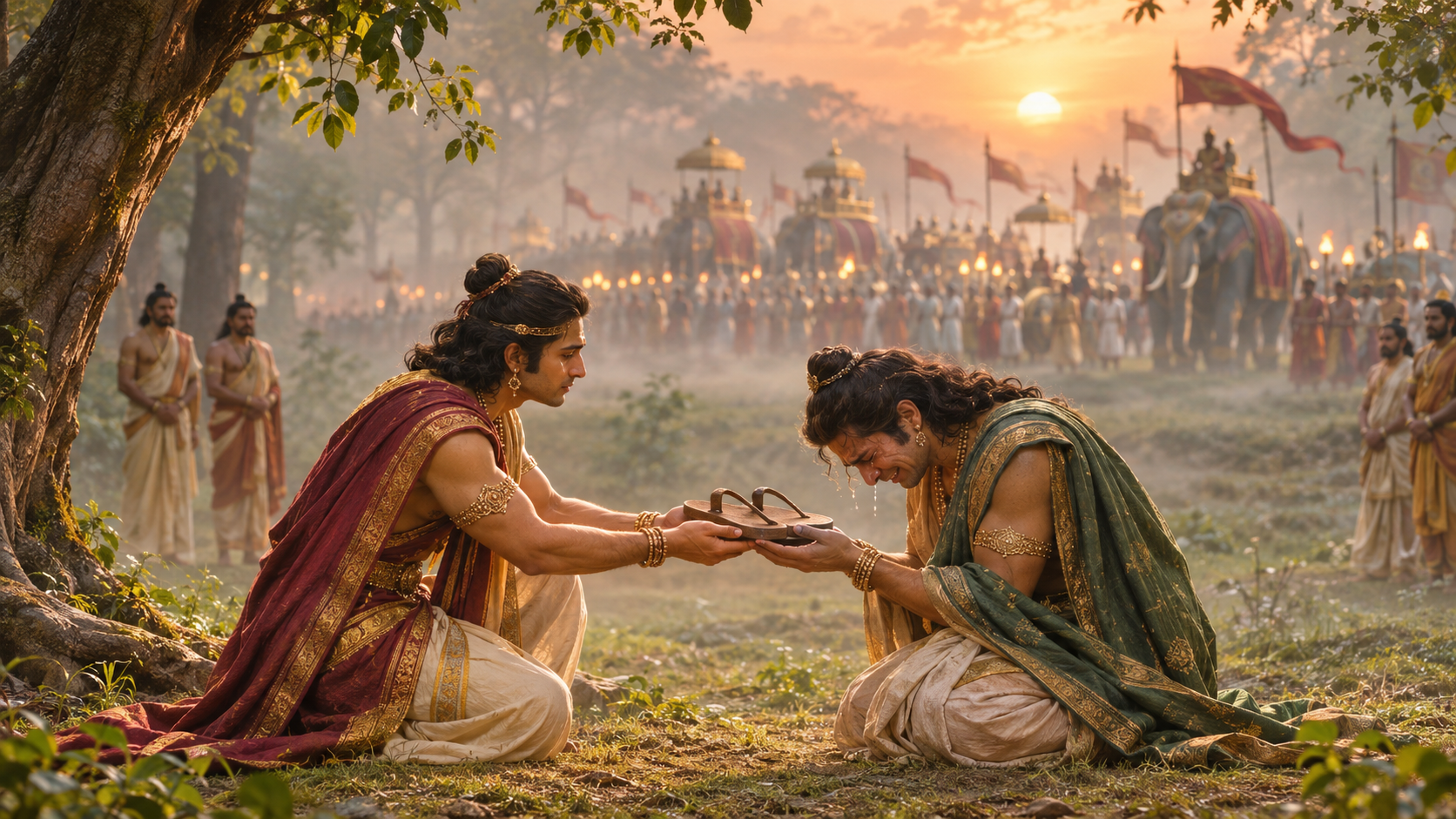
A Ramayana adaptation does not have to resemble a televised pravachan, nor must every scene reproduce one inherited version word for word. The tradition itself has supported many tellings, regional textures and artistic forms. But creative freedom does not remove the need to understand the epic’s moral grammar. The filmmaker may change the expression; the expression must still disclose dharma.
That is where Ramayana: Part 1 feels unsteady. It can make Lanka imposing, Ravana charismatic and conflict visually legible. It is much less successful at making restraint, reverence, sacrifice and righteous conduct dramatically alive. Adharma consequently receives stronger cinematic definition than dharma. This is not objectionable because Ravana must be made weak. A formidable Ravana is essential. The problem is that Sri Ram must possess an equally compelling moral and spiritual presence, not merely the appearance and movements of a hero.
Our rating is 5/10. That score recognises the film’s visible ambition and the strength of its Lanka passages, while accounting for serious weaknesses in characterisation, cultural blocking, sound, pacing and emotional culmination.
Key takeaways
- Watch primarily for Yash’s Ravana and the Lanka ensemble, not for a spiritually complete portrayal of Sri Ram and Sita.
- Do not expect premium presentation or 3D alone to solve the film’s deeper problem: its most important Dharmic relationships often lack emotional and cultural weight.
- Judge the adaptation by conduct as well as appearance. Costumes and visual effects matter, but the placement of a Guru, the bearing of Sri Ram and the handling of the Swayamvar communicate far more.
- If you want a devotional or culturally assured retelling, lower your expectations. If you want to examine how contemporary cinema interprets the Itihasa, the film remains worth discussing.
Sri Ram needs inner command, not an empty calm
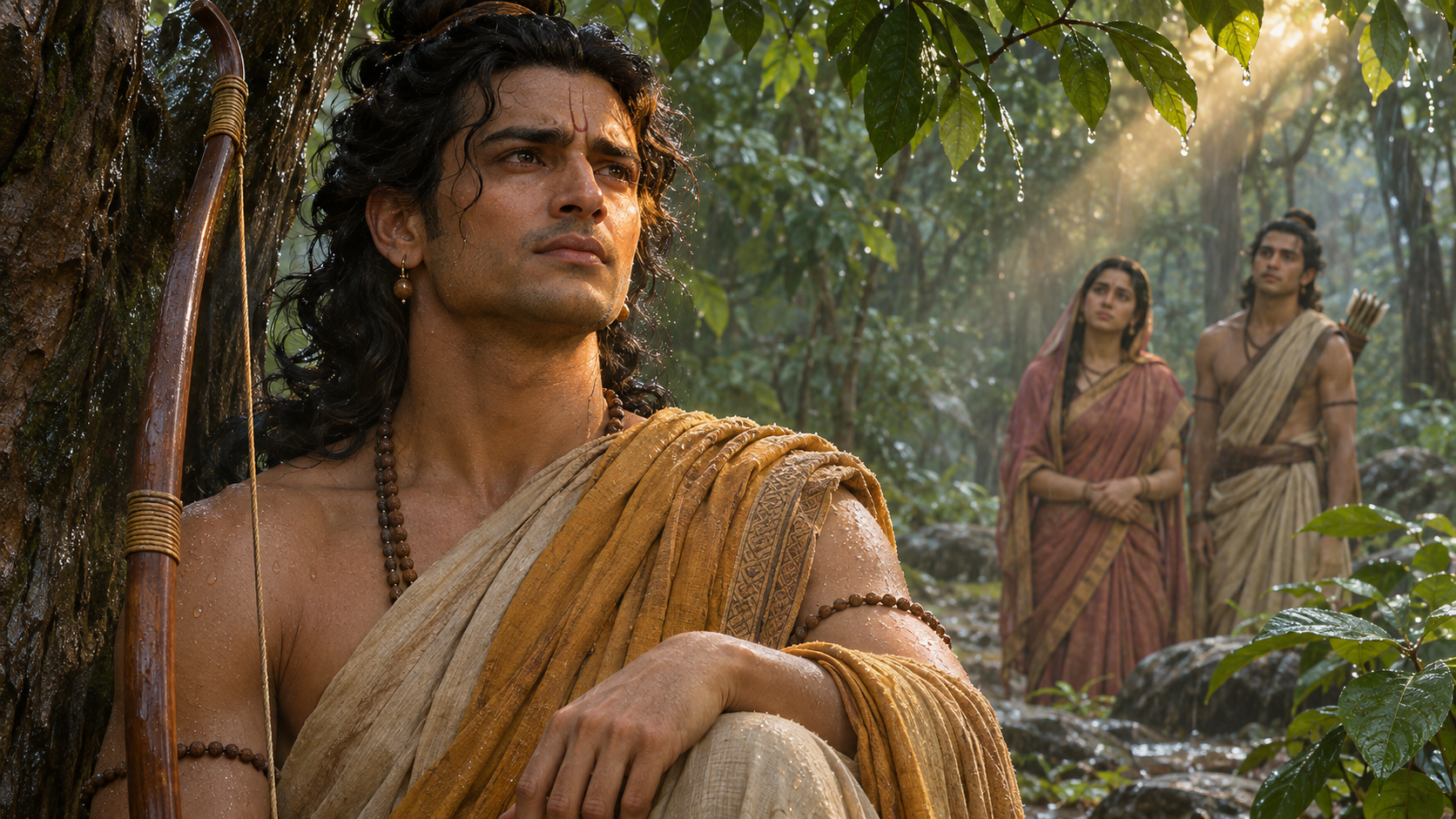
Portraying Sri Ram is difficult because composure can easily become blankness on screen. His calm is not an absence of emotion. It is emotion ordered by dharma. Grief, tenderness, strength, obedience and resolve remain present, but none is allowed to overthrow maryada. An actor and director must let you see that disciplined interior movement.
Ranbir Kapoor’s performance does not establish that distinction. He frequently registers as a contemporary action protagonist placed inside sacred iconography. The stillness is visible, but the moral energy beneath it is not. This leaves crucial moments without the sense that Sri Ram’s smallest gesture arises from a deeply integrated character.
This is why an expressionless face cannot serve as shorthand for serenity. Look at what a scene tells you before the dialogue begins. Does Ram’s presence alter the emotional atmosphere? Do other characters respond to more than his physical status? Does his restraint reveal a cost? When those signals are absent, calm becomes passivity and divinity becomes costume.
Sai Pallavi faces a related problem as Sita. Ability alone cannot rescue a conception of the character that feels insufficiently defined. Sita requires more than gentleness and visual grace. Her dignity, clarity and strength must be perceptible without turning her into a modern slogan or reducing her to an emblem beside Ram. Here, the performance and direction do not consistently discover that balance, making the casting feel less persuasive than it should.
Yash’s Ravana, by contrast, has the advantage of a clear cinematic proposition. He is allowed force, theatrical presence and a world designed to magnify him. Shobhana, Vivek Oberoi and Rakul Preet Singh add further weight to the Lanka portions, which emerge as the film’s strongest material. Ravana should indeed command the frame. But when the antagonist’s world is more confidently imagined than Ayodhya’s, the imbalance changes the moral centre of the film.
Ayodhya and Lanka expose two different levels of imagination

Lanka has atmosphere, personality and visual intention. Ayodhya often appears to have been assembled from the general vocabulary of a large mythological production. That difference matters. Ayodhya is not simply the bright kingdom that contrasts with a dark Lanka. It represents an ordered civilisation whose beauty should emerge through relationships, ritual, architecture, manners and public life.
The Sita Swayamvar shows the cost of treating an epochal event as a plot checkpoint. The lifting of Pinaka should bring several meanings together: the end of a public trial, the recognition of an extraordinary prince, the beginning of a sacred marriage and the revelation of power held without vanity. When the act is staged too casually, the audience understands what happened but does not feel why it matters.
This is a recurring distinction between scale and grandeur. Scale gives you a large hall, crowds, ornament and a difficult weapon. Grandeur comes from anticipation, reaction, silence, rhythm and consequence. A close-up held at the right moment can carry more majesty than another wide shot filled with digital architecture. The film spends heavily in visual terms without always arranging those elements into rasa.
The Ayodhya costumes create another break in the world. The issue is not that a mythological production must claim archaeological certainty about every garment. It should not. The problem is visual coherence. Modern-looking blouses, including Sita’s embroidered round-neck silhouette, pull the eye toward contemporary costume construction. Once you notice that vocabulary, the scene feels dressed for a production rather than inhabited by its characters.
A convincing design process would ask three practical questions. Does this garment belong to the world established by the sets and social customs? Does it reveal the wearer’s role without looking like present-day fashion in antique colours? And does the full ensemble remain coherent when several characters share the frame? Historical or sacred cinema loses credibility through accumulated small contradictions, not only through one spectacular error.
Cultural accuracy lives in blocking, gesture and hierarchy
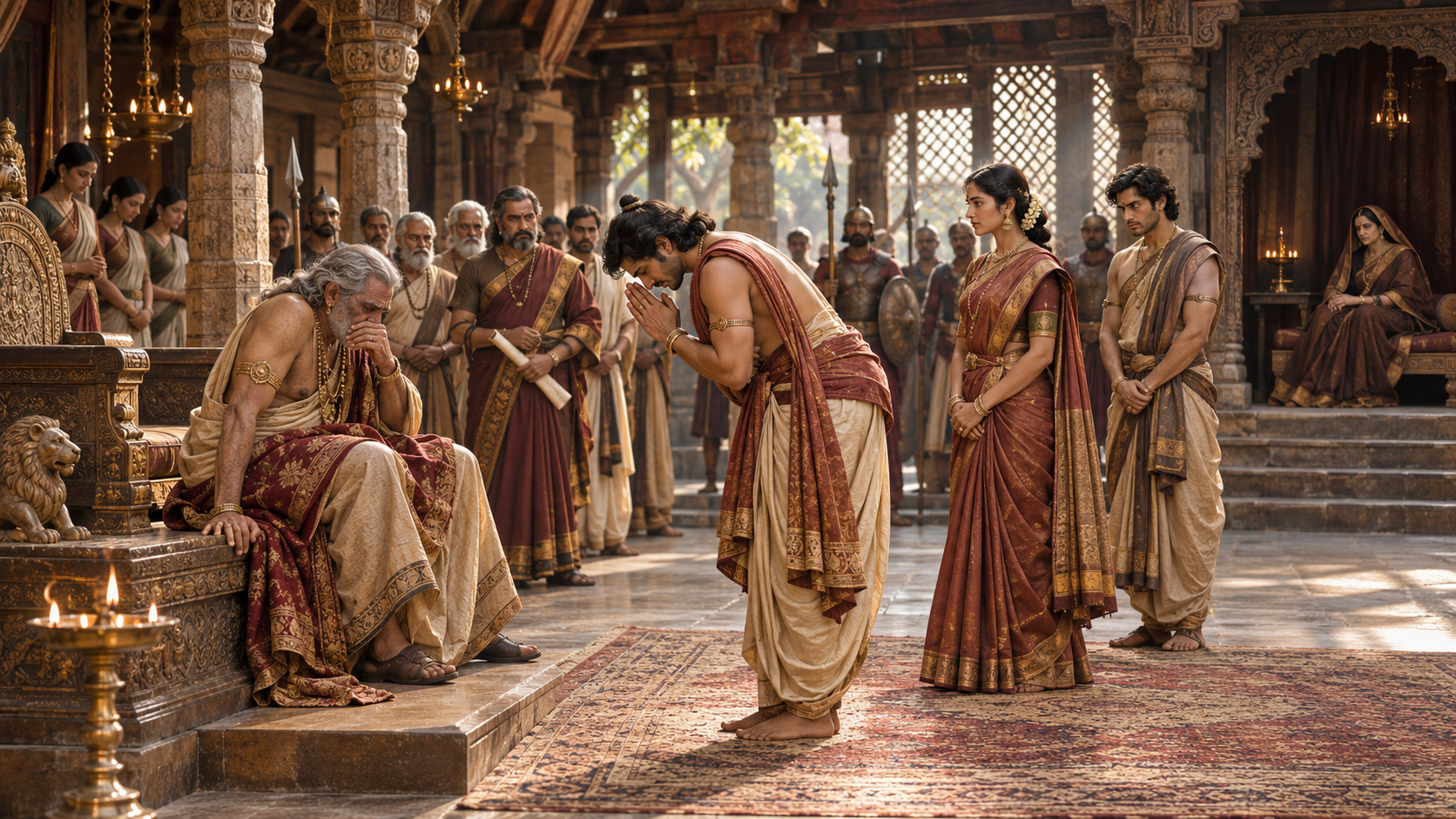
The most instructive problem is not a costume or visual effect. It is the forest meeting involving Ram, Bharata and their Guru. The Guru is positioned behind Bharata with the visual status of an attendant while the brothers sit and speak. Even if every line of dialogue were respectful, the blocking would communicate the wrong relationship.
Cinema teaches the audience where authority resides by deciding who sits, who stands, who occupies the centre and who waits at the edge. In a Dharmic setting, reverence for the Guru cannot be added later through a line or a bow if the composition has already demoted him. Sri Ram as Maryada Purushottam must embody proper regard through instinctive conduct. He should not need exposition to recognise the hierarchy.
This gives you a useful test for any adaptation of an Itihasa. Pause your attention on the apparently minor transitions: greeting an elder, entering an assembly, receiving counsel, taking leave, responding to a vow or sitting in the presence of a teacher. These actions carry civilisation. A production may reproduce crowns, bows and Sanskritised names while missing the cultural knowledge encoded in ordinary behaviour.
Fidelity, then, is not a checklist of decorative objects. It has at least three layers:
- Narrative fidelity: the major event and its consequence remain intelligible.
- Character fidelity: a figure’s actions arise from the qualities that make that figure recognisable within the tradition.
- Civilisational fidelity: relationships, duties, gestures and institutions reflect the moral world in which the story operates.
An adaptation can alter narrative details and still preserve the latter two. It can also follow the broad plot while failing them. Ramayana: Part 1 too often lands in the second category.
Sound, pacing and visual effects cannot be judged separately
The technical shortcomings would matter less if the dramatic architecture were strong. Instead, they compound it. The sound engineering lacks the force expected from a production of this scale, while the visual effects are serviceable rather than transporting. A 3D presentation may change the sensation of depth, but it cannot give a scene moral weight that was never built into its performance, rhythm and composition.
Sound is especially important in epic cinema because it controls anticipation. Pinaka does not become momentous merely through a loud impact. The scene needs a progression: the atmosphere before the attempt, the physical texture of the bow, the stillness surrounding Ram, the reactions of the assembly and the release after the deed. If the mix and edit do not shape that progression, volume becomes noise rather than power.
Pacing produces a similar problem. Introducing Ravana and Lanka early gives the film an immediate dramatic charge, but the Ayodhya material cannot sustain that momentum. The narrative moves through important episodes without building sufficient pressure inside them. Later, a pursuit of Ram, Sita and Lakshman by two asuras slips into unintended comedy. Once threat becomes awkward, the scene damages not just itself but the tonal authority of the surrounding passage.
If you are choosing a format, choose a large screen for the design of Lanka and Yash’s presence, not because 3D will repair the storytelling. If your main reason for attending is a devotional encounter with Sri Ram or a deeply rooted presentation of Ayodhya, wait for trusted reactions from viewers who share that priority. The distinction will save you from expecting one kind of film and receiving another.
Dharmic viewers should also resist the false choice between gratitude and criticism. A production based on Bharat’s sacred inheritance does not become culturally successful merely because it is large, sincere or internationally ambitious. Nor should every departure provoke outrage. Ask the more demanding question: does the change reveal the character and world more clearly, or does it replace inherited meaning with generic cinematic shorthand?
Take that question with you when you watch Ramayana: Part 1. Notice who is granted presence, how reverence is staged and whether a celebrated moment produces rasa rather than merely completing the plot. That is the standard worth carrying into Part 2, because the Ramayana needs more than reverent publicity. It needs filmmakers who understand that dharma itself must become dramatic.
References

Leave a Reply
You must be logged in to post a comment.