
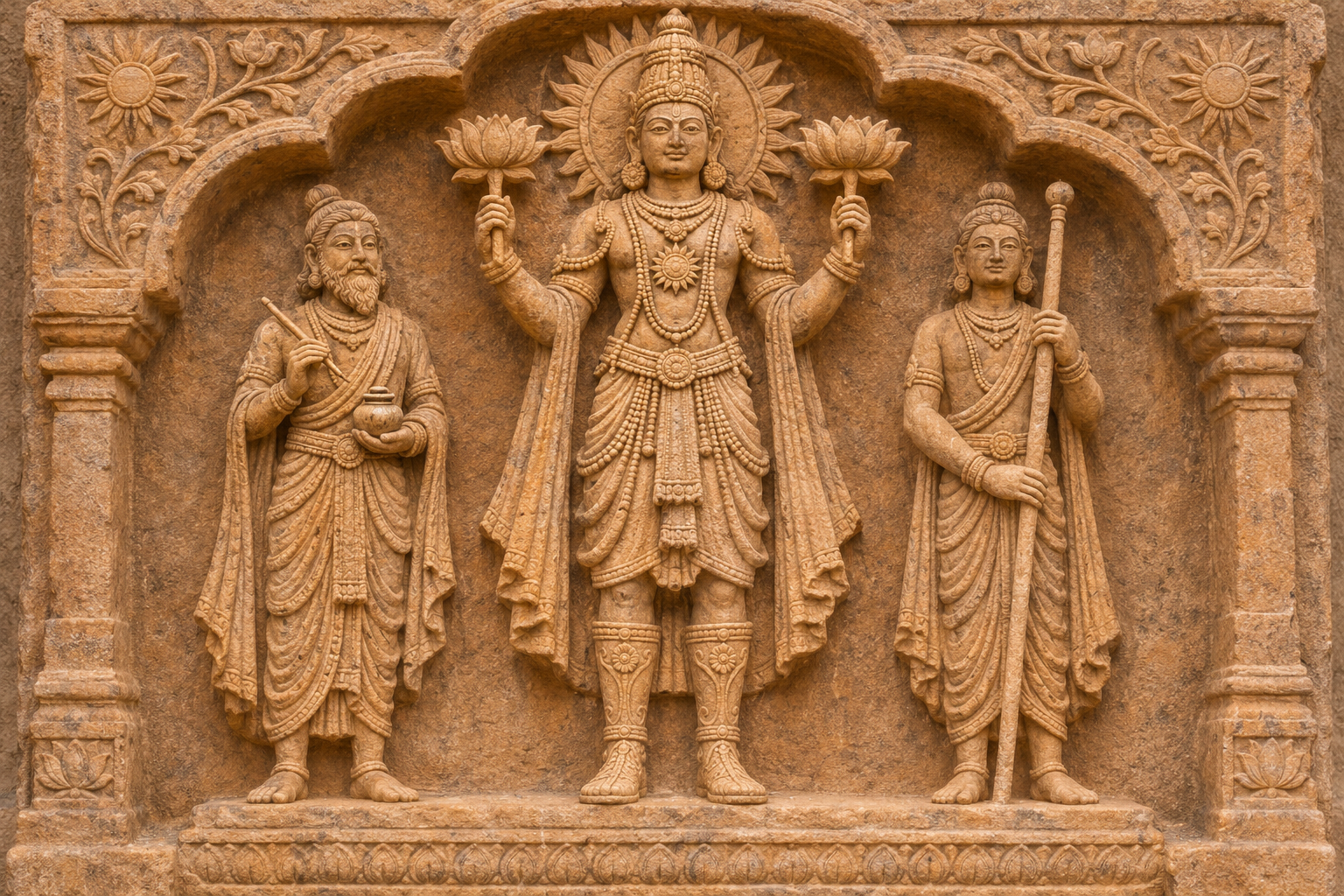
You recognize Surya in a sculpture, but the two figures beside him are harder to name. A damaged hand, a reversed photograph, or an incomplete caption can turn a familiar composition into a guessing game.
You can usually make a careful identification by reading the figures as a group. Look first for Pingala’s writing implements, then use the paired arrangement and the deity’s own right and left sides to assess whether the other attendant is Dandi.
Read the complete group before naming either attendant
Surya does not always appear as an isolated figure. In many representations, Pingala and Dandi accompany him. Their presence turns the image into a composed scene of divine attendance rather than a solitary solar figure.
Begin with the central deity and work outward. This prevents a common error: identifying an attendant from one suggestive object and then using that uncertain identification to name the entire group.
- Establish that the central figure is Surya from the sculpture’s context, an existing catalogue entry, a temple tradition, or other secure evidence.
- Check whether two subordinate figures flank the deity. Their matching relationship to the central figure matters even when their faces, scale, or surviving attributes differ.
- Examine both hands of the bearded attendant. A quill or pen and an inkpot are the strongest clues for Pingala.
- Determine right and left from Surya’s perspective, not from your own. In a frontal image, the deity’s right normally appears on the viewer’s left.
- Use the remaining figure’s place in the pair to evaluate an identification as Dandi. If the sculpture is broken or only one attendant survives, keep the conclusion qualified.
This order matters. Attributes provide the first identification; position and pairing test it. Position by itself should not carry the whole conclusion.
Pingala’s beard, quill and inkpot provide the clearest clues
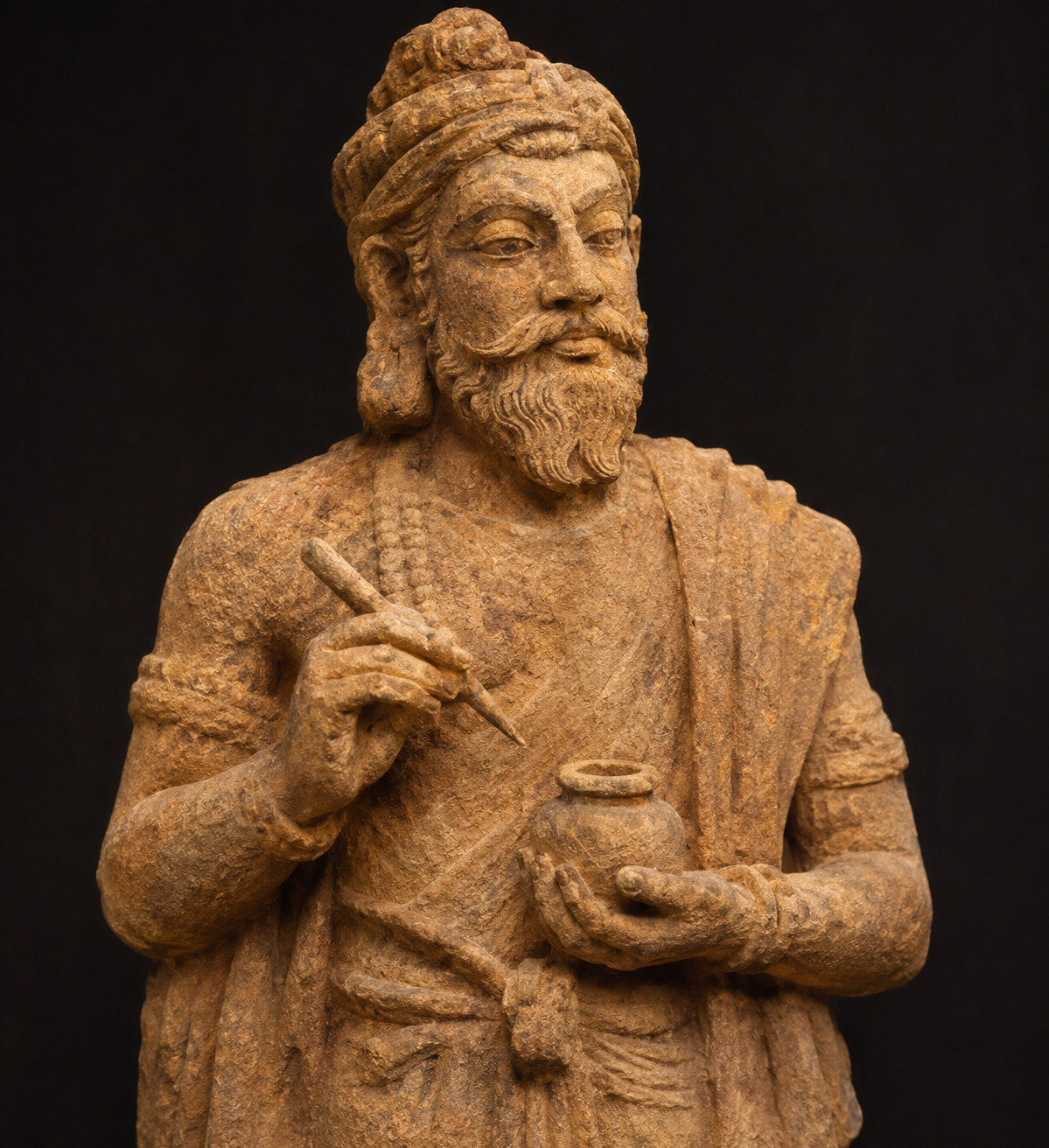
Pingala is the more readily recognizable member of the pair because he may combine three visible features: a beard, a writing implement, and an inkpot. In some early sculptures, he stands on Surya’s right and is shown as a bearded figure holding a quill and an inkpot.
Do not reduce that description to a single test. A bearded attendant without visible writing equipment is not automatically Pingala. A small round object is not automatically an inkpot. The identification becomes much stronger when the face, the hand-held objects, the location, and the paired composition agree.
The writing implements also tell you what the sculptor wanted viewers to notice. Pingala is not rendered as an anonymous bystander; he is characterized through the act or responsibility of writing. It is reasonable to describe this as an association with inscription or record-keeping. It is not enough, on its own, to assign the sculpture to a particular narrative, period, or regional school.
When the quill has broken away, inspect the hand rather than looking only for the missing object. Its grip, a surviving shaft, or an adjacent inkpot may preserve part of the intended arrangement. If neither writing implement can be seen, record the identification as probable or possible unless other reliable evidence settles it.
Treat right and left as supporting evidence, not a universal rule
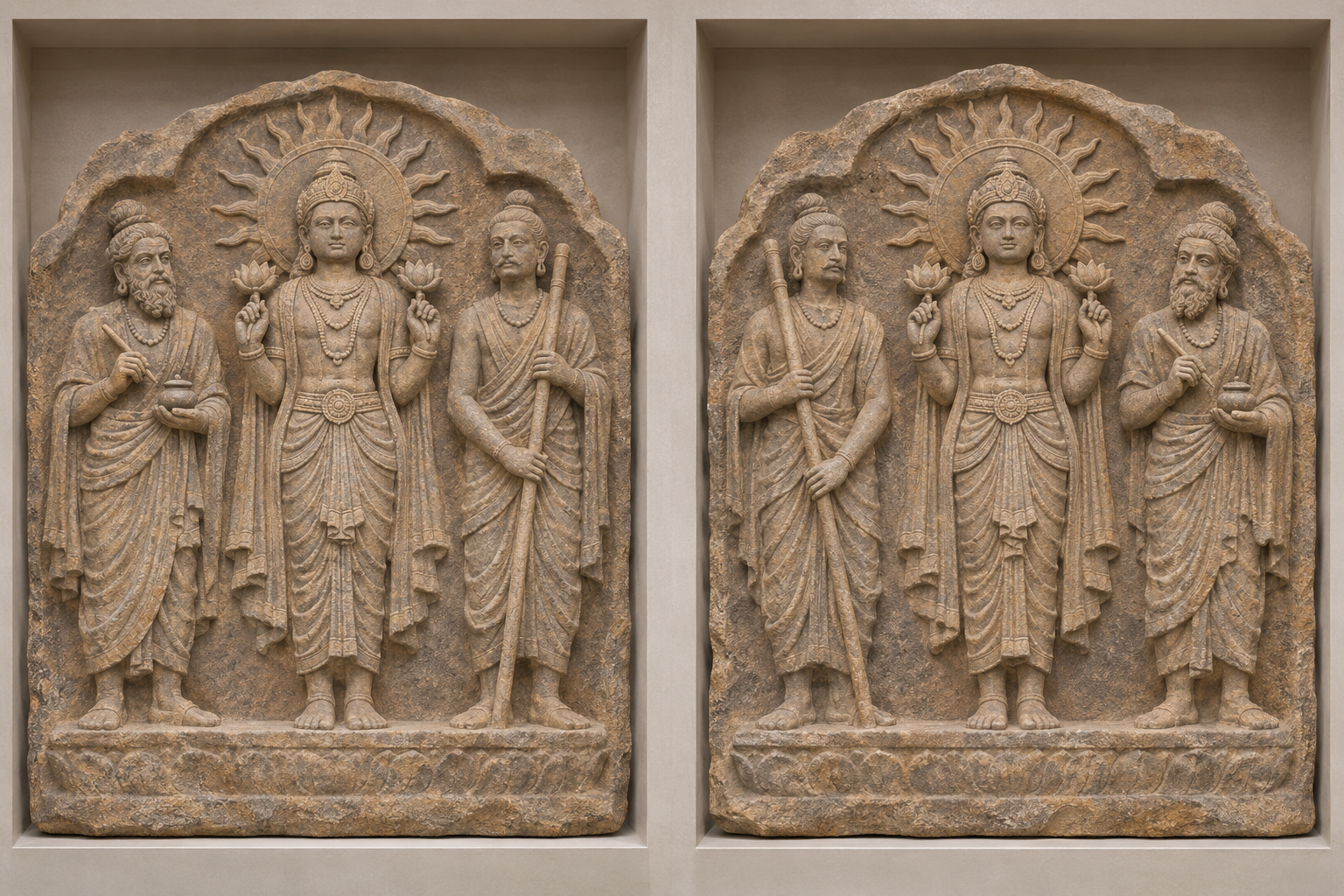
In the early arrangement described above, Pingala occupies Surya’s right and Dandi his left. The wording is easy to misread because museum labels and casual descriptions sometimes shift silently between the subject’s perspective and the viewer’s perspective.
Stand mentally where Surya stands. In a frontal composition, Pingala on the deity’s right will be on your left as you face the image. Dandi on the deity’s left will be on your right. A mirrored photograph can reverse even that visual relationship, so check whether you are looking at the sculpture itself, a faithful reproduction, or a flipped digital image.
The qualification “in some early sculptures” is essential. It tells you that this arrangement is attested, not that every Surya image must follow it. Regional practice, restoration, missing fragments, or a rearranged museum display can weaken positional evidence. If the quill and inkpot clearly identify Pingala but the apparent side is unexpected, investigate the image orientation before rejecting the attributes.
Key takeaways
- Pingala and Dandi may appear as a pair of attendants beside Surya.
- Pingala’s most useful identifying combination is a beard, a quill or pen, and an inkpot.
- Some early sculptures place Pingala on Surya’s right and Dandi on Surya’s left.
- The deity’s right is normally the viewer’s left in a frontal, unmirrored image.
- Use attributes, position, and the paired composition together; do not treat any one clue as conclusive when the sculpture is damaged.
Record what you can see before stating what it means
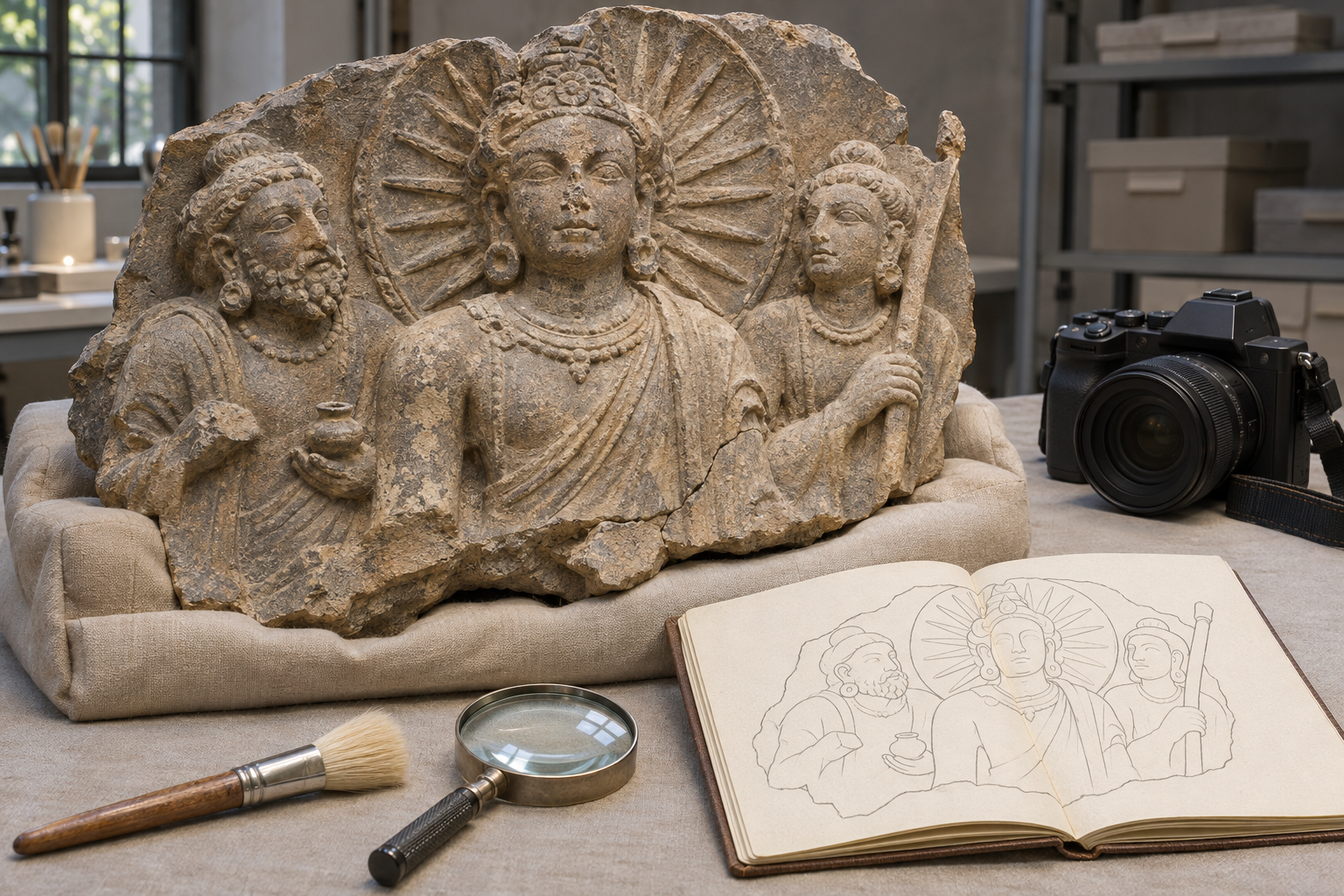
A useful identification separates observation from conclusion. First note the figure’s location, beard, surviving hand positions, quill, inkpot, and relationship to Surya. Only then supply the name. This makes your reasoning transparent and allows another viewer to reassess it if a clearer photograph or a missing fragment becomes available.
For a well-preserved example, a concise catalogue description might read: “Surya is flanked by two attendants. The bearded figure at the deity’s right carries a quill and inkpot and is identifiable as Pingala; the figure at the deity’s left is Dandi within this paired arrangement.”
For a damaged image, use more restrained wording: “The bearded attendant beside Surya may be Pingala, although the expected writing implements are not securely visible. The second attendant may therefore represent Dandi.” That is not evasive language. It accurately distinguishes recognition from inference.
The next time you encounter a Surya murti, begin with the hands of the bearded attendant and then verify the deity’s right and left. Those two checks will take you further than a name attached to an indistinct photograph.
References

Leave a Reply
You must be logged in to post a comment.