
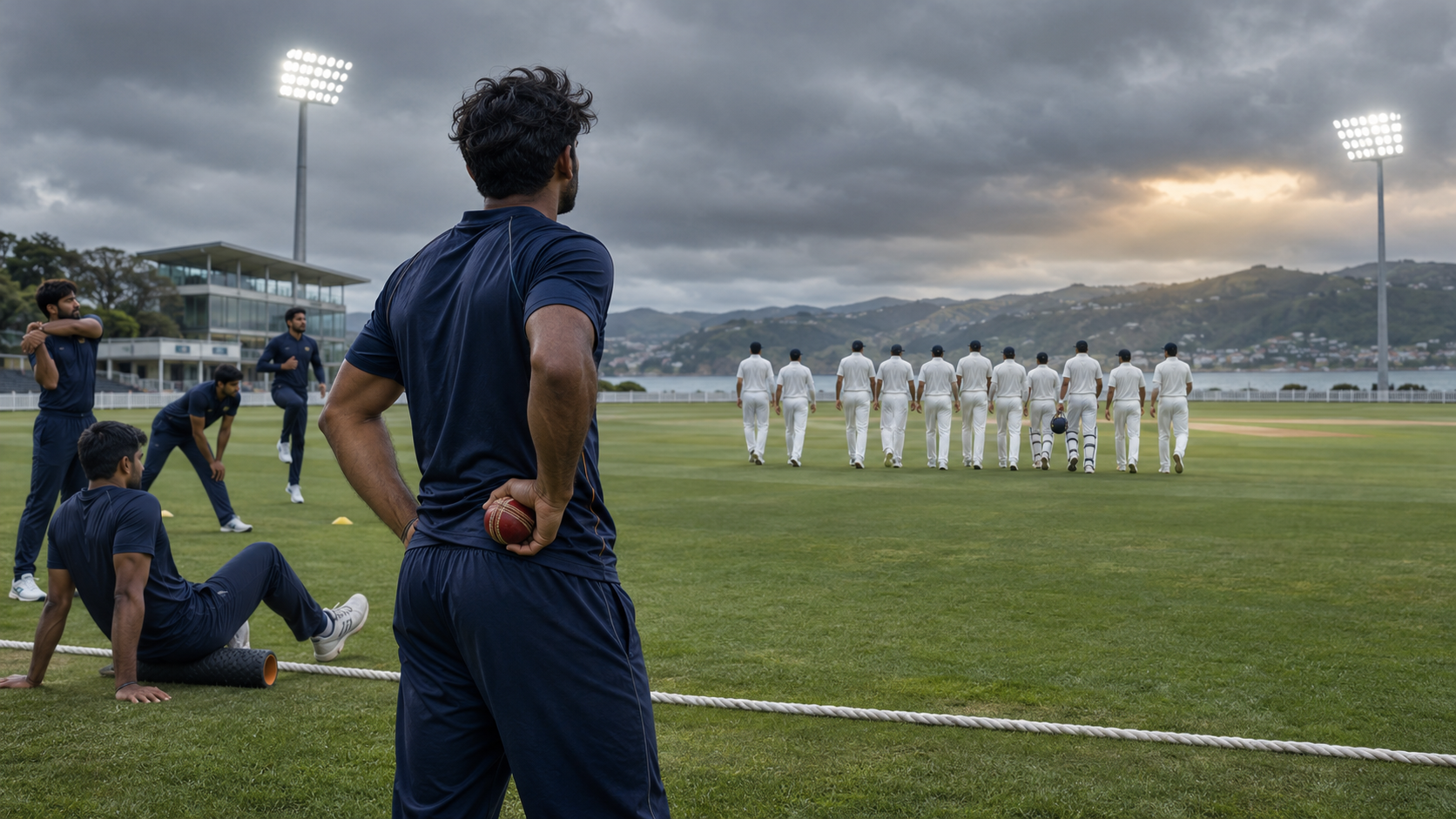
If you encountered the claim that Mohammed Siraj was excluded because of his religion, start with the detail most likely to disappear in the political argument: Siraj was not removed from India’s New Zealand series squad. He remained one of the 16 players selected for the series. The disputed decision concerned the playing XI for the first Test in Wellington.
That distinction does not prove that every cricket selection is fair. It does show why the religious-bias charge, as presented, does not hold up. A serious allegation needs evidence connecting a player’s identity to the decision. Here, the connection was asserted rather than demonstrated.
What happened, and what did not happen
On 20 November 2026, Congress MP Imran Masood gave Siraj’s omission an explicitly religious explanation:
His name is Siraj, so he didn’t find a place in the Indian team. What’s surprising about that?
Imran Masood, 20 November 2026
The remark collapses three different kinds of selection into one:
- Selection for an international career: whether a player is given opportunities to represent India at all.
- Selection for a series squad: whether a player is included among those available for the matches.
- Selection for a playing XI: whether that player is chosen for a particular match from the larger squad.
Siraj had cleared the first two levels. His T20I debut came in November 2017, followed by his Test call-up in October 2020. He was then selected for the 16-member New Zealand series squad. Only the third decision – his place in one match’s XI – went against him.
This chronology cannot establish that the Wellington decision was tactically correct. It does, however, contradict the sweeping suggestion that the name Siraj has itself prevented him from being selected for India. His name was the same when he entered international cricket, received a Test call-up and made the current series squad.
Ravindra Jadeja was also left out of the ODI side and the same Test. Jadeja is not a perfect cricketing comparator because he and Siraj perform different roles. His omission nevertheless illustrates a basic point: even prominent players can sit out, and the fact of omission alone does not reveal its cause.
Why the religious-bias claim fails the evidence test

Bias is a claim about causation. Siraj’s religious identity is one fact. His absence from the XI is another. To establish discrimination, evidence must connect the two. Masood’s remark supplies the identity and the outcome but no connecting statement, document, pattern or like-for-like comparison.
That missing connection matters because several explanations can exist for a match selection: pitch conditions, team balance, current form, workload, fitness or a tactical preference. None should be presumed to be the actual explanation without evidence. But their ordinary existence means religion cannot reasonably be treated as the default explanation merely because a Muslim player was not chosen.
A selection can also be mistaken without being discriminatory. Coaches and selectors can misread conditions, prefer the wrong combination or communicate badly. Criticising the cricketing judgment is legitimate. Converting disagreement about that judgment into a charge of religious exclusion requires a separate and much stronger evidentiary basis.
Coach Gautam Gambhir’s past role as a BJP MP may give political critics an easy narrative. It does not supply proof about why this XI was chosen. A person’s political history can justify closer scrutiny, but it cannot substitute for evidence about a specific decision.
Nor should anyone overstate the other side. Siraj’s existing career does not logically prove that bias could never affect a later decision. Jadeja’s omission does not prove that both players were treated identically. These facts weaken Masood’s broad inference; they do not establish the inner reasoning of every person involved. The defensible conclusion is therefore precise: the religious-bias allegation is unsupported by the facts presented.
Five questions to ask before sharing a discrimination claim

You do not need access to a dressing room to assess whether a public allegation deserves belief. Apply the same five questions regardless of the player’s religion or the politician’s party.
- What decision was actually made? Distinguish removal from a squad, omission from one playing XI, injury, rest and non-selection for an entire tour. A headline that blurs these categories can make a routine match decision look like a career ban.
- What evidence connects identity to the decision? Look for a direct remark, a document, a credible first-hand account, a repeated pattern or a departure from criteria consistently applied to comparable players. The mere coexistence of identity and disappointment is not causation.
- Is the comparison genuinely like for like? A useful comparator should have a similar role and face similar conditions. Comparing a fast bowler with an all-rounder may reveal that omissions are not unusual, but it cannot by itself settle which player best suited the match.
- Have ordinary explanations been examined? Ask what is known about team balance, pitch, fitness, workload and form. Do not invent a tactical defence for the selectors, but do not treat the absence of a detailed public explanation as proof of a communal motive.
- What evidence would change your view? A fair conclusion must be revisable. If direct evidence or a consistent discriminatory pattern emerges, reassess the case. Until then, label the charge accurately: an allegation, not an established fact.
This method prevents two common errors. The first is reflexive belief because an allegation confirms your politics. The second is reflexive dismissal because the allegation concerns an institution you support. Both replace judgment with allegiance.
Communal speculation also diminishes Siraj

There is a personal cost when every decision concerning Siraj is interpreted through his religion. He stops being treated as an elite athlete whose selection can be debated through role, performance and conditions. He becomes a communal symbol onto whom politicians and supporters project their preferred story.
That framing can trap the player in both directions. Selection may be presented as evidence of political benevolence; omission may be presented as persecution. Neither approach respects his professional standing. A cricketer should not have to carry a theory about the nation’s communal condition every time the team combination changes.
Unsupported accusations also make genuine discrimination harder to confront. When the word bias is attached to ordinary adverse outcomes without connecting evidence, the public becomes less able to distinguish a documented injustice from partisan insinuation. The answer is not to stop examining institutions. It is to preserve a standard strong enough to identify actual wrongdoing.
This is especially important before the 2027 Uttar Pradesh elections, when statements about religious identity can be absorbed immediately into electoral mobilisation. Political timing does not prove Masood’s motive, just as Siraj’s omission does not prove religious bias. It does mean you should resist being hurried from a provocative remark to a communal conclusion.
A Dharmic public ethic should be firmer than factional loyalty. Satya requires us to tell the truth even when an allegation benefits our side. Nyaya requires us to judge conduct on evidence rather than assign guilt through political or religious association. That standard protects Hindu society from reckless accusations without requiring us to pretend that real prejudice can never occur.
Key takeaways
- Mohammed Siraj was not excluded from the New Zealand series; he remained in the 16-member squad and was omitted from the first Test XI.
- A player’s religion and an adverse selection decision do not, by themselves, establish a causal connection.
- Siraj’s international career and inclusion in the current squad undermine the claim that his name itself bars him from selection.
- Ravindra Jadeja’s omission shows that established players can also sit out, though his different role means he is not a complete like-for-like comparator.
- The accurate verdict on the available facts is that the religious-bias allegation is unsubstantiated, not that every selection decision is beyond scrutiny.
- The same evidentiary standard should apply whether a claim helps Congress, the BJP, a Hindu constituency or a Muslim constituency.
When the next communal claim reaches your feed, pause at the missing link between identity and decision. Ask for the evidence before you repeat the conclusion. That simple discipline protects Siraj’s dignity, the credibility of genuine discrimination claims and Bharat’s social cohesion at the same time.
References
- Hindu Post – Indian Secularism Plumbs New Depths: ‘Boti-Boti’ Congress MP Imran Masood Says Md. Siraj Was Not Selected for Wellington Test Because of His Religion
- News18 – Opinion | How Congress Is Playing With Mohammed Siraj’s Religion And Career For Votes

Leave a Reply
You must be logged in to post a comment.