
If you are trying to decide whether the Shivneri controversy is a heritage-protection issue or a communal confrontation, begin with the narrower question: was the disputed religious structure lawfully present or authorised within the fort’s protected zone? Evidence on that question should determine what happens next.
BJP leader Kirit Somaiya has given the administration three days to remove an allegedly unauthorised dargah and warned that Shivbhakts will stage a sit-in if it is not removed. That creates urgency, but it does not turn an allegation into an official finding. The responsible path is a rapid, transparent heritage inquiry followed by equal enforcement of the rules.
Separate the established facts from the disputed claim
Three points can be stated clearly: Somaiya has raised the allegation publicly; he says the dargah stands within the protected zone of Shivneri Fort, described as a UNESCO World Heritage site; and he has attached a three-day deadline to his demand. The decisive claim – that the structure is unauthorised – still requires documentary verification by the competent administration.
Words matter here. Until official records establish the structure’s status, describe it as an allegedly unauthorised dargah, not as a proven encroachment. That distinction does not weaken the demand for action. It protects the demand from being dismissed as prejudged or politically convenient.
You should look for answers to five concrete questions:
- What is the exact boundary of the protected area, and does the structure fall within it?
- When was the structure built, extended, repaired, or altered?
- Which authority, if any, granted permission for its construction or continued presence?
- Do land, custodial, inspection, or conservation records identify its legal status?
- Has the administration issued a notice, finding, or enforcement order, and can the public read it?
A photograph can show that a structure exists. It cannot, by itself, prove when it was built or whether permission was granted. A political statement can force an authority to answer. It cannot replace the authority’s records. Keep those evidentiary functions separate.
Make heritage protection the governing principle
Two mistakes can derail this dispute. The first is to treat concern for Shivneri as inherently communal. Citizens have a legitimate interest in preventing unauthorised construction or alteration within a protected historic site. The second is to treat the word dargah as proof of illegality. A structure’s religious identity proves neither its age nor its authorisation.
The sound principle is neutral and demanding: no Hindu, Muslim, Jain, Buddhist, Sikh, governmental, commercial, or private structure should receive a special exemption from heritage rules. If an addition is unauthorised, the competent authority should remove it through lawful, conservation-safe procedures. If records show that it is authorised or historically protected, the administration should publish that basis and explain the conservation conditions governing it.
The reported location within a protected zone of a UNESCO World Heritage site raises the importance of careful enforcement. It does not settle the disputed structure’s status automatically. Boundary maps, permissions, inspection records, and a reasoned administrative decision still have to do that work.
For Dharmic citizens, this is where satya and self-restraint become practical disciplines. Speak truthfully about what has been established. Demand accountability without collective blame. Preserve the fort while resisting the temptation to damage it in the name of protecting it.
What a credible administrative response should contain
A three-day ultimatum can justify an immediate acknowledgment, an inspection, and interim protection against further alteration. It cannot substitute for verification. A credible response from the administration would include the following steps:
- Secure the present condition. If construction or alteration is continuing, direct that it stop while the status is examined. No party should be permitted to change the evidence during the inquiry.
- Identify the exact site. Publish a legible map or plan showing the protected boundary and the disputed structure’s location within or outside it.
- Assemble the documentary record. Examine permissions, ownership or custodial entries, inspection reports, earlier notices, dated photographs, and records of construction or alteration.
- Hear the relevant custodian. Give the person or body claiming responsibility for the dargah a defined opportunity to produce any permission or historical record on which it relies.
- Issue a written finding. State whether the structure, or any later addition to it, is authorised. Identify the evidence and the authority responsible for the conclusion.
- Enforce the finding. If unauthorised construction is confirmed, publish a lawful removal and restoration plan. If the allegation is not confirmed, explain why and specify the conservation controls that remain in force.
This sequence prevents two opposite failures: indefinite delay disguised as investigation, and irreversible action based only on assertion. The administration need not settle every historical question before protecting the site, but it should not order a permanent outcome without a documented basis.
How Shivbhakts can press the case without weakening it
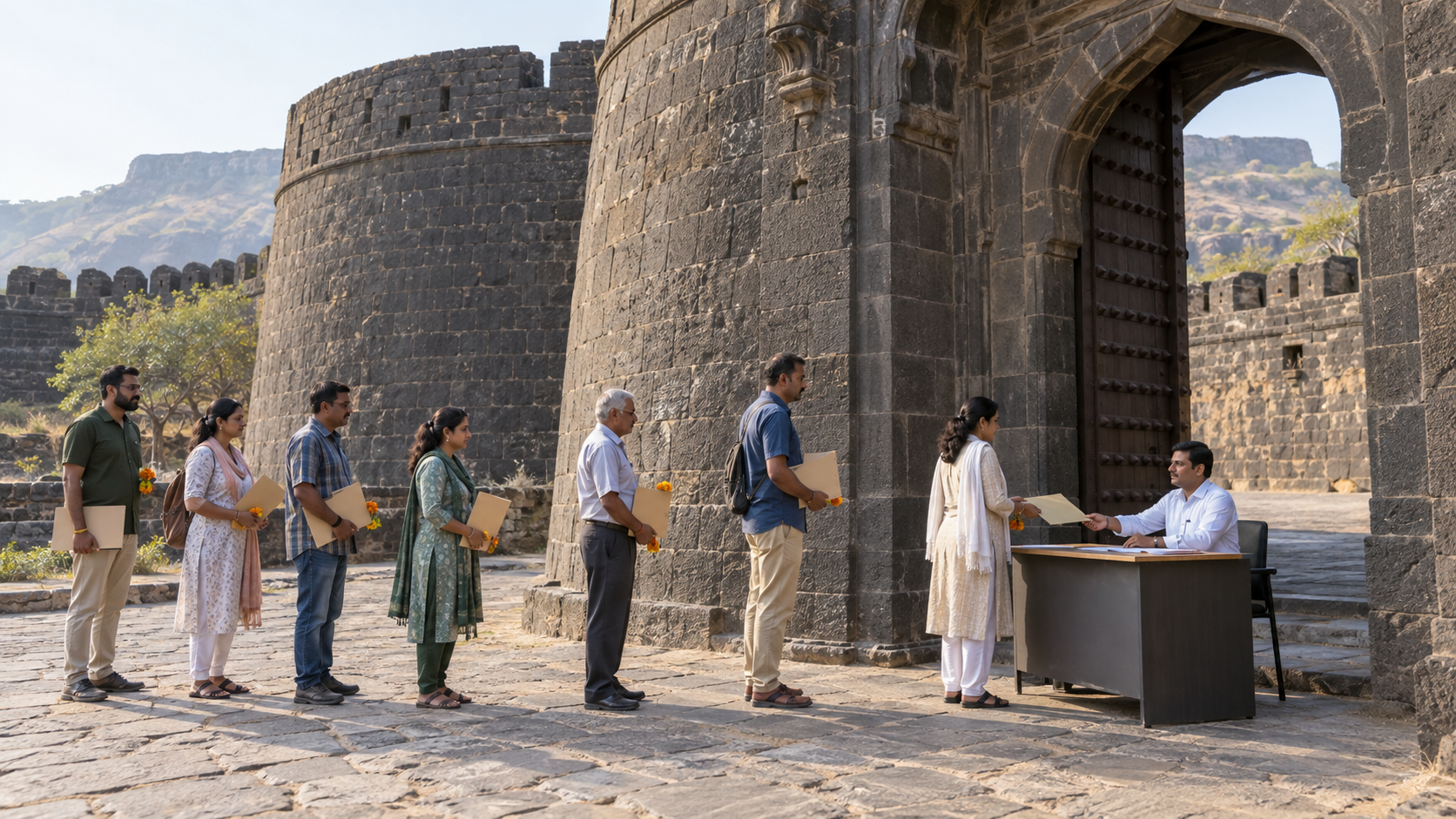
If you want action, build a record that an official cannot answer with a vague assurance. Submit one written representation containing the five questions above. Ask for an acknowledgment or receipt, identify the fort and disputed location precisely, and request a written response from the authority responsible for the protected area.
Keep a simple evidence folder with separate sections for official documents, maps, dated photographs, correspondence, and public statements. Preserve original files and dates. Label unverified material as unverified. Do not recirculate cropped images, anonymous claims, or captions whose date and location you cannot establish.
If a sit-in goes ahead, its demands should remain narrow and testable:
- Inspect the disputed structure and preserve the site’s current condition.
- Publish the protected-zone map and the relevant permissions or absence of permissions.
- Issue a written, reasoned finding within a declared timeframe.
- Apply the same heritage standard to every religious and non-religious structure.
- Carry out any removal only through competent authorities and conservation-safe methods.
Follow lawful directions governing access and public assembly. Do not enter restricted areas, touch the structure, attempt a private demolition, threaten a custodian, expose anyone’s personal information, or use abuse against Muslims as a community. Such conduct can harm people, damage the protected fort, create legal exposure, and hand opponents an easy way to avoid the actual documentary question.
A disciplined public message is harder to misrepresent: verify the structure, disclose the records, and enforce the heritage rules equally. If the evidence confirms unauthorised construction, that record will support removal far more strongly than anger will. If it does not, campaigners should correct the claim rather than preserve a convenient falsehood.
Key takeaways
- The dargah’s allegedly unauthorised status is the central disputed fact, not an established conclusion.
- Somaiya’s three-day ultimatum creates political and civic pressure; it does not replace an administrative finding.
- The strongest case will rest on a boundary map, permission records, dated evidence, inspection findings, and a written decision.
- Heritage rules should apply equally, regardless of the structure’s religious identity.
- No citizen should attempt removal. Any enforcement must be carried out lawfully by the competent authority without damaging Shivneri.
- Peaceful advocacy should target administrative accountability, not an entire religious community.
Your most useful next step is concrete: send a signed representation asking for the five missing facts, retain proof of submission, and publish only the answers you can verify. That turns concern for Shivneri from a slogan into a durable demand for truth, conservation, and equal law.
References

Leave a Reply
You must be logged in to post a comment.