
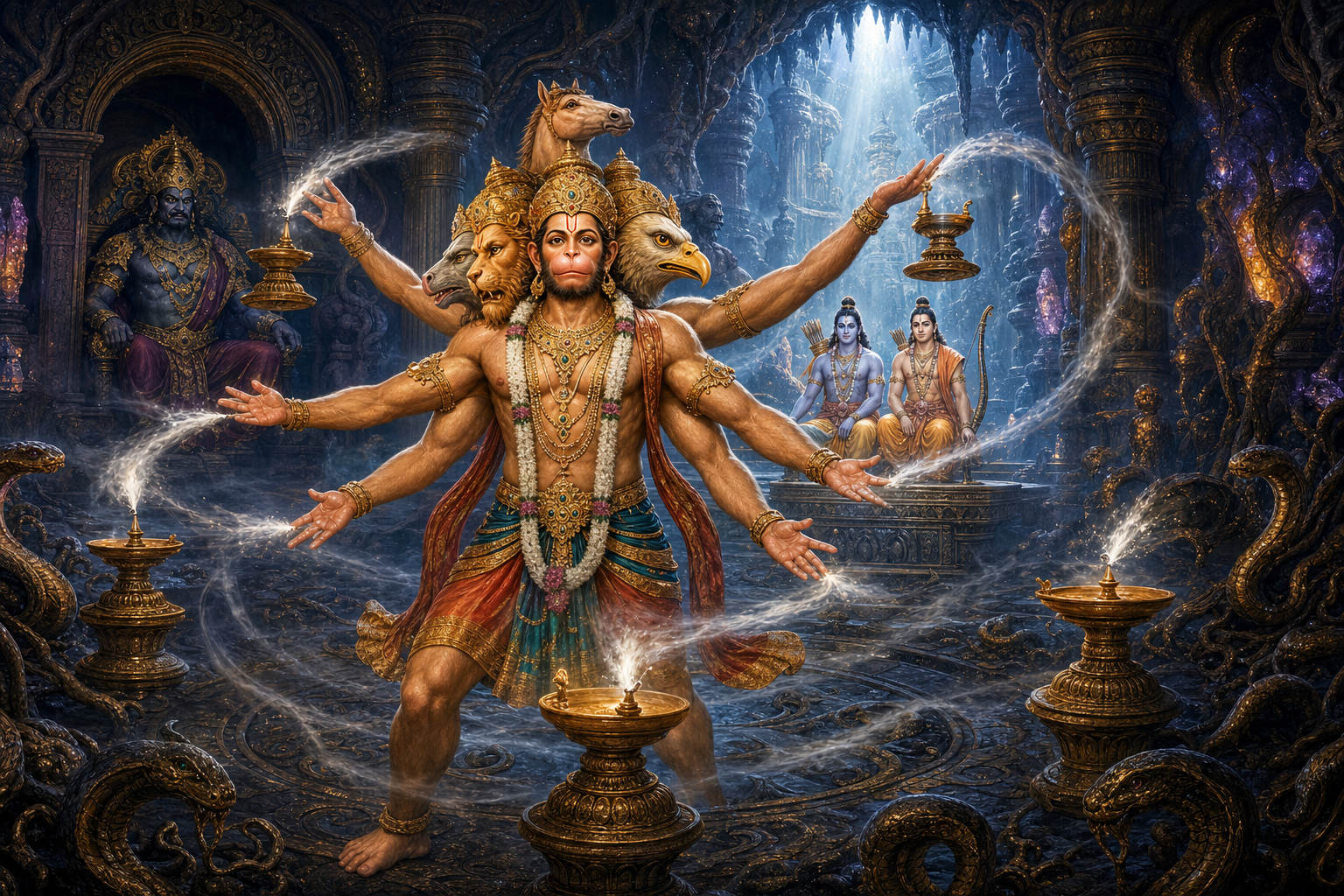
You hear Ahiravana named in a Ramlila, Mahiravana in a Yakshagana performance, and then someone insists that the entire Patala episode is "not in the Ramayana." The disagreement sounds larger than it is because three different questions have been bundled together.
If you want a reliable answer, separate the textual question from the regional one and the devotional one. Ask whether the episode occurs in the Valmiki Ramayana, how a particular lineage names the antagonist, and why Panchamukhi Hanuman stands at the climax. Once you do that, the variations become intelligible without forcing the living Rama-katha into a single cast list.
The shortest accurate answer: usually one demon, sometimes two
Mahiravana and Ahiravana are most often alternate names for the same underworld ruler: the sorcerer who abducts Rama and Lakshmana, takes them into Patala, and intends to sacrifice them. In some theatrical and regional versions, however, the names designate two allied figures, commonly brothers or a ruler and his lieutenant.
Neither answer works as an absolute rule. "They are always the same" erases versions that deliberately place both characters on stage. "They are two different demons" turns a particular dramatic arrangement into a universal claim. The responsible answer is therefore conditional: in most familiar tellings they are variant names for one Patala antagonist; in some performance lineages they are separate characters.
The episode itself does not occur in the Valmiki Ramayana. It belongs to later textual, oral, theatrical, and devotional developments of Rama-katha. That distinction matters, but it should be stated precisely. "Not in Valmiki" means that you should not cite it as part of Valmiki’s narrative. It does not mean that the episode is a recent fabrication, spiritually meaningless, or foreign to the Ramayana tradition as a whole.
This is where two common mistakes meet. One person treats the Valmiki Ramayana as though it were the only form in which Rama-katha has ever lived. Another person remembers the Patala rescue from childhood and assumes that every detail must therefore appear in Valmiki. You do not have to choose between those extremes. You can identify the textual layer honestly while respecting the authority that later traditions acquire through recitation, worship, theatre, and inherited community memory.
The names themselves help explain why they travel so easily. Ahi evokes a serpent, fitting the naga-associated underworld, while mahi evokes earth. Both can therefore mark a Ravana-like sovereign of the subterranean realm. Differences of language, pronunciation, metre, and performance lineage can favour one form over the other. This semantic closeness makes interchange plausible, though etymology alone cannot prove that two named characters are identical in every version.
When a dispute arises, ask one concrete question before debating the names: Which text, script, troupe, or oral lineage are we discussing? That usually resolves the apparent contradiction. The name tells you less than the narrative context does.
Follow the stable plot before arguing over the cast
The easiest way to recognize the tradition is to follow its narrative structure. In its widely known form, the Lanka war is underway when the Patala ruler enters Rama’s camp through deception. He often assumes the appearance of Vibhishana, bypasses the defenders, and carries the sleeping or incapacitated Rama and Lakshmana into the underworld for a sacrificial rite.
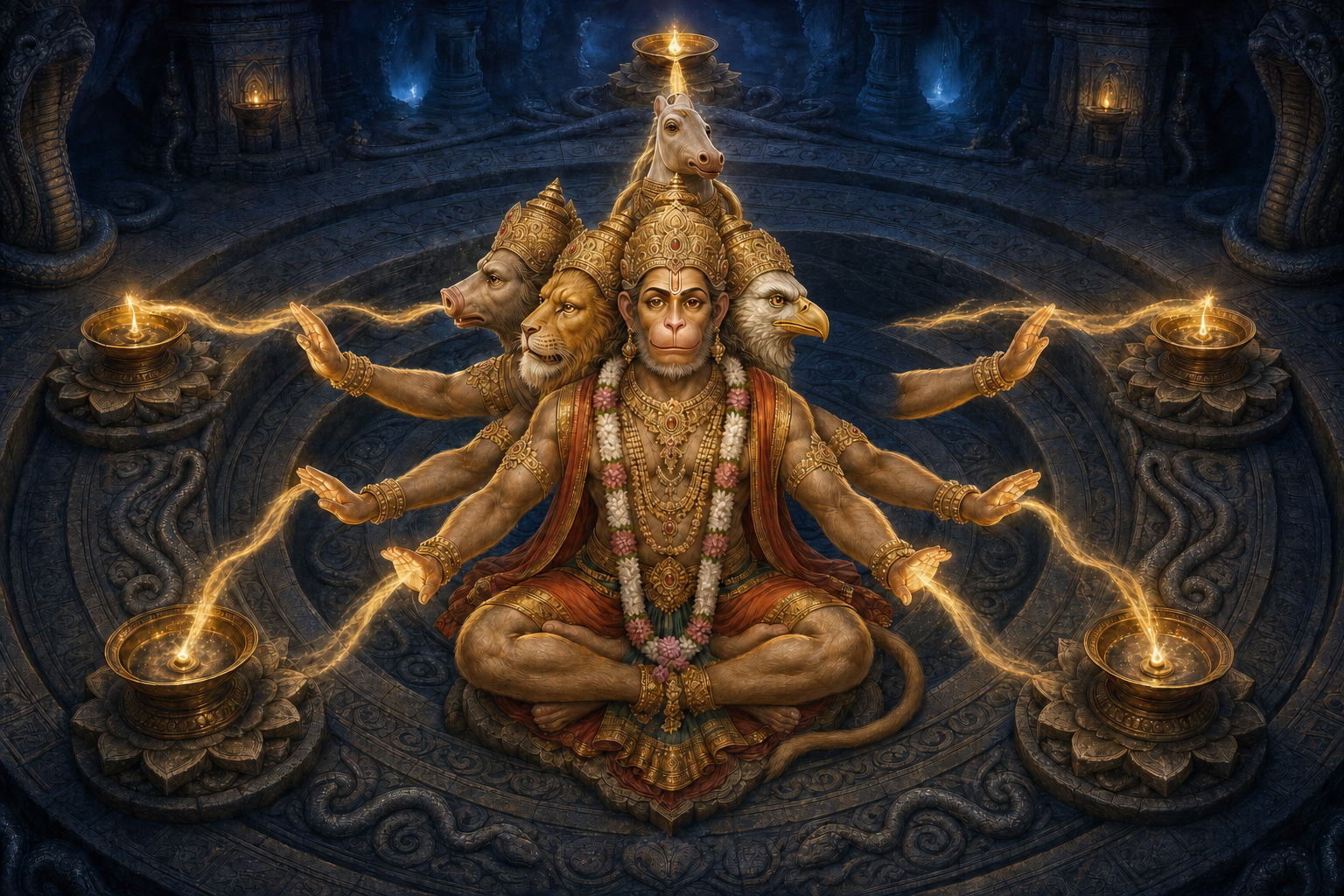
Hanuman then descends into Patala. His task is not simply to overpower another rakshasa. He must penetrate a realm governed by concealment, magical protection, and misdirection. The enemy’s life or invincibility is linked to five lamps burning in different directions. They cannot be extinguished one after another; all five must go out in the same instant.
That condition creates the need for Panchamukhi Hanuman. With five faces oriented across the sacred directions, Hanuman extinguishes the lamps simultaneously, defeats the Patala ruler, and returns Rama and Lakshmana to the struggle in Lanka. The names and supporting characters may change, but the deception, descent, fivefold protection, and rescue form the episode’s recognizable spine.
This gives you a practical way to evaluate unfamiliar retellings. Do not begin by asking whether every name matches the version you already know. First notice whether the same story-functions are present: an underworld abductor, a concealed route into Patala, a threatened sacrifice, a secret that ordinary force cannot overcome, and Hanuman’s coordinated answer. A version can alter the cast while preserving the episode’s identity.
The stability of that structure also explains why a dramatist might divide the antagonist into two figures. Two sorcerers allow for more dialogue, conflict, disguise, combat, and spectacle. One may initiate the abduction while the other guards the sacrificial chamber. Such doubling changes the staging, not the ethical centre. Hanuman still succeeds because devotion is joined to vigilance, discernment, courage, and precisely timed action.
That last point is easy to miss when the episode is reduced to a supernatural adventure. Hanuman does not prevail through strength alone. He recognizes deception, crosses into hostile territory, learns the condition sustaining the danger, and acts on every part of that knowledge at once. The rescue presents seva as intelligent responsibility. Love for Rama makes Hanuman more attentive, not less.
Use the performance context to identify the version
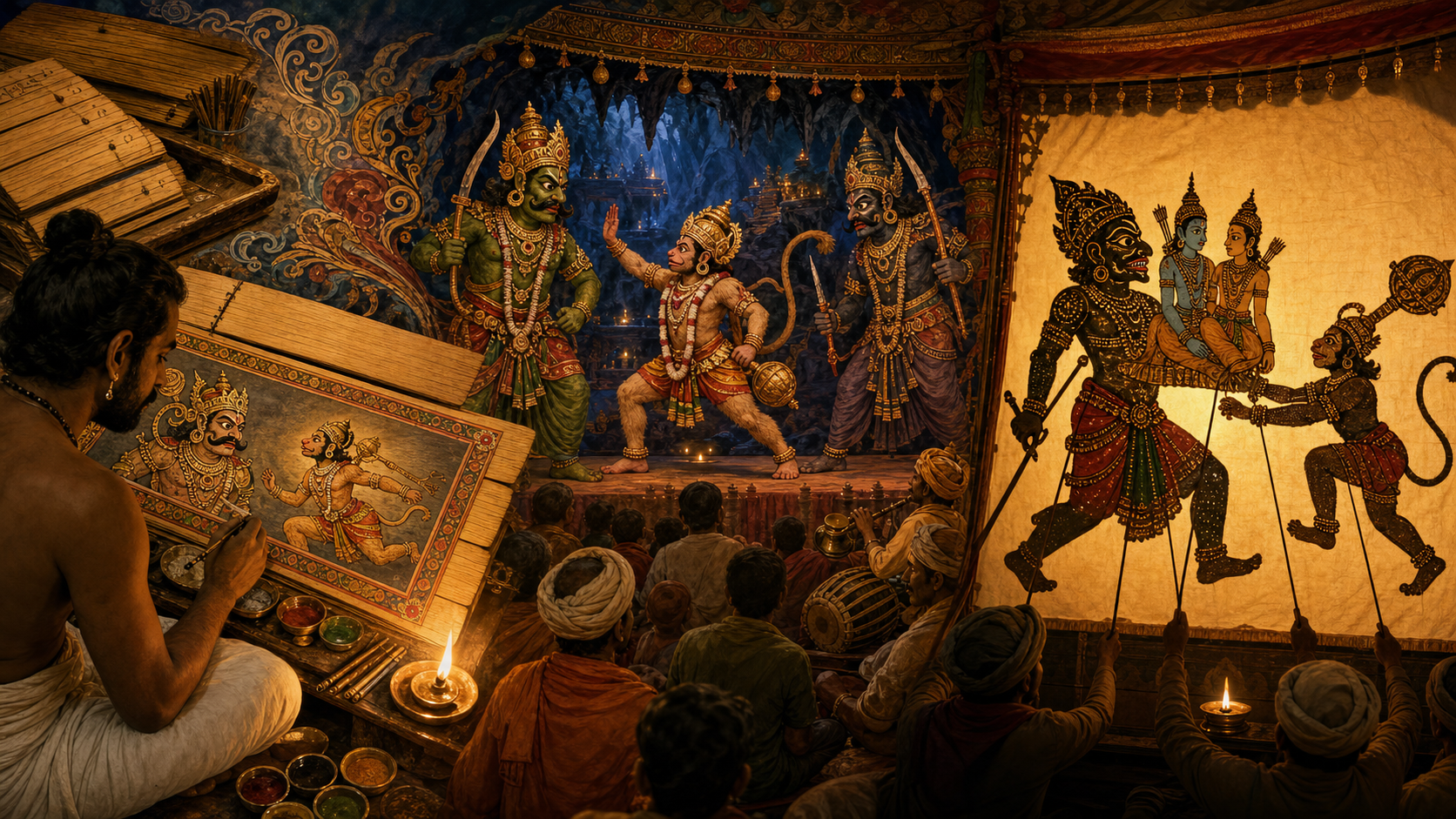
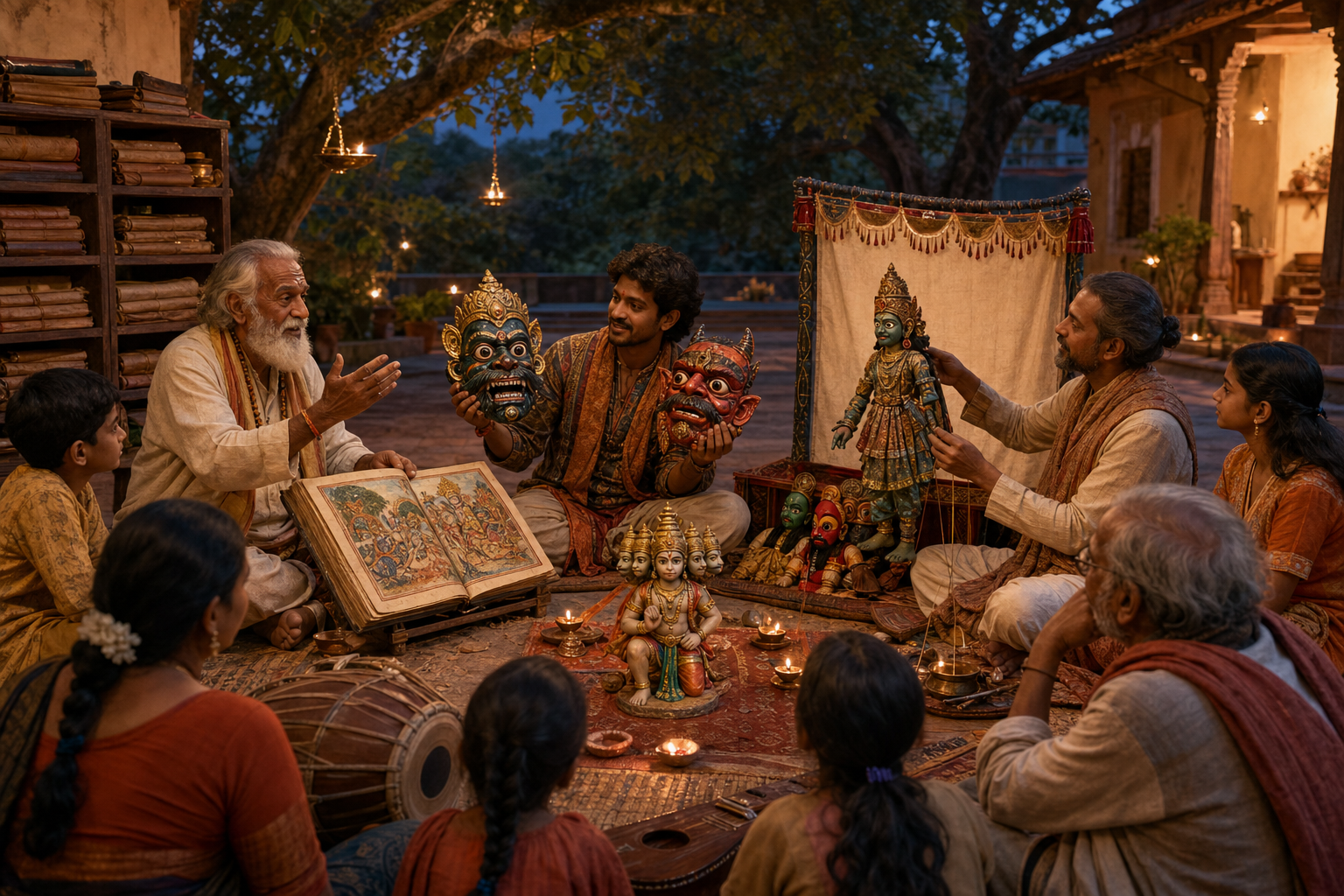
The Mahiravana-Ahiravana tradition did not move through Bharat in a single textual channel. It circulated through vernacular Ramayanas, devotional compendia, local print, oral narration, festival theatre, and temple-centred storytelling. A regional map can orient you, but the script or storyteller in front of you remains the best evidence for that particular telling.
| Context | Name you are likely to encounter | What to notice |
|---|---|---|
| North Indian Ramlila | Ahiravana | Patala Vijay may be staged as a recognizable unit even though it is absent from the Ramcharitmanas itself. |
| Bengali and Odia storytelling, Jatra, and local Ramayana traditions | Ahiravana or Mahiravana | Oral and performative usage may treat the names as alternatives for the same underworld ruler. |
| Coastal Karnataka Yakshagana | Mahiravana, sometimes alongside Ahiravana | Some prasangas use one chief antagonist; others distinguish a brother, ally, or lieutenant. |
| Tamil and Kannada performance cultures | Often Mahiravana | The Patala story can flourish on stage even when a major literary base, such as Kamba’s Ramavataram, does not contain it in its core narrative. |
| Thai Ramakien | Maiyarap | The cognate underworld abductor is adapted to Thai narrative and visual conventions while retaining the rescue pattern. |
The Bengali Krittivasi Ramayana is frequently associated with the Ahiravana narrative in popular discussion, while the later composite Ananda Ramayana also gives Ahiravana a prominent place. Yet the story’s life cannot be reduced to one book. Local chapbooks, reciters, Ramlila scripts, Jatra performers, Therukoothu troupes, and Yakshagana ensembles all helped establish what audiences now recognize as Hanuman’s Patala Vijay.
This distinction is useful whenever someone says, "It is in the Ramayana" or "It is not in the Ramayana." Ask them to complete the sentence. It is not in the Valmiki Ramayana or the core narrative of the Ramcharitmanas. It is present in later Ramayana traditions and has become integral to particular devotional and performative communities. Both statements can be true because "the Ramayana" may refer either to a specific text or to the much wider family of Rama-katha.
You should use the same precision when captioning a temple image, teaching children, writing about a performance, or discussing the episode online. Say, "In this Ramlila, the antagonist is Ahiravana," or, "This Yakshagana version distinguishes Mahiravana from Ahiravana." A small phrase such as "in this version" preserves both accuracy and respect.
The Ramakien’s Maiyarap widens the perspective further. The underworld abduction and Hanuman-led rescue travelled beyond South Asia and entered a distinct Southeast Asian aesthetic world. You need not pretend that every local detail is identical to recognize the shared narrative ancestry. Continuity lies in the story’s architecture; cultural vitality appears in the transformations.
Panchamukhi Hanuman is the solution, not an ornament
The five-faced form can look like a spectacular addition if it is separated from the problem Hanuman must solve. Within Patala Vijay, however, its logic is exact. Five flames in different directions sustain the enemy, and a sequential response will fail. Hanuman therefore becomes capable of attending to every direction simultaneously.
In the familiar directional arrangement, Hanuman faces east, Narasimha faces south, Garuda faces west, Varaha faces north, and Hayagriva faces upward. The form unites strength and service, protective ferocity, speed and clarity, grounded stability, and knowledge. These are not five unrelated displays of power. They become one coordinated act directed toward the protection of Rama and Lakshmana.
This is why the episode supports a deeper devotional reading without needing to become an abstract allegory. Hanuman’s bhakti is panoramic. He does not stare only at the visible enemy. He guards every direction, detects the hidden condition behind the threat, and brings several capacities under a single dharmic purpose. For a devotee, the form teaches that wholehearted service may require tenderness, force, knowledge, steadiness, and speed at the same time.
A popular contemplative interpretation treats the five lamps as the five senses. When perception runs in five directions without discipline, delusion remains supplied with fuel. Panchamukhi Hanuman represents gathered awareness: the senses are not destroyed but aligned and placed in service of dharma. This is a fruitful exegesis, but it should be identified as an interpretive reading rather than presented as the only literal meaning of every telling.
You can use that distinction in your own practice. Begin with the narrative meaning: five lamps require simultaneous action. Then consider the devotional meaning: scattered powers become effective when centred on seva. Only after that should you apply a personal analogy. This order prevents a sacred story from being flattened into generic self-help.
The same care applies when you encounter a Panchamukhi Hanuman murti in a temple or household shrine. The image often recalls Patala Vijay, but its devotional presence is not exhausted by a plot summary. Notice the convergence of divine forms, the directional vigilance, and the purpose for which power is gathered. The central question is not merely, "How many faces are there?" It is, "What does Hanuman protect by becoming attentive in every direction?"
The answer returns you to the ethical heart of the episode. Hanuman does not seek the Panchamukhi form for self-magnification. Extraordinary power appears because Rama and Lakshmana are in danger and an ordinary sequence of action cannot save them. Power is justified by protection, disciplined by knowledge, and completed through service.
Key takeaways
- The Patala Vijay episode is absent from the Valmiki Ramayana but well established in later textual, oral, theatrical, and devotional Rama-katha traditions.
- Mahiravana and Ahiravana usually name the same underworld antagonist, although some stage traditions make them brothers, allies, or separate sorcerers.
- Do not settle the identity question without naming the text, region, troupe, or storytelling lineage under discussion.
- The episode remains recognizable through its stable sequence: deception, the abduction of Rama and Lakshmana, descent into Patala, five protected lamps, Panchamukhi Hanuman, and rescue.
- The five-faced form is a precise response to a simultaneous five-directional problem and also supports a devotional lesson about integrated awareness in service of dharma.
- "Later than Valmiki" is a statement about textual history, not a reason to dismiss a tradition cherished through worship and performance.
The next time you meet Mahiravana, Ahiravana, or Maiyarap, identify the lineage before correcting the name. Then watch what the telling preserves: Hanuman sees through imitation, enters the place others cannot reach, discovers what truly sustains the danger, and gathers every power toward one act of seva. That is the continuity worth carrying forward.
References
