
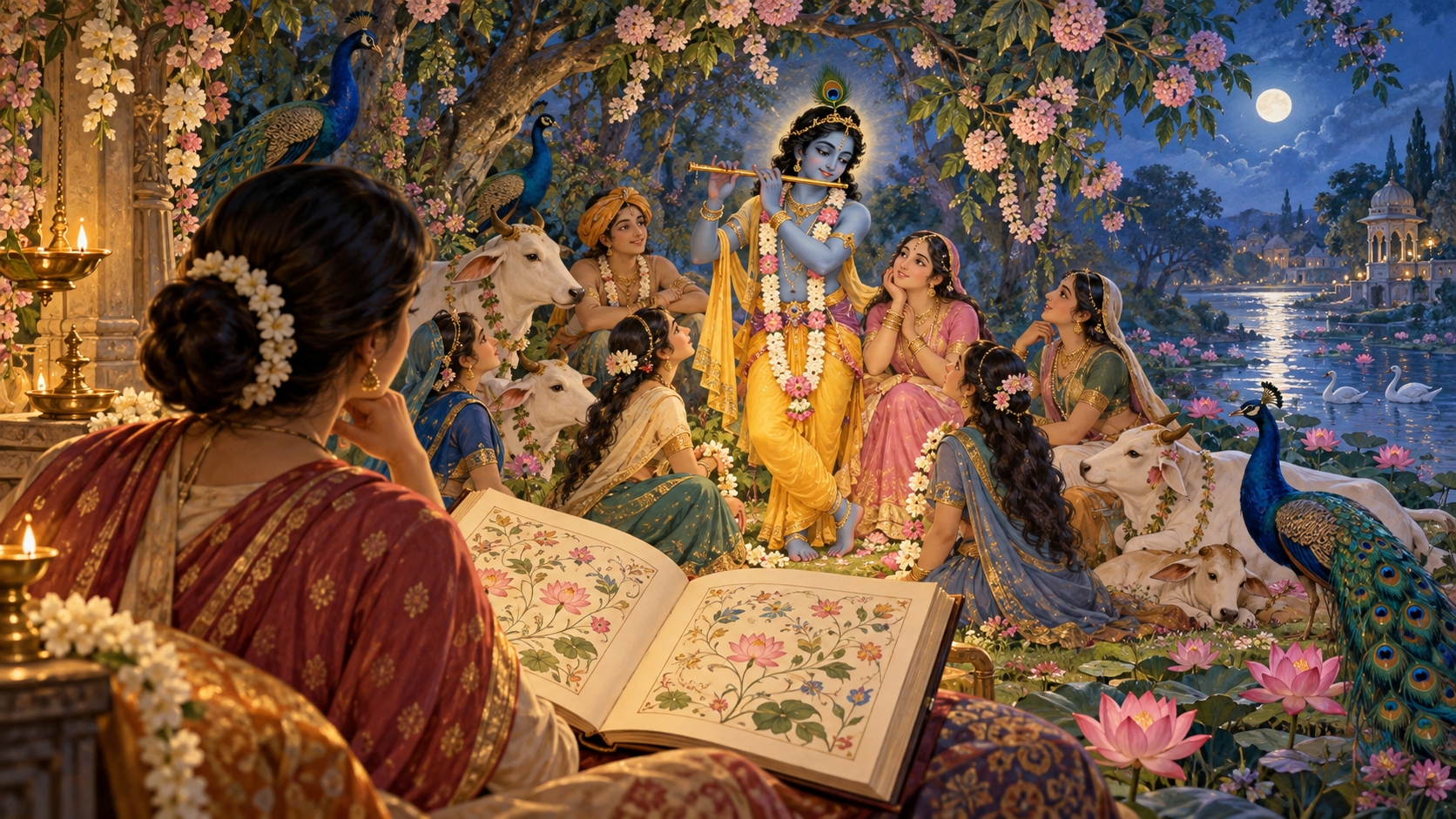
You open a Krishna-bhakti poem expecting theology and encounter eyes, lips, smiles, gestures and exquisitely described forms. If the language feels almost too sensuous, the right question is not whether beauty belongs in devotion. It is what kind of attention that beauty is asking from you.
Sacred beauty should be neither explained away as decorative allegory nor consumed as religiously licensed fantasy. In Krishna bhakti, form, character, action and relationship make the divine person knowable. Your task as a reader is to notice whether literary pleasure returns your attention to Krishna and loving service, or simply returns you to yourself.
The decisive question is what beauty serves
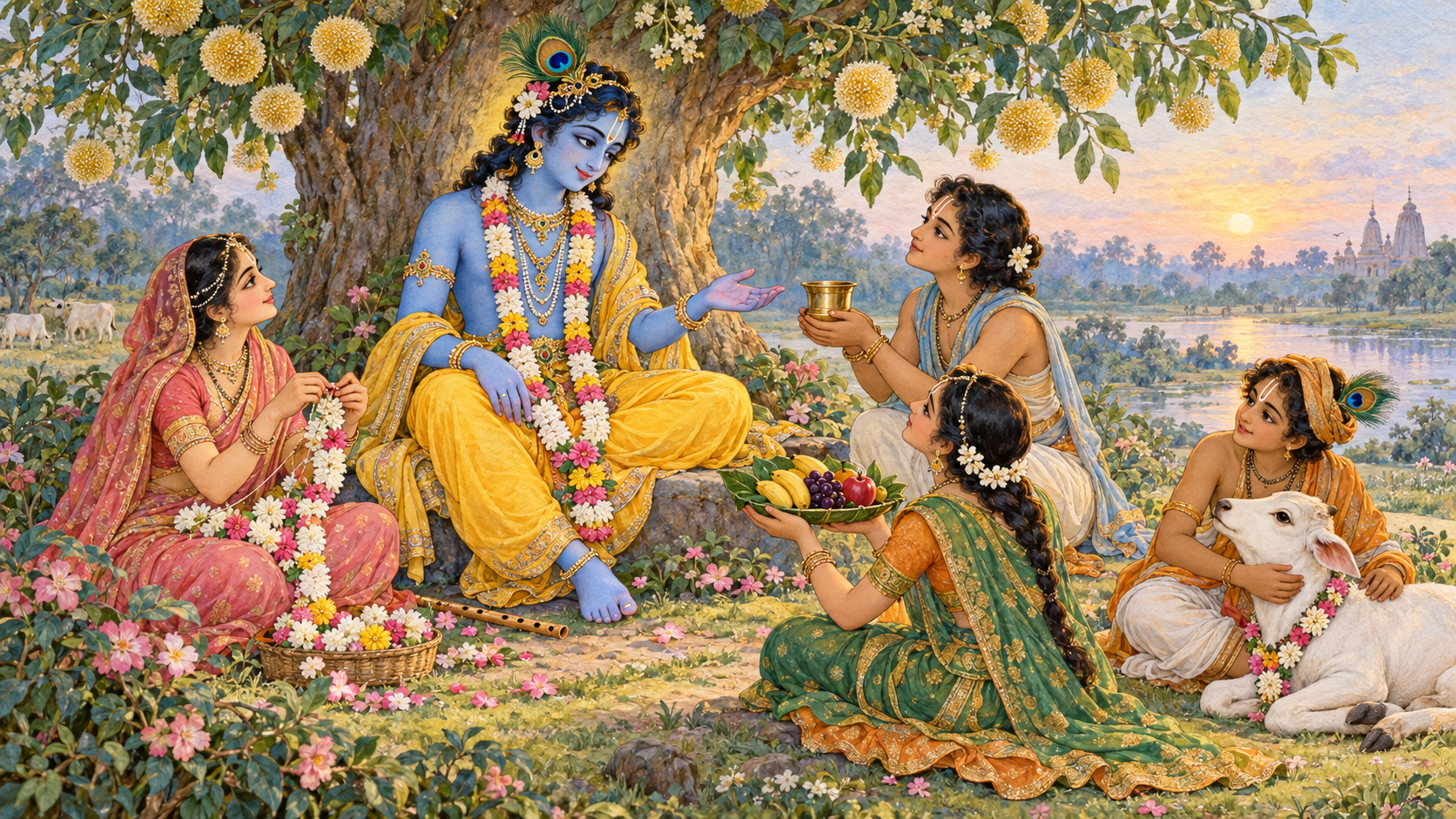
Literature often tries to rescue beauty from time. A poet fixes a face, a season or a beloved person in words and promises that the image will survive. Shakespeare’s verse supplies a classic example of the artistic wish to make mortal beauty endure. Yet a poem can preserve an image without saving the person it describes from age and death. Literary permanence is not liberation.
Krishna bhakti begins from a different premise. The poet is not attempting to confer immortality upon a perishable subject. The divine person is already understood as transcendent. Language serves remembrance, encounter and loving attention; it does not manufacture eternity through artistic skill.
This distinction changes the way you judge a devotional passage. Do not ask only whether it is moving, elegant or memorable. Ask where its movement takes you.
- Does the image disclose a person? Sacred description should lead beyond colour and shape toward character, presence and relationship.
- Does the pleasure remain possessive? If you merely want to consume the image, the attention still circles around your own enjoyment.
- Does beauty awaken a devotional response? The relevant response may be remembrance, reverence, gratitude, longing to serve or more careful hearing. It need not be emotional intensity.
- Can the image survive its context? A bodily feature detached from speaker, action and relationship is easy to misread. Put it back into the whole scene before interpreting it.
Aesthetic pleasure can soothe distress without curing its cause. That does not make art worthless, but it does mean that technical brilliance and spiritual efficacy are different achievements. A polished poem may leave self-centred desire untouched. A devotional poem succeeds spiritually when beauty becomes a path of directed attention rather than an attractive place to stop.
This also saves you from an unhelpful contest between sacred and secular canons. You do not need to prove Krishna-bhakti poetry valuable by declaring it more ingenious than every celebrated Western poet. Shakespeare and a Krishna-bhakti poet may both use rhythm, image, comparison and hyperbole, but they can place those instruments in the service of fundamentally different ends. Function matters as much as finish.
Renunciation does not require deleting form

A reader suspicious of sensuality may try to become spiritual by rejecting every name, image, attribute and relationship. In this approach, transcendence becomes a progressive stripping away of particularity. Beauty appears dangerous because beauty attracts, and attraction appears incompatible with renunciation.
Rupa Gosvami’s devotional framework challenges that conclusion. He calls indiscriminate rejection phalgu-vairagya, or incomplete renunciation. The problem is not that the practitioner renounces too much pleasure. The problem is that material form and transcendental form have been treated as though they were the same kind of thing.
Within this Krishna-bhakti theology, ultimate reality is not exhausted by undifferentiated spiritual existence. Krishna possesses a transcendental form and personal qualities, performs activities and enters loving relationships. Devotion therefore does not require the extinction of perception, thought or individuality. It requires their purification and redirection.
This is a distinctly devotional claim, not a neutral description of every Dharmic school. Impersonalist traditions understand the relation between ultimate reality and personal form differently. When you teach or discuss Krishna bhakti, identify the position honestly: the personal form is not being used as a temporary fiction that disappears at the highest level. It belongs to the tradition’s account of the highest reality.
That does not mean every attractive object, romantic feeling or ornate verse becomes spiritual once it receives a religious label. Use three tests:
- Object: Is Krishna, Radha or the devotee treated as a person with an existence and significance beyond the reader’s appetite?
- Relationship: Is the beautiful detail embedded in an exchange of love, remembrance or service, or has it been isolated for consumption?
- Fruit: Does your reading make attention steadier and less possessive, or does it feed agitation, self-display and fantasy?
These are reading diagnostics, not a mechanical test of spiritual attainment. A calm feeling does not prove that you have understood the passage, and a strong feeling does not prove that you have entered its devotional mood. If highly intimate imagery repeatedly pulls you into ordinary fantasy, begin with passages where Krishna’s qualities, actions and relationships are more explicit. This is disciplined sequencing, not rejection of sacred beauty.
Read form, quality, action and relationship together
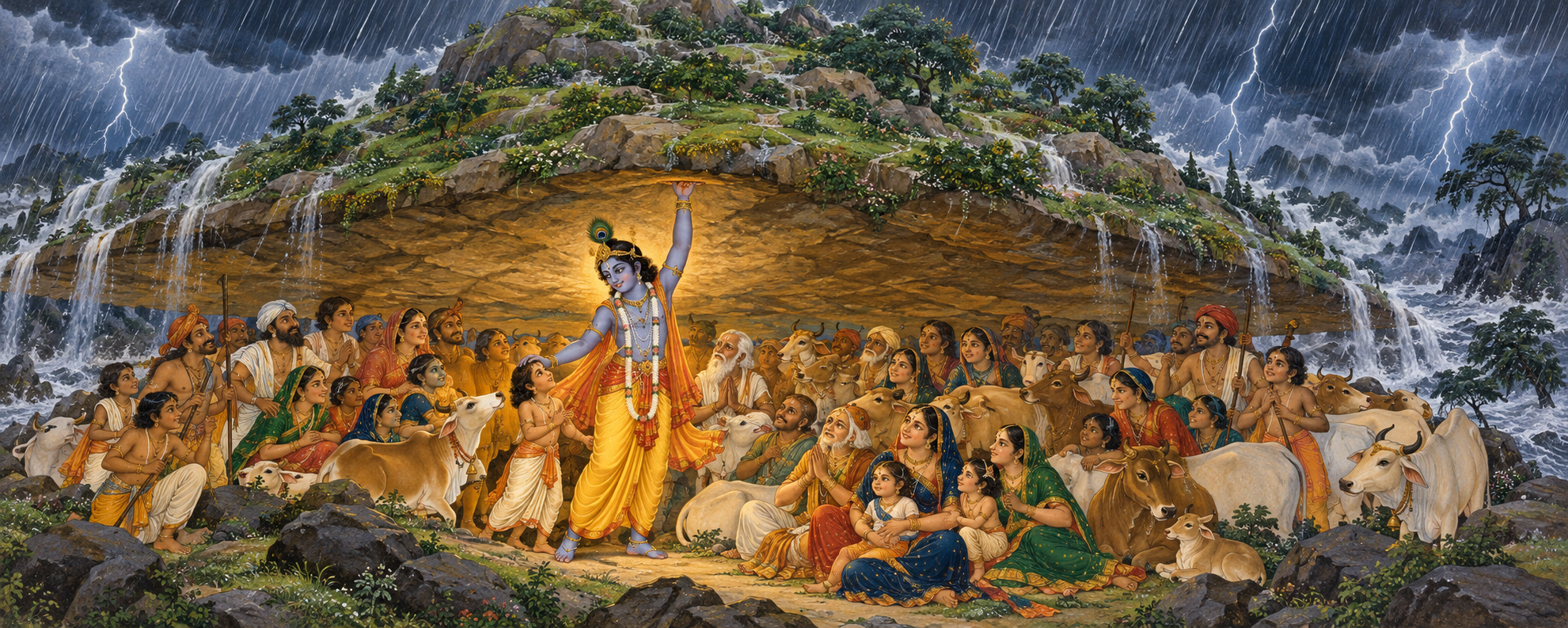
Devotional description becomes clearer when you stop treating beauty as a collection of isolated ornaments. A passage usually presents a person through four connected layers: form, quality, action and relationship. Marking those layers gives you a practical grammar for close reading.
- Form answers, “What is perceived?” Look for the concrete feature on which attention rests: a face, expression, posture, colour, garment or movement. Form makes the encounter particular rather than abstract.
- Quality answers, “What does the form disclose?” A smile may matter because it communicates welcome; a glance may reveal tenderness or playfulness. Do not stop at visual attractiveness when the description points toward character.
- Action answers, “What is happening?” Verbs prevent you from turning a living person into a static icon. Notice who approaches, looks, responds, remembers, speaks, withdraws or serves.
- Relationship answers, “For whom does this matter?” The same gesture acquires a different meaning depending on who sees it, who receives it and what bond connects them.
The fourth layer is especially important when a poem dwells on one bodily feature. A devotional meditation may focus closely on Sri Radha’s lips as a stimulus for ecstatic love. Removed from its devotional setting, the feature can look like an object in ordinary romantic description. Restored to its setting, it belongs to a particular person, is perceived within a particular bond and intensifies a particular movement of love.
Context does not make the physical detail irrelevant. It makes the detail relational. The difference is crucial. An embarrassed interpretation may insist that the lips do not really mean lips and replace them immediately with an abstract moral. A reductive interpretation sees only sensual anatomy. Devotional reading avoids both moves: the form remains real within the tradition’s theology, but its meaning unfolds through quality, action and loving relation.
Literary technique supports this movement. Rhythm slows attention. Repetition returns the mind to a name or image. Comparison connects a visible detail to a quality that ordinary description cannot contain. Point of view tells you whose love is shaping the scene. Superlative language may register a speaker’s sense that ordinary measurement has failed. Each device should be read as an action performed upon attention, not merely as decoration added to an idea.
Suppose a stanza lingers on Krishna’s smile and then turns toward the devotee’s desire to remember or serve. The image functions as a threshold: visible beauty opens into relationship. If you underline only the descriptive nouns, you miss that movement. Underline the verbs as well. They show where beauty goes.
A practical close-reading method for bhakti poetry

You do not need to choose between devotional receptivity and literary care. Close reading can itself become a discipline of attention. Use the following sequence with one short passage rather than racing through a long selection.
- Establish the immediate context. Read the lines before and after your chosen passage. Identify the scene as far as the text or edition allows. An isolated quotation often loses the relation that gives its imagery meaning.
- Name the speaker and addressee. Ask who sees, who speaks and who is being addressed. If the answer is uncertain, preserve that uncertainty instead of silently making yourself the speaker.
- Circle the concrete image. Mark the exact feature that holds attention. Do not paraphrase it into an idea yet.
- Underline the verbs. Track what each person does. A devotional scene is an exchange, not a museum display.
- Connect form to quality. Write one sentence explaining what the image reveals about the person described. If you can say only “this is beautiful,” read again.
- Identify the relational turn. Find the point where description produces remembrance, longing, reverence, service or another response. If no turn occurs, ask whether you are looking at only part of the passage.
- Read the passage aloud. Listen for repetition, pace and emphasis. Sound may guide attention toward words that silent reading treated as secondary.
- Examine the residue. After closing the text, notice what remains: the divine person and relationship, or merely your own excitement about the imagery. Use the answer to choose what you read next.
When sensuous language is difficult
Do not force yourself to manufacture the emotion that you think a devotional reader ought to feel. Performance creates a second distraction: you begin watching your own reaction instead of attending to the passage. Stay with grammar, speaker, action and relationship.
Three errors commonly distort intimate imagery:
- Reduction: You assume that sacred romance is nothing more than ordinary romance with divine names substituted into it. This erases the text’s theological claim about transcendental personality.
- Disembodied allegory: You translate every feature into an abstract virtue as quickly as possible. This erases the positive role of form and relation in Krishna bhakti.
- Emotional credentialism: You treat the intensity of your response as proof of spiritual understanding. Aesthetic excitement can be genuine while its direction remains self-centred.
When you notice one of these errors, return to the four layers. State the form without embarrassment, the quality without sentimentality, the action without embellishment and the relationship without placing yourself inside a role the text has not given you. That modest reading is more reliable than either cynicism or pretended ecstasy.
Turn close reading into a devotional exercise
Copy one short stanza or paragraph onto a page. Make four headings: form, quality, action and relationship. Place each important word beneath the heading it serves, allowing a word to appear in more than one column when necessary. Then write a single sentence beginning, “This beauty directs attention toward…” If you cannot complete the sentence without vague language, return to the verbs and point of view.
This exercise also exposes translation problems. If a crucial pronoun, speaker or relational term is unclear, consult an edition that identifies speakers and explains technical vocabulary. Do not build a large theological conclusion on a grammatical uncertainty. Where different interpretations remain possible, retain both until the wider context decides between them.
Key takeaways
- Sacred beauty in Krishna bhakti is not merely attractive content; it directs attention toward a transcendent person and a loving relationship.
- Literary excellence cannot by itself overcome mortality or prove spiritual value. Judge the direction of the pleasure as well as the quality of the craft.
- Renunciation need not erase name, form, quality, activity or relation. In Rupa Gosvami’s framework, indiscriminate rejection is incomplete renunciation.
- Read every beautiful detail through four connected layers: form, quality, action and relationship.
- Neither reduce intimate imagery to ordinary romance nor dissolve it into abstract allegory. Preserve the form while recovering its devotional context.
- Do not use emotional intensity as a certificate of realization. Let careful attention precede claims about experience.
At your next reading, choose one short passage and mark its images, verbs, disclosed qualities and relationships. End by writing what the beauty asks you to remember or do. That small act turns literary analysis from a verdict on the poem into disciplined attention to the person whom the poem reveals.
References
- Dandavats – My Encounter With the Art of Perfection
- Dandavats – Stimulation for Ecstatic Love Part 200: Sri Radha’s Lips

Leave a Reply
You must be logged in to post a comment.