
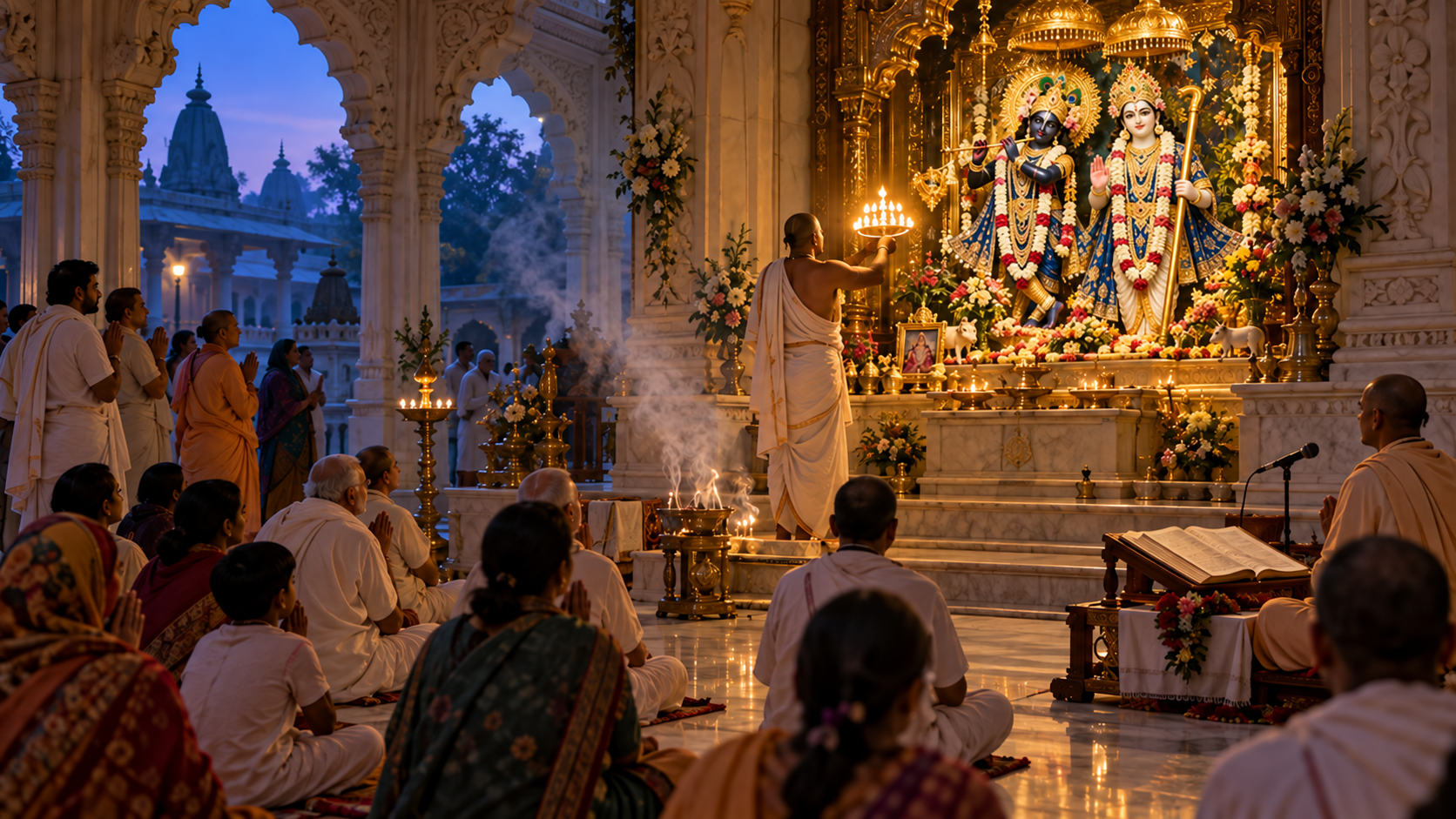
You have opened an ISKCON Vrindavan broadcast because you want more than temple footage or a devotional lecture playing in the background. You want to receive the worship properly, understand the Bhagavata discourse, and carry something real into the rest of your day.
The most useful approach is to treat mangala-arati and scriptural hearing as one practice. The worship gathers your attention around Krishna. The discourse disciplines that attention through shastra. Your conduct afterward shows whether either encounter reached beyond the screen.
Receive the worship and discourse as one continuous practice
Arati and Bhagavata hearing engage you differently, but they should not become separate compartments. A helpful sequence is simple: direct the senses toward the Lord, submit the intelligence to scripture, and let daily conduct answer what you heard. Without that continuity, worship can become atmosphere and discourse can become information.
The 17 October 2026 programme brings together live mangala-arati darshan from Sri Sri Krishna Balaram Mandir in ISKCON Vrindavan and Vaisheshika Prabhu’s discourse on Srimad-Bhagavatam 11.5.18. That pairing gives you a ready-made structure for sadhana: darshan first, attentive hearing next, application afterward.
Before you begin, ask yourself two direct questions: Whom am I coming to see, and what am I prepared to change if the teaching corrects me? These questions prevent the broadcast from becoming content you merely consume.
Prepare for mangala-arati so darshan remains active
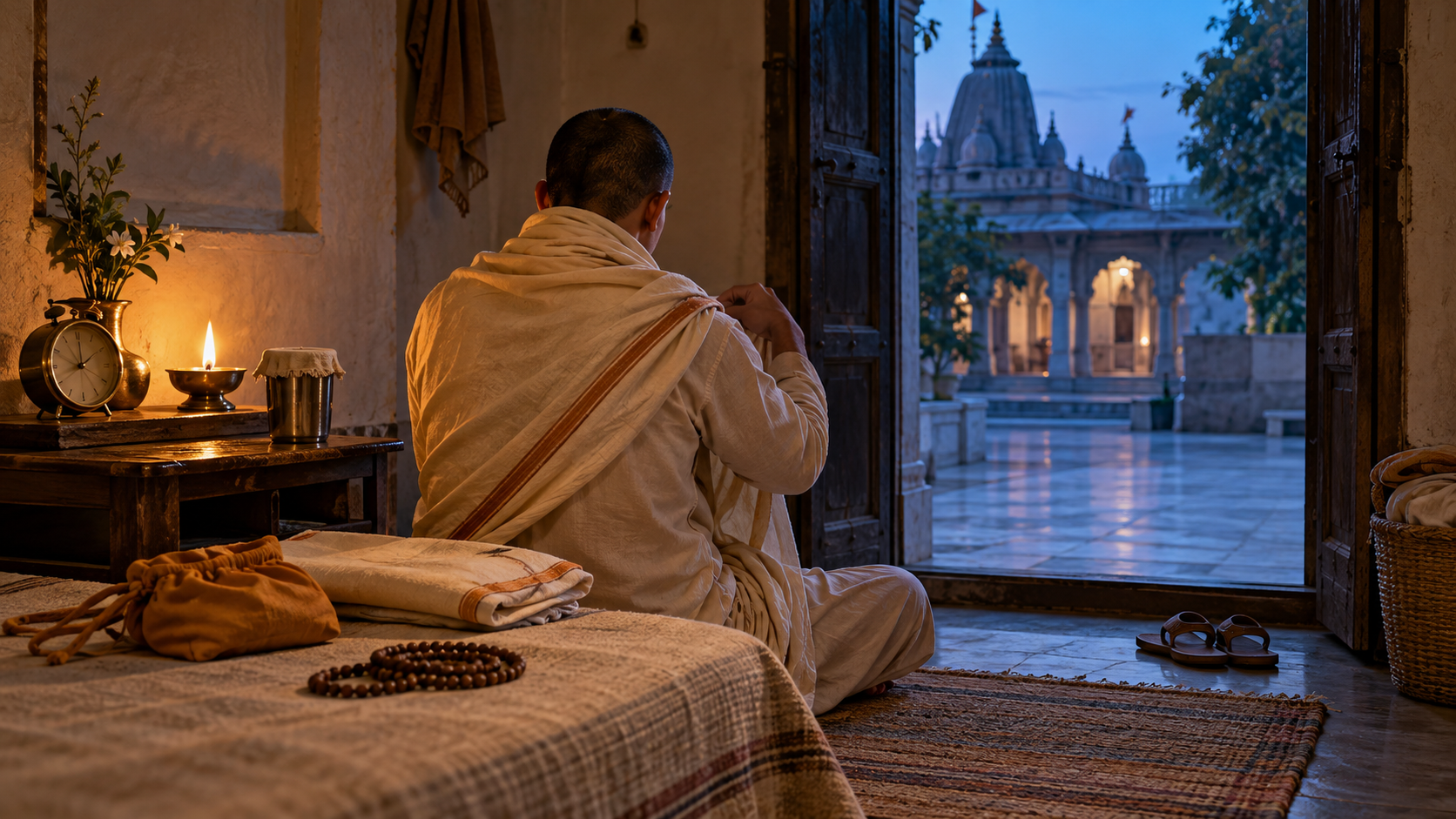
Mangala-arati is auspicious morning worship. Arati centres on ritual offering, commonly including light, while darshan in bhakti practice means beholding the sacred presence. When you join remotely, the decisive issue is not whether your screen is large or the camera angle is ideal. It is whether your attention is available.
- Set a boundary around the session. Close unrelated tabs, silence alerts, and place the device where you will not keep handling it. A notification may take only a moment to dismiss, but it changes your posture from worshipper to browser.
- Make the immediate space orderly. You do not need to imitate the temple setting. A clean, steady place and an unhurried posture are enough to signal that this period is different from ordinary viewing.
- Join before the worship begins when possible. Use the waiting period to settle your breathing and intention. Arriving inwardly matters as much as opening the stream.
- Participate only in ways you understand. You may stand or sit reverently, fold your hands, bow, or sing prayers you know. Do not improvise ritual actions simply because you see them performed in the temple.
- Keep the transition quiet. When arati concludes, resist the impulse to check messages. Remain attentive and carry the same devotional orientation into the discourse.
A livestream gives access to darshan, but it does not reproduce pilgrimage, temple community, or embodied service. Accept that limitation without devaluing the opportunity. Work with what the medium can offer: a shared time of worship, a visible altar, devotional sound, and a focal point for remembrance.
You also do not need to reproduce the temple’s external ritual at home. If you use a household lamp, follow an established practice and ordinary fire safety; never improvise with flame near a device, loose clothing, or fabric. Folded hands and undivided attention are more appropriate than copying an offering you have not learned to perform safely.
Listen to Srimad-Bhagavatam 11.5.18 as shastra
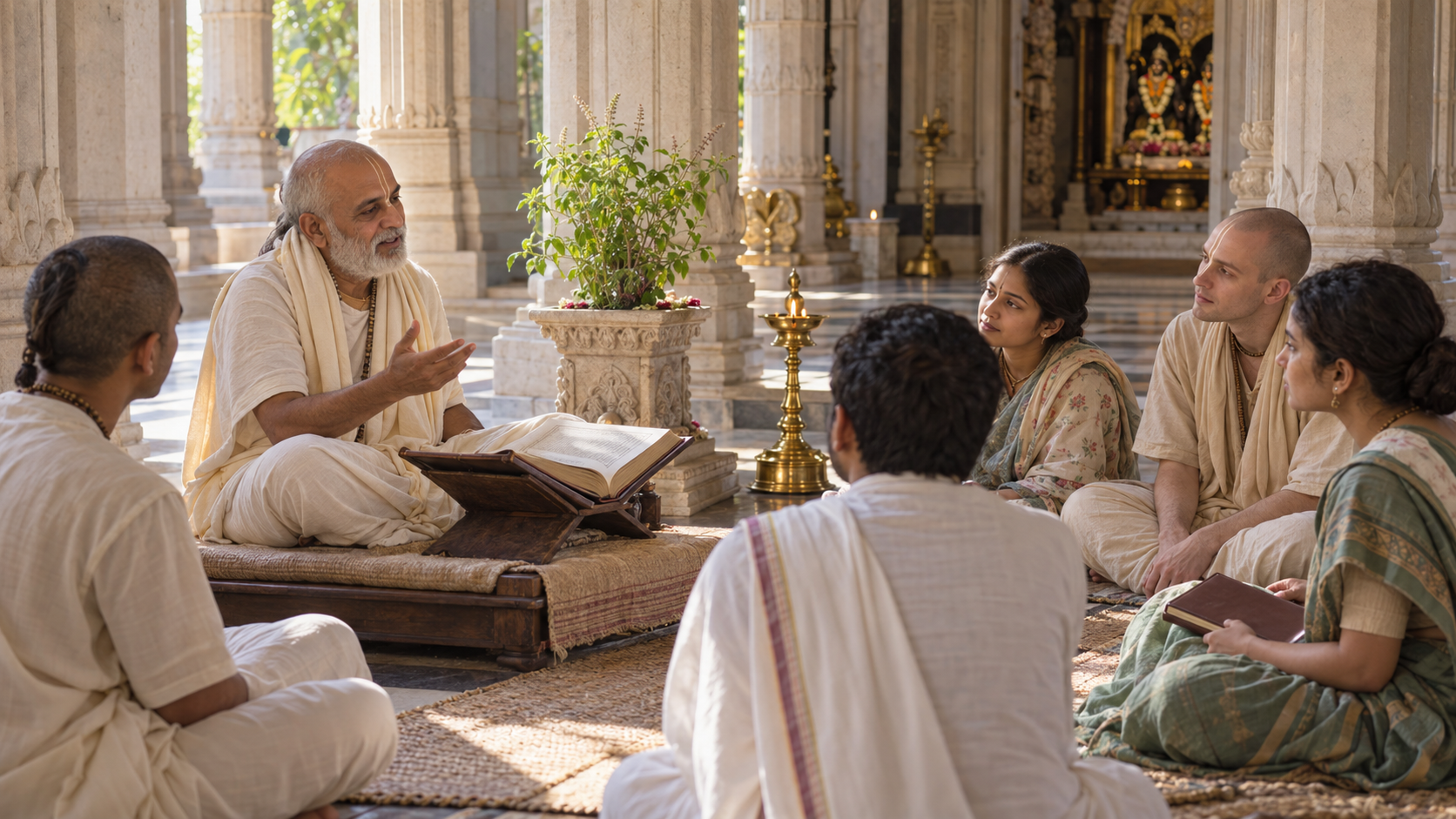
The notation SB 11.5.18 identifies the Eleventh Canto, Fifth Chapter, and Eighteenth Verse of Srimad-Bhagavatam. That reference is not a decorative label. It lets you anchor every explanation to a definite scriptural passage rather than remembering only an attractive sentence from the talk.
Prepare a page with four labels before Vaisheshika Prabhu begins:
- Text: What does the verse itself affirm?
- Terms: Which Sanskrit expression or theological term receives explanation?
- Reasoning: How does the speaker move from the verse to his conclusion?
- Application: What response does that conclusion require from you?
Do not try to transcribe everything. Wait until a thought is complete, then record its hinge: the reason, contrast, consequence, or instruction that makes it meaningful. If you are unsure whether you heard an exact quotation, mark it as uncertain. Do not place quotation marks around remembered wording merely because it sounds authoritative.
Keep three layers distinct in your notes. The verse is one layer. The speaker’s explanation is another. Your own inference is a third. All three may be valuable, but confusing them makes it easy to attribute your assumptions to scripture. A clear note might therefore say, “The passage states…,” “The speaker explains…,” and “My application is….”
If a term or argument remains unclear, record the question instead of forcing a conclusion. When you later consult a trusted edition of the text or ask a qualified teacher, you will have a precise issue to investigate. “What does this term mean in this verse?” can be answered. “I did not understand the class” is much harder to resolve.
When watching an archived recording, replay the difficult explanation rather than automatically replaying the entire programme. When listening live, stay with the flow and note the point you want to revisit. Constant pausing can preserve words while destroying the line of reasoning that connects them.
Turn the discourse into a practice you can actually observe
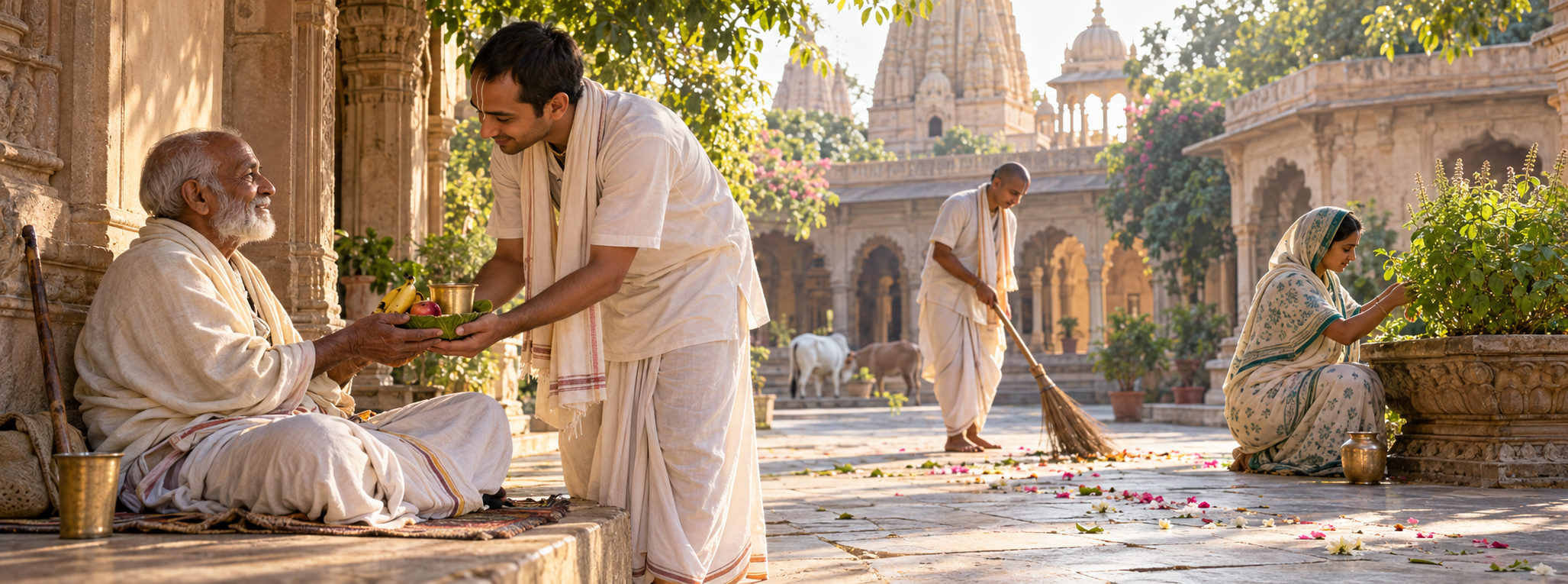
The smallest unit of spiritual change is not another saved video. It is a remembered instruction at the moment when you could act differently. After the discourse, make a compact practice card with these fields:
- Teaching: State the point in your own words without embellishment.
- Trigger: Name the ordinary situation in which you usually forget it.
- Response: Choose the smallest visible action that would express the teaching.
- Review: At the end of the day, ask whether you remembered and attempted it.
The action must arise from what you actually heard. Do not replace the discourse with a generic resolution to “be more spiritual.” If the explanation concerns speech, identify the kind of conversation in which it matters. If it concerns remembrance, connect it to a routine transition in your day. If it concerns service, specify the duty you are prone to avoid or perform carelessly.
Choose an action that can be attempted without waiting for a particular mood. Devotional feeling matters, but a practice that depends entirely on feeling is difficult to sustain. A concrete act gives remembrance somewhere to land.
Before your next worship session, read the previous practice card. This creates continuity between days and exposes a useful difference: sometimes you did not understand the teaching, sometimes you understood but forgot it, and sometimes you remembered but resisted it. Each difficulty calls for a different response—further study, a better reminder, or more honest effort.
Key takeaways
- Treat mangala-arati, Bhagavata hearing, and daily application as one movement rather than unrelated devotional activities.
- Prepare your physical and digital environment before darshan so the screen serves attention instead of fragmenting it.
- Use the reference SB 11.5.18 to keep the discourse anchored to its specific passage.
- Distinguish the scriptural wording, Vaisheshika Prabhu’s explanation, and your own inference in your notes.
- Carry the teaching into a defined situation and review whether you attempted it before beginning another discourse.
At your next session, begin with a quiet space and an empty note page. Stay with the worship, listen for the reasoning of the verse, and leave with a practice definite enough to meet you later in the day.
References

Leave a Reply
You must be logged in to post a comment.