
Perhaps you came looking for Mewar in Sanskrit drama and found a harder question: can a play preserve usable history about an invasion? In this case, yes, but only if you resist turning a powerful scene into either decorative poetry or a complete military chronicle.
An early thirteenth-century court scene carries urgent news from Medapāṭa, the region we know as Mewar. It tells you who attacked, how the catastrophe was represented, and how word of it reached another royal court. It cannot provide casualty totals or prove that every settlement in the region burned. Keeping that boundary clear is what makes the evidence useful.
The line that changes how you read Sanskrit
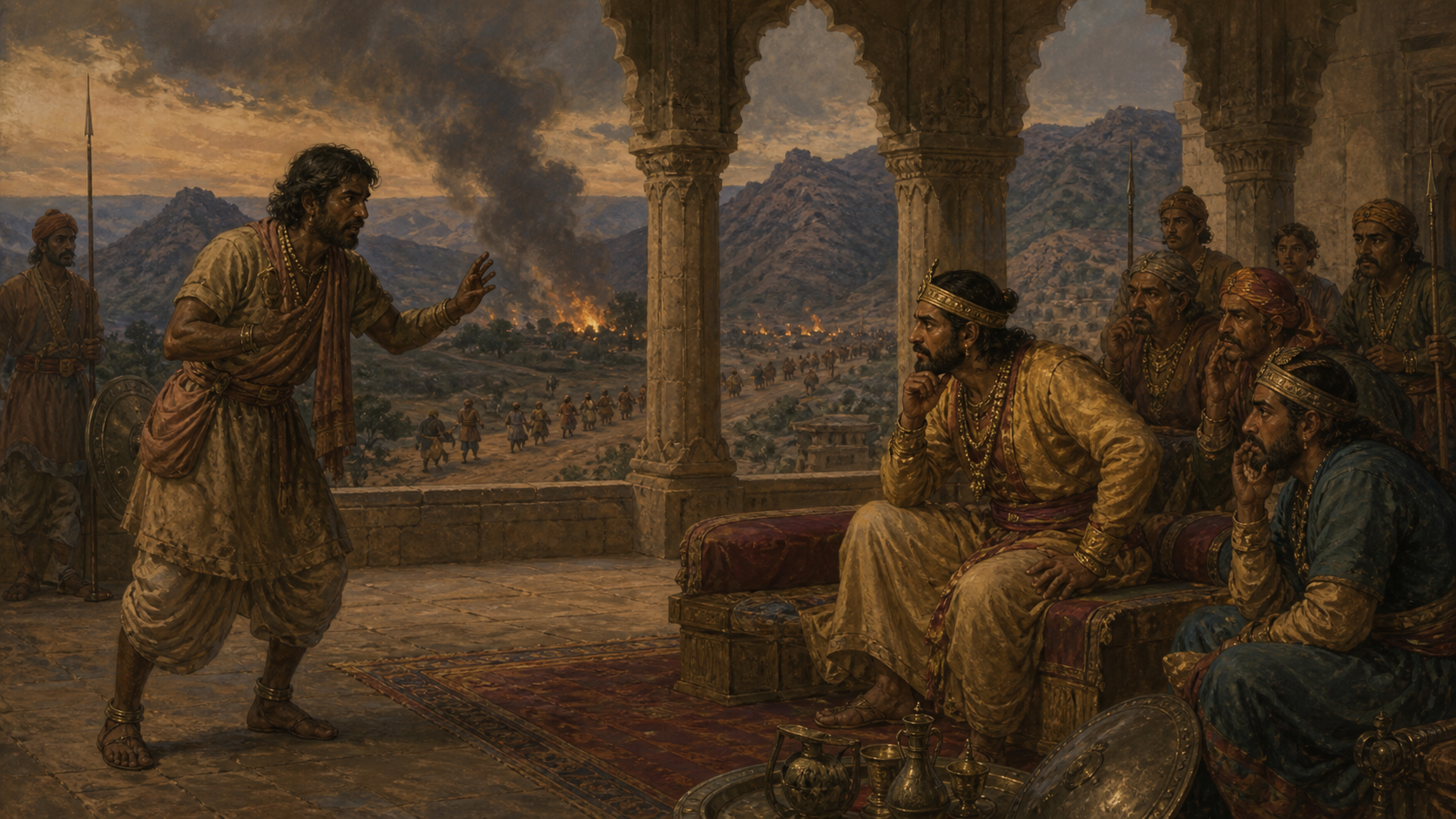
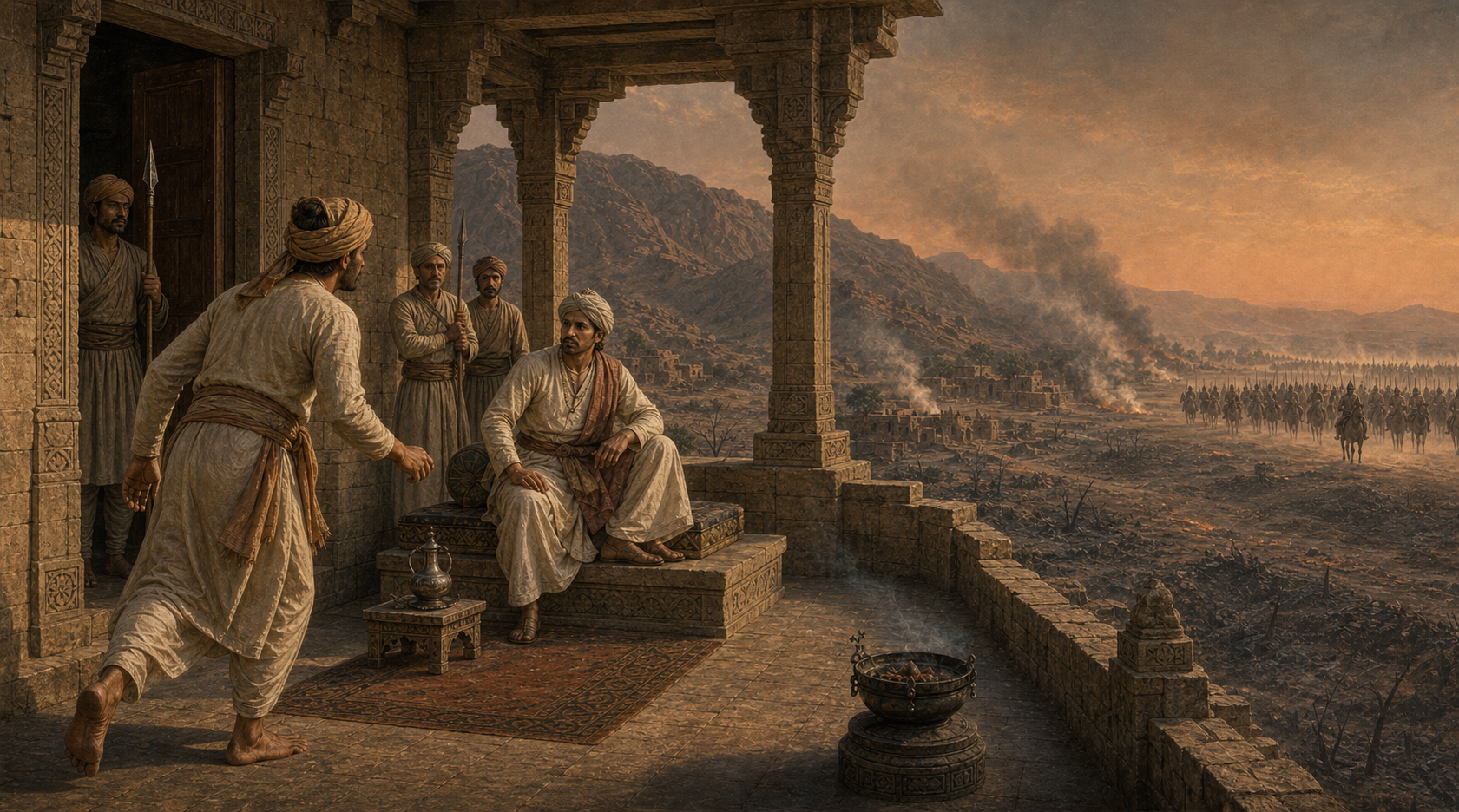
If you associate Sanskrit primarily with sacred teaching, philosophy, royal praise, or refined romance, the voice of Kamalaka forces a correction. He is a royal spy arriving with political intelligence, and his message is brutally direct:
“The whole of Medapāṭa (modern Mewar in southern Rajasthan) has been burnt by Hammira’s warriors.”
Kamalaka’s report in an early thirteenth-century Sanskrit drama
Do not soften this into the bloodless statement that a campaign occurred. The scene presents invasion as the burning of a land, accompanied by slaughter and widespread panic. Political history appears here through its consequences for a population, not merely through the movement of rulers and armies.
At the same time, do not turn “the whole of Medapāṭa” into a modern survey result. The safest reading is that Kamalaka describes the disaster as region-wide and overwhelming. The expression establishes perceived scale; it does not verify the condition of every village, field, temple, or dwelling. You preserve the force of the testimony by stating both points together.
Four identifications keep the scene from becoming vague
Before interpreting the passage, map its names. Otherwise Mewar disappears behind historical forms, and a precisely situated crisis turns into a generic story about medieval warfare.
- Medapāṭa is Mewar. It denotes the region in southern Rajasthan that is central to Kamalaka’s warning.
- Hammira is Iltutmish in this scene. The invader must not be left as an unidentified “Hammira” or confused with a ruler of Mewar. The report concerns Sultan Iltutmish of Delhi.
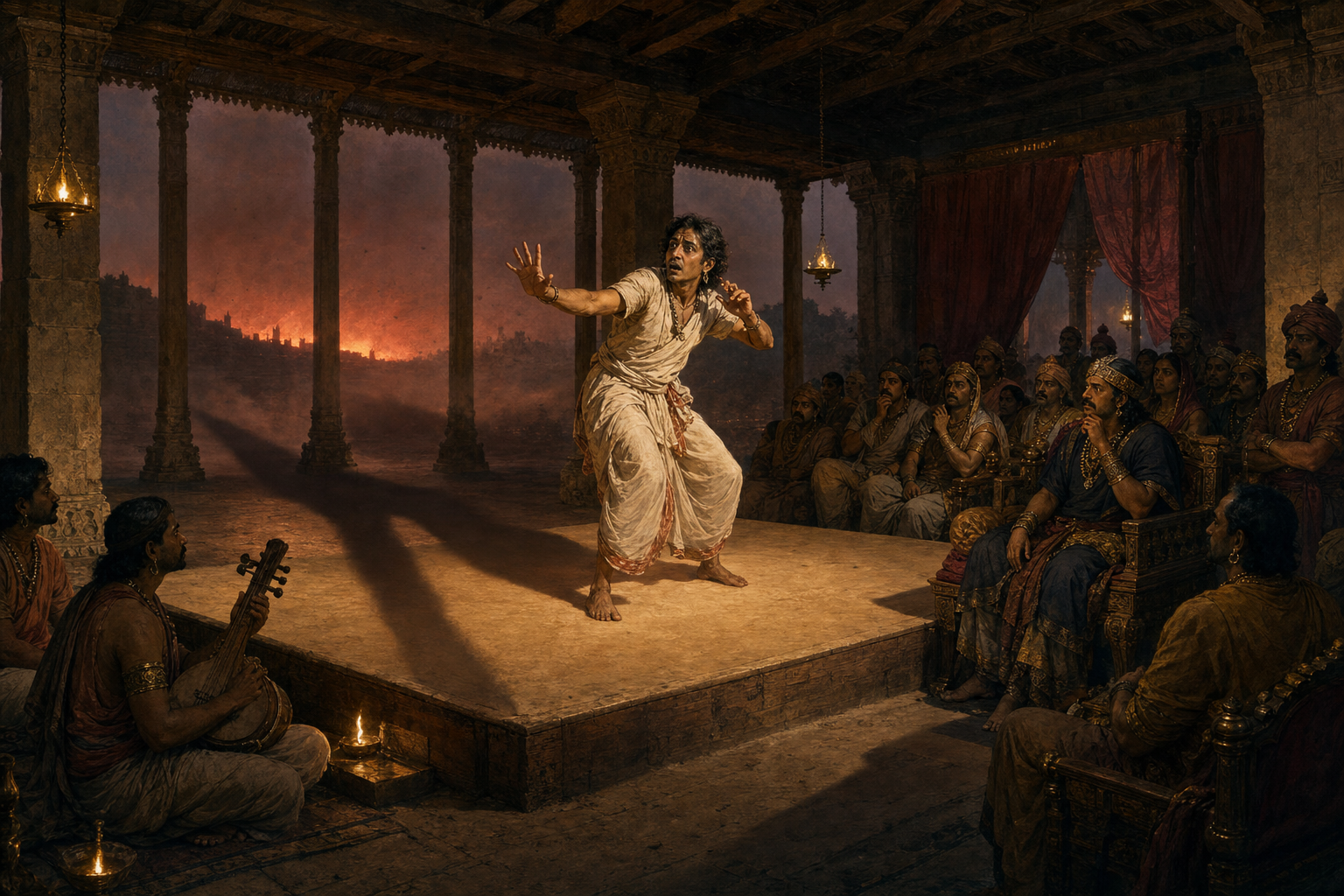
- Kamalaka is the messenger and royal spy. The destruction is not staged before the audience. It arrives as intelligence carried by someone whose role is to report political danger.
- Viradhavala receives the news. He is the powerful Vāghelā ruler of Gūrjara-deśa, corresponding to modern Gujarat. His court is at Dhavalaka, modern Dholka.
The dramatic setting is therefore not Mewar itself. Kamalaka reaches Viradhavala’s court at Dhavalaka with news from Medapāṭa. That separation matters. The audience encounters Mewar’s devastation as a crisis transmitted across political space and placed before another ruler.
The wider setting is Iltutmish’s advance into western India during the early decades of the thirteenth century. Once the names are resolved, the scene becomes geographically legible: an army associated with the Delhi sultan has overrun Mewar, and the consequences have entered the intelligence world of a Vāghelā court in Gujarat.
What the dramatic form reveals, and what it cannot prove
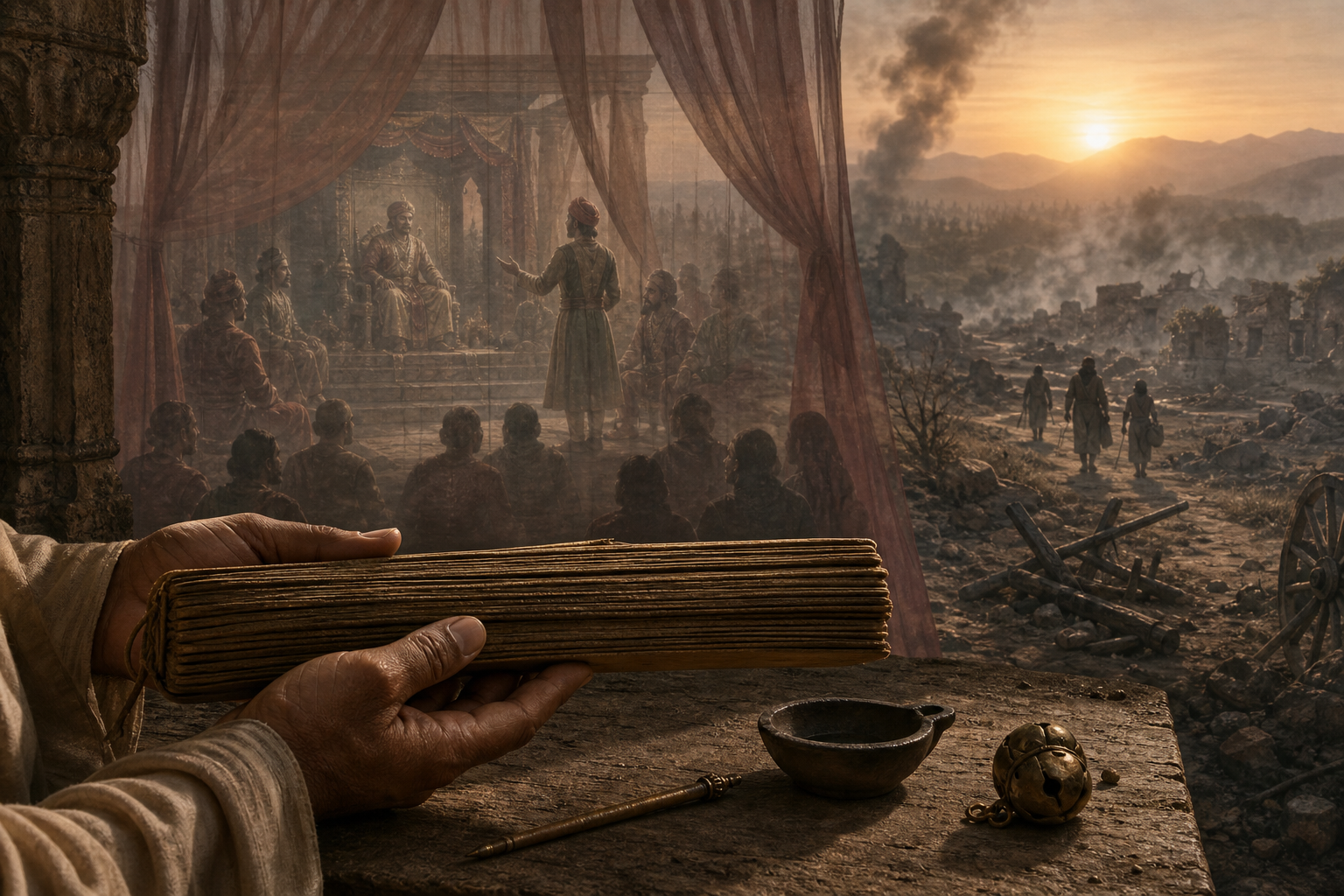
A drama and a chronicle do different work. That does not make the drama historically useless. It means you must ask what kind of evidence the scene actually preserves.
The explicit layer is firm: Kamalaka identifies Medapāṭa as devastated by Hammira’s warriors, while the surrounding account includes slaughter and panic. The dramatic layer is also clear: Mewar’s suffering reaches the audience through a spy reporting at a royal court. These are features you can state without embellishment.
A reasonable inference follows. The catastrophe was represented as politically important beyond the place where it occurred. It was not treated as a private misfortune or an isolated battlefield event; it became intelligence worthy of a ruler’s attention. The passage also shows that Sanskrit literary culture could carry the fear, displacement, and human cost associated with invasion.
Several stronger claims remain unproven. The line does not tell you that the dramatist personally witnessed the invasion. It supplies no casualty number, no settlement-by-settlement account, and no basis for treating Kamalaka’s speech as a verbatim field report. Nor do the affected people speak in their own voices. Their suffering is mediated through a royal agent and shaped for the stage.
That mediation is both the value and the limit of the scene. It lets you notice that popular distress entered elite political awareness, but it cannot restore the names, choices, or individual experiences of the people who endured the attack. “The drama preserves a report of devastation” is therefore a stronger historical formulation than either “it is only fiction” or “it proves every detail exactly as spoken.”
How to use the Mewar episode without distorting it
If you are discussing this episode in an essay, classroom, lecture, or conversation, build the claim in three moves. First identify the historical names. Then state the reported event. Finally mark the evidentiary limit.
- Identify the setting: an early thirteenth-century Sanskrit dramatic scene at Viradhavala’s court in Dhavalaka.
- Identify the report: the spy Kamalaka says that the warriors of Hammira, identified here as Iltutmish, have burned Medapāṭa or Mewar; slaughter and panic accompany the invasion.
- Identify the limit: the scene preserves literary and political memory of the catastrophe, not an independently quantified casualty register or a complete campaign chronology.
A careful short formulation would read like this: In an early thirteenth-century Sanskrit court scene, the spy Kamalaka tells the Vāghelā ruler Viradhavala at Dhavalaka that Iltutmish’s warriors have devastated Medapāṭa, or Mewar, amid slaughter and panic. The episode preserves the memory of invasion as urgent political and human catastrophe, although it does not quantify the destruction.
This wording avoids four common errors. It does not leave “Hammira” unidentified. It does not claim that the court scene takes place inside Mewar. It does not convert a rhetoric of total devastation into false numerical precision. Most importantly, it does not erase the people whose terror gives the report its moral weight.
The episode also suggests a better way to approach Sanskrit historical memory. Do not search only for texts that resemble modern chronicles. Ask who is speaking, where the speech occurs, what place names need to be decoded, which event is asserted, and whose experience reaches us only indirectly. Those questions allow literary form to contribute to history without pretending that literature and administrative documentation are interchangeable.
Key takeaways
- Mewar appears under the historical name Medapāṭa and is located in southern Rajasthan.
- Hammira refers to Sultan Iltutmish of Delhi in this particular dramatic scene.
- The royal spy Kamalaka brings the news to the Vāghelā ruler Viradhavala at Dhavalaka, modern Dholka in Gujarat.
- The report presents invasion through burning, slaughter, and panic rather than as a bare change in political control.
- The scene is valuable evidence for how catastrophe entered Sanskrit literary and courtly memory, but it does not provide exact casualty figures or a complete military chronology.
If you care about Mewar’s Dharmic and civilizational memory, accuracy is a form of respect. Begin with Kamalaka’s words, resolve each historical name, retain the suffering carried by the scene, and state openly where the evidence ends. That disciplined reading is more durable than either dismissing the passage as fiction or turning it into a slogan.
References
