
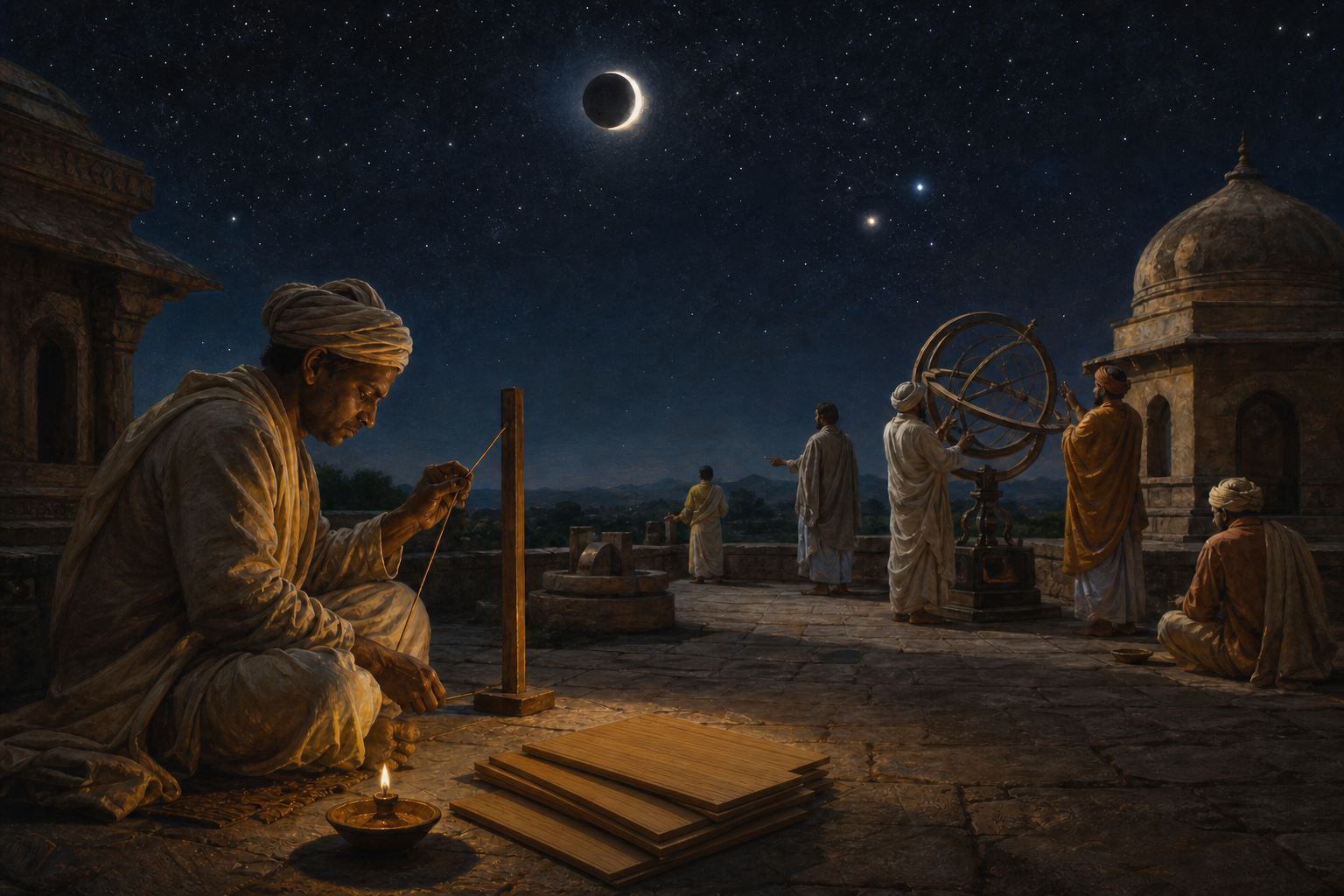
You may know Aryabhata’s name and still have difficulty answering a basic question: what, exactly, did Bharatiya astronomers contribute? A useful answer must do more than praise ancient wisdom. It must identify the problems they examined, the methods they developed, and the kinds of texts in which their knowledge survives.
Once you apply that standard, the picture becomes clearer. Vedic hymns reflect an early concern with cosmic origin and celestial order. Mathematical astronomers then treated planetary motion, eclipses, and recurring cycles as problems that could be modelled and calculated. Modern Bharat has carried those names into its space programme. You can value that continuity without confusing poetry, mathematical astronomy, and spacecraft engineering.
Start with Aryabhata and ask a precise question

When someone calls Aryabhata a great astronomer, do not stop at the adjective. Replace it with a concrete statement: his mathematical and astronomical work addressed planetary motions, eclipses, and celestial cycles. That tells you what kind of intellectual labour is being discussed.
Each of those subjects demands more than watching the sky. Planetary motion requires a model that relates changing positions. Eclipse work requires an account of recurring celestial relationships and timing. A celestial cycle turns recurrence into something that can be tracked and calculated. The important contribution is the treatment of these phenomena as structured mathematical problems.
You can use four questions whenever you encounter a claim about ancient astronomy:
- What was the problem? Was the scholar examining planetary motion, eclipses, celestial cycles, timekeeping, or the origin and order of the cosmos?
- What was the method? Was the claim expressed through a hymn, a philosophical account, an observation, a calculation, or a mathematical model?
- What was the result? Did the scholar leave a treatise, an explanatory framework, or a procedure that others could examine and develop?
- How strong is the evidence? Can the specific contribution be attached to a named scholar or text, or are you looking at a broad civilizational claim?
This test protects you from two opposite mistakes. One is dismissing Bharatiya astronomy as vague religious speculation. The other is crediting every modern discovery to an ancient name without showing the relevant method or text. Aryabhata deserves better than either treatment: name the astronomical problem, identify the mathematical character of the work, and avoid unsupported superlatives.
The other names reveal a tradition, not a solitary genius
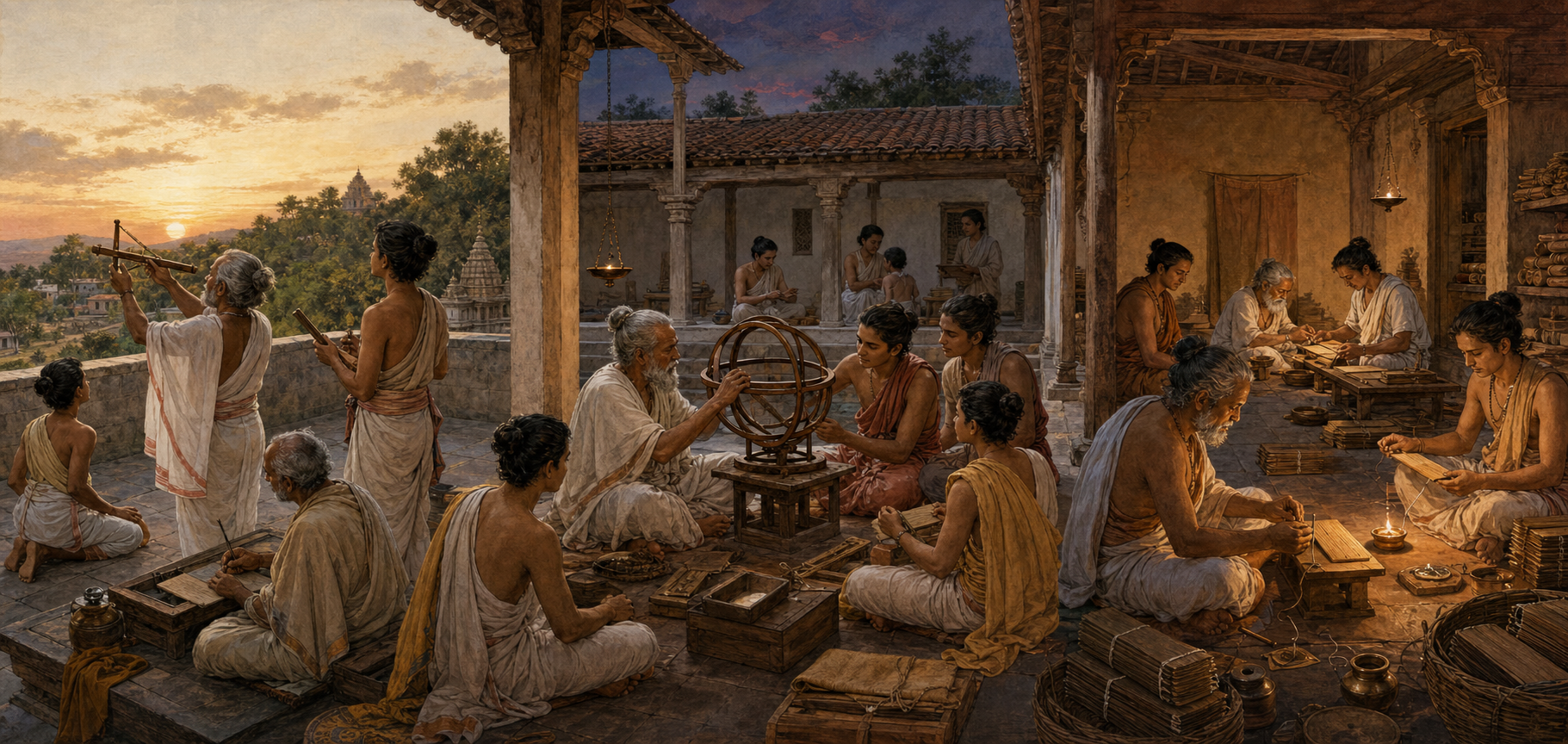
Aryabhata should be a doorway, not the entire room. Brahmagupta, Varahamihira, Vatesvara, and Bhaskara also developed mathematical and astronomical models. Their presence points to a sustained intellectual tradition rather than a single brilliant figure appearing in isolation.
That distinction changes how you should learn or teach the subject. A list of celebrated names may inspire curiosity, but it does not yet explain a tradition. A tradition becomes visible when you trace the problems scholars inherited, the models they formulated, and the questions that remained open for further work.
Build a contribution map instead of memorising a roll call. Give each scholar a separate entry with these fields:
- The scholar’s name.
- The astronomical or mathematical problem being addressed.
- The named text or model, when you have reliable evidence for it.
- The method used: observation, calculation, geometrical reasoning, numerical procedure, cosmological reflection, or a combination.
- The exact claim that the available evidence supports.
- Any detail that remains uncertain or requires further verification.
Leave a field blank when the evidence does not supply it. Do not transfer a contribution from one astronomer to another merely because both belong to the Bharatiya tradition. Intellectual pride becomes more credible, not less, when every achievement is attached to the right person and the right kind of evidence.
This method also helps you notice continuity. If several scholars are working with mathematical and astronomical models, the history is no longer a collection of isolated discoveries. It is a culture of inquiry in which celestial phenomena were considered worthy of repeated, disciplined investigation.
Keep Vedic cosmology and mathematical astronomy connected but distinct
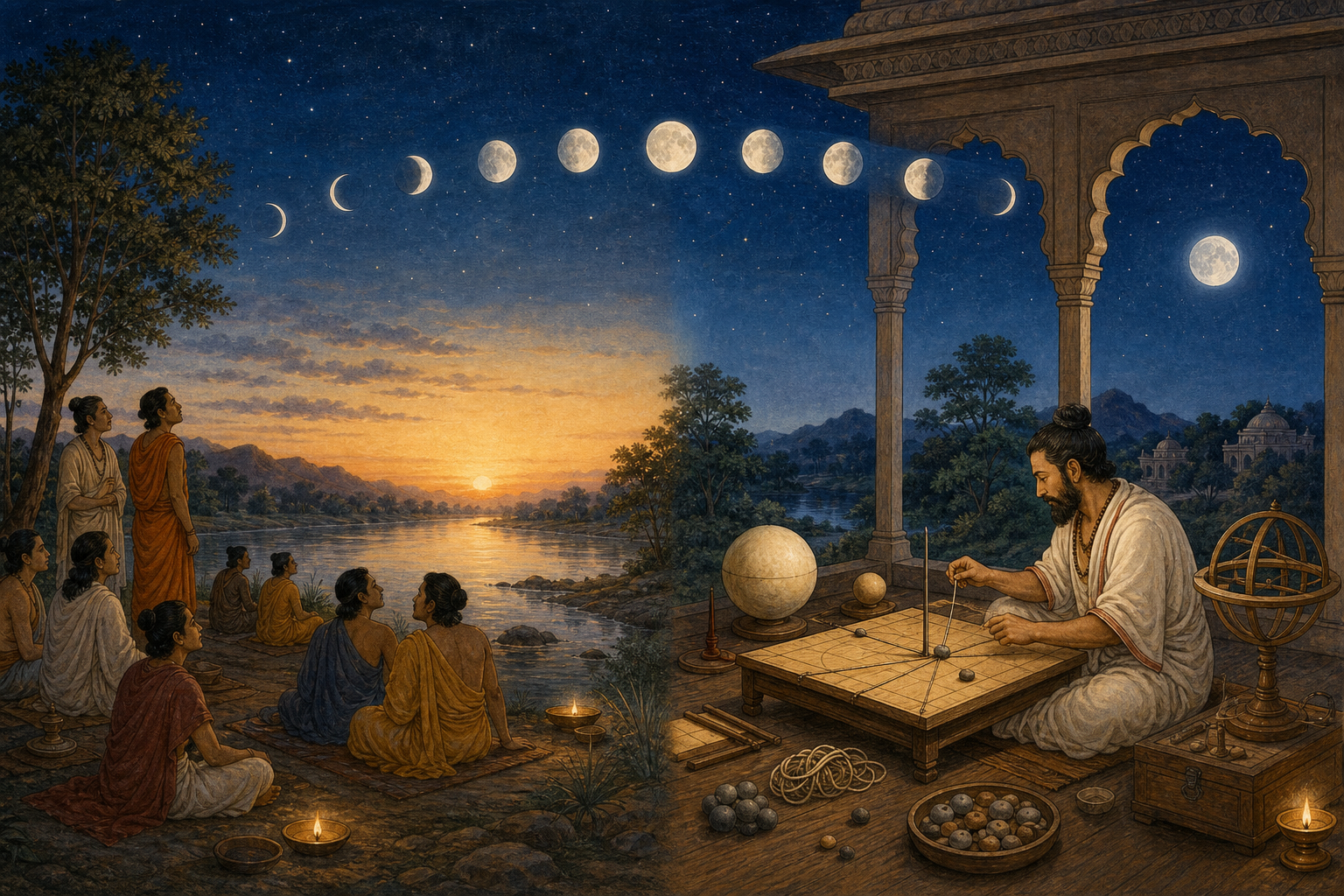
The roots of Bharatiya interest in the heavens reach into Vedic literature. The Rigveda includes hymns concerning the origin of the universe and the movement of celestial bodies. That is significant evidence of cosmic inquiry, but genre still matters.
A hymn reflecting on cosmic origin is not the same kind of work as a mathematical treatise calculating celestial motion. The first can pose foundational questions about existence, order, recurrence, and humanity’s place in the cosmos. The second can formalise relationships and make a celestial problem available to calculation. Both belong to Bharatiya intellectual history, but they should not be presented as interchangeable.
This distinction does not weaken the Dharmic inheritance. It prevents a category error. You do not need to claim that every later equation appears verbatim in a Vedic hymn in order to recognise that Vedic thinkers took the cosmos seriously. Nor should you describe mathematical astronomy as merely symbolic because it arose within a civilization rich in sacred cosmology.
If you are writing, speaking, or teaching about this inheritance, use two clear sentences rather than one inflated claim:
- Vedic literature preserves early Bharatiya reflection on cosmic origin, celestial movement, and the order of the universe.
- Astronomers such as Aryabhata and the scholars associated with the wider mathematical tradition developed formal models for astronomical problems.
The first statement identifies an intellectual foundation. The second identifies a technical development. Keeping both allows you to describe civilizational continuity while respecting the difference between cosmology and computation.
Use Bharat’s space programme as a doorway, not a shortcut
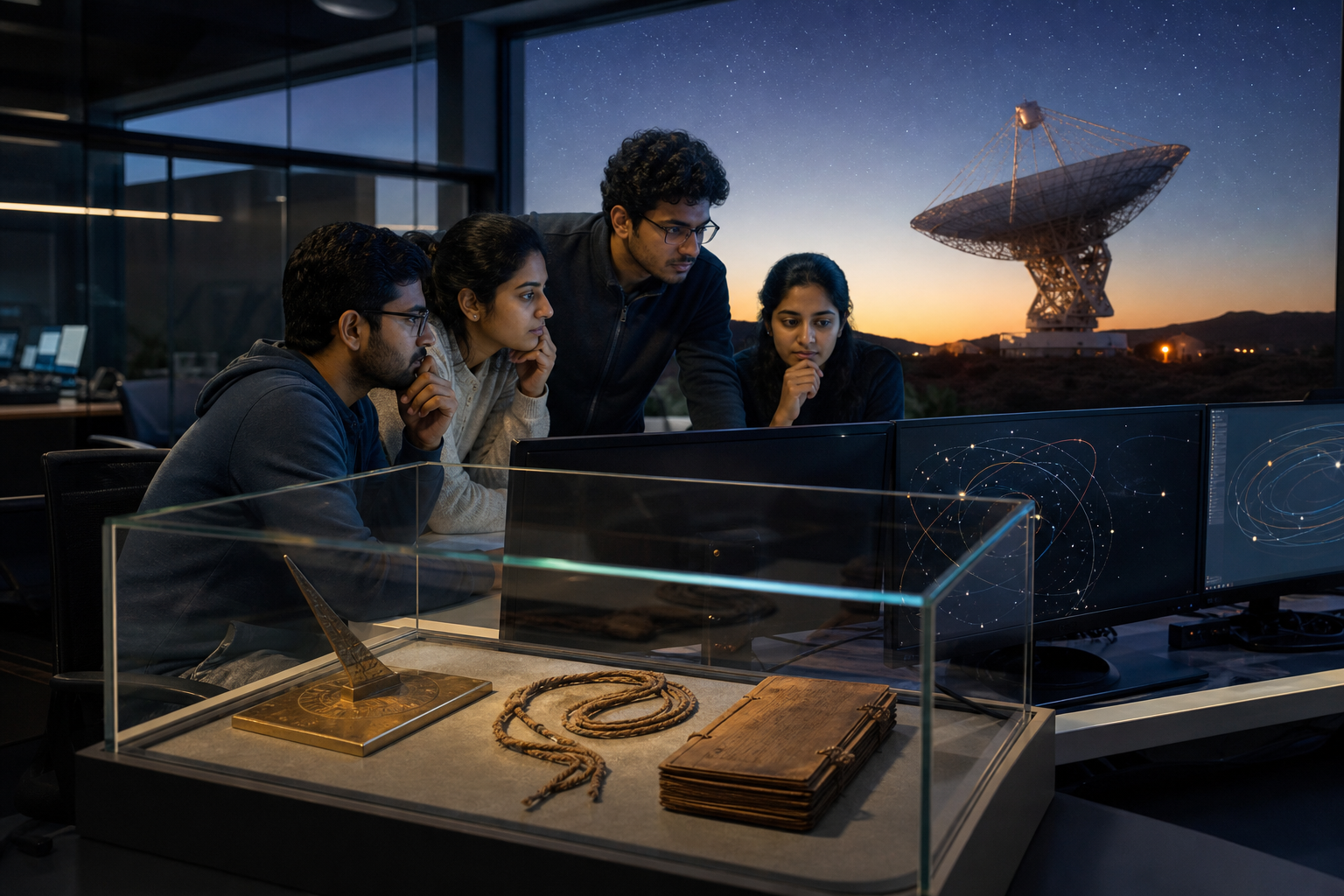
Modern Bharat has deliberately kept Aryabhata in public memory. In 1975, ISRO launched its first satellite and named it Aryabhata. The name matters because it placed a modern technological institution within a longer civilizational story.
That act of remembrance should be interpreted accurately. Naming the satellite after an ancient astronomer honours an intellectual ancestor; it does not mean that a modern satellite uses an unchanged ancient technique. The continuity lies in the commitment to understanding the heavens, in the social esteem given to astronomical knowledge, and in the conscious preservation of historical memory.
The modern achievement is substantial on its own terms. On 23 August 2023, Chandrayaan-3 placed a lander and rover on the Moon. India thereby became the fourth country to achieve a lunar landing and the first to land near the lunar south polar region. Bharat now observes 23 August as National Space Day.
The theme chosen for the 2025 observance made the intended historical arc explicit: “Aryabhatta to Gaganyaan: Ancient Wisdom to Infinite Possibilities”. Read that phrase as an invitation to study both ends of the arc, not as a substitute for doing so.
If you want to introduce a student or younger family member to Bharatiya astronomy, use this sequence:
- Begin with the first ISRO satellite and ask why it was named Aryabhata.
- Move to the concrete historical questions associated with Aryabhata: planetary motion, eclipses, and celestial cycles.
- Expand the discussion to Brahmagupta, Varahamihira, Vatesvara, and Bhaskara so that one famous name does not obscure the wider tradition.
- Then turn to Vedic cosmic inquiry and explain how a foundational cosmological question differs from a mathematical model.
- Return to Chandrayaan-3 and ask what has continued across the centuries: not identical machinery, but a civilizational willingness to study the sky and honour those who did so before us.
This route gives modern spaceflight historical depth while keeping every stage intelligible on its own terms.
Key takeaways
- A precise account of Aryabhata begins with the astronomical problems attached to his work: planetary motions, eclipses, and celestial cycles.
- Brahmagupta, Varahamihira, Vatesvara, and Bhaskara should be studied as participants in a broader mathematical-astronomical tradition, not treated as decorative names.
- Vedic cosmic reflection and mathematical astronomy belong to the same civilizational history, but they are different genres of knowledge.
- The 1975 Aryabhata satellite commemorates historical inheritance; it does not erase the technological difference between ancient calculation and modern spaceflight.
- When assessing a claim, identify the scholar, the problem, the method, and the evidence before repeating it.
The next time you encounter a sweeping claim about ancient Bharatiya science, write down those four items: name, problem, method, and evidence. If all four can be supplied, you have something worth teaching. If they cannot, treat the claim as a question to investigate rather than a fact to circulate. That discipline is one of the most practical ways to honour the astronomers themselves.
References
