
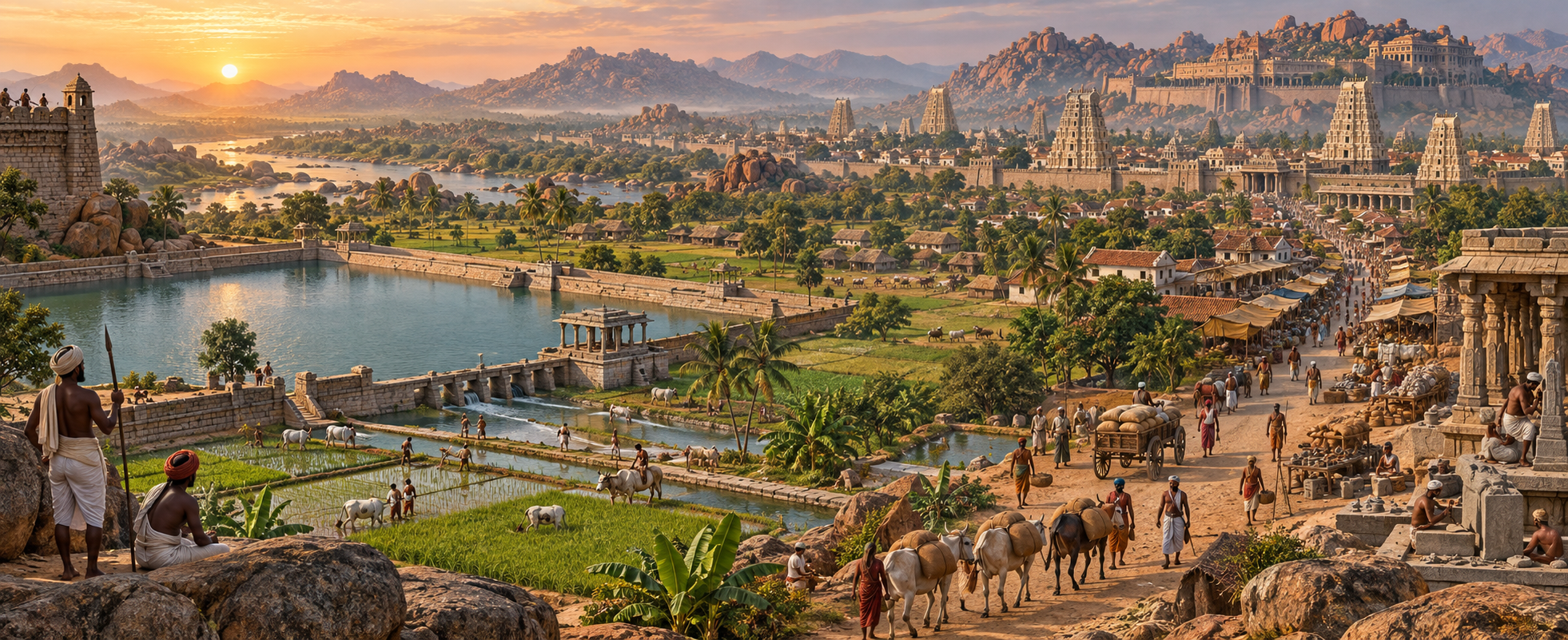
If you know Vijayanagara through ruined bazaars, monumental temples and descriptions of abundance, it is easy to stop at one word: prosperous. The harder question is more useful. What moved wealth from a cultivated field to a market, from a merchant to the treasury, and from the treasury into armies, public works and sacred institutions?
To understand the economic history of Vijayanagara, follow a chain rather than a catalogue of wonders. Water made cultivation more dependable. Cultivation produced an assessable surplus. Revenue and trade converted that surplus into political power. Coinage, merchants and temples helped value circulate. Once you see those connections, Vijayanagara’s wealth stops looking mysterious and starts looking like the result of institutions, incentives and labour.
Begin with water, because the economy began with risk
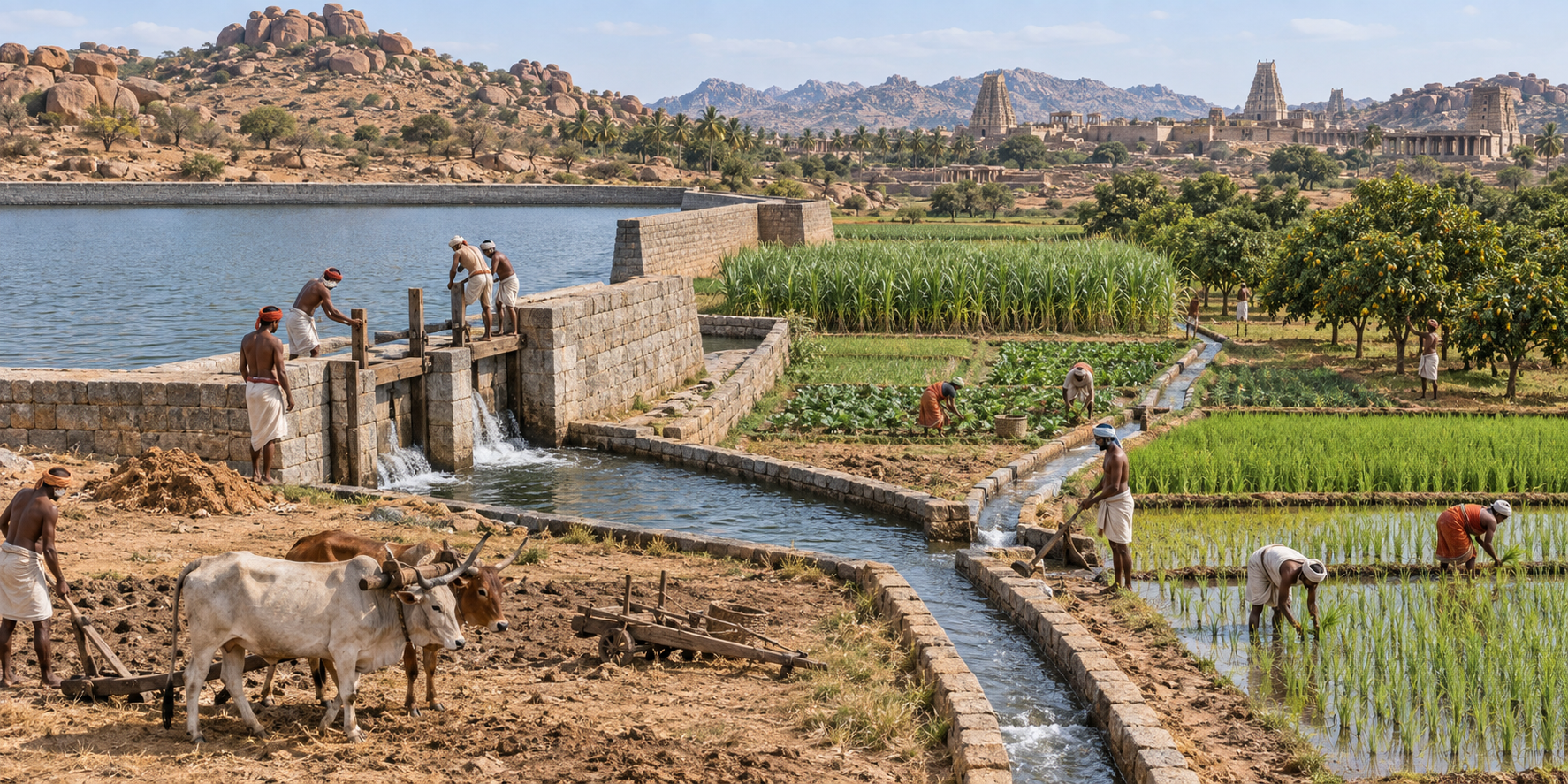
An inland imperial capital could not live on courtly splendour. It required a large and reasonably reliable stream of grain, fodder, oil, cloth, timber and other necessities. That stream began in the countryside, where rainfall varied and cultivators had to manage both scarcity and seasonal concentration.
Tanks, reservoirs, canals, channels and wells were therefore more than feats of engineering. They were economic infrastructure. By storing or redirecting water, an irrigation work could bring additional land under cultivation, reduce the uncertainty surrounding an existing field, support a wider choice of crops and make agricultural revenue more dependable.
Do not picture one centrally owned hydraulic grid. Irrigation could involve rulers, military commanders, temples, local authorities, landholders and cultivators. One party might finance construction, another supply labour, another receive rights over the improved land, and another assume responsibility for maintenance. The benefits and obligations could be distributed just as widely.
- Stored or diverted water reduced the immediate exposure of cultivation to rainfall.
- More dependable cultivation produced a larger or more predictable surplus.
- That surplus supported non-farming populations and created revenue for political and religious institutions.
- Revenue could then sustain soldiers, officials, construction, worship and further investment in productive land.
This is the first test you should apply to any claim about Vijayanagara’s prosperity: ask what managed the underlying risk. A record of a new tank or land grant is not merely a story about royal generosity. It may reveal an attempt to expand cultivation, create a new revenue claim, secure ritual merit or bind a local group to the political order. Those purposes could operate at the same time.
The same evidence also requires caution. Construction did not guarantee permanent maintenance, and expanded production did not guarantee an equal distribution of its gains. When you encounter an irrigation grant, ask four questions: who paid, who worked, who obtained the water, and who acquired a claim on the resulting produce. That turns an impressive public work into an intelligible economic arrangement.
Revenue connected the village, the court and the army
Agriculture formed the broad base of Vijayanagara’s fiscal system, but the state did not draw resources from land alone. Commercial duties, occupational obligations and other local collections also mattered. Payment could take different forms, including produce, money, labour and assigned rights over revenue. Treating all of these as a single modern-style tax obscures how the system worked.
The crucial distinction is between producing wealth and holding a claim on it. A cultivator could produce grain; a landholder, temple, commander or ruler might possess some right to a share; a merchant could move part of the surplus; and a customs authority could collect at the point of exchange. Vijayanagara’s political economy consisted in large part of arranging, enforcing and renegotiating those claims.
At various points, the imperial order delegated revenue rights to military commanders and other intermediaries in return for service and troops. That did not make the countryside separate from the army. It made agrarian collection one of the mechanisms through which military capacity was assembled. A field, a revenue assignment and a cavalry unit belonged to the same fiscal chain, even when they were far apart.
Maritime commerce added another link. War horses were a strategic import, so access to ports, merchants and purchasing power mattered to the state’s military position. Agricultural revenue could help pay for imported animals and military personnel, while customs on commerce returned income to the political order. The relationship between farm and port was therefore strategic, not accidental.
This system could mobilise formidable resources, but mobilisation is not the same as general welfare. A wealthy treasury may indicate productive land, effective collection, heavy extraction or some combination of the three. You should never infer the material condition of ordinary cultivators from the income of the court alone. Separate gross production from the share households retained after dues, rents and other obligations.
That distinction protects you from two opposite errors. Vijayanagara was not economically important only because rulers accumulated treasure, and its achievements do not require you to pretend that every producer benefited equally. Productive capacity, state power and household welfare are related measures, but they are not interchangeable.
Bazaars were endpoints of supply chains, not theatre
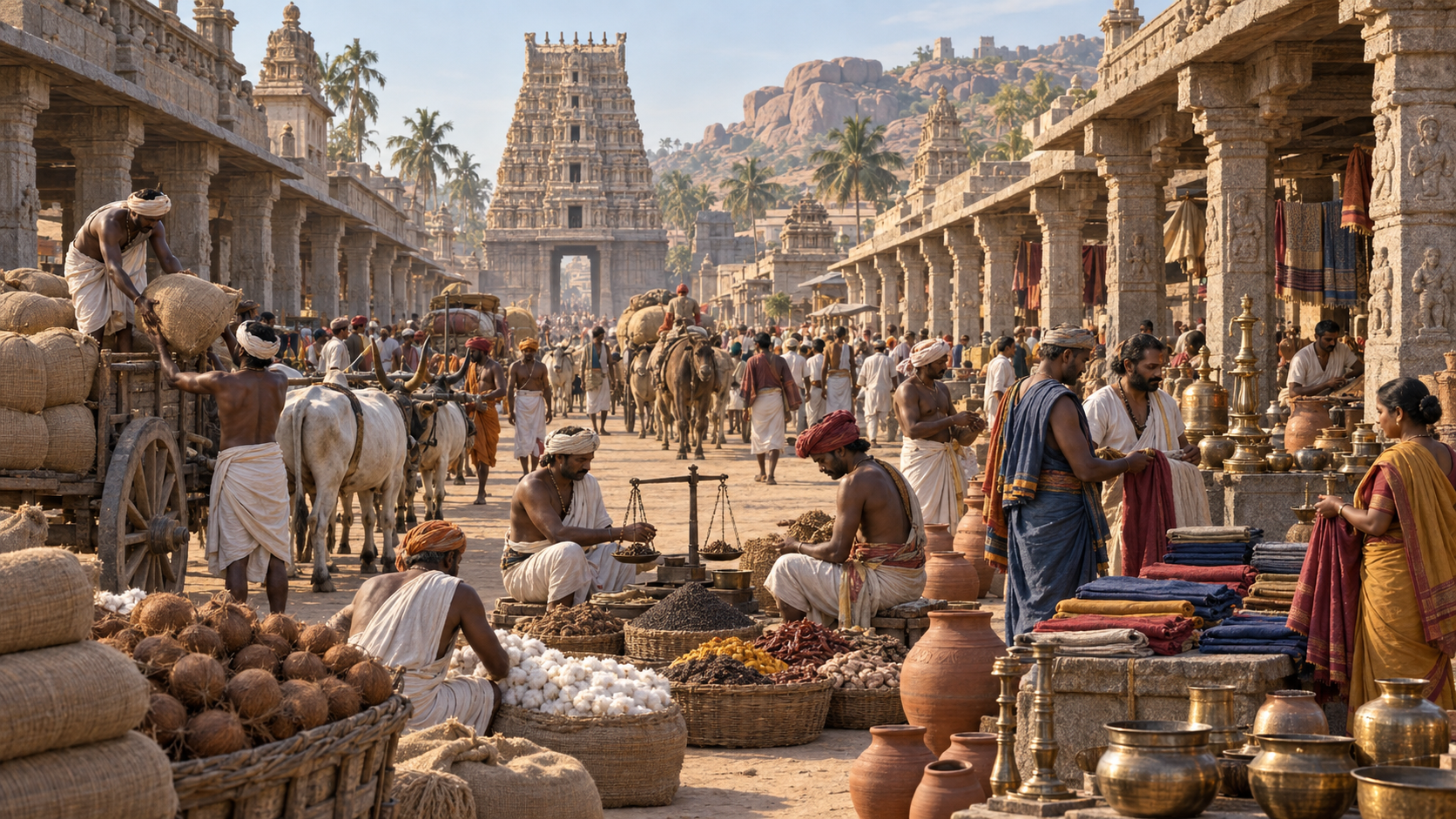
Descriptions of crowded markets are memorable because they make a vanished city feel immediate. Yet a bazaar was the visible end of a much longer process. Every sack of grain, piece of cloth, metal object or precious good had to be produced, transported, protected, measured and exchanged. The market worked only because less glamorous systems worked behind it.
Start by separating bulk commerce from high-value commerce. Food, fodder, fuel and building materials were indispensable because they sustained a large urban population. Textiles, spices, metalwares and precious goods connected specialised producers and affluent consumers to wider networks. The most dazzling commodity in a description was not necessarily the commodity that did the most to keep the city alive.
Then separate the two connected commercial circuits. Inland routes joined villages, periodic markets, craft centres, garrison towns and the capital. Maritime routes joined coastal ports to the wider Indian Ocean world. Goods, merchants and revenue moved between these circuits, which is why an inland empire had a direct interest in coastal security and port access.
The combination of internal exchange and overseas commerce matters more than a list of exports. External trade could supply strategic imports and customs revenue, but it depended on production and transport within the subcontinent. Ports did not manufacture the agrarian surplus or all the craft goods they shipped. Their prosperity rested on hinterlands and routes extending far beyond the waterfront.
- Origin: Where was the good cultivated, extracted or manufactured?
- Movement: Which road, river crossing, pack animals, market or port carried it onward?
- Risk: Who protected the route, extended credit or absorbed loss?
- Claim: Which producer, merchant, local authority, temple or ruler received a share of its value?
- Use: Did the good sustain daily life, display status, support worship or strengthen the military?
Use those five questions whenever you meet a dramatic claim about Vijayanagara’s trade. They force you to replace the vague idea of a rich market with an actual supply chain. They also show why political authority mattered: security, predictable dues and access to routes could encourage exchange, while conflict or arbitrary collection could raise costs before a good ever reached the bazaar.
Coinage and temples made value durable
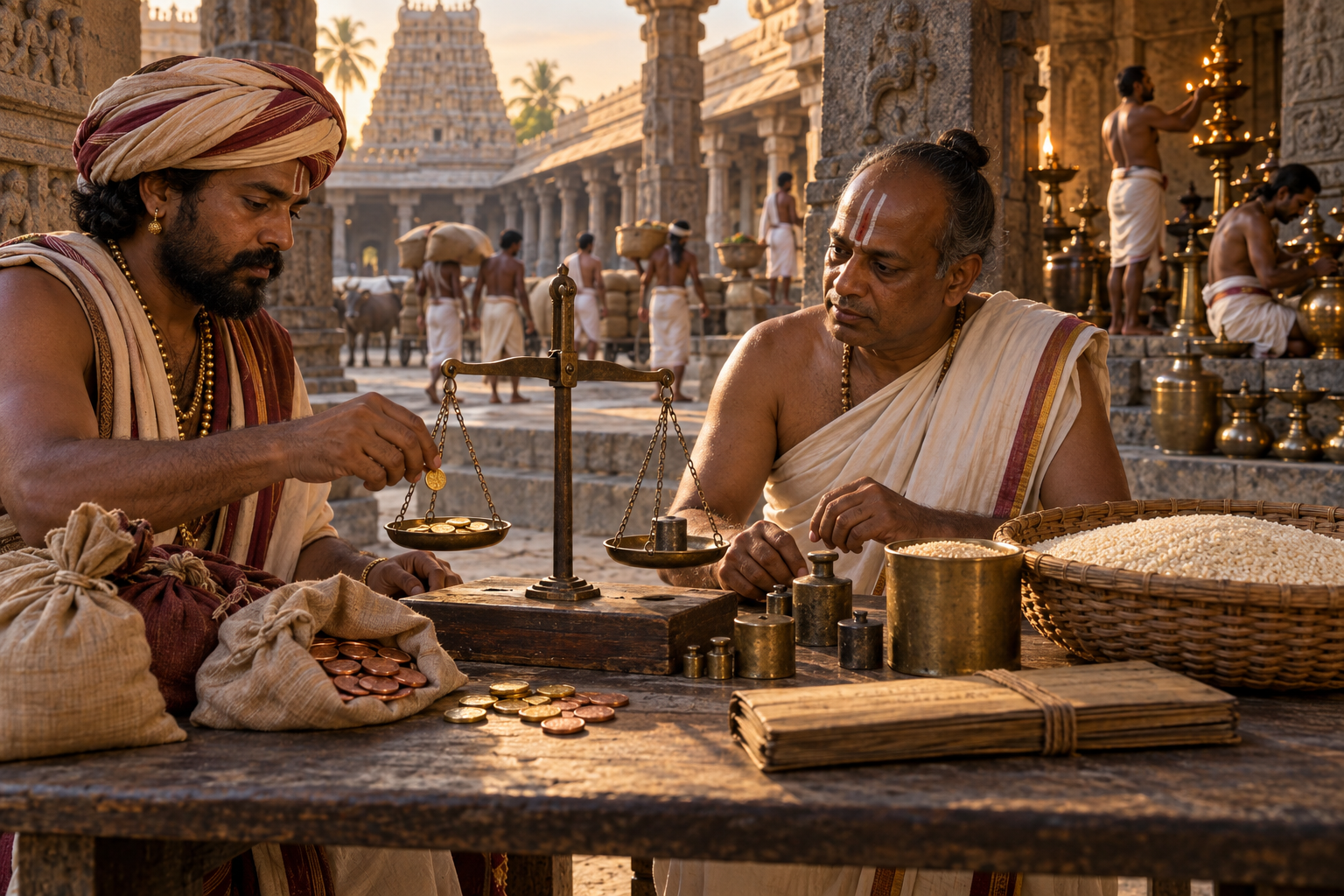
Vijayanagara’s coins, especially its gold issues, are compact statements of sovereignty as well as instruments of exchange. A coin could carry value across transactions more conveniently than many payments in kind, facilitate state expenditure and present royal authority in a recognisable form.
Coin finds do not prove that the whole economy ran on cash. Money, payments in produce, credit, labour obligations and assigned revenue rights could coexist. Large commercial or official payments might use coin while a village obligation was discharged in grain or work. The better question is not whether Vijayanagara had a monetised economy, as if the answer must be yes or no. Ask which transactions used money, in which denominations, and alongside which non-monetary arrangements.
Temples require the same care. Calling them banks is tempting but too modern and too narrow. A major temple could hold endowed land, receive produce or money, employ religious specialists and labourers, commission artisans, maintain ritual services and redistribute resources through recurring activities. Those functions gave an endowment economic consequences without reducing its sacred purpose to finance.
This is where a Dharmic reading should be especially precise. Dharma and artha did not have to occupy sealed compartments. A gift intended to sustain worship, earn merit or honour a deity could also support cultivation, employment and craft production. A temple festival could be a sacred observance and a point of commercial concentration. Recognising both dimensions is more faithful than declaring the institution either purely spiritual or secretly commercial.
Temples could also give obligations a long time horizon. A one-time gift of land or revenue was expected to maintain repeated worship, lamps, food offerings or other services. That required management across seasons and generations. When you read an endowment, look beyond the donor and ask what recurring flow of produce, money and labour was supposed to keep the obligation alive.
Test every prosperity claim against four kinds of evidence
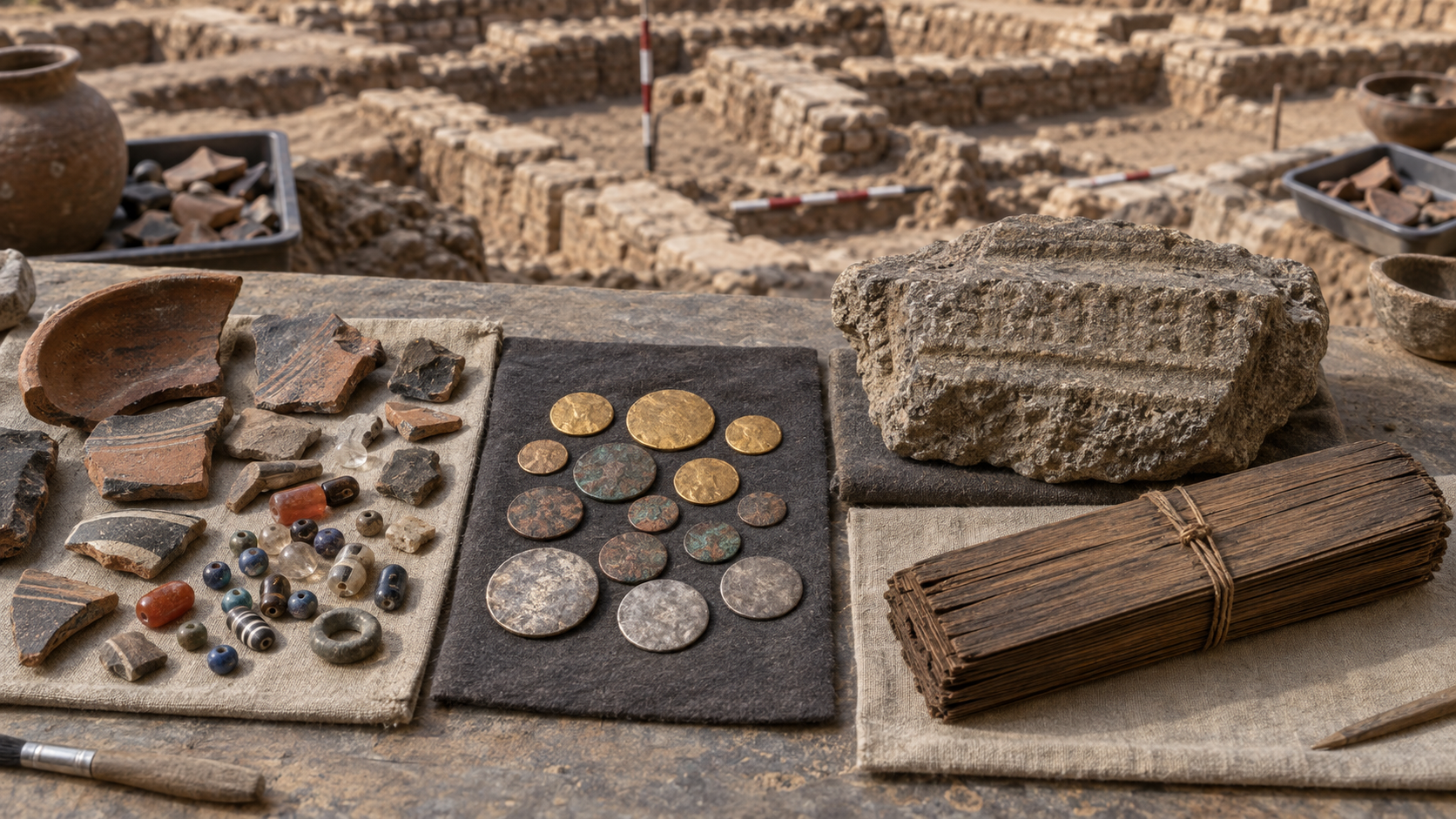
Vijayanagara’s economic achievement is substantial enough to survive careful scrutiny. It does not need every vivid description to be treated as a census, or every monumental ruin as proof of universal affluence. Different forms of evidence answer different questions.
| Evidence | What it can show well | What you should not assume |
|---|---|---|
| Inscriptions | Named grants, dues, offices, irrigation works, endowments and rights | That recorded rules were applied uniformly, or that a commemorated grant describes ordinary life |
| Coins | Issuing authority, denominations, metal use and circulation when the find context is known | That surviving coins measure total output, everyday purchasing power or the welfare of all households |
| Archaeological remains | Urban layout, waterworks, roads, workshops, storage and patterns of material consumption | That everything visible belonged to one moment, or that the capital represented every region |
| Travel and literary descriptions | Observed goods, market activity, urban impressions and contemporary expectations | That a striking scene supplies comprehensive quantities or an evenly representative social picture |
Triangulation is the practical answer. A vivid market description becomes stronger when material remains confirm the commercial setting and inscriptions identify relevant dues or institutions. A coin becomes more informative when its archaeological context is known. An irrigation inscription gains depth when the associated landscape reveals where water could actually flow.
Keep three distinctions in view. The capital was not the whole empire. The value of luxury goods was not the same as their physical volume. State revenue was not the same as household prosperity. Losing any one of these distinctions turns evidence of a complex economy into a slogan.
Key takeaways
- Vijayanagara’s economy began with agrarian production and the management of water risk, not with the spectacle of the imperial market.
- Revenue transformed local surplus into administration, construction and military capacity, but high state income does not by itself prove broad household welfare.
- Inland markets and Indian Ocean commerce formed one connected system; ports depended on interior producers, routes and political protection.
- Coin, produce, credit, labour and assigned revenue rights could operate together, so a simple cash-versus-barter model will mislead you.
- Temples joined sacred continuity to land, employment, craft production and redistribution without ceasing to be religious institutions.
- The strongest interpretation combines inscriptions, coins, archaeology and contemporary descriptions while respecting the limits of each.
The next time you meet a grand claim about Vijayanagara’s wealth, trace one complete chain: water to field, field to surplus, surplus to market or revenue, and revenue to its final use. If the links cannot be identified, admire the image but suspend the economic conclusion. If they can, you will see something more instructive than a legendary rich city: a Dharmic empire coordinating land, labour, trade, worship and force across a demanding political landscape.
References

Leave a Reply
You must be logged in to post a comment.