
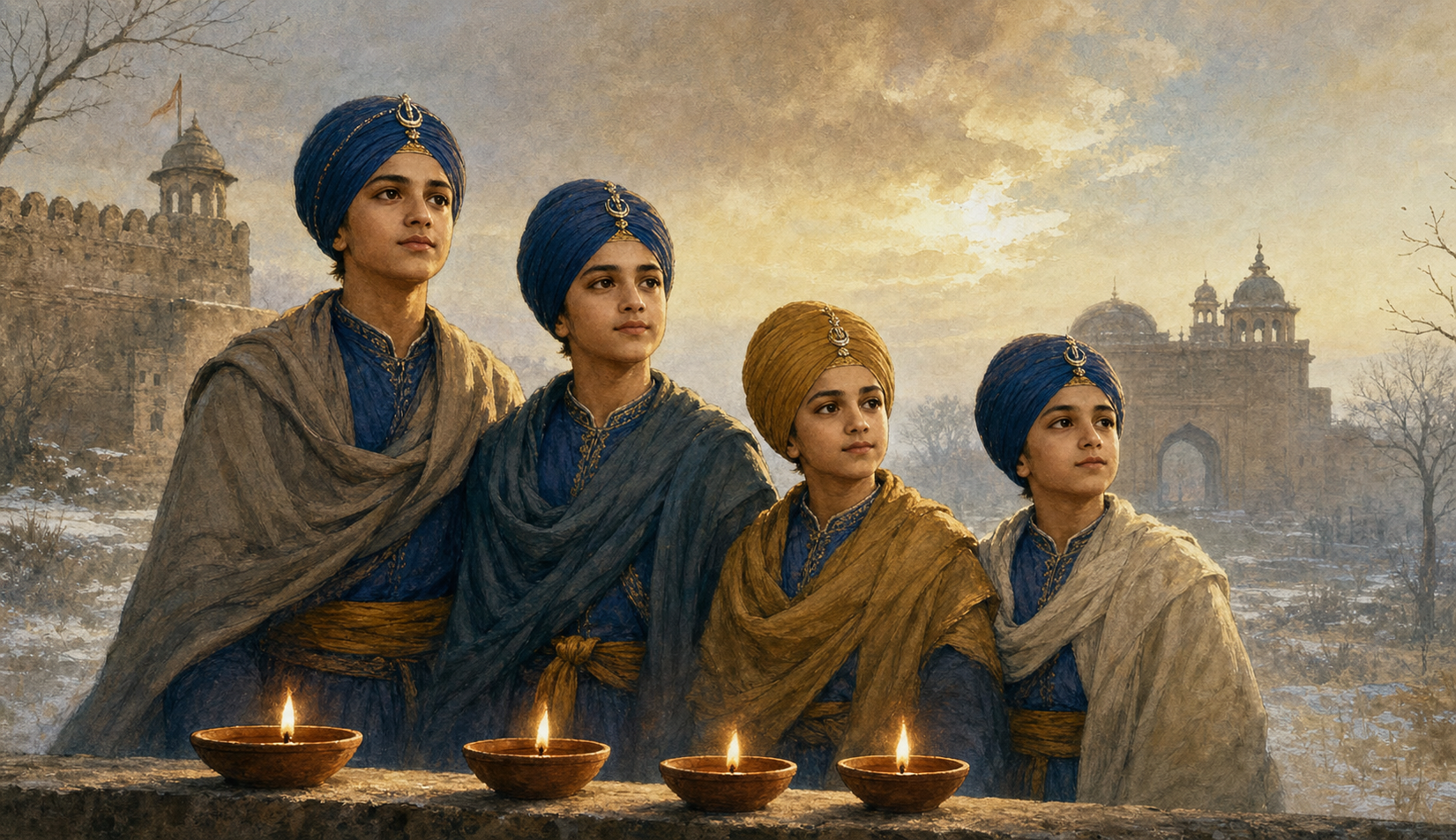
If you are trying to explain the Sahibzadas to a child, a student, or even yourself, the hardest question is not what happened. It is why Sikh memory honours four young lives cut short without making death itself the ideal.
The answer lies in what the Sahibzadas defended. Their martyrdom joins freedom of conscience to disciplined action: the elder sons of Guru Gobind Singh resisted on the battlefield, while the younger sons refused to surrender their faith under coercion. Neither sought death as an achievement. Each accepted its possibility rather than purchase safety with betrayal.
Four Sahibzadas faced two different tests of courage
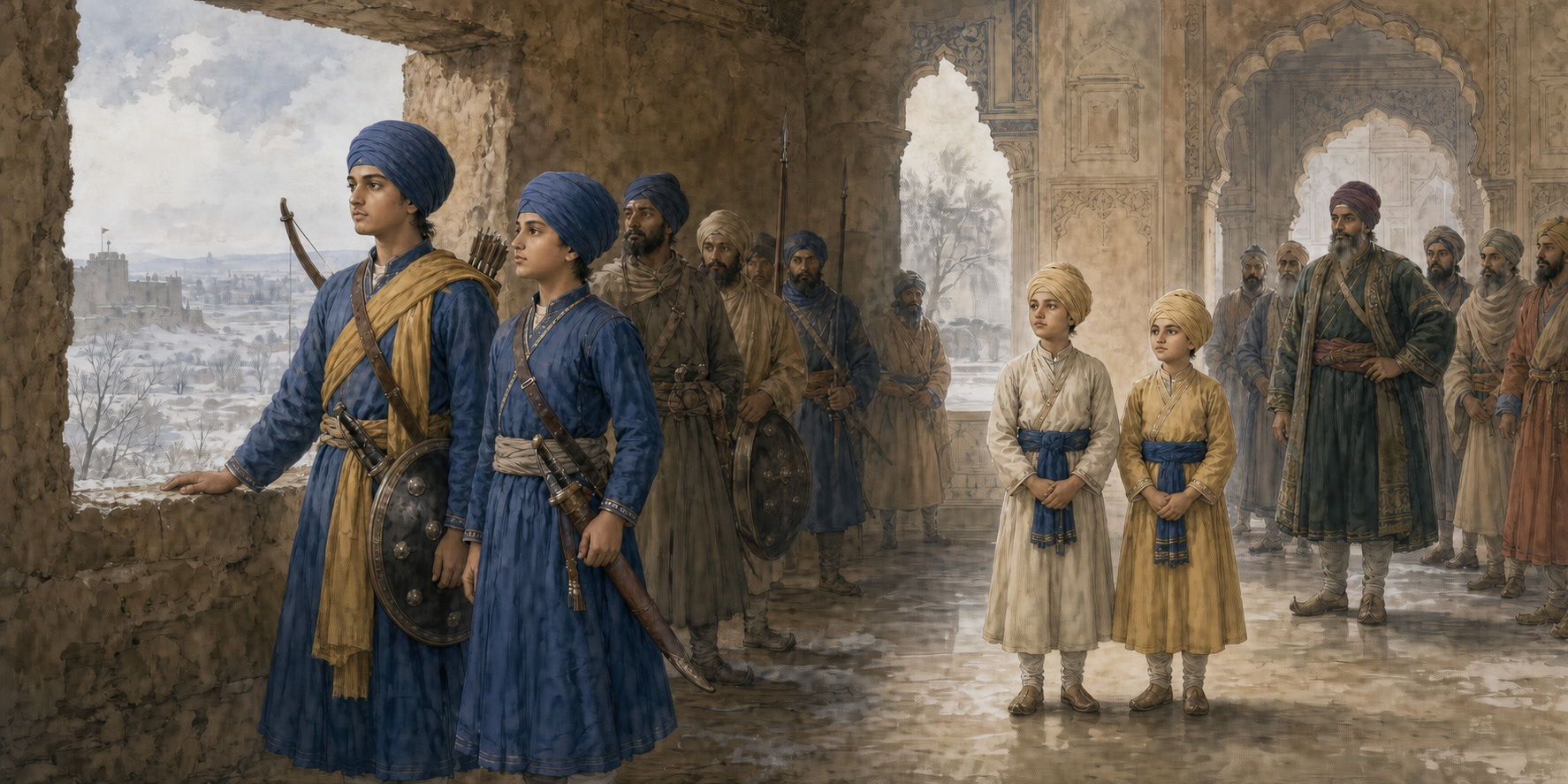
The four sons of Guru Gobind Singh are remembered together, but their stories should not be compressed into one indistinct tale of sacrifice. The difference between their circumstances is essential to understanding the Sikh ethic of martyrdom.
Baba Ajit Singh and Baba Jujhar Singh, the Vadde Sahibzade, attained martyrdom at Chamkaur during the upheaval following the evacuation of Anandpur Sahib. A small Sikh contingent occupied a fortified garhi against a vastly larger force. In that setting, the elder Sahibzadas expressed fidelity through protective action under overwhelming odds.
Baba Zorawar Singh and Baba Fateh Singh, the younger Sahibzadas, faced another kind of pressure at Sirhind during the same winter. They were not being tested through battlefield command. Their test was whether fear could compel them to abandon their faith. Their refusal made freedom of conscience the centre of their martyrdom.
Place these two scenes beside each other and a crucial distinction appears. Courage does not always have the same outward form. For Ajit Singh and Jujhar Singh, courage meant standing in defence. For Zorawar Singh and Fateh Singh, it meant refusing submission. The common element was not a particular method of resistance. It was the refusal to let coercion determine conviction.
This distinction changes how you tell the history. If you present only a martial story, you lose the moral power of the younger Sahibzadas. If you present only innocent suffering, you lose the disciplined responsibility of the elder Sahibzadas. Sikh remembrance holds action and refusal together because both can serve dharma when they protect truth, dignity, and spiritual freedom.
Martyrdom means fidelity despite death, not a pursuit of death

A martyr is not simply someone who dies in a conflict. Death alone cannot establish the moral meaning of a life. The decisive questions are what the person refused to betray, whom the action protected, and whether the sacrifice arose from disciplined duty rather than rage, pride, or a desire for spectacle.
The Sahibzadas are therefore best understood as having chosen fidelity despite lethal consequences. Saying merely that they chose death distorts the choice. It makes the fatal outcome sound like the object of their conduct, when the object was to remain true to faith and duty under conditions designed to make integrity unbearably costly.
You can use four tests when discussing whether an act reflects this ethic:
What is being defended? In the Sahibzadas’ case, the moral objects include conscience, dignity, justice, faith, and the freedom to live without forced spiritual surrender.
Is the danger real or manufactured? Their sacrifice answered coercion and an overwhelming threat. It was not risk created for personal display.
Does the response fit the duty? The elder Sahibzadas defended in battle; the younger Sahibzadas refused to renounce their faith. Steadfastness took the form required by each situation.
Does the choice serve something beyond the self? Their conduct preserved the authority of conscience and strengthened a community whose mission continued after their deaths.
These tests also show why martyrdom cannot be used as a romantic label for recklessness. A needless danger, an act of vengeance, or a demand that someone else accept avoidable harm does not become dharmic merely because the language of sacrifice surrounds it. The Sikh lesson is not that the costliest action is automatically the noblest. It is that fear must not become the ruler of conscience.
The language of dharma-yuddha belongs here as an ethic of resistance to grave injustice, not as permission for aggression. The moral focus remains protective: preserving spiritual choice, defending dignity, and preventing coercive power from deciding what another person must believe.
Chamkaur shows why wise survival can also be a duty
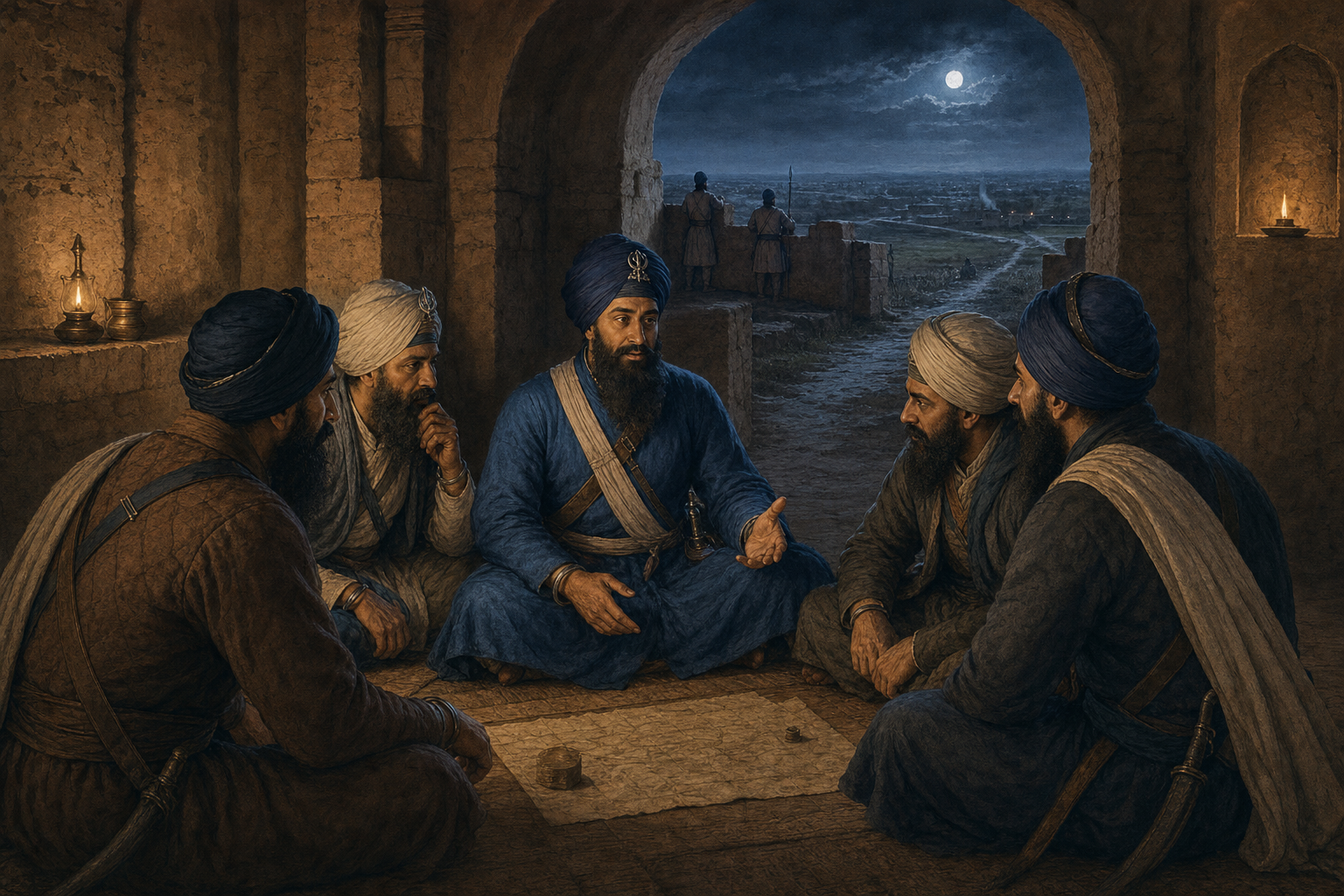
Chamkaur contains an important corrective to a shallow reading of martyrdom. Baba Ajit Singh and Baba Jujhar Singh went forward to defend the Sikh position. Guru Gobind Singh, however, departed after being urged by the Panj Piare, allowing the Khalsa mission to continue. One setting therefore produced two different duties: some held the line, while the Guru preserved the future of the community.
If death were the highest good in itself, the Guru’s departure would be difficult to explain. It becomes coherent once the mission, rather than the spectacle of personal sacrifice, is placed at the centre. The elder Sahibzadas’ responsibility required accepting mortal danger. The Guru’s responsibility required surviving separation, loss, and judgment so that the Khalsa would retain leadership and continuity.
This is one of the most practical lessons in the entire remembrance: duty is not measured by how much pain you can absorb. It is measured by what the situation genuinely requires. Sometimes integrity asks you to stand openly. Sometimes responsibility asks you to withdraw, preserve capacity, listen to collective counsel, and continue the work.
Before invoking sacrifice in a modern dispute, ask:
- What exactly must be protected: a person, a principle, a community, or merely someone’s pride?
- Is personal danger necessary to protect it, or would a safer action be more effective?
- Am I acting from disciplined judgment and trusted counsel, or from anger and a wish to prove myself?
- Who depends on me to remain alive, capable, and present after this moment?
- Will this action preserve the mission, or leave others to bear avoidable damage?
For ordinary civic and family life, the responsible translation is usually lawful and nonviolent: tell the truth, document coercion, protect a targeted neighbour, seek help, organise with others, and refuse demands that violate conscience. The history is not permission to turn everyday disagreement into a battlefield. Nor should martyrdom language ever be used to pressure a child, volunteer, or subordinate into accepting a danger that leaders could prevent.
Teach the Sahibzadas without romanticising violence
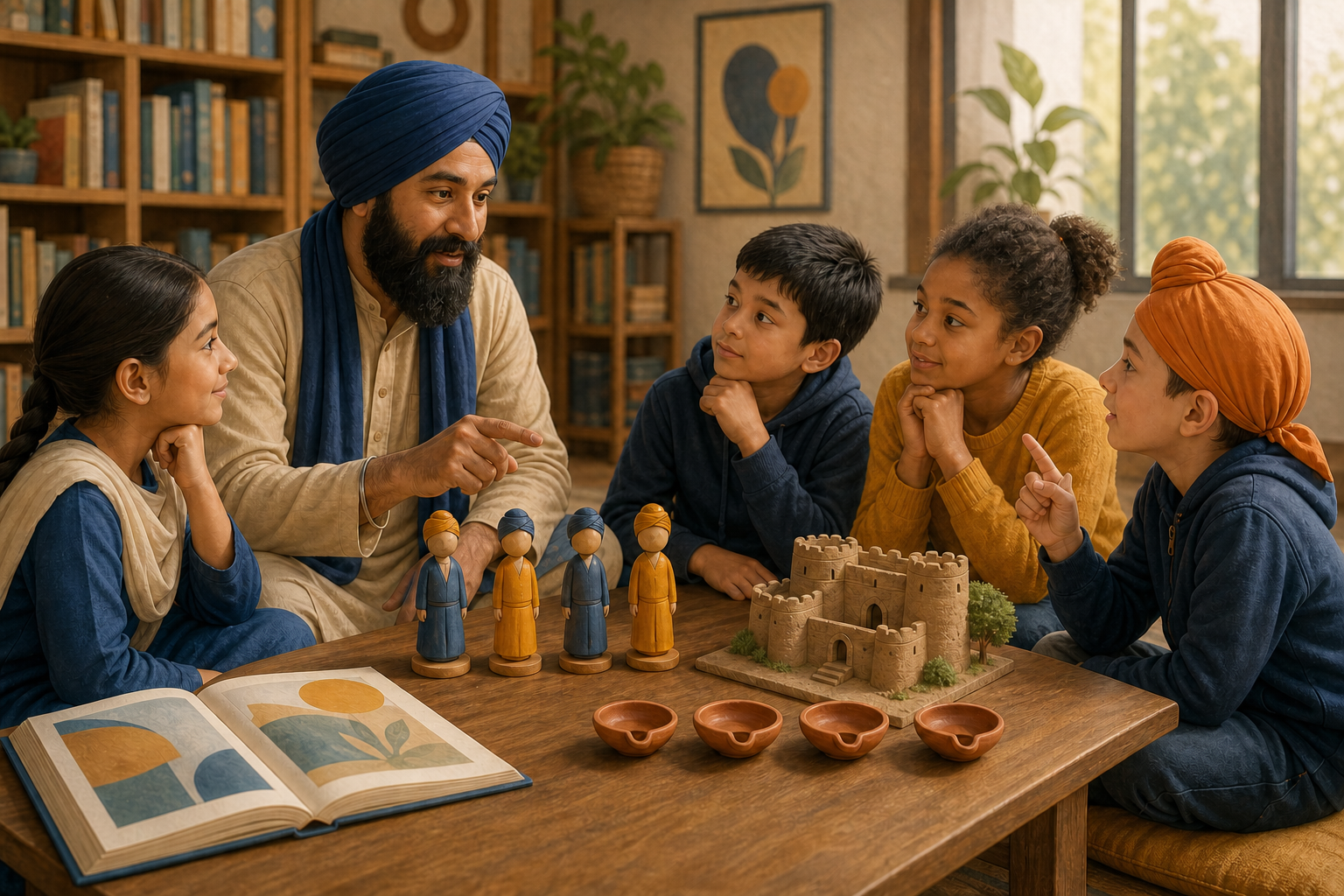
Many people first encounter the Sahibzadas through family narration, gurdwara programmes, Nagar Kirtans, or community commemorations. These settings can form character, but only when the telling keeps moral agency in view. Graphic suffering may produce shock; it does not necessarily produce understanding.
A clear teaching sequence works better:
Name all four Sahibzadas. Identify Baba Ajit Singh and Baba Jujhar Singh as the elder sons, and Baba Zorawar Singh and Baba Fateh Singh as the younger sons. This prevents the younger or elder pair from disappearing into a generic collective.
Tell the history in two scenes. Chamkaur presents defence under overwhelming military pressure. Sirhind presents refusal under pressure to abandon faith.
Use precise moral verbs. The elder Sahibzadas defended; the younger Sahibzadas refused; all four remained steadfast. Do not make dying the main verb.
Ask what coercion was trying to obtain. The question moves attention from suffering to conscience: what would fear have forced them to surrender, and why did that surrender matter?
Translate memory into one present duty. Ask the listener to name a truthful, lawful action they can take when someone is bullied, silenced, or pressured to deny a sincere conviction.
End with seva. Connect remembrance to service for someone vulnerable. This keeps admiration from remaining an emotion and turns it into responsibility.
Match the emphasis to the listener
With young children, centre the four names, the two kinds of courage, and the principle that another person cannot force your heart or faith. Gruesome detail is unnecessary.
With adolescents, examine how threats, peer pressure, institutional power, and the fear of exclusion can influence conscience. Ask them to distinguish principled refusal from stubbornness.
With adults and community leaders, discuss the tension between sacrifice and continuity. Chamkaur requires readers to honour those who stood while also understanding why the Guru listened to the Panj Piare and preserved the Khalsa mission.
Keep dharmic unity precise
The Sahibzadas can speak powerfully to a wider dharmic audience. Truth, righteous duty, compassion, restraint, and reverence for life resonate across Hindu, Buddhist, Jain, and Sikh traditions. The shared ground becomes clearer when it does not erase difference.
Begin with the Sikh setting: the family of Guru Gobind Singh, the Khalsa, the Panj Piare, Chamkaur, Sirhind, and resistance to coerced abandonment of faith. Only then draw the wider connection. Dharmic unity does not require pretending that every tradition describes armed duty or renunciation in identical terms. It asks us to recognise a shared obligation to protect conscience and to let each path speak in its own voice.
This order matters. Turning the Sahibzadas immediately into generic symbols of bravery strips away the discipline that gave their conduct meaning. Keeping their Sikh particularity intact allows their universal relevance to emerge honestly: no civilisation remains plural if its people will not defend another person’s freedom to live by conscience.
Key takeaways
- The four Sahibzadas share one commitment to conscience, but the elder and younger pairs expressed it through different forms of courage.
- Sikh martyrdom honours fidelity despite death; it does not treat death, suffering, or danger as goods in themselves.
- Chamkaur joins courageous resistance to strategic survival: the Sahibzadas defended while Guru Gobind Singh preserved the continuity of the Khalsa.
- A modern appeal to sacrifice should be tested by its purpose, necessity, discipline, effect on others, and service to a mission beyond the self.
- Teach the history through names, choices, duties, and seva rather than allowing gruesome details or martial spectacle to dominate.
- Connect the Sahibzadas to wider dharmic values only after explaining the distinct Sikh meaning of their lives and martyrdom.
At your next family or community remembrance, ask each person to name one pressure they will answer with truthful, lawful courage and one person whose freedom of conscience they will help protect. Then choose one act of seva to complete that week. That is how the Sahibzadas move from honoured memory into lived character.
References
- SikhNet – Saka Chamkaur: Honoring the Vadde Sahibzaade’s Courage, Sacrifice, and Dharmic Unity
- SikhNet – Sahibzadas’ Supreme Sacrifice: A Moving Testament to Faith, Freedom, and Dharmic Unity
