
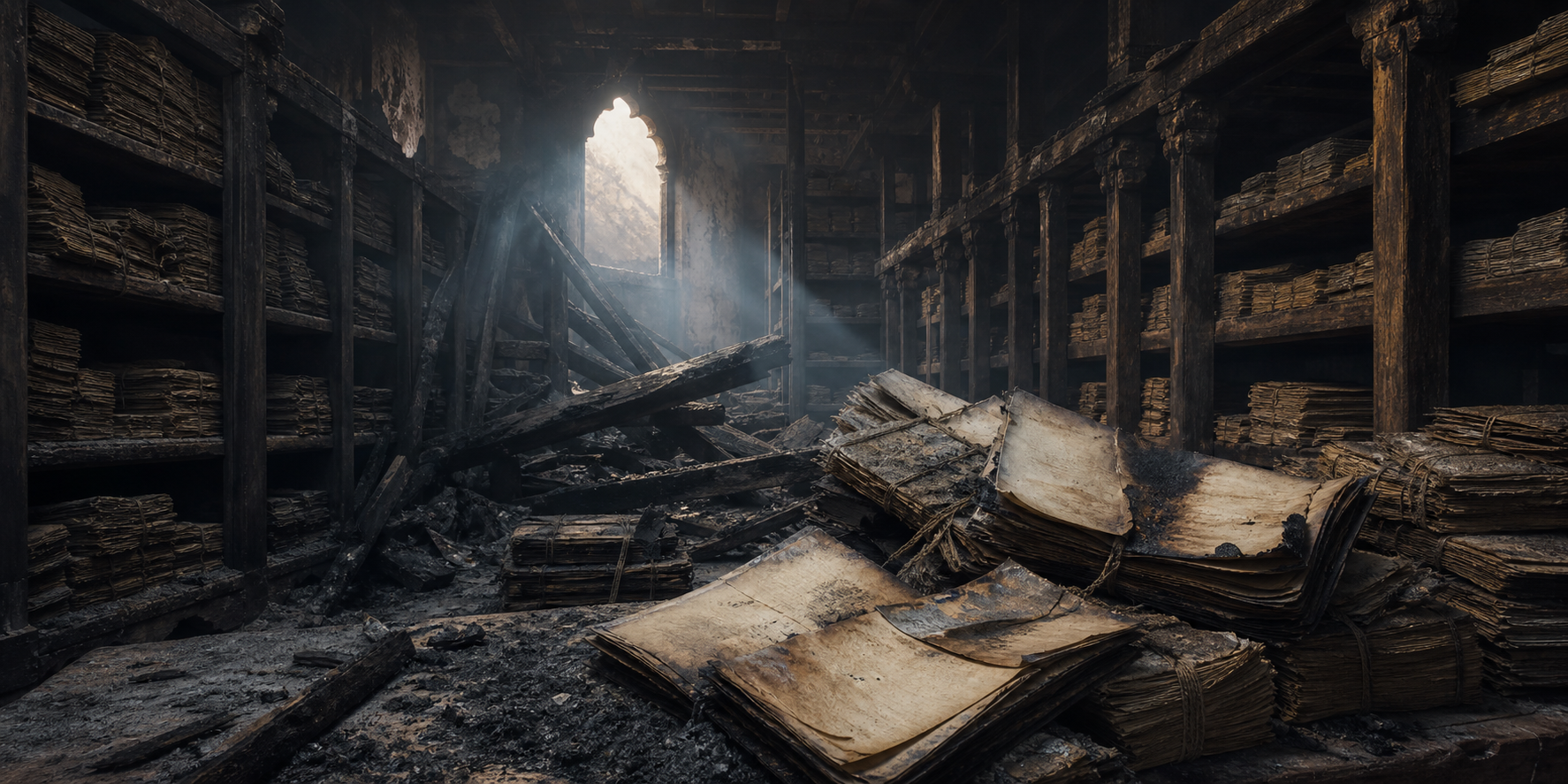
If you have gone looking for firm evidence about Holkar rule and found the trail strangely thin, the problem is not simply that Maratha India failed to keep records. Indore once held one of the most important repositories of Maratha state papers, and a fire destroyed nearly all of it.
The useful question is no longer whether we should lament that loss. It is how you can read Holkar history honestly when its documentary centre is missing, recognize the administrative failures that made the destruction possible, and protect the civilizational records still within reach.
The missing archive changes what you can honestly claim
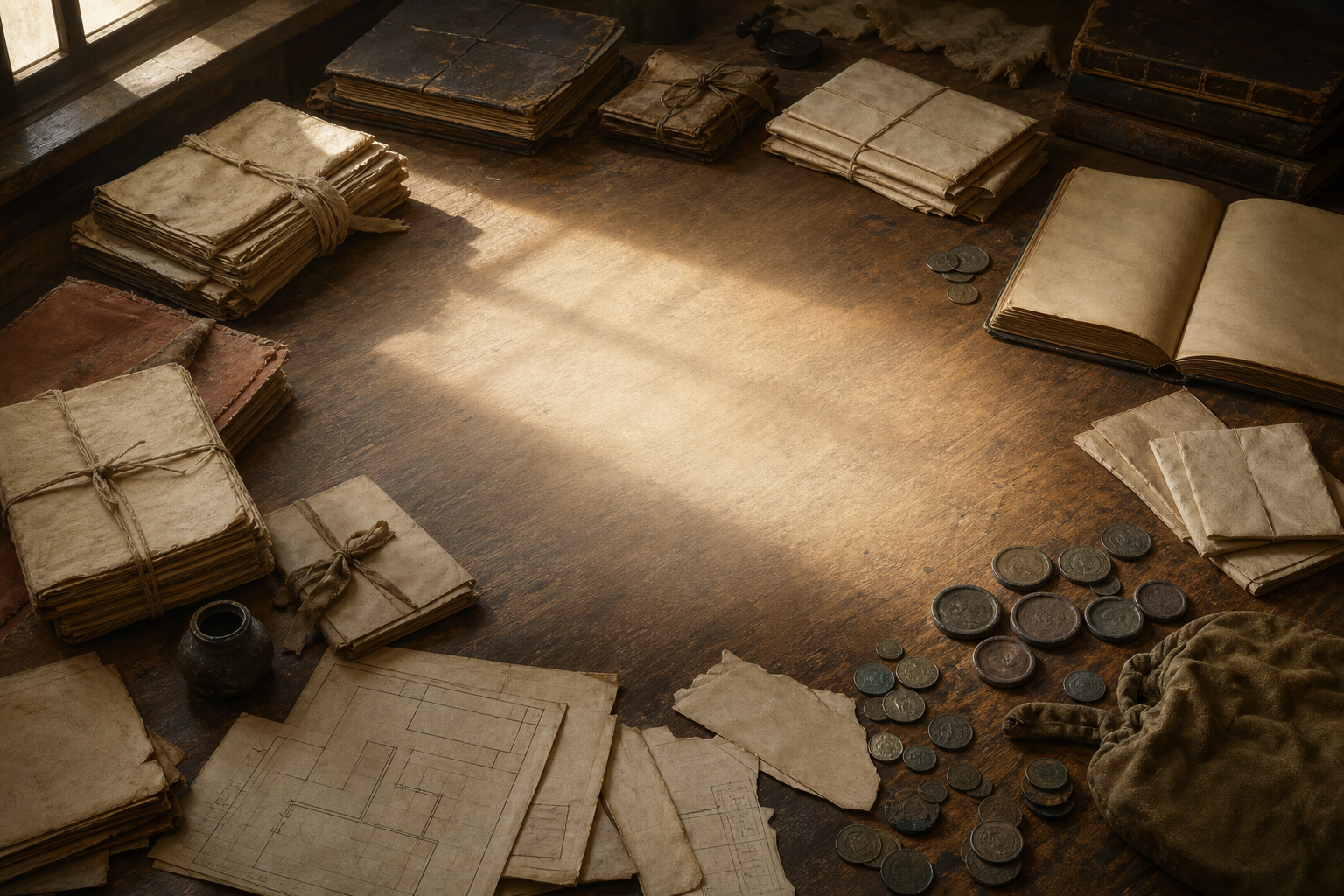
An archive is not merely a room full of old paper. It is the working memory of institutions. Orders, revenue records, judicial proceedings, diplomatic correspondence and routine administrative files reveal how authority operated after ceremonies and proclamations were over. They can show who made a decision, which office implemented it, what local conditions complicated it and how ordinary people encountered the state.
The Holkar collection mattered because its records were reportedly full and substantially unimpaired before the fire. They offered evidence about governance, jurisprudence, revenue, diplomacy and everyday life in territories that helped shape present-day Madhya Pradesh and Maharashtra. Their destruction therefore removed more than a sequence of royal anecdotes. It broke the internal paper trail of a major Maratha power.
That break creates an evidence imbalance. A historian may still find a Holkar name in Peshwa correspondence, a diplomatic transaction in another court’s papers or a later recollection in a private collection. Such fragments can illuminate the points at which two worlds met. They cannot automatically reconstruct the missing internal sequence: the original instruction, departmental discussion, implementation, objection and final outcome.
This distinction gives you a practical rule for reading any confident claim about Holkar history: ask what kind of evidence supports it. Is there a surviving contemporary record? Is the claim corroborated indirectly by connected repositories? Is it a reasonable interpretation of incomplete material? Or has the silence created by the fire been treated as proof that something never occurred?
Use three working labels in your own notes: documented, corroborated and unresolved. Documented means that a relevant surviving record can be identified. Corroborated means that independent fragments support the claim without replacing the lost Holkar file. Unresolved means that the available evidence cannot settle the matter. This small discipline prevents archival absence from becoming false certainty.
The decisive failure happened before the flames
The fire was the final event, but the disaster developed through a chain of earlier decisions. The order matters because it separates careful accountability from theatrical blame.
- The Indore papers remained unusually valuable while other major Maratha collections had already suffered loss, dispersal or chronological limitations.
- D. B. Parasnis pursued scholarly access for years but repeatedly encountered opaque procedure and official obstruction.
- Permission arrived only after a retired political agent in England supported his application to the Government of India.
- Parasnis set out for Indore and stopped briefly in Bombay to make purchases. A telegram then informed him that fire had broken out in the records building.
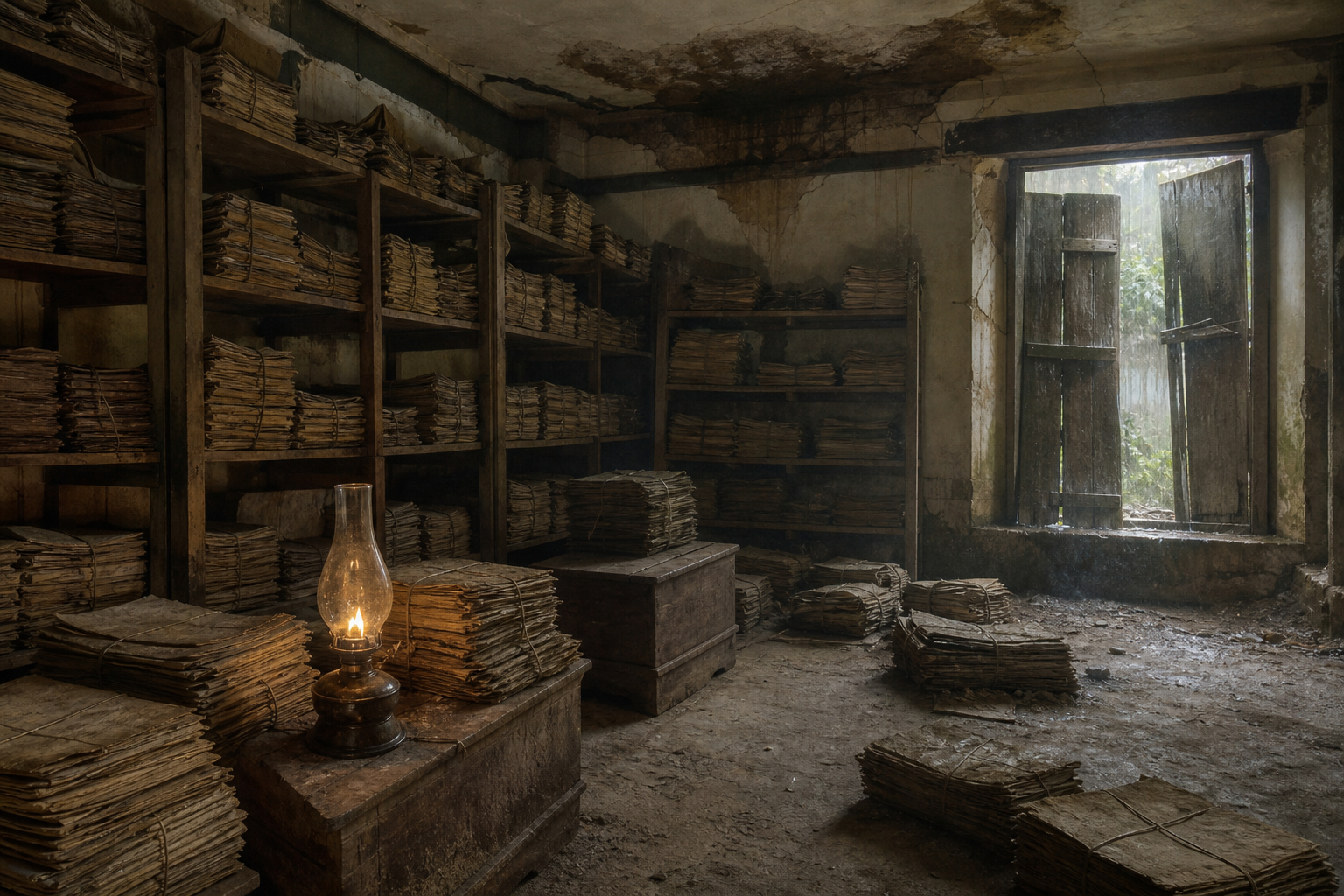
- The papers had been crowded into a low, dark kutcha structure designed like bulk storage rather than a secure repository, and nearly the entire collection perished.
There is no need to claim that obstructive officials caused the ignition. The more defensible conclusion is also more useful: administrative delay and unsafe custody operated together. The bureaucracy kept a qualified scholar away while leaving irreplaceable papers in conditions where one fire could become a nearly total loss.
Restricted access is therefore not only an inconvenience for researchers. It can hide deterioration, poor storage and missing inventories from the people most likely to recognize the danger. Scholars cannot describe conditions, build public concern or help attract preservation support for a collection they are never allowed to examine. Secrecy without competent stewardship is not protection.
Parasnis’s own collection points toward a better model. His Satara home had become an important centre for students of Maratha history, but he understood that personal devotion was not a permanent preservation system. Lord Sydenham visited the collection in 1909; Lord Willingdon later promised a dedicated museum; the Great War delayed the plan; and the Satara Museum was completed in 1924 and opened on 3 November 1925 by Sir Leslie Wilson.
Parasnis died unexpectedly on 31 March 1926. The dates carry a practical lesson. A collection can outlive its maker only if ownership, custody, facilities, succession and access have been settled before that person’s death. Affection for inherited papers is valuable, but affection without an institutional future leaves the collection exposed to the next change of household, office or leadership.
A preservation test any custodian can use
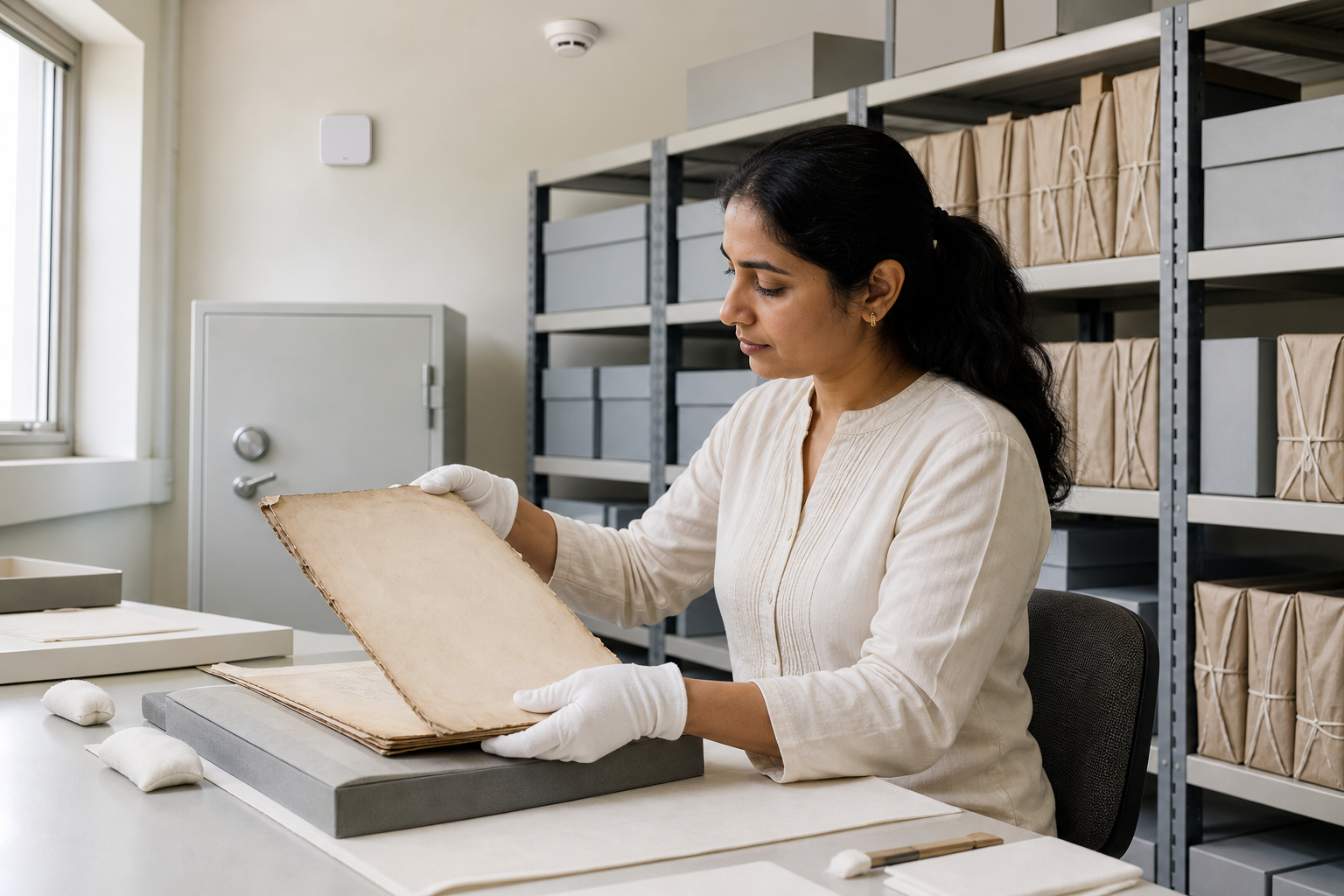
You do not need to manage a state archive for the Indore lesson to apply. A temple office, matha, gurdwara, Jain bhandar, educational institution or family may hold registers, correspondence, manuscripts, legal papers and account books found nowhere else. Their age may be obvious while their uniqueness is not. Test the collection against the following layers.
- Repository: Use a purpose-built or professionally assessed space with fire-rated construction, suitable detection and suppression, fire separation and protection against water intrusion. A locked room is a security measure, not a preservation design.
- Storage: Keep records on appropriate shelving in archival-grade enclosures, with enough order that a container can be removed without shifting an unstable pile. Bulk stacking turns routine handling and emergency removal into additional hazards.
- Environment: Monitor temperature, humidity, light, pests and water leaks. Stability matters because slow damage can continue unnoticed even when no dramatic incident occurs.
- Inventory: Give every collection, series or container a unique identifier. Record its creator, approximate date range when known, language or script, physical location, condition, access status and digitization status. A scan that cannot be connected to its original is merely a digital heap.
- Custody and access: Record who may enter, who removed an item, why it was removed and when it returned. Publish a clear scholar-access policy so that permission does not depend on opaque personal discretion.
- Redundancy: Microfilm or digitize valuable material, retain the originals and keep a managed duplicate away from the same physical hazard. A second copy in the same vulnerable building does not protect against a building-wide event.
- Response: Maintain a written disaster plan with named responsibilities, emergency contacts and priorities for salvage. Test scenarios with the people expected to act; an unpractised plan is unlikely to guide a confused response.
If the collection has no inventory, begin non-invasively. Number the containers, describe their apparent contents without unnecessarily rearranging fragile material, photograph their condition and storage area, and record who currently holds custody. If papers are already damaged or handling may worsen them, pause and involve a trained conservator. Preservation work that destroys original order or physical evidence can create another irreversible loss.
Digitization should follow the inventory rather than substitute for it. Match each file name to the collection’s identifiers, preserve a high-quality master, attach descriptive metadata, store a separate managed copy and periodically verify that the files remain readable. Do not discard an original merely because an image exists; the physical object can retain seals, watermarks, annotations, sequence and material evidence that a scan does not fully capture.
Governance is the outer protective layer. Princely-state papers need explicit legal protection, professional oversight, documented chains of custody, stable funding, scheduled declassification and transparent access rules. An independent trust can help when historians, conservators and relevant community institutions have meaningful representation rather than ceremonial seats.
Ask five hard questions of any institution that claims to preserve heritage: What exactly does it hold? Where is the current inventory? Who is accountable for each collection? Where is the redundant copy? When was the emergency procedure last exercised? If every answer is a person’s name rather than a documented system, the archive remains dependent on goodwill and memory.
How to research a history whose centre is gone
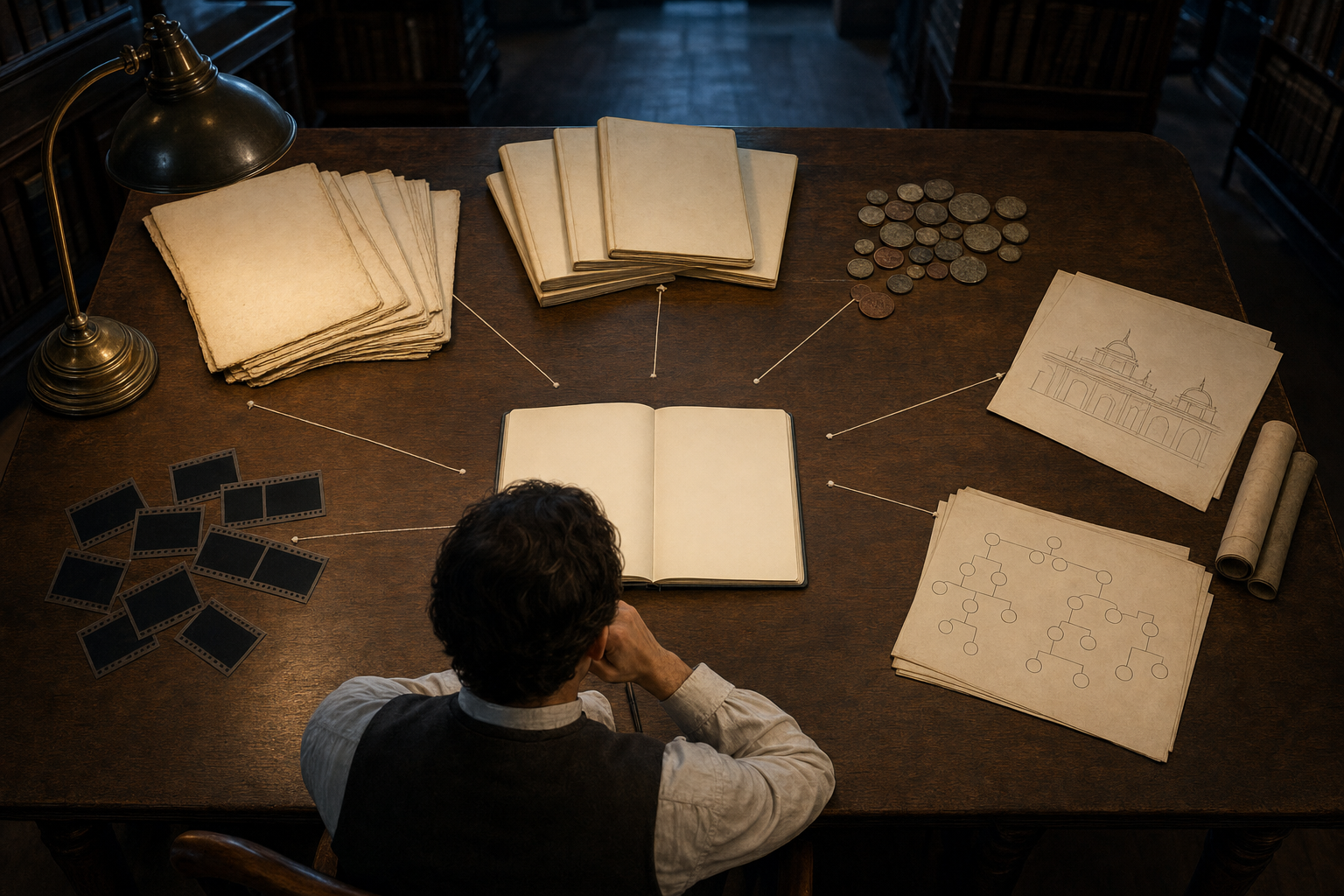
Research after a major archival loss should begin with an evidence map, not a sweeping thesis. The aim is not to pretend that scattered records recreate the destroyed whole. It is to extract what they can establish while making the limits visible.
- Define the claim narrowly. A question about a particular administrative decision, relationship or period can be tested more honestly than a claim about the entire character of Holkar rule.
- Map connected repositories. Peshwa records, later Gaekwad papers, surviving Sindhia material, private collections and records produced by offices that interacted with Indore may preserve relevant intersections. Note that the Peshwa collection was itself only partly preserved, the Gaekwad papers were mostly from after 1802, and older Sindhia records were reportedly cleared away as waste. One damaged archive cannot simply repair another.
- Record provenance before interpretation. Identify who created an item, for what administrative purpose, when it entered its present collection and whether its sequence is intact. A copy, translation or later summary may remain useful, but it is not interchangeable with the original file.
- Triangulate languages and viewpoints. Search beyond the language or political perspective most familiar to you. Agreement across records can strengthen a conclusion; disagreement can reveal institutional interests or a question that remains open.
- Publish the boundary of the evidence. Say that a record has not survived or has not been located when that is what you know. Do not silently turn not found into never existed.
Parasnis practised this wider method even when it produced disappointment. He acquired French material on the governors-general of the Dutch Indies and a German journal containing Dr. Oskar Mann’s extended summary of the Persian Majanua-ut-tawarikh bad az Badriyya. He hoped the latter would illuminate the Third Battle of Panipat from the Afghan side, but the narrative ended before Ahmad Shah Abdali’s Indian campaigns.
That negative result models good historical practice. Parasnis did not stretch a promising text beyond its actual coverage. You should apply the same restraint when a fragment seems to support a cherished civilizational, political or sectarian conclusion. The strength of a Dharmic account of history must come from fidelity to evidence, including evidence that disappoints us.
The stakes extend beyond dynastic history. Princely-state records of this kind can preserve evidence of administration, finance and philanthropy involving Hindu, Buddhist, Jain and Sikh communities. They can reveal cooperation, patronage, dispute and local practice without forcing the past into a modern slogan. Shared Dharmic memory becomes more credible when it rests on identifiable records rather than retrospective assertion.
When you encounter a confident statement about a period whose central archive has vanished, caution does not require automatic rejection. It requires a better question: which surviving record carries the weight of this claim, and what would the missing internal papers have been able to confirm, complicate or refute?
Key takeaways
- The thinness of surviving Holkar evidence reflects catastrophic archival destruction, not an absence of record-keeping or historical activity.
- Bureaucratic obstruction can become a preservation risk when it prevents scholars and professionals from seeing unsafe conditions.
- Fire-safe construction, controlled storage, environmental monitoring, inventories, access logs, redundancy and practised disaster response must operate as one system.
- Digitization protects memory only when scans remain linked to identifiers, metadata, managed storage and the preserved originals.
- After archival loss, distinguish direct documentation, indirect corroboration and unresolved claims. A missing record is not proof that an event never occurred.
- Private custodians should settle succession and institutional custody while they can still shape the collection’s future.
Choose one collection within your reach: a family archive, institutional record room, manuscript library or public repository. Ask for its inventory, custody policy, redundant-copy plan and tested emergency procedure. If those do not exist, put the questions in writing and begin with the smallest safe improvement you can document.
A pro-Dharmic culture of history cannot depend on reverence alone. It must make preservation, evidence and responsible access ordinary habits. Indore’s loss cannot be reversed, but the conditions that produce another such loss can still be changed.