

You may have heard the pond-side story and come away with a simple verdict: Shuka was pure, while Vyasa was somehow less pure. That reading is tempting, but it misses the ethical challenge directed at you. What does your way of looking do to the person who is being looked at?
The useful answer is more demanding than a judgment about two sages. Dharmic perception joins inner intention, disciplined attention, social context, and responsiveness to another person’s dignity. A clean motive does not authorize intrusion. Modesty does not prove impurity. The ethical gaze neither grasps a person nor ignores the signals that person gives.
The pond encounter is not a ranking of saints
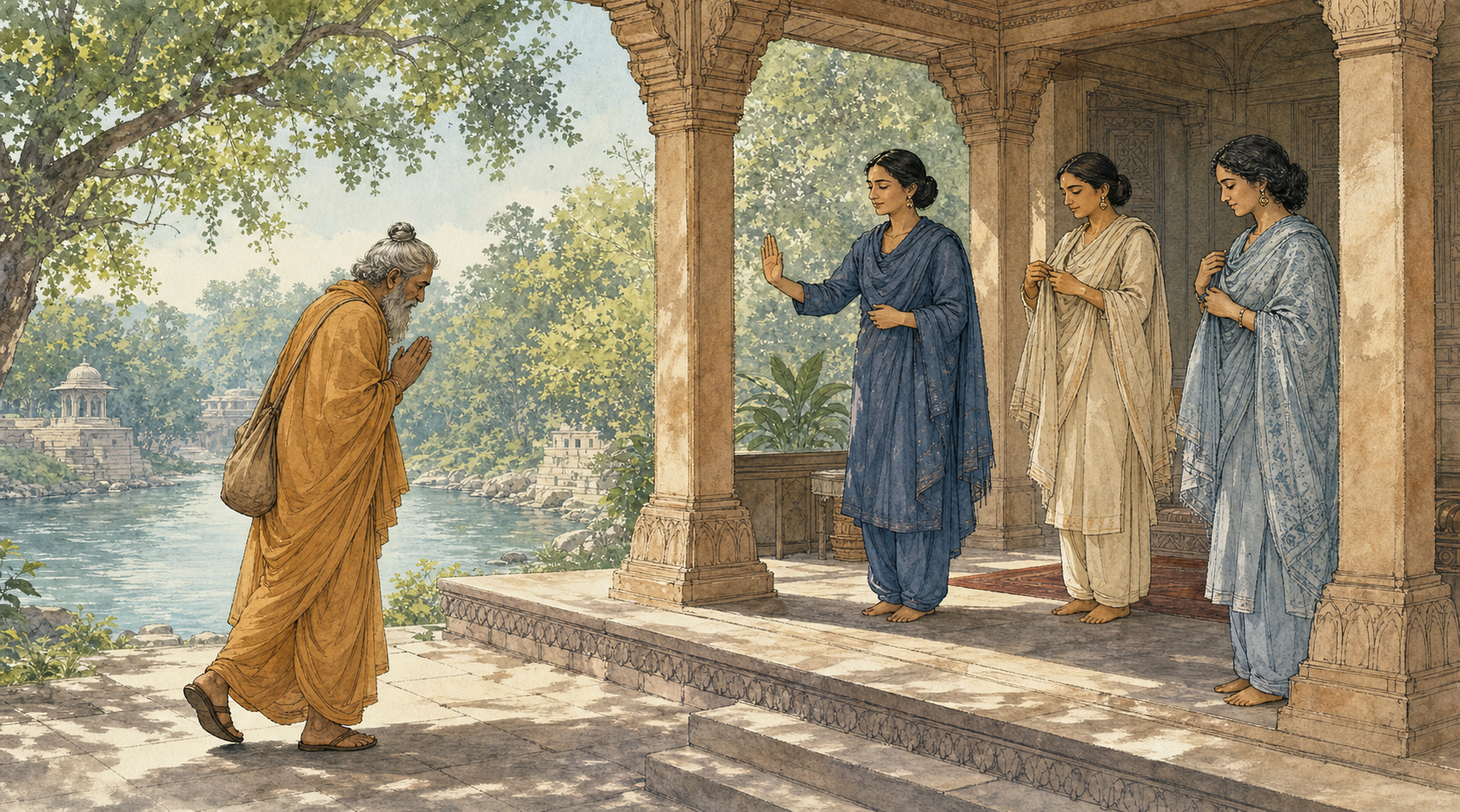
In the familiar account, the youthful ascetic Shuka passes women bathing at a village pond. They remain at ease. When Vyasa approaches shortly afterward, they cover themselves. Asked about the difference, they explain that Shuka’s presence did not awaken the ordinary distinction between man and woman, whereas Vyasa’s presence restored the conventional code of modesty appropriate to a householder. This contrast between Shuka’s detachment and Vyasa’s householder status is the key to the encounter.
A textual caution matters. The episode circulates widely in traditional teaching lore, but it cannot be confidently assigned to one canonical chapter and verse. You should therefore treat it as a didactic parable consistent with established portrayals of Shuka and Vyasa, not as an isolated verse from which every detail of conduct can be legislated.
The Bhagavata Purana portrays Shuka as radically free from attachment and absorbed in the Divine. Traditional language calls such a person vitaraga, free of possessive attachment, and jivanmukta, liberated while living. Vyasa represents a different excellence. He is the sage who organizes sacred knowledge and remains engaged with the structures of family and society. His work expresses lokasangraha: sustaining the world through responsible action.
The contrast is therefore not between a saint and a sinner, or even between a pure sage and an impure one. It is between two modes of presence. Shuka stands outside the normal economy of acquisition so completely that the usual gendered script does not arise. Vyasa, although spiritually exalted, remains socially legible as an elder male householder. The ordinary code returns without implying that he has behaved wrongly.
This distinction protects you from two common mistakes. Do not imagine that householding life is spiritually discrediting. Do not imitate the outward informality associated with a liberated renunciate while your own attention remains governed by curiosity, attraction, status, or self-interest. Shuka is a standard of inward transformation, not a permission slip for ignoring convention.
Drishti turns perception into an ethical act

Drishti means more here than eyesight. It is perception shaped by intention. In ordinary experience, visual contact is followed almost immediately by classification: attractive or unattractive, familiar or foreign, useful or irrelevant, threatening or desirable. Latent tendencies, or vasanas, supply emotional force. Ahamkara, the self-making habit, then asks what the perceived person means for me. Seeing becomes objectification when another being is reduced to a source of pleasure, validation, information, control, or advantage.
Recognizing a body, gender, role, or appearance is not itself a moral failure. The decisive turn occurs when recognition becomes acquisition. You stop encountering a person and begin consuming an image of that person. Attention lingers because it wants something. Fantasy supplies access that has not been offered. Entitlement converts interest into a silent claim.
Shuka represents sakshi-bhava, the stance of the witness. This is not blankness, dissociation, or a performance of indifference. The witness sees clearly without organizing the scene around appetite. Gender may remain available as a practical fact, but it no longer drives grasping, projection, or possession. In the language of Yoga, when mental movements settle, the Seer abides in its own nature. Perception illumines without trying to seize.
This is why brahmacharya cannot be reduced to physical abstinence. Abstinence may regulate behavior, but brahmacharya reaches into the structure of attention. It conserves and redirects prana-shakti so that desire serves clarity rather than compulsion. Its practical test is not whether you can claim never to notice beauty. Ask whether noticing recruits fantasy, entitlement, repeated looking, suggestive speech, or an attempt to secure a response from the person you have noticed.
Your body also communicates before you explain yourself. People register direction of gaze, posture, distance, facial expression, and tone with great speed. A non-acquisitive presence can reduce social tension; a fixed or appraising gaze can increase it. The felt difference between grasping and non-grasping attention helps explain why the women respond differently in the traditional account.
Yet no one can reliably inspect another person’s soul. Purity is not self-certified, and another person’s comfort is not yours to declare. You may know that you intended no harm while still producing discomfort through staring, proximity, speech, or disregard for context. Ethical perception therefore requires both inner examination and outward correction.
Vyasa’s presence restores social context and mutual maryada
Hindu ethics attends to desa-kala-patra: place, time, and the persons involved. Conduct appropriate in a family home may be inappropriate in a temple, bathing place, workplace, or secluded room. Familiarity changes what can be assumed. Age, role, authority, and the degree of privacy all affect what respectful behavior requires.
Vyasa’s arrival reactivates this social field. The women do not need to accuse him of desire before observing modesty. They recognize a householder participating in the same role-governed world that they inhabit. Covering themselves can therefore express maryada, dignified regard for boundaries, without functioning as a judgment on his character.
This interpretation also keeps the women at the moral center of the encounter. They are not props used to measure male holiness. They assess their setting and act according to their own discernment. Their ease before Shuka and modesty before Vyasa are both intelligible choices. Neither response makes them spiritually superior or inferior.
That point becomes even more important outside the parable. A person may cover the body, change posture, step away, avoid eye contact, become quiet, or leave for many reasons. The reaction could arise from modesty, uncertainty, prior experience, cultural formation, personal preference, or a boundary you have unintentionally crossed. Do not turn the reaction into a diagnostic test of your purity or the other person’s state of mind.
Respond to the boundary before debating its cause. Relax your gaze. Increase distance. Stop the personal remark. Return the conversation to its proper purpose. If an apology is appropriate, make it briefly and without asking the other person to reassure you. The ethical question is not whether you can prove innocence. It is whether you can protect another person’s freedom once a signal becomes visible.
Maryada consequently binds the observer as much as the observed. Modesty cannot mean that one party carries the entire burden of preventing objectification. The person who sees must discipline attention, respect privacy, and adjust conduct to context. The person being seen retains the right to decide what level of exposure, distance, and interaction feels appropriate.
Non-duality should sharpen boundaries, not erase them

An Advaita reading distinguishes the ultimate from the conventional. At the paramarthika level, Atman is not male or female and cannot be reduced to bodily characteristics. At the vyavaharika level, embodied differences, social roles, privacy, vulnerability, and personal agency still shape responsible conduct. Shuka’s freedom lies in not mistaking the conventional identity for the whole person. It does not require pretending that the conventional world has disappeared.
The dangerous error is to use metaphysical unity as social entitlement. The claim that all is one cannot logically become a claim that permission, distance, or privacy no longer matter. Non-duality removes the impulse to possess another; it does not grant access to another. If realization is genuine, it should make your conduct less intrusive because there is less egoic hunger to satisfy.
Bhakti reaches a compatible ethical result through devotion. When beings are encountered as forms belonging to the Divine, love loses its possessive edge. Darshana becomes reverent seeing rather than visual consumption. You do not have to deny the form before you; you learn to meet it without converting sacred presence into private use.
Related disciplines appear across the wider dharmic family. Buddhism trains non-grasping awareness against tanha, craving. Jainism venerates the vitaraga, one freed from attachment. Sikh thought honors sehaj, a natural equipoise grounded in the One. These terms are not interchangeable, and their traditions should not be flattened into a single system. They nevertheless share an ethical direction: inner freedom reduces the will to appropriate other beings.
This gives you a practical test for spiritual language. Does the teaching make you less covetous, less invasive, and more responsive to another person’s agency? Does it deepen ahimsa at the level of thought as well as action? If a lofty idea leaves grasping untouched or provides cover for ignored boundaries, the idea has not yet transformed perception.
A five-part practice for retraining perception

You do not need to claim Shuka’s attainment before beginning. Work at the point where a perception becomes a choice. Use this audit in a workplace, temple, public space, family gathering, or digital feed.
- Catch the movement of attention. Notice where your attention lands and when it returns. A first perception may arise without planning, but sustained attention reveals what the mind is feeding. Observe the body, role, status, or quality you selected before inventing a justification for selecting it.
- Name the acquisition. Ask what you are trying to obtain from this person or image. It may be stimulation, admiration, approval, intimacy, information, control, or the satisfaction of judging someone. Naming the desired gain exposes the sankalpa operating beneath an apparently neutral look.
- Restore full personhood. Reframe the person according to your path: as Atman, as a manifestation of the Divine, as a being deserving ahimsa, or simply as a conscious subject whose life is not organized around your wants. This is not an abstract compliment. It should interrupt the impulse to consume, classify, or possess.
- Apply desa-kala-patra. Adjust gaze, distance, language, and access to the actual setting. Keep professional interactions relevant to their purpose. Honor privacy in secluded or intimate spaces. Follow the stated code of a temple, community, household, or institution even when you believe your motives are harmless. Greater authority as a teacher, elder, or supervisor calls for greater restraint because the other person may have less freedom to object.
- Let impact correct intention. Watch for visible changes in comfort without pretending you can read minds. If someone steps back, covers up, withdraws, or redirects the exchange, make room immediately. Do not demand trust and do not defend your inner purity. At the end of the day, revisit one such moment and identify the earlier point at which awareness could have changed your conduct.
This discipline also applies when no physically present person can react. Images on a screen can still train vasanas. Repeatedly returning to content because it feeds compulsion strengthens the same acquisitive pattern that brahmacharya is meant to redirect. Closing, scrolling past, or removing a recurring trigger can be an act of attention rather than a condemnation of the person depicted.
Key takeaways
- Shuka and Vyasa represent different dharmic modes of presence, not a simple hierarchy of purity.
- An ethical gaze is free from acquisition and responsive to the context in which seeing occurs.
- Brahmacharya disciplines attention before compulsion becomes speech or action.
- Non-dual insight strengthens respect for privacy and agency; it never cancels them.
- Another person’s modesty or discomfort is a boundary to honor, not evidence to reinterpret for your own vindication.
In your next ordinary encounter, pause long enough to ask three questions: What am I trying to take? What does this setting require? What signal am I being given? That pause is where the ethics of perception becomes daily sadhana.