

If you have heard the Bower Manuscript invoked as proof of Bharat’s influence in Central Asia and China, the important question is not whether the discovery was remarkable. It is what the evidence actually proves. A single bundle of birch bark can be made to carry too little meaning or far too much.
The defensible case is stronger than a slogan. You need to separate the manuscript’s ancient life from its purchase in 1890, its scholarly decipherment in 1891, and the archaeological movement that followed. Once those stages are clear, Kucha emerges not as a remote place containing an isolated Indian curiosity, but as a major centre in a Dharmic network of texts, monasteries, translators, rulers, artists and performers.
The discovery began as an accidental purchase in Kuchar
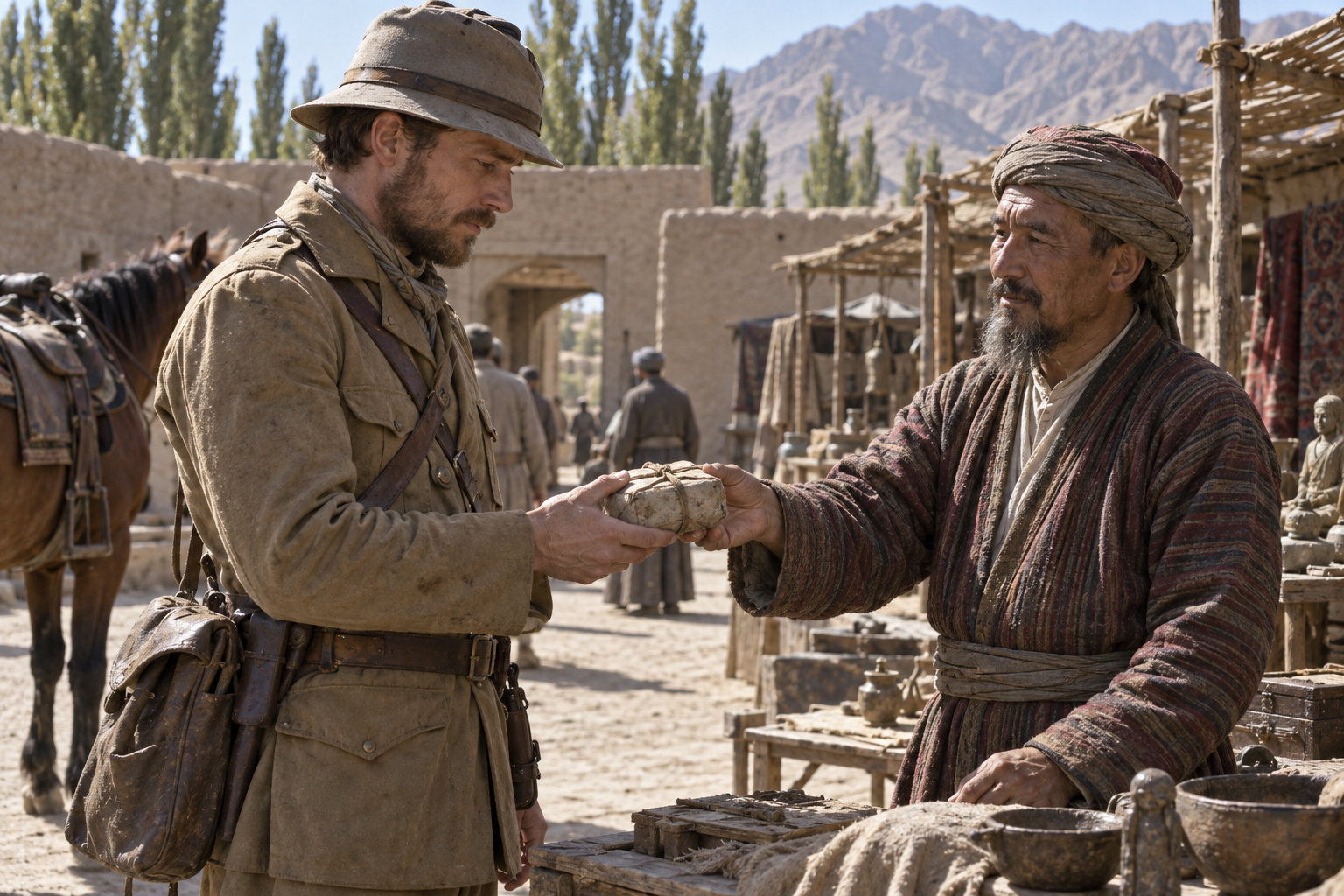
Lieutenant Hamilton Bower did not enter Eastern Turkistan in search of Sanskrit manuscripts. The British Government in India had sent him after Daud Mohammed Khan, a fugitive accused of murdering Andrew Dalgleish. Bower pursued the trail from Kashgar and reached the thriving commercial city of Kuchar, now generally called Kucha or Kuqa, in January or February 1890.
A Turkic Muslim treasure-hunter approached him there. The man said that he had been digging around what he regarded as an underground city and had recovered a book rather than treasure. He brought Bower a packet of old writing on birch bark and sold it for a small sum. He also offered to lead Bower to the subterranean site at midnight because he feared trouble with the Chinese authorities if anyone discovered that he had taken a European there.
This transaction is usually compressed into the discovery of the Bower Manuscript. That convenient label hides several distinct roles. An unnamed local finder excavated the object. Bower recognised that it could be valuable and acquired it. Scholars in India later identified and deciphered it. Long before any of them arrived, an older civilisation had produced, copied, carried, used and preserved the manuscript.
Keeping those roles separate prevents a common error. The person after whom an artefact is named is not necessarily its creator, original owner or even its first modern finder. In this case, the surviving name commemorates the colonial recipient. It tells you almost nothing about the people responsible for the manuscript’s ancient existence.
The fugitive hunt eventually ended when Daud Mohammed Khan was arrested in Samarkand. Its unintended historical consequence had already occurred. A confidential imperial mission had intersected with a local antiquities trade, placing an ancient Sanskrit manuscript in the hands of institutions capable of studying it. Contingency, commerce and colonial power all belong to the recovery story.
Why the April 1891 decipherment changed the historical map

Bower’s purchase became historical evidence only after the writing could be read and situated. The manuscript passed through J. Waterhouse to the German Indologist Augustus Frederic Rudolf Hoernle, a Sanskrit scholar and former editor of the Journal of the Asiatic Society of Bengal. Hoernle obtained it after returning to India early in 1891 and published a preliminary decipherment in the society’s April 1891 proceedings.
The decisive fact was geographic. An ancient Sanskrit manuscript written on birch bark had surfaced at Kucha in Eastern Turkistan, far beyond the conventional boundaries within which colonial scholarship often confined Indian civilisation. The find made it much harder to treat the movement of Indian learning across Central Asia as a vague tradition or an occasional exchange. Here was portable textual culture recovered from the ground.
The Bower Manuscript did not, by itself, explain the entire history of Kucha or prove every later claim about Indian influence. Its greater importance was catalytic. It showed that the region could preserve old manuscripts and that systematic exploration might recover more. The colonial government financed archaeological work in Eastern Turkistan, while European and Japanese explorers subsequently entered the field. What began with one packet of birch bark expanded into a broad search for buried cities, cave complexes, inscriptions, paintings and libraries.
This is why the discovery belongs to more than manuscript history. It changed where scholars looked. A territory previously treated as a difficult corridor between established civilisations became an archive in its own right. The later finds then supplied the context that one manuscript alone could never provide.
Key takeaways
- The famous discovery of 1890 was an acquisition at Kuchar, not the moment when the manuscript was created or first used.
- Hoernle’s April 1891 decipherment converted an intriguing object into readable evidence of Sanskrit transmission in Eastern Turkistan.
- The manuscript’s largest consequence was to direct sustained archaeological attention towards the region.
- The civilisational case rests on convergence: manuscript evidence becomes far stronger when read beside monasteries, inscriptions, artistic forms, doctrinal records and Sanskrit drama.
- The evidence points to cultural transmission through learning, translation, patronage and performance; it does not require a claim of Indian political sovereignty over Kucha.
Kucha was a Dharmic crossroads, not a passive frontier

Kucha’s location can mislead a modern reader. Because Kuqa now lies in the Xinjiang region of China, it is easy to project current borders and identities backwards and imagine an isolated Chinese town receiving a few foreign objects. Ancient Kucha was a substantial commercial and religious centre linked to routes running through India, Central Asia and the Chinese cultural world.
By the seventh century CE, Xuanzang encountered scores of temples and hundreds of Buddhist stupas there. Kuchan rulers bore Sanskrit names such as Suvarna-deva and Suvarna-Pushpa and supported the Sarvastivada school of Bauddha Dharma. Xuanzang recorded that its doctrine and disciplinary rules resembled those of India and that readers used the same textual originals. That is evidence of institutional continuity, not merely a decorative taste for Indian names.
The distinction matters. A borrowed motif can travel through fashion. A monastic system requires teachers, texts, trained readers, discipline, patronage and repeated transmission. Sanskrit royal names, Indian doctrinal affiliations and the continued use of original texts point to a living intellectual environment.
Kumarajiva shows how people carried the tradition
Kumarajiva makes this network visible at the scale of a human life. His father, Kumarayana, migrated from Kashmir to Kucha during the third or early fourth century CE to spread Bauddha Dharma. He married Jivaka, the sister of Kucha’s king. Their son mastered the Buddhist Agamas and Sarvastivada teachings before travelling to Kashgar, another major centre of learning, where he studied Mahayana thought and Nagarjuna’s Madhyamaka philosophy.
Kumarajiva later became a formative translator for Chinese Buddhism. His importance cannot be reduced to carrying finished Indian ideas across a border. Translation requires disciplined choice: deciding how a concept should enter another language, which meanings must be preserved and how an unfamiliar philosophical structure can become intelligible without being emptied of its substance. Kucha therefore functioned as a place of reception, training, interpretation and onward transmission.
His memory also became part of the physical landscape. In 384 CE, Kumarajiva built the White Horse Pagoda in honour of Tianliu, the horse associated with carrying Buddhist scriptures from Kucha towards Dunhuang. A sculpture of Kumarajiva at the entrance to the Kizil Caves continues to mark his place in the region’s history. The route embodied by these memories runs from Kashmir through Kucha and Kashgar into the wider Chinese Buddhist world.
The caves make the network visible
Archaeological exploration after the Bower discovery brought the Kizil and Kumtura cave complexes into sustained view. Kizil alone contains 236 caves and is also known as the Caves of the Thousand Buddhas. These sites add architecture, inscriptions, monastic terminology, painting and literature to the manuscript evidence.
Sanskrit inscriptions in the caves preserve the names of rulers who patronised Buddhist monks and supply historical information about that world. Monastic cells retained the Sanskrit name kuti. Murals display recognisable influences associated with the Mathura, Gandhara and Kashmir schools of art. No single feature has to bear the entire civilisational argument; several independent classes of evidence point in the same direction.
The so-called Kizil Library deepens the case further. It contained Sanskrit scripts of full-length plays explicitly identified as nataka. They followed the combined dramatic form of prose, verse, music and pantomime and included scenic directions enabling a performer to change voice and attitude while enacting a complete play. Some have been characterised as among the oldest surviving copies of Indian theatre.
This is more than proof that someone in Kucha could read Sanskrit. Drama depends on conventions shared by writers, performers and audiences. The presence of technical stage directions suggests that theatrical knowledge travelled with texts and could be enacted, taught or adapted. Philosophy and monastic discipline were not the only exports from Bharat’s cultural world; aesthetic theory, storytelling and performance grammar also crossed the mountains and deserts.
You should nevertheless keep the traditions precise. The strongest religious evidence at Kucha is Bauddha. Calling every Buddhist cave narrowly Hindu would erase that specificity. At the same time, Buddhism arose within Bharat’s wider Dharmic and Sanskritic civilisation, and its movement carried Indian languages, philosophical categories, artistic vocabularies and disciplines. Recognising the shared matrix need not collapse the distinct traditions within it.
Build the civilisational claim from an evidence ladder
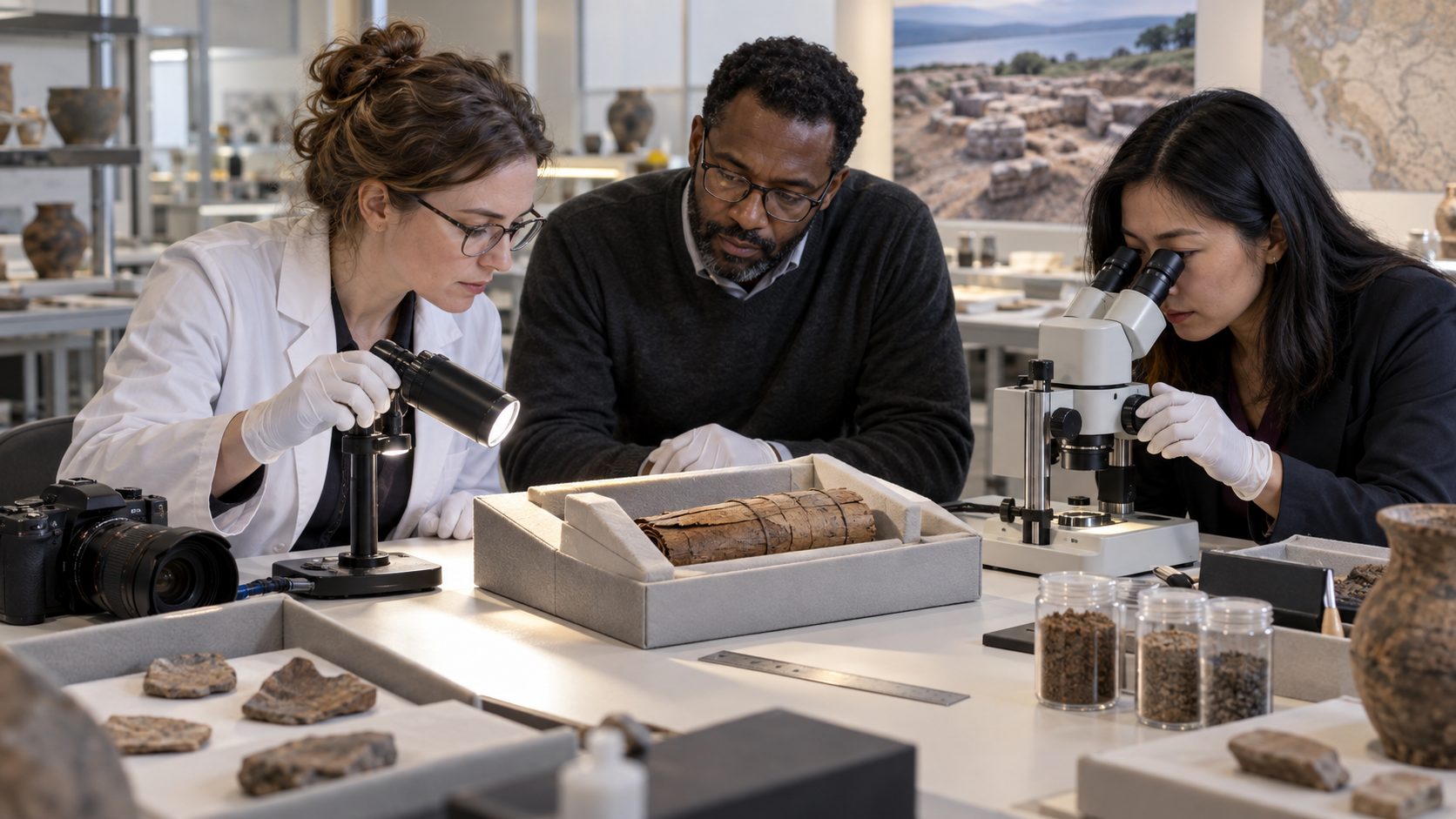
The safest way to understand the Bower Manuscript is to ask what each piece of evidence establishes and where its limits lie. This produces a stronger account than either nationalist exaggeration or automatic dismissal.
| Evidence | What it supports | What it does not establish by itself |
|---|---|---|
| The Sanskrit birch-bark manuscript acquired at Kuchar | Sanskrit textual culture reached or circulated within Eastern Turkistan. | The precise place of composition, the identity of every user, or Indian political rule over Kucha. |
| Xuanzang’s account of temples, stupas and Sarvastivada discipline | Kucha sustained organised Buddhist institutions connected to Indian doctrine and textual originals. | Complete uniformity between every Kuchan and Indian practice. |
| Sanskrit royal names, cave inscriptions and the term kuti | Indian language and institutional vocabulary operated within royal and monastic life. | That Sanskrit displaced every local language or identity. |
| Mathura, Gandhara and Kashmir influences in cave murals | Artistic methods and visual ideas moved through connected cultural routes. | Simple copying from one school or the absence of Kuchan adaptation. |
| Sanskrit nataka with performance directions | Indian dramatic forms and technical stagecraft travelled beyond the subcontinent. | That all theatre in the Chinese cultural world derived from a single Indian source. |
At the first level, the evidence directly establishes an Indian textual and religious presence far beyond the subcontinent. At the second, the convergence of doctrine, language, patronage, visual culture and drama supports a larger civilisational conclusion: Bharat functioned as a generative centre whose ideas and cultural forms were learned and reproduced across Central Asia.
At the third level comes interpretation. The transmission was not a mechanical export from an active India to a passive Kucha. Kuchan rulers funded institutions. Local monks learned and taught. Translators such as Kumarajiva rendered ideas for new audiences. Artists combined influences in new settings. Recipient agency does not weaken Bharat’s role as a civilisational source. It explains how that inheritance took root and travelled farther.
What the evidence does not show is equally important. Cultural reach is not identical to territorial possession. A Sanskrit inscription does not turn an ancient city into a province of a modern nation-state. Nor should present borders be used to erase connections that predate them. Civilisational history follows teachers, texts, rituals, artistic forms and patronage networks across boundaries that political maps later made appear permanent.
This disciplined distinction gives you a more persuasive position. You do not have to inflate archaeological evidence into a claim of conquest. Kucha’s documented participation in an Indian-origin intellectual, religious and artistic world is already historically substantial.
Keep the colonial recovery process in view
The route by which the manuscript entered scholarship also requires double vision. British intelligence operations brought Bower into the region. A local trade in excavated objects brought the manuscript to him. The seller regarded his payment as worthwhile, while Bower considered the sum small in relation to the object’s possible value. Colonial institutions then possessed the money, scholarly networks and publishing infrastructure needed to turn the object into an international academic event.
That asymmetry should not be romanticised. Ancient heritage could be removed from its landscape through transactions shaped by poverty, unequal power and imperial demand. Local finders often disappeared from the historical record while European purchasers gave their names to what they acquired.
Yet dismissing the resulting knowledge simply because colonial actors handled it would create another distortion. Hoernle’s decipherment helped expose a past that contradicted colonial caricatures of Hindus and Indian civilisation as primitive, inert or confined to the subcontinent. The same imperial scholarly machinery that classified conquered peoples also uncovered evidence that made its racial assumptions harder to sustain.
You can preserve both truths by asking separate provenance questions. Who created the object? Where was it used? Who recovered it? Who purchased it? Who deciphered it? Which institution preserved or interpreted it? Collapsing these roles produces either colonial hero worship or a refusal to learn from the artefact. Neither does justice to the people whose civilisation made the object possible.
Turn inherited pride into historical practice
The Bower Manuscript becomes most useful when it changes how you evaluate and communicate civilisational history. The aim is not to memorise a discovery anecdote. It is to learn how a serious claim is built.
Put the place on a map. Locate historical Kucha in modern Kuqa, then connect it with Kashmir, Kashgar and Dunhuang. The map immediately corrects the picture of India and China as sealed civilisations separated by an empty Central Asian space.
Separate the timelines. Kumarajiva belongs to the third and early fourth-century world, the White Horse Pagoda to 384 CE, Xuanzang’s description to the seventh century, Bower’s acquisition to 1890 and Hoernle’s first decipherment to April 1891. Combining these dates into one vague ancient past destroys the causal sequence.
Corroborate across media. A manuscript can travel without transforming a society. A manuscript found beside evidence of monasteries, patronage, Sanskrit terminology, doctrinal continuity, murals and dramatic practice supports a much deeper conclusion. Look for this convergence whenever someone makes a large claim about civilisational influence.
Name the human carriers. Civilisations do not influence one another as disembodied blocks. Monks travel. Translators make concepts legible. Rulers provide patronage. Merchants sustain routes. Artists and performers embody ideas in forms that people can see and hear. Kumarajiva is indispensable because his life reveals the mechanism behind the archaeological pattern.
State the boundary of the claim. Say that the evidence demonstrates a profound Dharmic and Indian civilisational presence in Kucha and an important route into the Chinese Buddhist world. Do not convert that into an unsupported claim of political ownership. Precision protects the history from easy dismissal.
Demand stewardship, not ceremonial praise. Manuscripts and cave paintings matter only when people can study them. A serious civilisational programme would support careful cataloguing, Sanskrit training, archaeological context, translations, conservation and high-quality digital access. It would teach Kucha alongside better-known Indian centres of learning, allowing students to follow ideas across the whole route rather than stopping at the modern border.
A compact lesson can begin with four locations on a map, five dated milestones and five kinds of evidence: manuscript, doctrine, inscription, art and drama. That is enough to show a student how Bharat’s influence moved, how Kucha adapted it and why one chance purchase in 1890 changed the study of an entire region.
The next time you share the Bower Manuscript’s story, attach the place, date, transmission chain and evidentiary limit to the claim. That small discipline turns inherited pride into durable historical knowledge and gives Bharat’s civilisational achievement the accuracy it deserves.
References
- DharmaRenaissance Blog — When the Bower Manuscript Unlocked the Portals to a Vast Hindu Civilisational Imprint in China
- DharmaRenaissance Blog — When a Turkish Muslim Treasure-Hunter Sold an Ancient Sanskrit Manuscript to a Colonial British Colonel in China
