
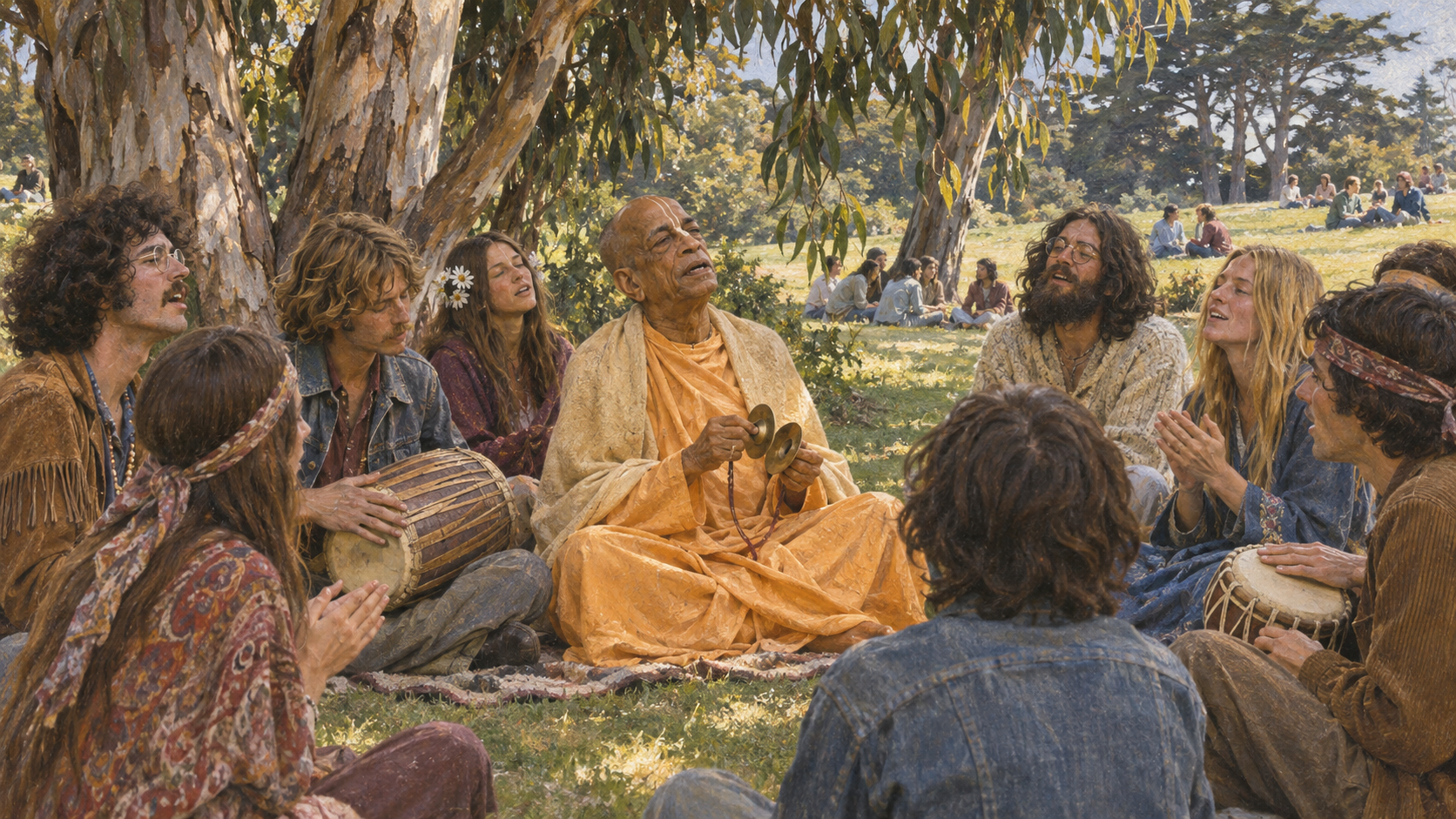
If you have encountered the name “Hippie Hill” in connection with Srila Prabhupada and wondered why the moment matters, resist two easy conclusions. It was neither merely a colourful 1960s curiosity nor, on the evidence available here, an occasion onto which we should project every later achievement of the Hare Krishna movement.
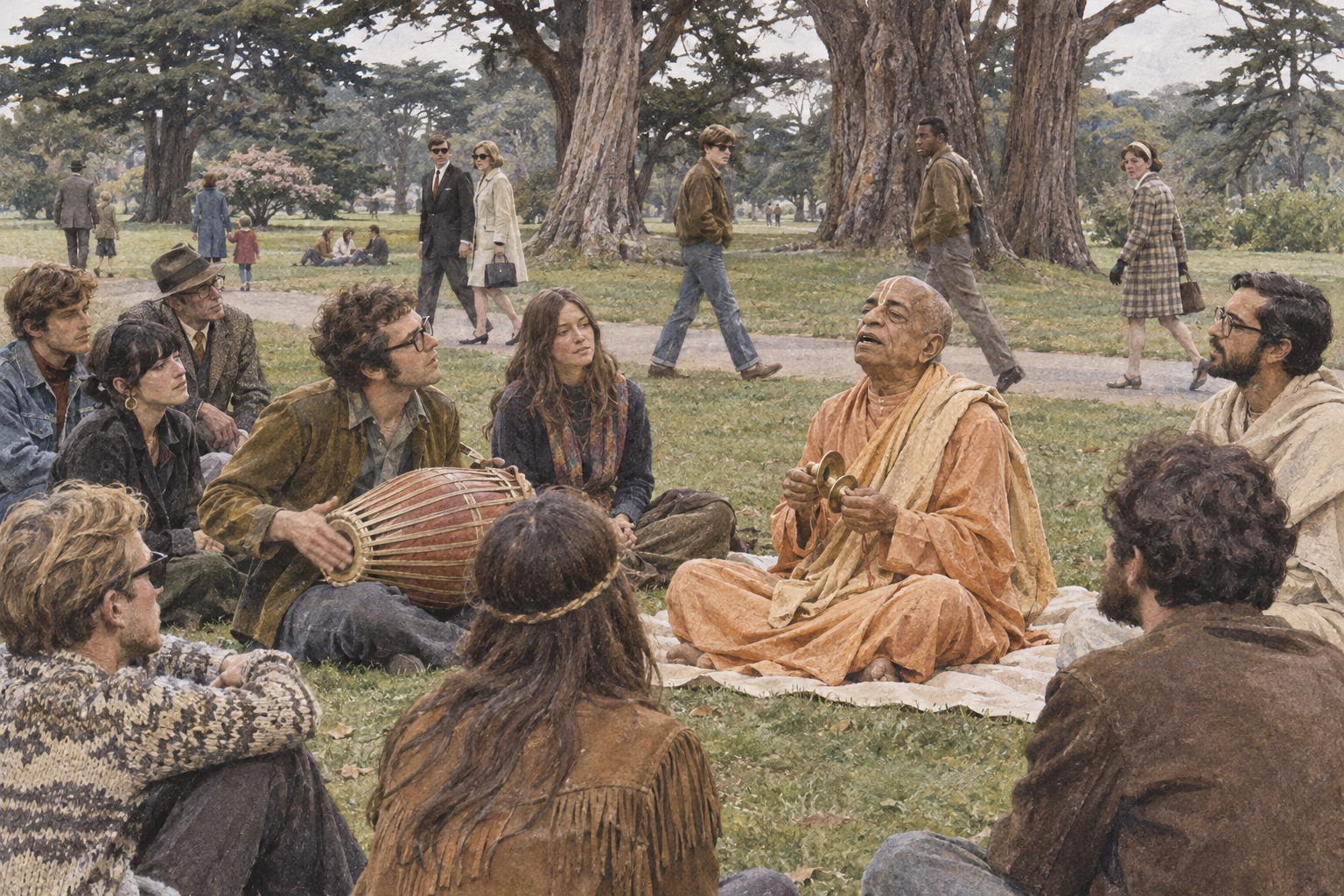
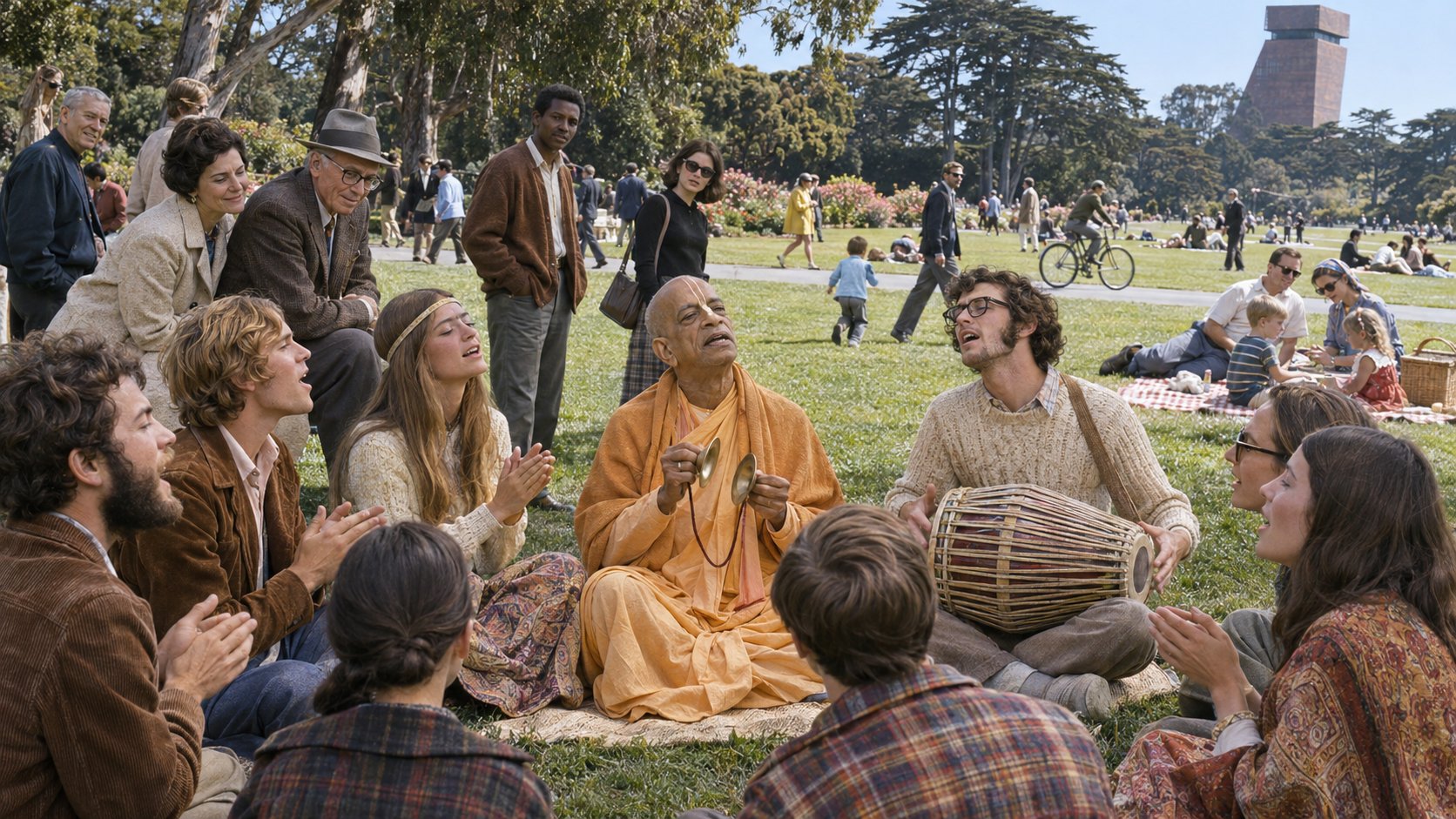
The durable historical core is simple: Srila Prabhupada chanted Hare Krishna at Hippie Hill in Golden Gate Park, San Francisco, in 1966. That is enough to reveal something important about dharmic transmission: a tradition can cross an ocean, enter an unfamiliar public setting and remain recognisably centred on its sacred practice.
Start with the four facts that can carry the story
Historical enthusiasm often creates details faster than it verifies them. In this case, four anchors are secure enough to use:
- Who: Srila Prabhupada, also known as A.C. Bhaktivedanta Swami Prabhupada.
- What: chanting Hare Krishna.
- Where: Hippie Hill in Golden Gate Park, San Francisco.
- When: 1966.
Those four facts do not establish the exact date, duration, size or composition of the gathering. They do not tell you how every listener responded. They also do not, by themselves, prove that this was the first, largest or most consequential event of its kind. If you are teaching the episode, captioning an image or sharing it online, do not supply any of those missing particulars unless you have separate evidence for them.
This restraint does not weaken the story. It protects it. Dharmic history is served badly when devotion becomes an excuse for embellishment. A precise account allows the genuine significance to stand without borrowed drama.
Why a public park changes the meaning of the encounter
A temple establishes a sacred environment before a visitor enters. A public park does not. There is no doorway marking a transition, no prior expectation that everyone present understands the theology and no requirement that a passerby has already chosen to attend a religious programme.
Chanting works differently from a lecture in that setting. You do not need to master a philosophical vocabulary before you can hear it. You do not need to accept a complete doctrinal system before you can repeat a divine name. Sound creates the first point of contact, while explanation can come later.
That sequence is worth noticing. It does not place understanding against devotion. It recognises that human beings often encounter a tradition through practice before they can articulate its philosophy. A mantra may first be heard as sound, then repeated as participation, then investigated as meaning and finally approached as disciplined spiritual practice. Not everyone follows that path, but the threshold is visible.
The location therefore matters without requiring us to romanticise the word “hippie.” A place-name does not prove that everyone present belonged to one subculture, held the same beliefs or received the chanting in the same way. What it does establish is the meeting of a Vaishnava practice with an American public space. That is the historically responsible claim.
Accessibility did not require the tradition to become vague
The Hare Krishna mantra did not need Krishna to be translated out of it before it could be offered publicly. Its accessibility came from the form of the encounter: a sacred name could be heard directly, repetition lowered the barrier to participation, and the practice did not depend on social status or specialist education.
This gives present-day dharmic communities a useful three-part framework:
- Keep the core clear. If the practice centres on divine names, a teaching, a discipline or a sacred text, do not hide that centre to appear more acceptable.
- Lower the threshold. Let a newcomer observe or participate without demanding prior command of Sanskrit terms, sectarian history or complex etiquette.
- Provide the scaffolding. Explain pronunciation, meaning, lineage and conduct in layers, so initial accessibility can mature into informed practice rather than remaining a passing experience.
Confusing these layers produces two opposite mistakes. One community may guard the threshold so tightly that almost nobody reaches the core. Another may make the threshold easy by removing the core itself. The Hippie Hill moment points toward a more confident approach: preserve the sacred content while making the first encounter humanly possible.
You can apply this beyond kirtan. A public reading, meditation session, langar, festival explanation or temple open house can be unmistakably dharmic without expecting a newcomer to know everything in advance. The practical test is straightforward: can a visitor identify what the practice is, participate respectfully at an appropriate level and find a clear path to learn more?
How to share the history without enlarging it
If you plan to use this episode in a class, exhibition, social-media thread or community talk, a disciplined five-step method will keep your account useful.
- Lead with the minimum verified caption. Name Srila Prabhupada, the chanting of Hare Krishna, Hippie Hill, Golden Gate Park, San Francisco and 1966.
- Separate observation from interpretation. “He chanted Hare Krishna there” is the historical claim. “The setting illustrates the portability of bhakti practice” is an interpretation. Both can be valuable, but they are not the same kind of statement.
- Audit what the caption cannot prove. Do not infer crowd size, audience identity, exact chronology, musical arrangement or public reaction from the place-name alone.
- Explain the religious centre. Do not reduce the event to an eccentric feature of 1960s culture. Hare Krishna is a devotional invocation, and chanting divine names belongs within the wider world of bhakti.
- Connect it to the present through a principle, not an inflated claim. Ask how a community can bring an authentic practice into a shared public space. Do not claim that one documented moment single-handedly explains every later development.
A responsible short caption could read: “Srila Prabhupada chants Hare Krishna at Hippie Hill in Golden Gate Park, San Francisco, in 1966. The setting helps us see how a Vaishnava devotional practice could be presented openly in an American public space.” The first sentence states the record; the second tells the reader why it merits attention.
Preserve the identifying information whenever you repost historical material. Names, place and year are not decorative metadata. Once separated from an image or recording, they are difficult to recover, and an evocative fragment can quickly become an untraceable legend.
A short FAQ for readers and teachers
Does “Hippie Hill” tell us who attended?
No. It identifies the location, but it does not establish the identity, beliefs or number of everyone who may have been present. Treat any stronger description of the audience as a separate claim requiring separate evidence.
Was the chanting made non-religious for the public setting?
Nothing in the central fact supports that reading. The act identified is the chanting of Hare Krishna, not a generic musical performance. Its public accessibility should not be confused with the removal of its devotional meaning.
What is the most important lesson for a dharmic organiser?
Make the point of entry simple without concealing the identity of the practice. Let people hear, observe or participate respectfully, then give them accurate language and a clear route to deeper understanding. Openness and rootedness can support each other.
The next time you share the Hippie Hill moment, begin with its four firm anchors and label your interpretation as interpretation. Then put its deeper principle to work: take a living dharmic practice into the world with its centre intact and its threshold open.
References

Leave a Reply
You must be logged in to post a comment.