
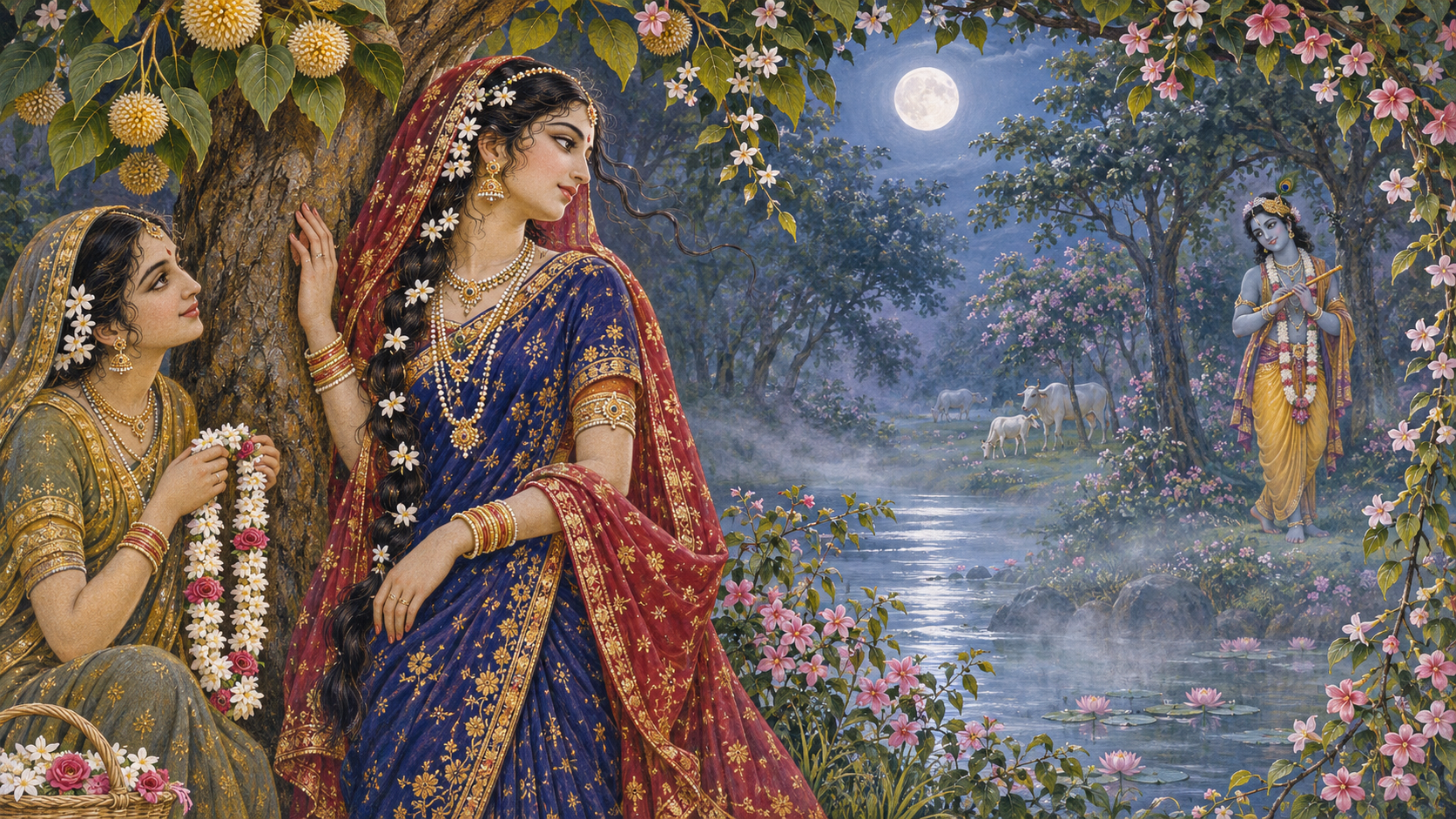
You may encounter a painting, poem, or meditation that dwells on Sri Radha’s hair and wonder how you are meant to receive it. Is the detail merely ornamental, uncomfortably sensual, or spiritually significant? Devotional aesthetics gives you a practical answer: do not stop at the visible feature. Follow it toward relationship, remembrance, and seva.
This change in attention matters. Hair can communicate movement, care, intimacy, concealment, interruption, or composure without a long explanation. Read within a devotional scene, it becomes a doorway into bhava. Isolated from that scene, it can collapse into decoration or objectification.
Why one visible detail can awaken devotional feeling
Ordinary description often asks what someone looks like. Devotional description asks what the sight awakens in a particular relationship. That is why Sri Radha’s hair can be contemplated as a stimulus for ecstatic love, rather than treated as an incidental part of her appearance.
In the vocabulary of bhakti-rasa, a cue that awakens or intensifies a devotional disposition may be called an uddipana. The word is useful so long as you do not hear it mechanically. A visual feature does not manufacture devotion by itself. It becomes spiritually expressive within a field of identity, relationship, lila, memory, and response.
This gives you the first rule for interpretation: Sri Radha is not assembled from a collection of attractive features. Her features matter because they are hers. The person gives meaning to the beauty; the beauty does not define the person.
Hair is particularly expressive because it can be arranged or loosened, adorned or left plain, covered or revealed, still or moving. These are not fixed codes with one meaning each. They are visual conditions that can carry meaning when the surrounding scene tells you what happened, who is present, and how the beholder responds.
We use bhava here in the practical sense of devotional mood or disposition. The point is not to admire technique and then move on. The visible form should help orient your attention toward the loving reality expressed through it.
Read the motif through four connected questions
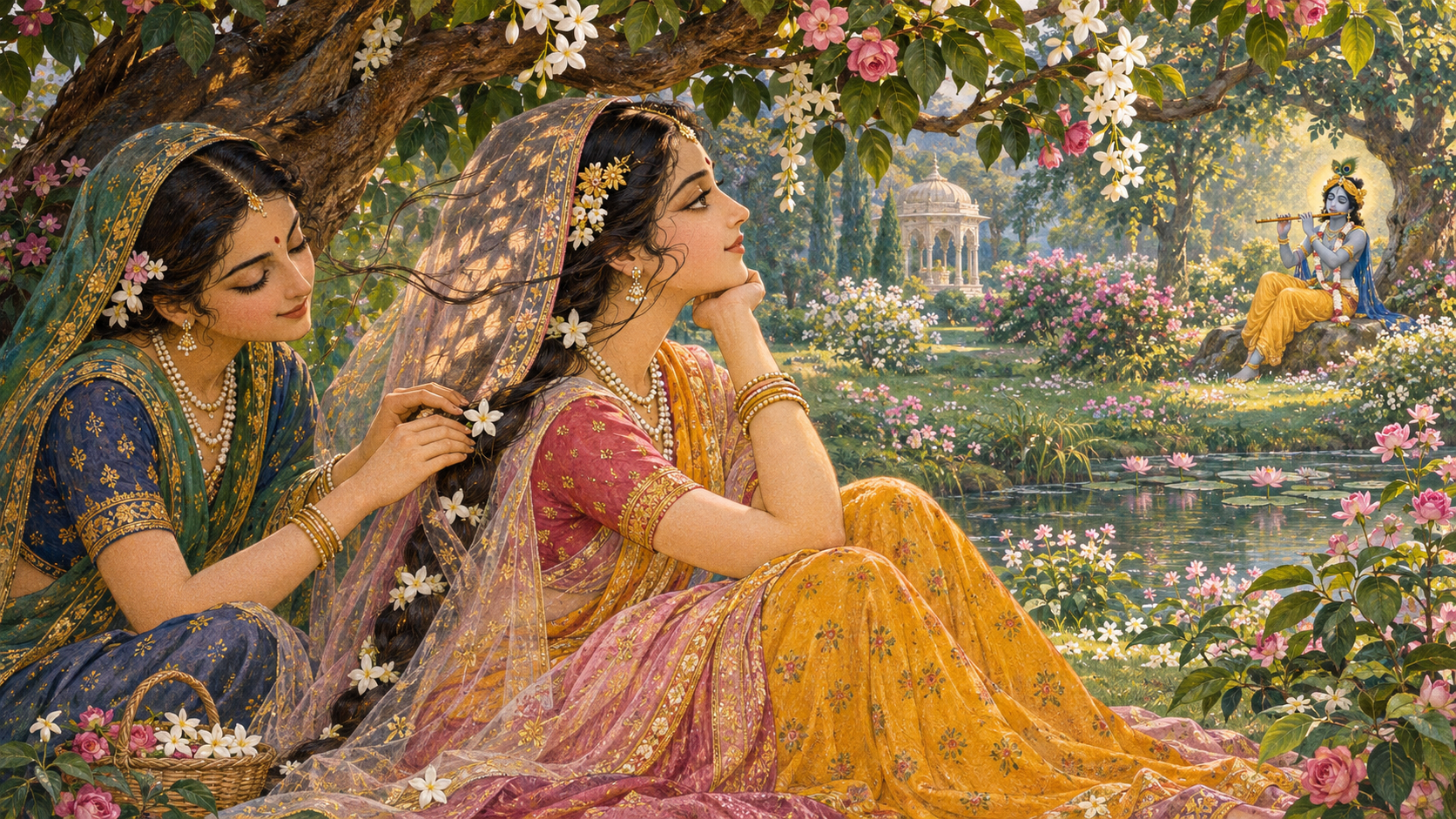
A common mistake is to assign a fixed emotional definition to a visible feature: arranged hair must mean one thing, loosened hair another. That approach turns devotional imagery into a codebook. A better reading follows four connected questions.
- What is its condition? First observe what is actually present. Is the hair composed, disturbed, ornamented, covered, visible, still, or in motion? Do not name an emotion yet. Observation prevents your interpretation from outrunning the image or words before you.
- What caused that condition? Look for movement, an act of adornment, an interruption, a covering, or another action supplied by the scene. Cause turns a static feature into part of a lila. If no cause is given, leave the question open rather than inventing one.
- Who notices it? A detail perceived by Krishna, attended by a sakhi, remembered by a devotee, or presented directly to a viewer does not occupy the same relational position. Do not assume the witness. Identify the gaze that the scene actually establishes.
- What response follows? Ask whether the perception produces tenderness, wonder, longing, remembrance, service, or another devotional movement. The response is often where the motif’s meaning becomes clearest.
You can record the sequence in four words: condition – cause – witness – response. If one link is missing, acknowledge the gap. If several links are missing, avoid announcing a precise bhava. Restraint is not a failure of devotion; it protects the scene from being replaced by your projection.
This method also explains why two depictions of hair need not mean the same thing. The visible condition may resemble another image, yet a different cause, witness, or response can give it a different devotional function. Context carries more weight than resemblance.
Sacred intimacy is not the same as objectification
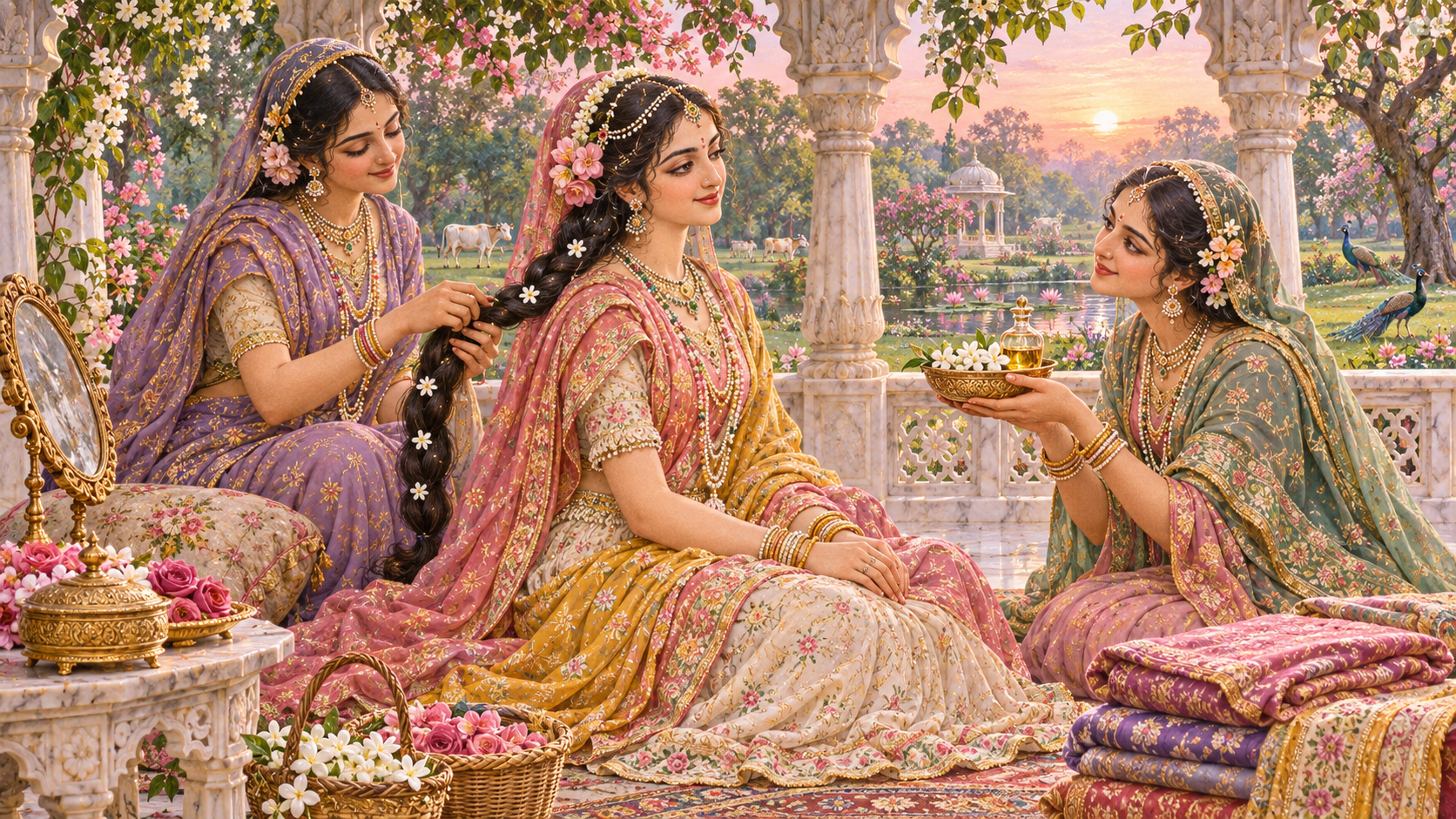
Many readers feel a real tension here. They do not want to reduce Sri Radha to physical beauty, but they also do not want to strip devotional tradition of its sensuous richness. The way through is neither indulgence nor embarrassment. It is disciplined attention.
Objectification removes a feature from personhood and relationship so that it can be consumed as a spectacle. Devotional seeing moves in the other direction. It receives the feature as belonging to Sri Radha, situates it within lila, and asks what transformation it produces in the beholder.
When you evaluate a description or image, watch for four warning signs:
- The physical feature receives more attention than Sri Radha’s agency, presence, or relationship.
- The viewer’s gaze is treated as neutral, with no question about who is looking or why.
- Adjectives accumulate, but the scene, action, and devotional consequence remain vague.
- The description ends in visual possession rather than remembrance, reverence, tenderness, or seva.
The repair is concrete. Put Sri Radha back in the grammatical and devotional center. Connect the detail to an action. Identify the relationship in which it is perceived. Then show what the perception asks of the beholder.
Reverence does not require you to drain the image of beauty. Beauty itself is not the lapse. The decisive question is where the beauty directs desire and attention. Does the viewer remain outside the scene as a consumer, or become inwardly oriented toward loving remembrance and service?
Audience and lineage also matter. Intimate contemplative material should not be detached from the theological and devotional formation that makes it intelligible. If your sampradaya places boundaries around particular forms of lila-smarana, honor those boundaries. An aesthetic technique cannot replace siddhanta, disciplined practice, or guidance appropriate to your path.
A practical method for readers and creators

If you are reading or viewing
- Pause before naming the mood. Describe the visible detail to yourself without interpreting it. This separates observation from assumption.
- Reconstruct only the scene you have actually been given. Note the action, setting, and relationships. Do not fill every silence with an imagined episode.
- Ask what the motif is doing. It may indicate motion, preserve a trace of an earlier action, become an object of care, or awaken recognition. Choose the function best supported by the scene.
- Notice where your own attention goes. If it stops at appearance, return to the person and relationship. If it leads toward remembrance or seva, remain with that devotional movement.
- Translate the response into your established practice. Depending on your path, that may mean nama-japa, kirtan, prayer, study, or a form of mental seva received within your lineage.
This procedure keeps aesthetic sensitivity joined to spiritual discipline. You are not trying to suppress your perception. You are training it to move from form to relationship and from relationship to devotion.
If you are writing, teaching, or making sacred art
Begin with the scene, not the ornament. Before composing the physical detail, write three answers in the margin: Who perceives this? What has happened? What should the perception awaken? If you cannot answer those questions, adding more visual detail will usually make the work more decorative, not more devotional.
- Give the motif one primary function. Let the hair indicate movement, receive adornment, preserve a trace of action, focus an act of care, or stimulate recognition. Asking it to perform every function at once produces clutter.
- Keep Sri Radha as the acting presence. Grammar matters. A passage dominated by detachable body parts can objectify even when every adjective is reverential.
- Preserve relational cues. If the scene includes Krishna, a sakhi, or a devotee-beholder, let that relationship shape composition, direction of gaze, and emphasis. Do not insert a figure merely to make the image look more devotional.
- Use detail selectively. One well-placed indication of movement or care can carry more bhava than an inventory of ornaments.
- End on consequence. The final emphasis should fall on what is remembered, felt, recognized, or offered – not on the completion of a visual catalogue.
A simple revision exercise makes the difference visible. A flat sentence merely announces, “Sri Radha’s hair is beautiful.” A more devotional sentence connects beauty to function: the movement of her hair returns the beholder’s attention to the lila and awakens a wish to serve. The second sentence is not better because it is longer. It is better because it has a scene-facing direction and a devotional consequence.
For a painting, apply the same test before adding another ornament, highlight, or strand. Ask whether the addition clarifies movement, relationship, or mood. If it only increases surface richness, it may compete with the devotional center. For a temple talk or caption, explain why the detail matters before cataloguing how it appears.
Do not turn these principles into another rigid formula. Sacred art can work through suggestion, silence, and ambiguity. The discipline is not to explain everything. It is to ensure that what you emphasize serves the lila rather than displacing it.
Key takeaways
- Sri Radha’s hair is devotionally meaningful when it awakens bhava within a relationship, not when it is isolated as a physical spectacle.
- Read the motif through condition, cause, witness, and response. Do not assign a fixed mood from appearance alone.
- Objectification detaches beauty from personhood; devotional seeing returns beauty to Sri Radha, lila, remembrance, and seva.
- Writers and artists should give the detail one clear function and keep relational cues stronger than ornamental accumulation.
- Honor the interpretive boundaries of your sampradaya, especially when approaching intimate contemplative material.
The next time Sri Radha’s hair catches your attention in an image or verse, take one minute before moving on. Name its condition, identify the relationship around it, and notice the response it awakens. That small discipline can turn passive admiration into devotional seeing.
References

Leave a Reply
You must be logged in to post a comment.