
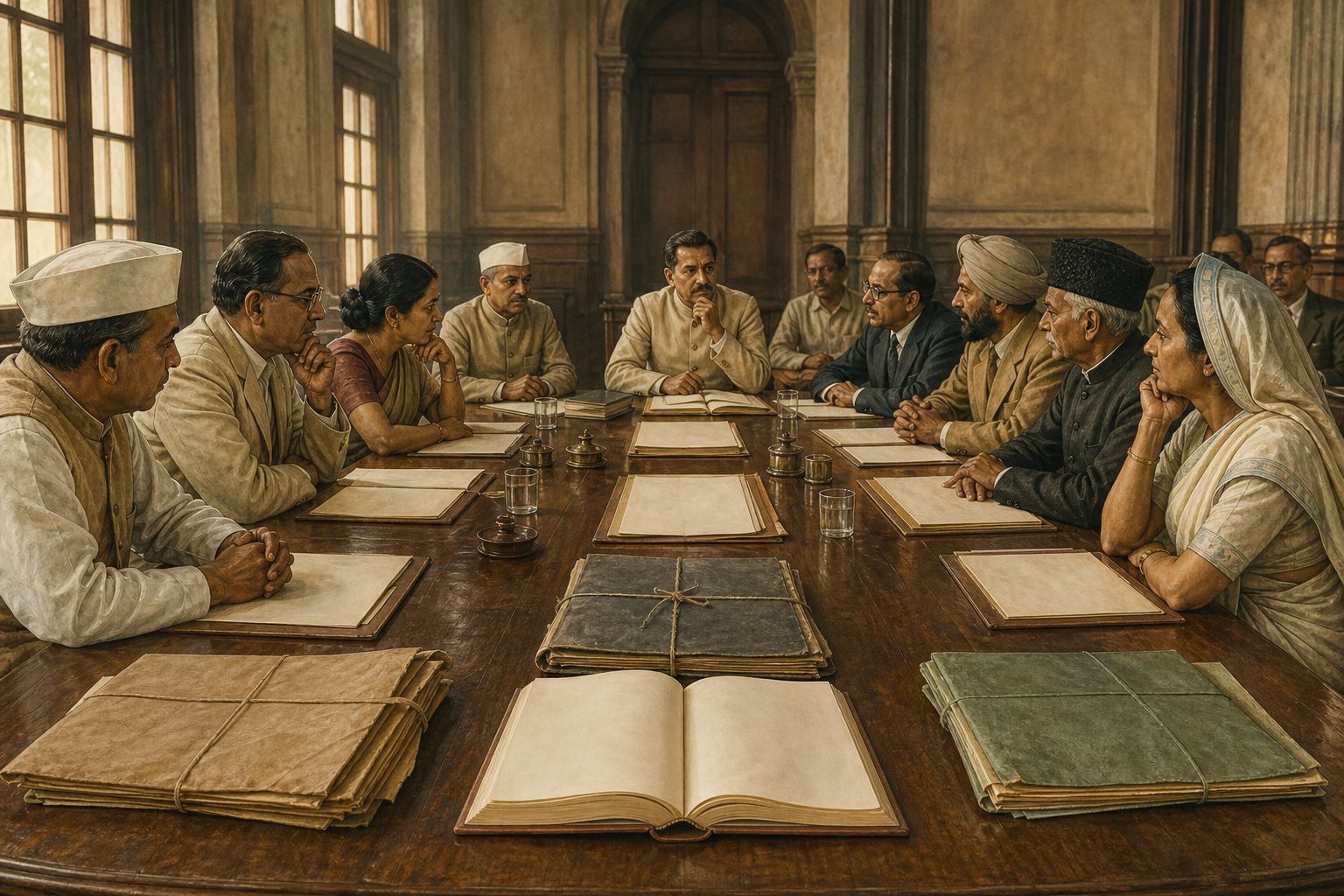
If you are trying to answer one narrow question — did India’s Constitution-makers overlook religious conversion when they considered Scheduled Caste protections? — do not begin with a present-day slogan. Begin with the institutional sequence.
That sequence gives you a firmer answer than either extreme usually offers. The Constituent Assembly’s minority process did confront the position of Christian converts from the Depressed Classes. It made a deliberate classification choice. But that choice was not a finding that conversion instantly eliminated poverty, inherited disadvantage, or social prejudice.
The conversion question was before the Assembly process in 1947
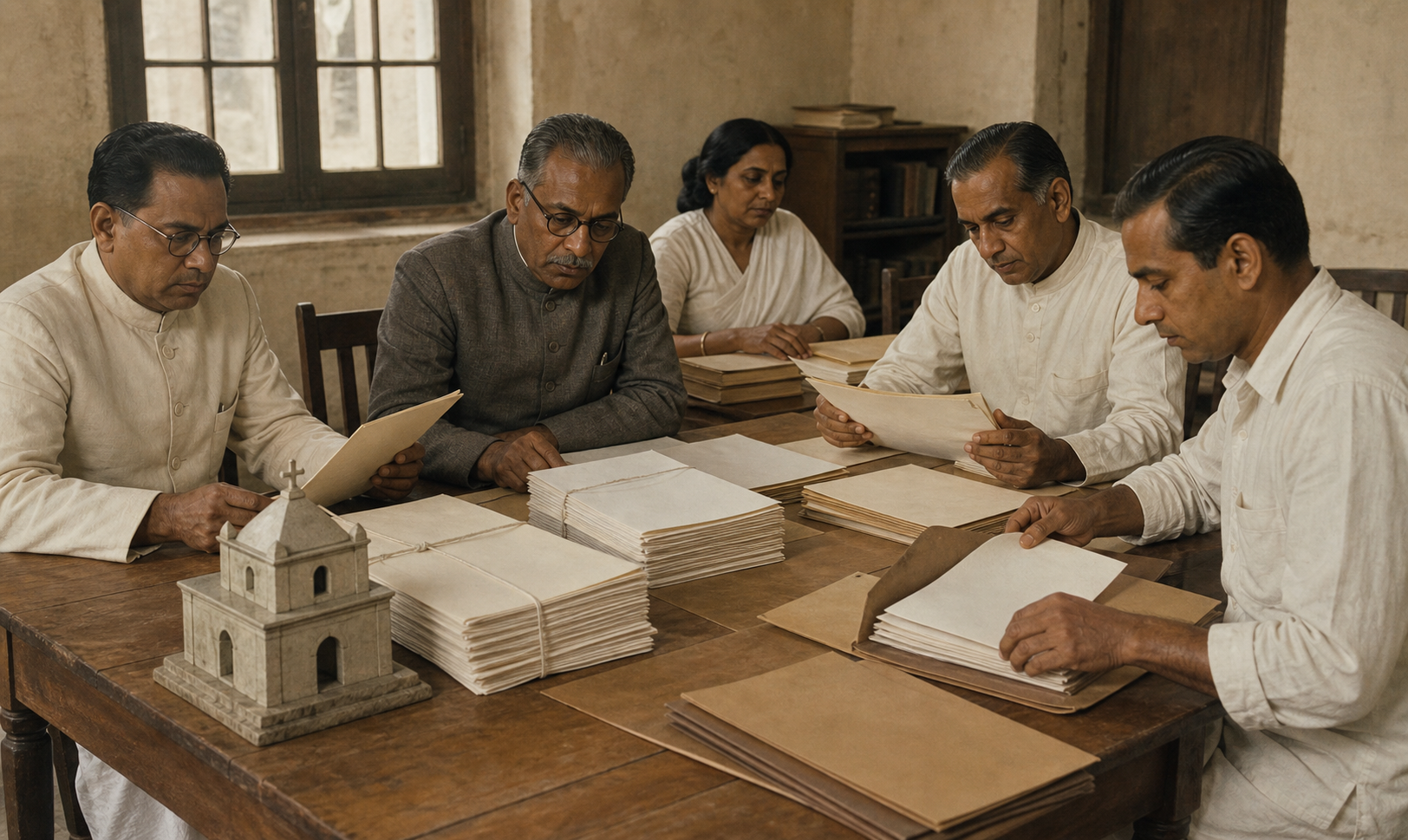
In August 1947, the Constituent Assembly’s Sub-Committee on Minorities considered representations from the Madras Provincial Christian Association, the Travancore-Cochin Native Christian Association, and the South Indian Christian Dalit Federation. These organisations argued that conversion to Christianity had not materially changed the economic condition of Dalit converts and that the converts should continue receiving protections available to the Hindu Depressed Classes. The issue was therefore raised expressly rather than left unnoticed.
This corrects a common historical error. You cannot reasonably describe the exclusion of Christian converts as an accidental gap created because nobody had considered their circumstances. Christian organisations made the continuity-of-disadvantage case before the constitutional framework was completed.
The participation question matters as well. The issue was resolved with the direct involvement of elected Christian representatives within the Assembly. That does not mean every Christian agreed, nor does representation make a decision immune from later criticism. It does mean the episode should not be narrated as though an entirely absent Christian community had a rule silently imposed upon it.
Keep the conclusion within its evidentiary boundary. This episode directly establishes consideration of claims made for Christian converts. It should not be stretched into proof of every religion-specific argument about Muslim converts unless the corresponding proceedings are also identified.
What the Sub-Committee decided — and what it did not decide

The Sub-Committee declined to create a separate category of Christian Scheduled Castes. Instead, it placed Christians of different caste origins within a single category of Indian Christians. The classification treated conversion as constitutionally relevant rather than preserving the convert’s previous Scheduled Caste identity unchanged. It also followed a classification position traced to the colonial state from 1932.
That was a substantive boundary-making decision, not merely a filing convenience. The Assembly process distinguished between a Hindu Depressed Class classification and membership in the Indian Christian minority. Religious identity was treated as having consequences for the constitutional category under which a person would be considered.
Do not convert that legal conclusion into a broader sociological claim. The Sub-Committee’s refusal to create Christian Scheduled Castes did not prove that every convert had escaped poverty, occupational disadvantage, family history, or prejudice. Indeed, the Christian organisations had placed continuing economic deprivation at the centre of their request. The institutional response was that such deprivation did not, by itself, require retention of the previous religiously situated classification.
This distinction protects the history from two opposite distortions. One side cannot say that continuing hardship automatically settled the constitutional category in favour of converts. The other cannot say that the classification decision established the disappearance of hardship. The Assembly process considered both religious identity and disadvantage, but it did not treat them as interchangeable facts.
Four questions that should not be collapsed into one

Most arguments become confused because they move between social conditions, constitutional design, historical intent, and present policy without announcing the change. You can keep the debate honest by separating four questions.
- Did material disadvantage continue after conversion? Christian organisations answered yes in their 1947 representations, specifically invoking the economic condition of Dalit converts. That was a claim about lived circumstances.
- Did continuing disadvantage automatically preserve the same constitutional classification? The Sub-Committee answered no. That was a decision about how protections and minority categories would be structured.
- Was conversion treated as legally irrelevant? No. The refusal to create Christian Scheduled Castes shows that the change of religious identity carried classificatory consequences.
- Must present-day India retain every boundary chosen in 1947? History alone cannot answer that normative question. A contemporary change can be argued for, but it should be presented as a proposed change, not disguised as the recovery of an intention the 1947 episode contradicts.
Watch for the skipped step. If someone begins with continuing discrimination and immediately concludes that the framers intended Christian converts to retain Scheduled Caste status, the classification question has disappeared. If someone begins with the Sub-Committee’s decision and concludes that Christian converts could not have experienced deprivation, the social question has disappeared instead.
A Dharmic reading should resist both shortcuts. Hindu society’s responsibility to reject untouchability, humiliation, and inherited exclusion does not depend on whether a person qualifies for a particular constitutional category. At the same time, the moral urgency of social reform does not entitle us to rewrite a constitutional history in which conversion was consciously treated as relevant.
This is where a pro-Hindu case is strongest: acknowledge injustice without evasion, support reform without hesitation, and describe the constitutional boundary without pretending that the framers never heard the objection to it.
How to test claims about what the framers intended

You do not need to accept a sweeping historical claim merely because it invokes the Constituent Assembly. Use the following audit whenever a speech, petition, or social-media thread tells you what the framers supposedly settled.
- Identify the forum. Distinguish the full Assembly from a committee or sub-committee. Here, the specifically identified forum was the Sub-Committee on Minorities. Do not casually turn a sub-committee action into a unanimous plenary vote.
- State the exact request. The relevant Christian organisations were not making a general plea for religious freedom. They argued that conversion had not materially improved Dalit converts’ economic position and sought continued access to protections associated with the Hindu Depressed Classes.
- Name the participants. Ask who submitted the demand and whether representatives of the affected community took part. This prevents both the erasure of Christian advocacy and the false impression that Christians had no voice in the process.
- Track the disposition. Consideration is not acceptance. The Sub-Committee heard the position but declined the requested Christian Scheduled Caste subcategory, choosing a unified Indian Christian minority classification.
- Limit the conclusion. The episode establishes deliberate consideration and rejection of a specific demand. It does not, without further evidence, establish unanimity among every framer, prove the end of caste-origin disadvantage, or resolve every modern legal and policy question.
Language is a useful warning signal. Be cautious when someone says the Constitution explicitly says something but cannot identify the provision. Be equally cautious when someone says the framers were silent while ignoring the 1947 minority process. The most defensible wording is narrower: the Sub-Committee considered representations seeking continued protections for Christian Dalit converts and declined to create a Christian Scheduled Caste category.
For deeper verification, ask for the date of the proceeding, the committee name, the organisations represented, the relief requested, and the recorded outcome. These five details make a historical claim testable. Without them, an invocation of constitutional intent is often only a political preference wearing historical clothing.
Key takeaways
- The claim that Christian converts were simply forgotten does not fit the August 1947 Sub-Committee process; Christian organisations expressly sought continued protection for Dalit converts.
- The Sub-Committee rejected a Christian Scheduled Caste subcategory and classified Christians together as the Indian Christian minority.
- The decision treated religious conversion as constitutionally relevant, but it did not establish that conversion erased every form of economic or social disadvantage.
- A modern proposal to change the boundary should be debated on its present merits, not justified by claiming that the framers never considered the issue.
When you next encounter this controversy, write three separate lines before reaching a conclusion: what happened in 1947, what the governing law currently provides, and what policy you believe India should adopt. If one sentence tries to perform all three tasks, split it. That simple discipline will expose most of the confusion surrounding Scheduled Castes and conversion.
If an individual’s eligibility for a benefit or legal protection is at stake, historical reasoning is not enough. Verify the current legal position through applicable official rules and qualified legal advice. The 1947 decision is essential to an argument about constitutional history, but it cannot substitute for the law governing a particular claim.
References
