
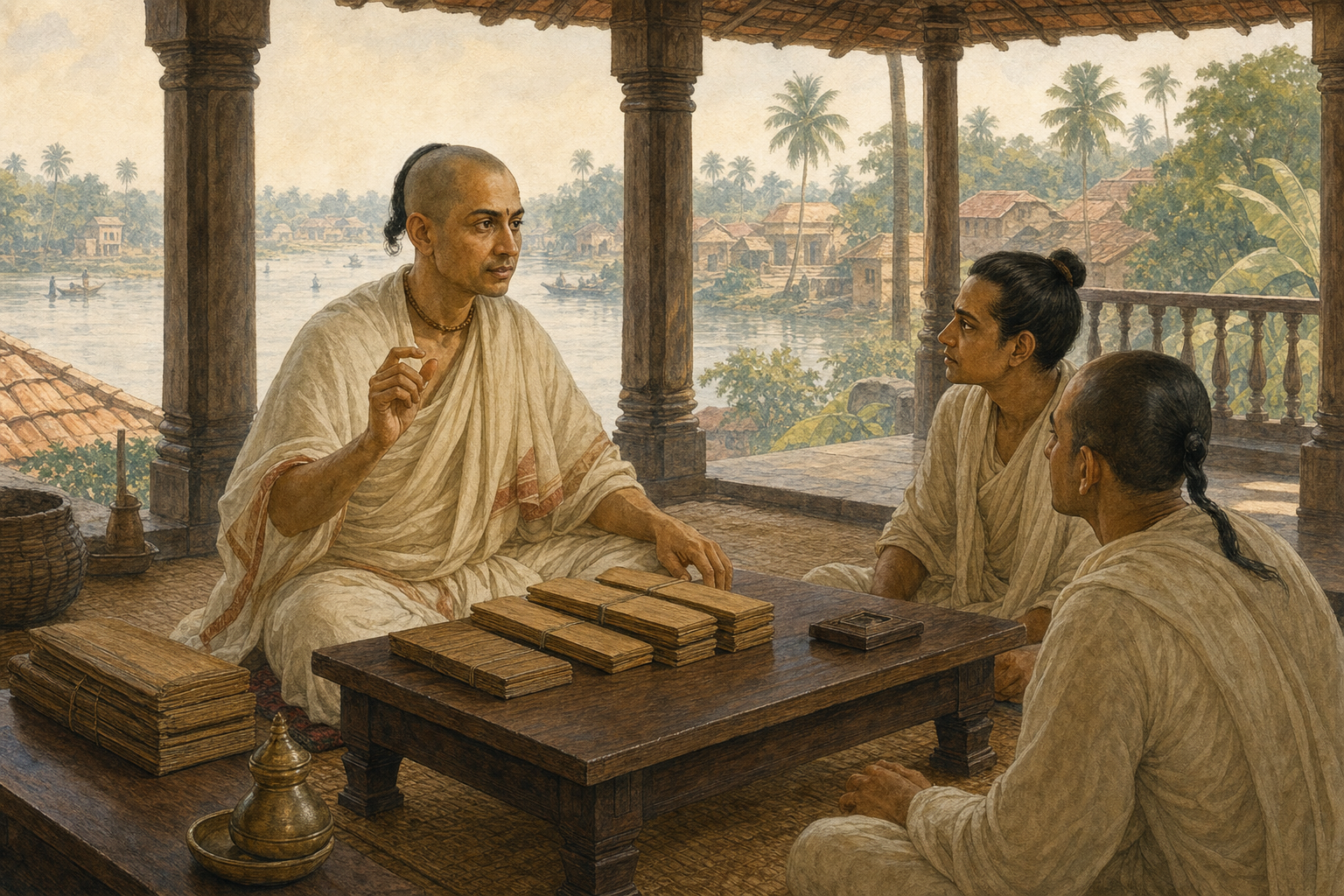
If you were taught that India entered modern intellectual life only after encountering European thought, Raghunātha Śiromaṇi creates a serious problem for that account. Working within Sanskrit learning rather than against it, he treated inherited philosophical categories as open to criticism, refinement, and even rejection.
You do not need to turn Raghunātha into an Indian Descartes to understand his importance. The more useful question is whether Indian thinkers developed their own practices of intellectual renewal: practices in which reason could revise authority, technical language could be rebuilt, and continuity with a tradition did not require submission to every conclusion inherited from it.
Before calling Raghunātha modern, define the claim
The word modernity can conceal several different claims. It may refer to a historical period, a particular set of political institutions, the rise of experimental science, secularization, or a style of inquiry that permits received knowledge to be tested. Those meanings overlap, but they are not interchangeable.
Raghunātha’s case supports a precise claim about intellectual modernity. A philosophical tradition became capable of examining its own foundations through disciplined argument. Its practitioners did not merely preserve old answers. They developed methods and a technical vocabulary with which those answers could be separated, reconstructed, challenged, and replaced.
That is narrower than claiming that every institution associated with later European modernity already existed in India. It is also more defensible. Raghunātha, who lived approximately from 1475 to 1545, worked roughly a century before Francis Bacon and René Descartes. Chronology matters because it rules out the assumption that his critical method must have been borrowed from them. Chronology alone, however, does not make two intellectual projects identical.
Key takeaways
- Raghunātha represents intellectual renewal within a Sanskrit philosophical lineage, not a revolt that required abandoning that lineage.
- His importance lies in method: widely accepted positions remained answerable to independent reasoning and careful evaluation.
- Navya-Nyāya innovation involved both ideas and language. Finer analysis required a more exact technical idiom.
- The comparison with Descartes is useful for correcting a one-sided chronology, but misleading if it turns Europe into the measure of every Indian achievement.
- Indian modernity is strongest as a specific historical argument, not as a slogan claiming that India possessed every later form of modern life first.
What Raghunātha changed inside Nyāya
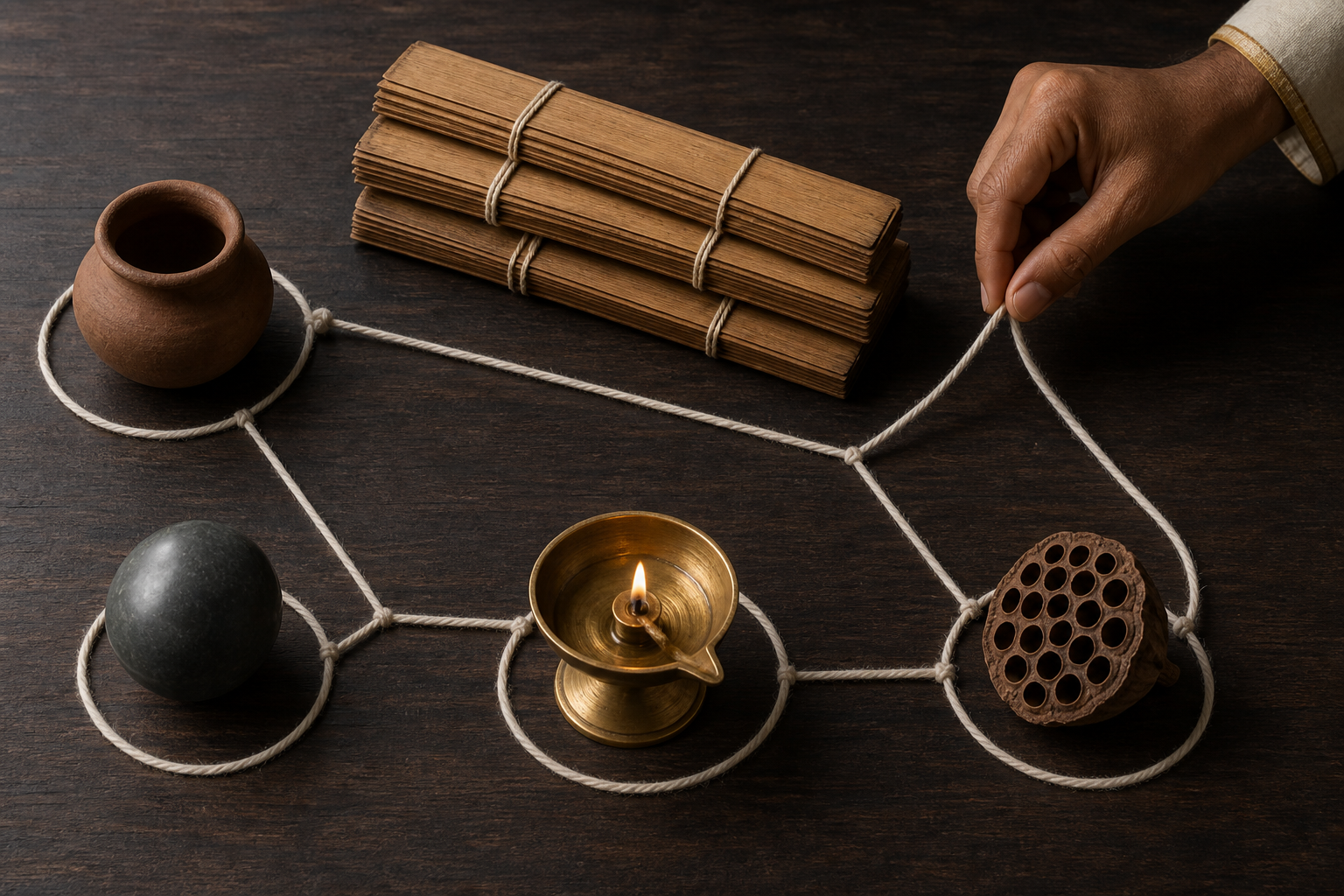
Raghunātha’s importance cannot be reduced to the fact that he was an intelligent commentator. His Padārtha-tattva-nirūpaṇa participated in a deeper transformation of logic, epistemology, and ontology. Three features help you recognize the scale of that transformation.
Inherited positions became revisable
A tradition can accumulate enormous learning while remaining intellectually static if every conclusion has already been protected from criticism. Raghunātha took another path. Even an established position had to survive close examination. Scriptural interpretation and respect for earlier teachers could frame a question, but they did not eliminate the need for reasons.
This distinction is easy to miss. Traditional vocabulary does not necessarily signal traditionalist obedience. The real test is what happens when an inherited classification fails under analysis. Must the thinker preserve it because it is old, or may a stronger argument force its revision? Raghunātha’s willingness to reconsider accepted views places him on the second side of that line.
Technical language became an instrument of discovery
Navya-Nyāya thinkers needed to express relationships at an exceptional level of precision. Ordinary philosophical Sanskrit, even with its rich inherited vocabulary, did not always provide an unambiguous form for the distinctions they wanted to make. They therefore developed a specialized analytical idiom capable of tracking fine relations as well as the larger structures composed from them.
This was not ornamentation. When a disagreement turns on the scope of a property, the location of a qualifier, the relation between a cognition and its object, or the exact structure of an inference, loose language can conceal the problem. A stricter vocabulary makes hidden assumptions visible. Once visible, those assumptions can be tested.
You can recognize the same mechanism in any rigorous field. New notation is often created because an old vocabulary cannot carry the required analysis without ambiguity. The notation does more than shorten an explanation. It allows investigators to notice relationships that were previously difficult to isolate. Navya-Nyāya’s technical language served that kind of philosophical work.
Commentary could transform rather than merely preserve
Modern readers often look for originality in a standalone treatise that announces a clean break with earlier authorities. Sanskrit intellectual life frequently placed innovation inside commentary, subcommentary, debate, and reinterpretation. A thinker could begin with an inherited text and still alter how its argument, concepts, or consequences were understood.
The Navya-Nyāya style used commentary to expose implicit meanings, resolve difficult arguments, and sometimes reconstruct a text through a new conceptual framework. Judging such work by its literary form produces a category error. The useful question is not whether an old text appears on the page. Ask whether the commentator merely repeats it or makes its claims pass through a new standard of analysis.
When you encounter a work from a scholastic tradition, use this sequence:
- Identify the proposition inherited from an earlier teacher or text.
- Reconstruct the reasons offered for it instead of treating the cited authority as the reason.
- Locate any ambiguity that the later thinker is trying to remove.
- Notice whether new terminology changes what can be distinguished or inferred.
- Check whether the inherited conclusion survives, is qualified, or is rejected.
This method keeps you from mistaking continuity of format for absence of innovation.
Continuity was a method, not a refusal to change
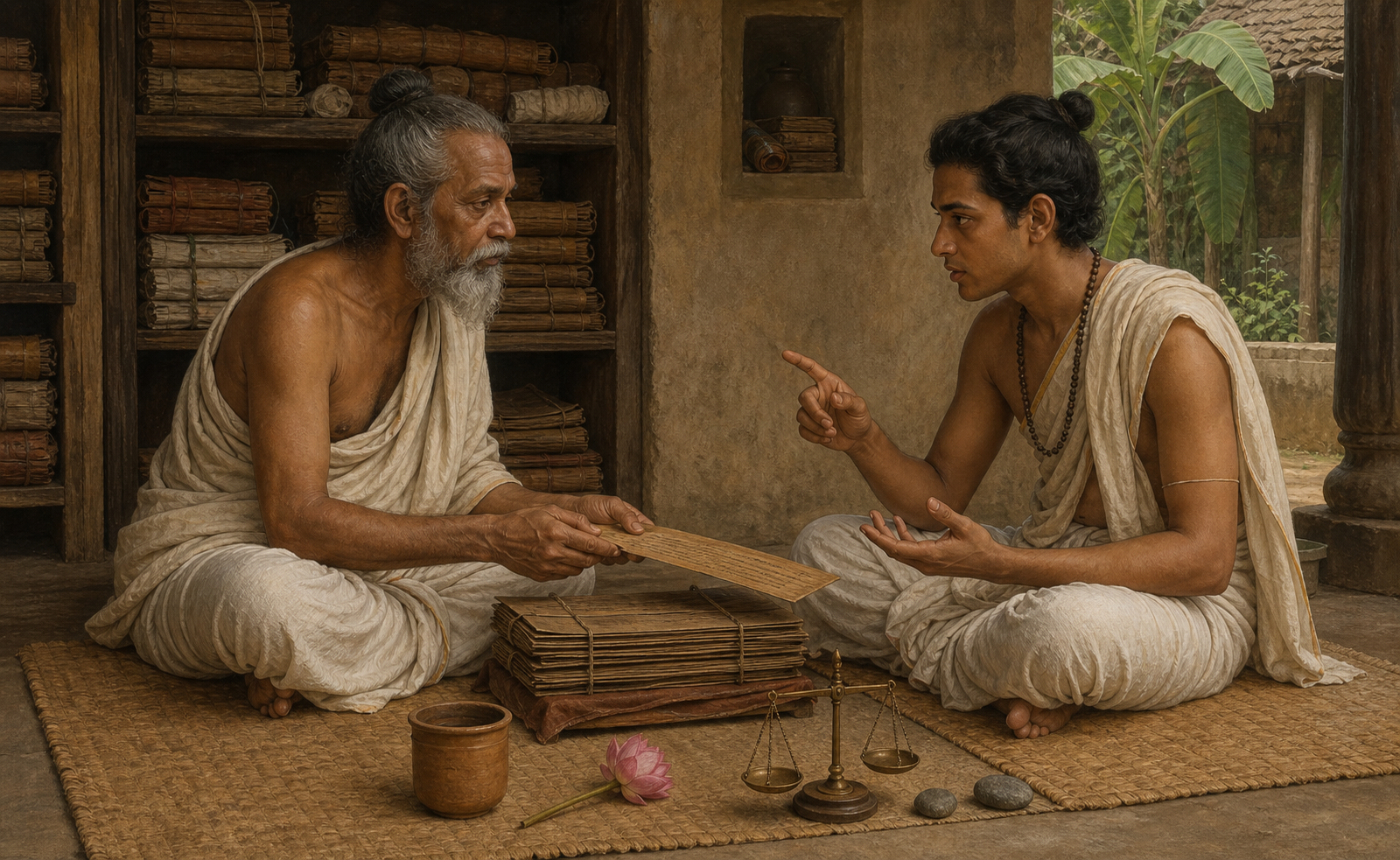
Some accounts of modernity begin with rupture: the new thinker escapes the old world by refusing its authorities. That describes parts of European intellectual history, but it should not become a universal entrance requirement. Indian philosophical renewal often worked by returning to inherited questions with sharper distinctions and stronger objections.
The wider Dharmic record makes this visible. The Upaniṣadic movement questioned the sufficiency of ritualism while preserving and reworking older philosophical insights. Buddhist arguments denied a persisting individual self, while Nyāya-Vaiśeṣika treated the self as ultimately real. Jaina traditions developed their own logical disciplines and cultivated ways of reasoning across multiple standpoints. These were not minor variations around a compulsory consensus. They were disagreements about reality, knowledge, liberation, and the human person.
Tradition, in this setting, was not one frozen answer. It was an inherited arena of questions, concepts, practices, teachers, objections, and standards of debate. Membership in that arena gave a thinker intellectual resources, but it did not require every school to reach the same conclusion.
This gives you a better test for continuity. Do not ask only whether a thinker cites an earlier authority. Ask whether the lineage permits reasons to expose a weakness in an inherited view. Continuity becomes intellectually productive when it preserves the conversation while leaving its conclusions revisable. It becomes mere deference when age or status makes a proposition immune to examination.
The distinction also protects Dharmic unity from being reduced to doctrinal sameness. Hindu, Buddhist, Jaina, and Sikh readers do not need to pretend that their traditions teach identical metaphysics. A more credible civilizational bond lies in the seriousness with which they have treated questions of truth, conduct, consciousness, discipline, and liberation. Shared respect for inquiry can hold real disagreement without erasing it.
Raghunātha therefore matters for more than Nyāya specialists. He demonstrates that fidelity and criticism need not be opposites. A thinker can learn the inherited system well enough to discover where it fails, then use the system’s own discipline of reasoning to move beyond an accepted conclusion.
Institutions made exact reasoning durable
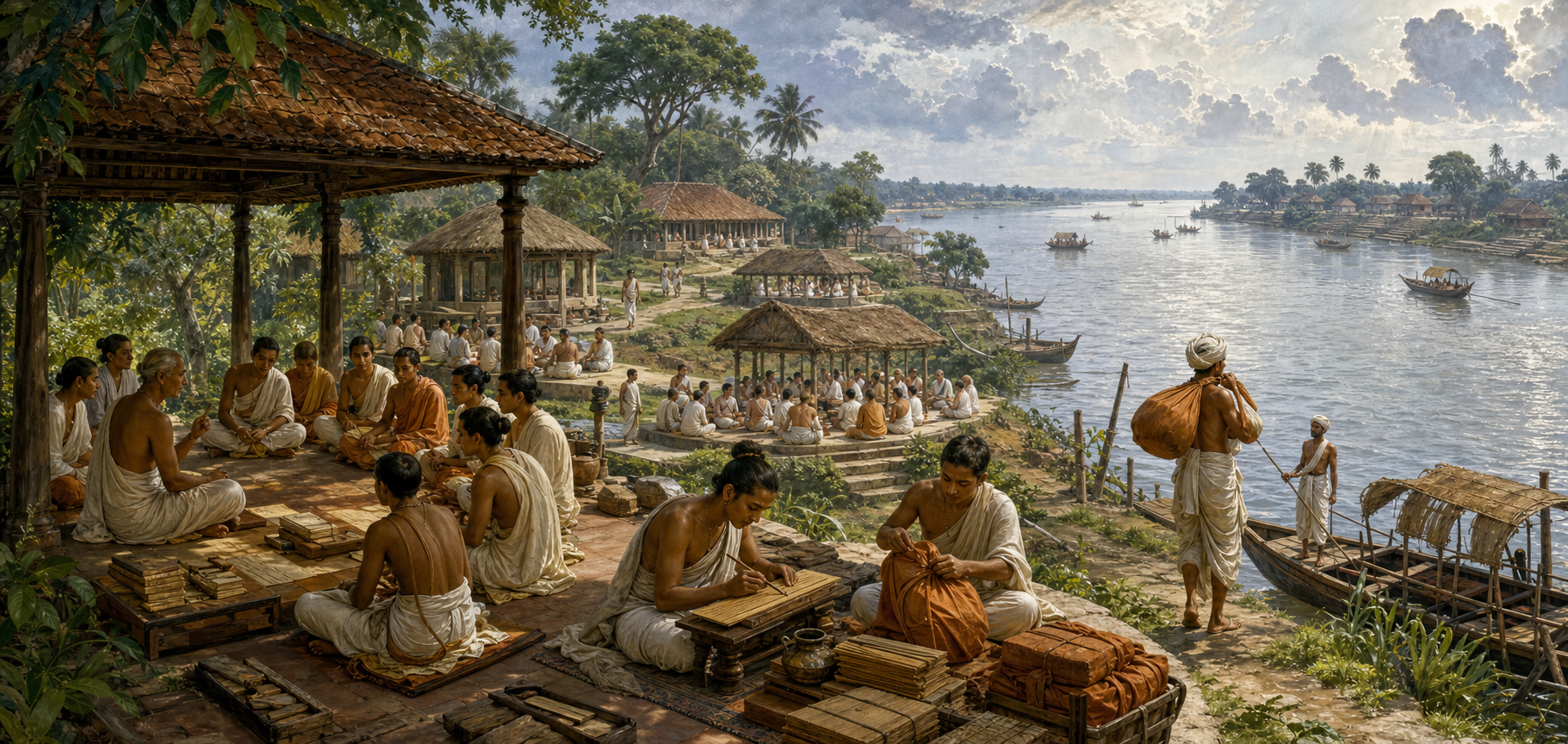
A single gifted philosopher does not create an intellectual culture by himself. Methods survive when students can learn them, teachers can refine them, patrons can sustain the necessary leisure, and scholars can circulate between centers of learning. Raghunātha belonged to such an ecosystem.
Between approximately 1450 and 1700, Mithila, Navadvīpa, and Varanasi formed major centers in a vigorous Sanskrit philosophical world. Some thinkers lived near these centers without becoming wholly absorbed into courtly life. That combination mattered: proximity offered students, libraries, debate, and reputation, while a degree of distance could preserve the concentration demanded by technical scholarship.
Material support came from more than one political order. The Mughal court, the Bengal Sultanate, and local landholders all contributed forms of patronage. Yet the Sanskrit philosophical corpus from this milieu shows little direct Persianate imprint. The careful conclusion is not that the communities lived without contact. It is that political support and conceptual dependence are different questions. A scholar could receive protection or resources in a plural political environment while conducting arguments primarily within the categories of a Sanskrit sampradāya.
Authority within that scholastic network depended heavily on training and argumentative rigor. Pedagogical lineage mattered because it transmitted a demanding method, not simply because a famous personality stood at its head. This helps explain how Navya-Nyāya became a dominant language of logic and epistemology in Sanskrit learning.
The network also crossed regional and sectarian boundaries. Scholars came from Tibet and Nepal, and in the seventeenth century pandits from Navadvīpa assisted the Fifth Dalai Lama. That later episode should not be presented as Raghunātha’s personal achievement. It shows what the intellectual culture associated with these centers became capable of carrying across generations.
When someone claims that a civilization produced an important intellectual breakthrough, look beyond the celebrated name. Ask five institutional questions:
- Where were practitioners trained?
- Which lineages preserved the method?
- What technical language allowed scholars in different places to communicate?
- Who supplied the material support required for sustained study?
- Where did students, arguments, and specialists travel afterward?
Raghunātha’s world has answers to all five. That is why his career is evidence of more than an isolated flash of genius. It reveals an organized capacity to generate, teach, criticize, and export difficult knowledge.
Use the legacy without reducing it to a slogan
Raghunātha is easy to misuse because the neglected history around him invites an understandable reaction. Once people discover that disciplined critical inquiry flourished in India before Bacon and Descartes, the temptation is to answer an old Eurocentric story with an equally simple civilizational boast. That weakens the case.
Four shortcuts are especially worth avoiding:
- Do not call him an Indian Descartes and stop there. The comparison corrects chronology, but it also makes a European philosopher the standard by which an Indian thinker becomes legible.
- Do not claim that India invented modernity as one indivisible thing. Raghunātha provides strong evidence for an indigenous analytical modernity. That does not automatically establish claims about every political, economic, scientific, or social meaning attached to the word.
- Do not describe his achievement as reason defeating tradition. His critical inquiry grew inside a lineage, using training inherited from that lineage. The important contrast is between revisable and unrevisable authority, not between anything traditional and anything rational.
- Do not turn Dharmic intellectual history into compulsory agreement. Its strength includes serious conflict among schools. Buddhist no-self reasoning and Nyāya realism about the self cannot be merged without losing the substance of both.
A defensible formulation is more exact: by the early sixteenth century, Raghunātha Śiromaṇi was using the disciplines of Navya-Nyāya to subject inherited philosophical categories to independent, reasoned evaluation, while a wider Sanskrit scholastic network developed the language and institutions needed to sustain that inquiry.
The later weakening of that network also requires care. Jonardon Ganeri argues that British rule disrupted traditional institutions by treating them as irrelevant. The further possibility that colonial authorities regarded their critical capacity as a source of intellectual resistance is significant, but it should remain a qualified interpretation rather than an asserted motive. Recovering Indian thought does not require turning every gap in the record into a certainty.
The disappearance of a school from a modern curriculum is not evidence that the school lacked sophistication. Curricula are products of institutions, and institutions determine which languages, methods, and lineages remain visible. If Navya-Nyāya is introduced only as a difficult remnant of premodern scholasticism, students never reach the more revealing question: what kind of intellectual freedom was exercised through its difficulty?
You can apply that question whenever someone claims that rationality arrived in Bharat from outside. Ask what proposition an Indian thinker revised, what analytical tool made the revision possible, which standards of argument controlled it, and which institutions transmitted it. If those answers are specific, the discussion has moved beyond civilizational pride into history.
Begin with Raghunātha in that spirit. Learn the name of his work, distinguish his method from the larger bundle called modernity, and refuse both colonial dismissal and careless exaggeration. The most fitting way to honor a logician is not to protect him with a slogan. It is to make the claim about him precise enough to withstand questioning.
References
