
You may have reached a point where several choices can all be defended as duty. Should you keep learning, concentrate on providing for others, accept another leadership role, or step back and let someone else carry the work? The problem is not always a lack of values. Sometimes valid duties are competing for priority.
Brahmacharya, grihastha, and vanaprastha give you a practical way to sort out that conflict. They ask whether the present moment calls for disciplined learning, responsible participation, or reflective withdrawal. You do not have to wait for a particular age to put those questions to work.
Do not turn the three branches into a rigid age chart
Dharmaskandha names three interrelated branches of righteous life in Chandogya Upanishad 2.23.1. The Vedic student develops through study, restraint, and service. The householder supports family and society through livelihood, care, hospitality, and generosity. The forest-dweller gradually turns toward contemplation, simplicity, counsel, and restraint.
Calling these branches “stages” is useful if it helps you see the changing emphasis of a lifetime. It becomes misleading when it makes you believe that one mode must end before another begins. A householder still needs the humility of a student. A student already has duties toward other people. A person moving toward contemplation does not become indifferent to society.
| Mode of ethical life | Its central work | Question for you |
|---|---|---|
| Brahmacharya | Form judgment through study, service, and restraint | What must I understand or correct before I act? |
| Grihastha | Sustain relationships, livelihood, community, and sacred institutions | Who depends on me, and what do I owe them? |
| Vanaprastha | Simplify, contemplate, transfer wisdom, and loosen attachment to control | What should I release so that clearer judgment can emerge? |
The most useful diagnosis is therefore not “Which stage am I officially in?” It is “Which branch have I neglected?” Constant study without responsibility can become avoidance. Responsibility without reflection can become restless accumulation. Withdrawal without prior care for real obligations can become abandonment dressed as spirituality.
Related balances appear elsewhere in the Dharmic family without making the traditions identical. Buddhism and Jainism maintain relationships between disciplined renunciant and lay vocations. Sikhism gives strong spiritual dignity to householder life joined with seva. The shared insight is structural: inner formation and service to others must strengthen each other.
Brahmacharya: train your character before claiming authority

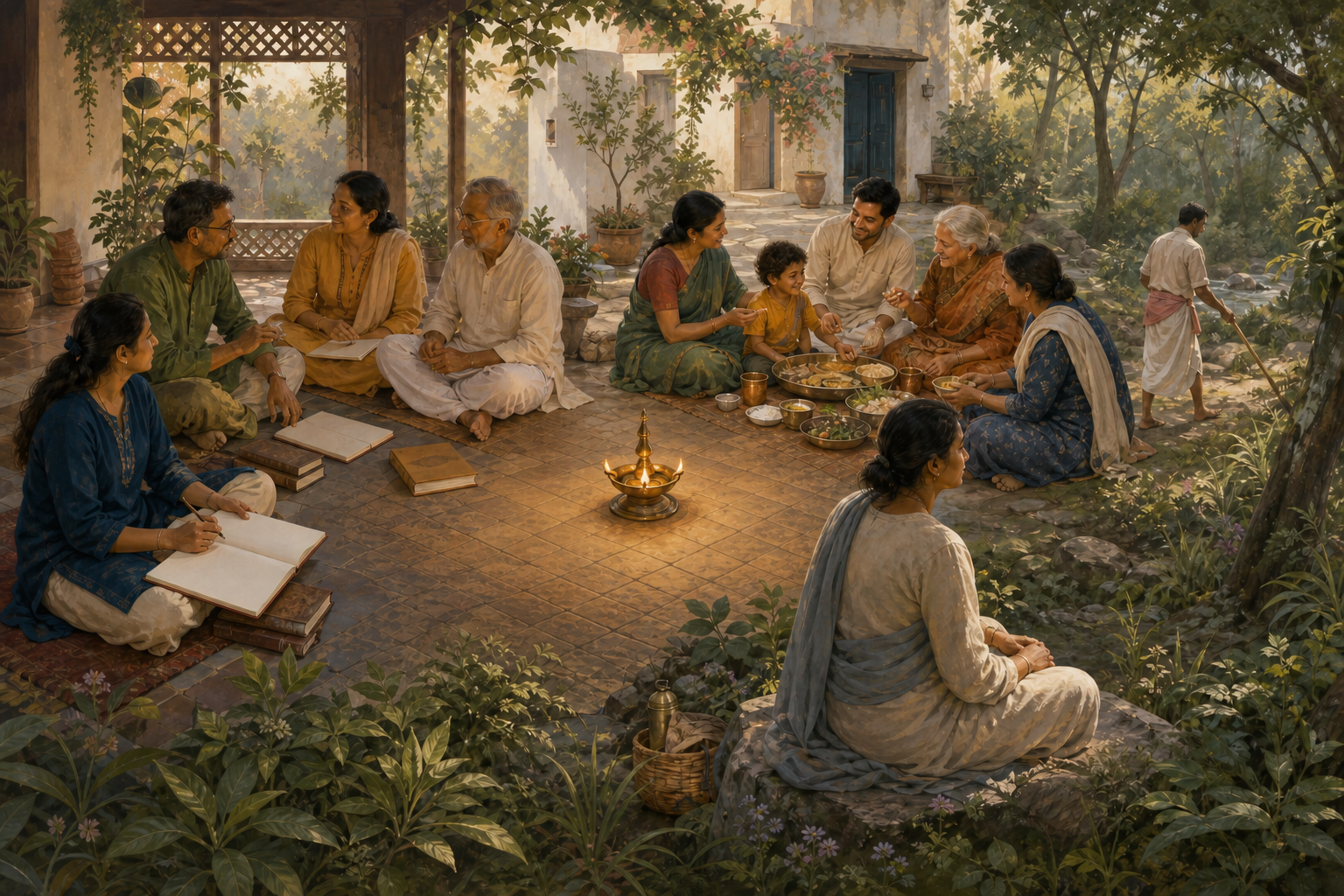
Brahmacharya is the ethical discipline of formation. Its work includes svadhyaya, or disciplined study, but information alone is not the goal. Study is joined to restraint, service, humility, and reverence for knowledge so that what you learn changes the quality of your decisions.
This distinction matters in an environment where quotations, opinions, and fragments of sacred teaching are easy to collect. Recognising a Sanskrit term is not the same as being formed by it. If your learning makes you quicker to display knowledge but less willing to accept correction, the brahmacharya function is not being fulfilled.
Bring this branch into a decision by asking three concrete questions:
- What do I actually know? Separate what you have studied from what you have merely heard or repeated.
- Where do desire and ego enter my conclusion? Restraint creates enough distance to see whether convenience is masquerading as principle.
- Whom does my learning help me serve? Knowledge that never improves conduct, care, or judgment remains unfinished.
For present-day practice, keep a stable course of study rather than moving endlessly between disconnected teachings. Read slowly enough to restate the teaching in your own words. Keep track of the questions you cannot yet answer. When correction comes from someone more competent, examine it before defending yourself.
Brahmacharya is especially important before you advise, teach, vote on a community matter, make a public accusation, or take responsibility for someone else’s welfare. The ethical first step is not silence forever. It is learning enough to act without pretending that confidence is understanding.
Grihastha: make ordinary obligations part of spiritual life
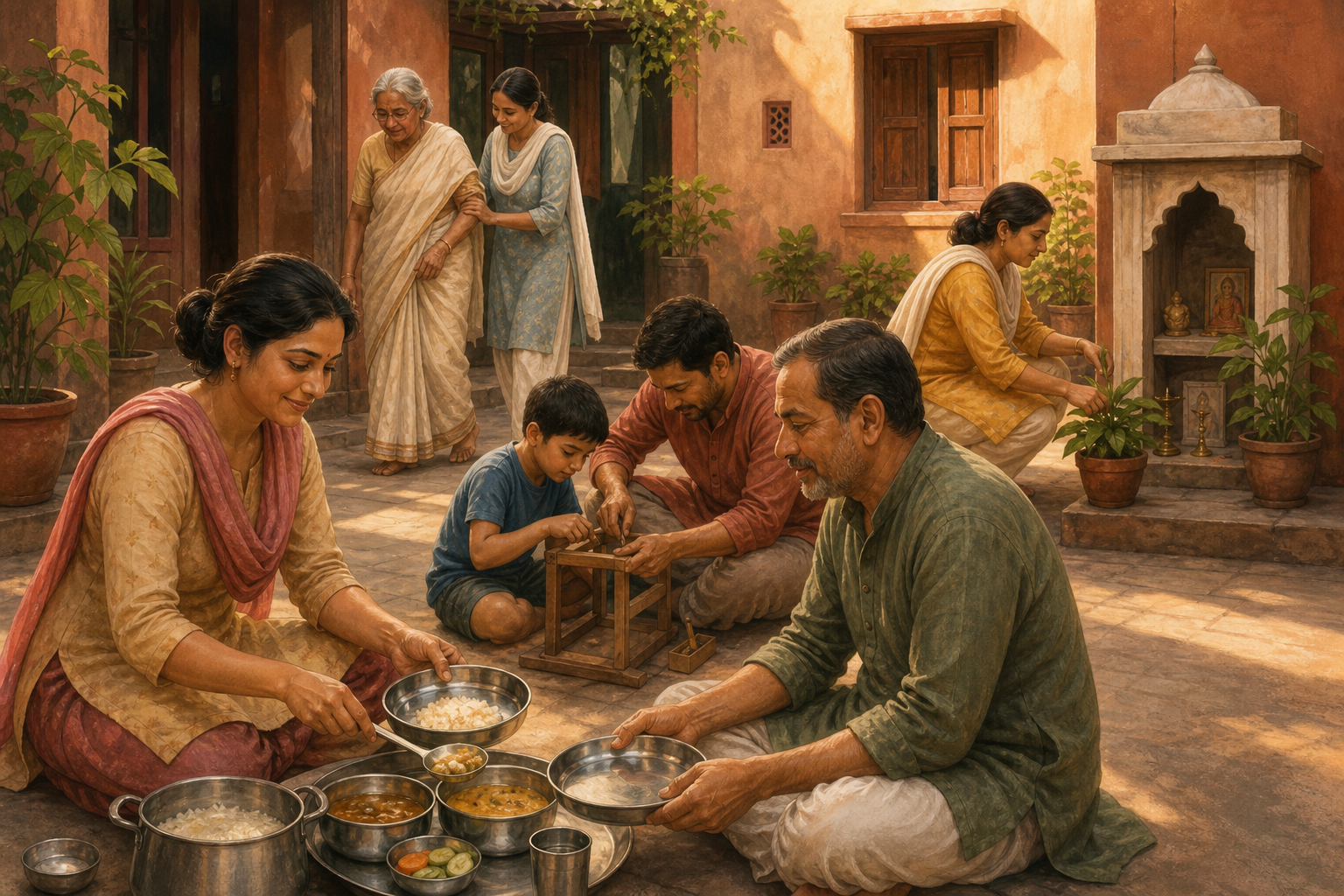
Grihastha places dharma inside the household, workplace, and community. The householder earns a livelihood, cares for family and elders, practises hospitality, gives through dana, and supports social and sacred institutions. These duties make householder life a central support of collective life rather than a spiritually inferior interval between study and withdrawal.
The hard part is that responsibility can easily be confused with ambition. More income, influence, or activity is not automatically more dharmic. Provision becomes ethical when it serves real obligations through honest work. Public service does not compensate for neglecting those who directly rely on you, and private comfort does not erase duties toward the wider community.
Use a household-and-community audit when work and duty seem impossible to distinguish:
- Dependence: Identify the people whose care, security, or development genuinely depends on your decisions.
- Livelihood: Examine not only what your work provides, but also whether the way you earn is consistent with the values you claim.
- Reliability: Notice which promises, relationships, and community roles suffer when every new opportunity is treated as urgent.
- Dana: Decide what you can give without using generosity as a performance or as an excuse to ignore nearer obligations.
- Hospitality and care: Make room for elders, guests, neighbours, and institutions that preserve knowledge and community life.
The test is not whether you can carry every burden. It is whether the burdens you accept are ordered by dharma rather than status, guilt, or appetite. Sometimes the right householder decision is to work more. Sometimes it is to refuse work that would make you materially successful and relationally absent.
Grihastha also prevents spirituality from becoming private self-improvement. Patience with a family member, integrity in livelihood, care for an elder, hospitality toward a guest, and dependable support for a community institution are not distractions from dharma. They are places where dharma becomes visible.
Vanaprastha: step back without disappearing
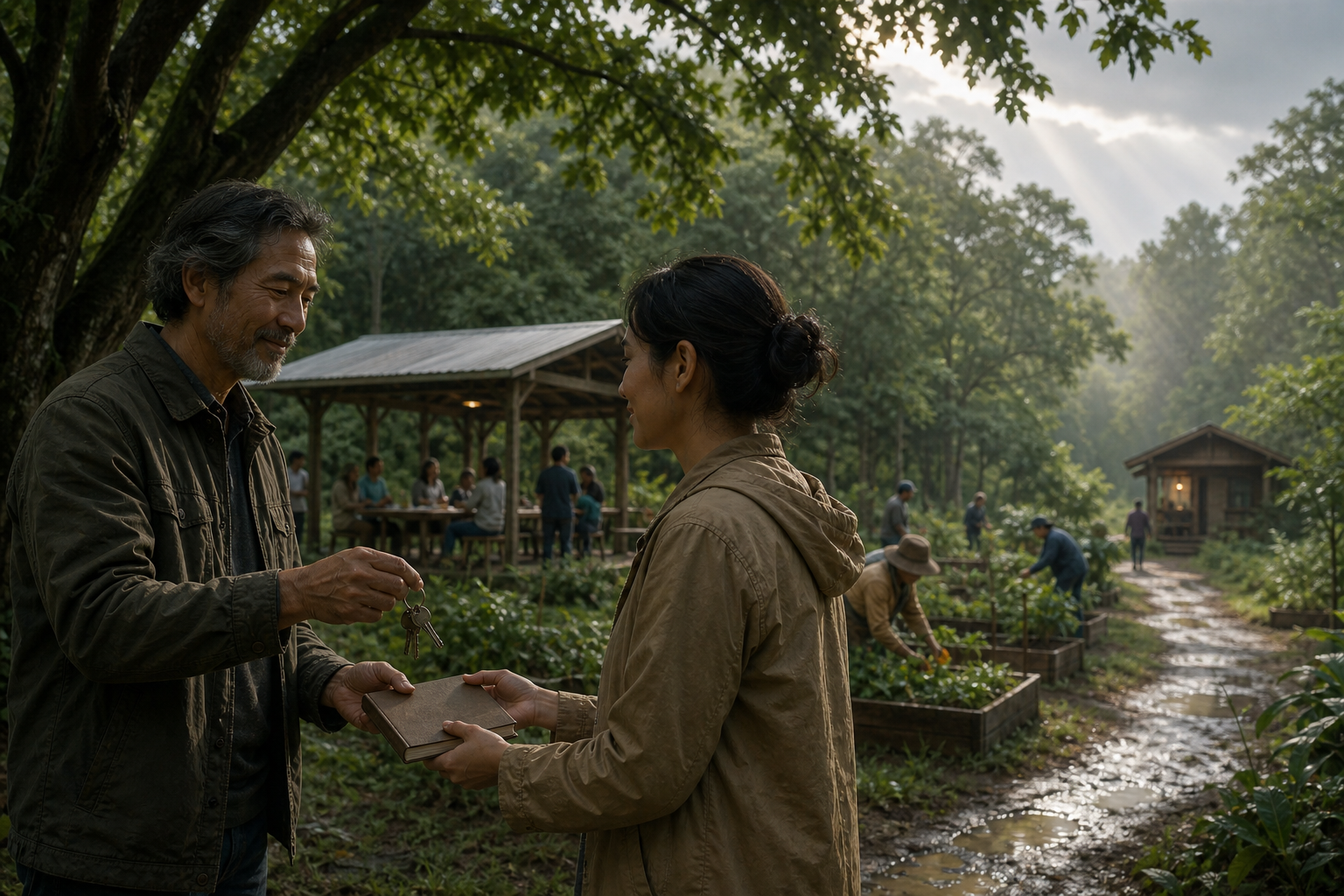
Vanaprastha is a gradual turning toward contemplation, counsel, and simpler living. Its movement away from constant acquisition and administration is not a declaration that society no longer matters. Concern continues, but its expression changes. The person who once carried every task can begin transferring responsibility, offering perspective, and making room for others to mature.
This branch corrects a common danger in responsible people: the belief that remaining indispensable is the same as serving. If no one else is allowed to learn, decide, or lead, years of work may build dependence rather than continuity. Wise withdrawal includes preparing others to act without your control.
You can practise the vanaprastha function without literally moving to a forest:
- Transfer a responsibility together with the knowledge and authority needed to carry it.
- Create periods of quiet in which you are not consuming information, defending a position, or managing other people.
- Remove commitments maintained chiefly because they protect identity, prestige, or control.
- Simplify consumption and let ecological restraint become part of ethical self-discipline.
- Offer counsel without demanding that the recipient reproduce your choices.
- Use retreats and contemplative practice to return to responsibility with clearer motives, not to hide from unresolved duties.
Timing matters. Stepping back before dependants are cared for can be evasion. Refusing to step back after others are ready can be attachment. Ask whether your continued control is still serving the work or merely preserving your place within it.
Vanaprastha is therefore not passivity. It is a change in the form of contribution: from possession to stewardship, from constant intervention to counsel, and from expansion to deliberate restraint.
Key takeaways: use a three-question dharma check
When you face a difficult choice, place it under all three branches before deciding. Each reveals a different kind of moral blind spot.
- What must I learn? Use brahmacharya to identify missing knowledge, needed correction, and desires that require restraint.
- Whom must I sustain? Use grihastha to name dependants, promises, livelihood duties, community needs, and opportunities for dana or service.
- What must I release? Use vanaprastha to expose needless consumption, status-seeking, accumulated roles, and attachment to being in control.
When the answers conflict, begin by establishing the facts, then identify the obligations that cannot honestly be abandoned, and finally remove ego and excess from the way you fulfil them. Do not use contemplation to escape dependants. Do not use family duty to excuse greed. Do not use further study to postpone an action you already understand.
Take one decision that is currently unsettled and write one answer under each question. The neglected branch will usually become apparent. Act first on that omission: learn what you have been assuming, fulfil the responsibility you have been avoiding, or release the control you no longer need to hold.
References
