
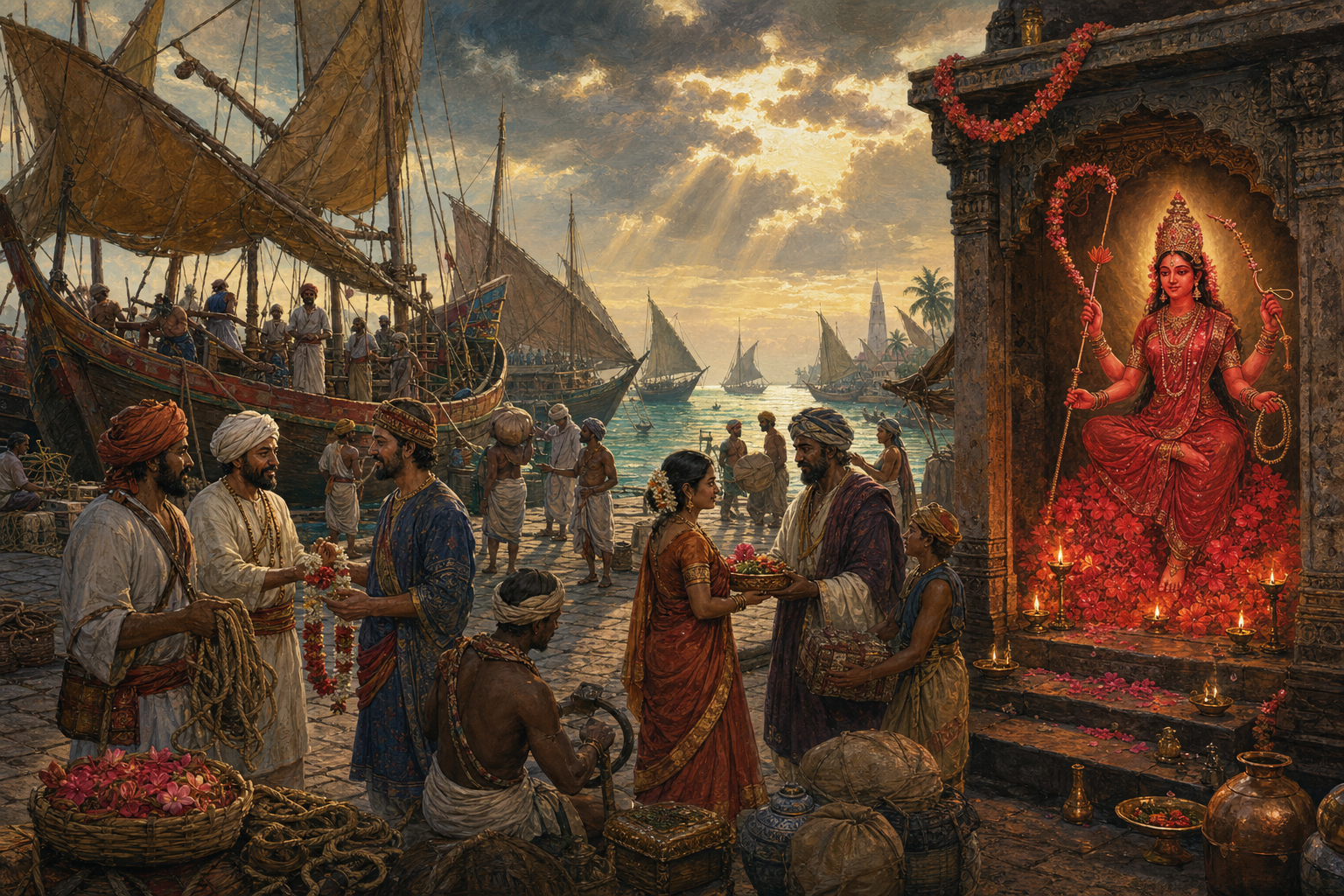
If you have encountered Kurukula as the goddess who protected Indian Ocean merchants, the important question is not whether that image is compelling. It is how much historical weight the image can carry.
The most useful answer is also the most careful one. Kurukula is better understood as a Śākta power of attraction, protection, and auspicious relationship within a network of ports, shrines, merchant bodies, households, and sailing rites. She should not be turned into the universally documented patroness of every Indian port. That distinction lets you appreciate a real Dharmic pattern without presenting inference as inscription.
What we can responsibly claim about a maritime Kurukula
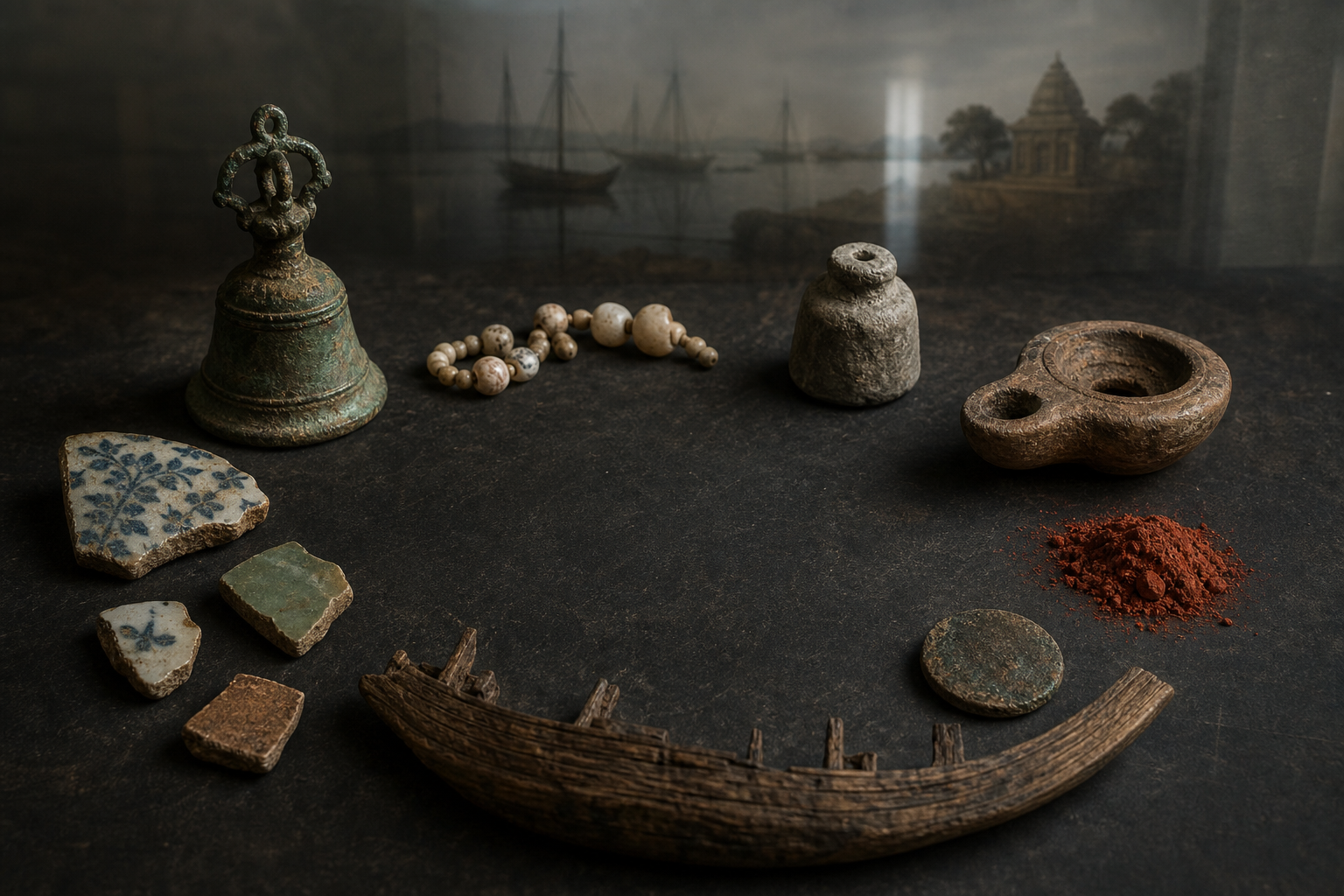
Three kinds of claim are easily confused when people discuss a goddess moving through a trade network.
- Direct attestation means that Kurukula’s name, image, mantra, yantra, or ritual appears in a datable object or record from a named place.
- Contextual presence means that Śākta worship, merchant patronage, protective goddesses, and maritime rites existed in the same social environment.
- Functional resonance means that Kurukula’s powers made particular sense to people facing the uncertainties of travel, credit, negotiation, and exchange.
The second and third claims are considerably easier to support than the first. Coastal evidence reveals a dense relationship among temples, guilds, docks, and forms of Śakti worship, but an inscription from that environment cannot be assigned to Kurukula merely because her functions fit it. If her name is absent, the honest description is a compatible Śākta setting, not a confirmed Kurukula cult centre.
This caution does not make Kurukula irrelevant. It changes the scale at which you look for her. Instead of expecting a chain of temples dedicated exclusively to one goddess, look for a portable ritual vocabulary: attraction, safe passage, cohesive partnerships, auspicious speech, protected goods, and the return of wealth to the community. Kurukula could operate within that vocabulary without displacing Varuṇa, Lakṣmī, Bhagavati, Bhadrakālī, or a local village goddess.
Key takeaways
- Understand Kurukula as a networked Śākta power, not as the proven patroness of every Indian Ocean port.
- Keep direct evidence, religious context, and functional interpretation in separate categories.
- Trace merchant institutions, household vows, seasonal rites, and charitable endowments as well as temples.
- Compare Hindu Kurukula and Buddhist Kurukullā without assuming that their identities or rites were identical.
- Read attraction as the creation of trustworthy relationships, not simply as domination or seduction.
Why a power of attraction belonged in a trading world
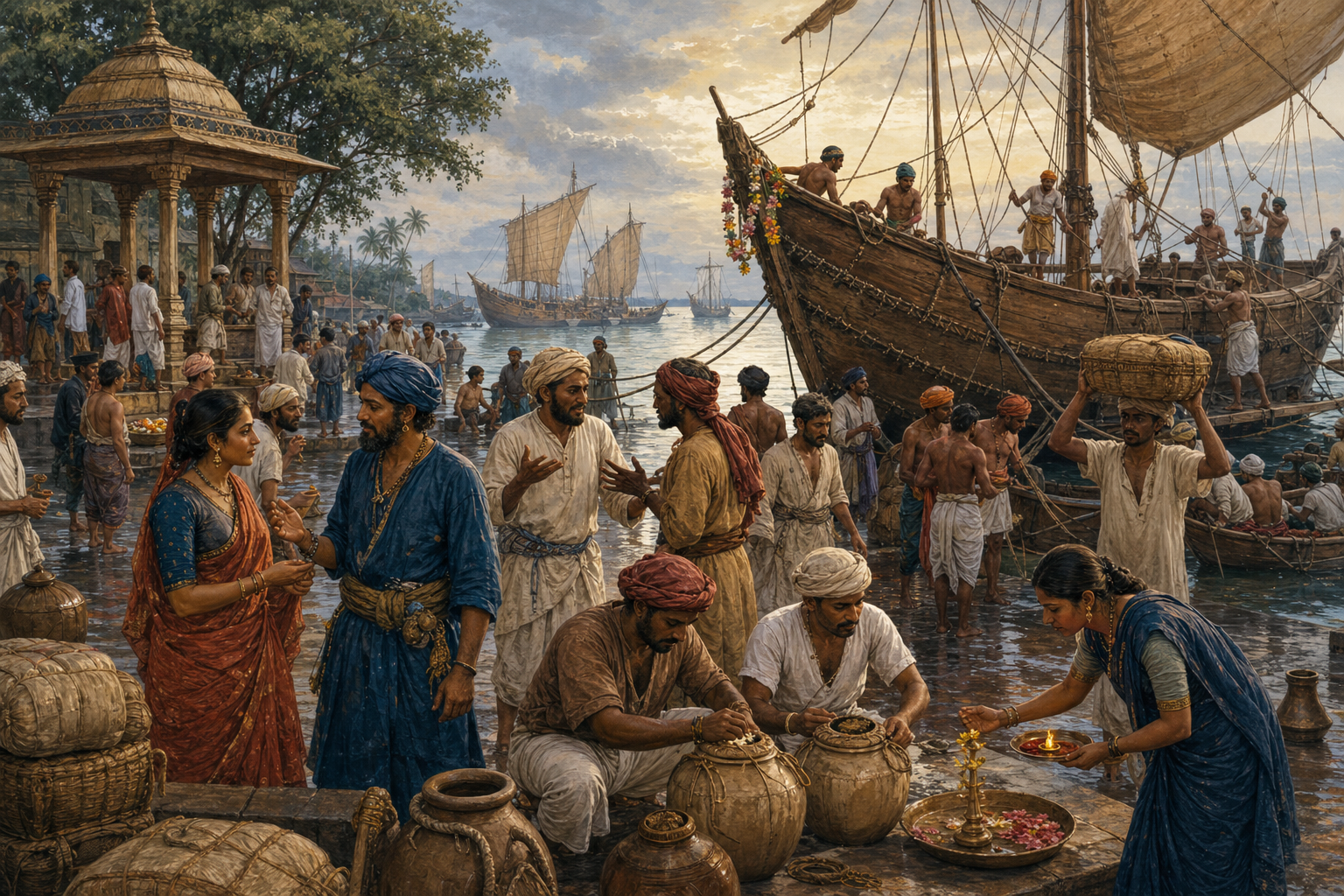
The Sanskrit idea of ākarṣaṇa is commonly rendered as attraction, but maritime commerce gives the term a wider practical range. A voyage needed to draw together a vessel, crew, financiers, cargo, brokers, buyers, favourable timing, and a safe harbour. A failure in any one relationship could undo the work of all the others. Attraction therefore meant cohesion: bringing the necessary people and conditions into a workable order.
Kurukula was also associated with prosperity and harmonisation. Those qualities addressed risks that seamanship alone could not settle. Merchants faced not only shoals, storms, piracy, and limited supplies, but also unreliable intermediaries, changing prices, disputed obligations, and failures of credit. Divine protection could consequently include the safeguarding of reputation and agreement as well as bodies and cargo.
Related goddess iconographies make this logic visible through a red form bearing a flower bow and arrow, hook, and noose. These implements belong to the language of drawing, directing, and securing. In a commercial interpretation, the hook gathers what has become scattered, the noose holds a commitment together, and the bow directs intention toward a chosen end. This is an interpretive maritime reading of the symbols, not proof that every such image was commissioned by sailors.
Ritual language surrounding Kurukula could employ bīja sounds such as hrīm and klīm, which carry associations of Śakti, attraction, beauty, and plenitude. Yet specific mantras differ by lineage. A list of syllables found online is therefore not a substitute for a transmitted practice. If you approach Kurukula devotionally, follow the form preserved by your guru, family, temple, or sampradāya rather than assembling a mantra from attractive fragments.
This portability helps explain why the goddess need not have possessed an exclusive maritime institution. A merchant could seek Lakṣmī’s abundance, Varuṇa’s relation to the waters, a local mother’s guardianship, and Kurukula’s harmonising attraction without experiencing those devotions as mutually exclusive. Indian Ocean religion was often cumulative at the level of lived practice: a new protection could join an existing sacred repertoire.
Reconstruct the network through people, places, and seasons
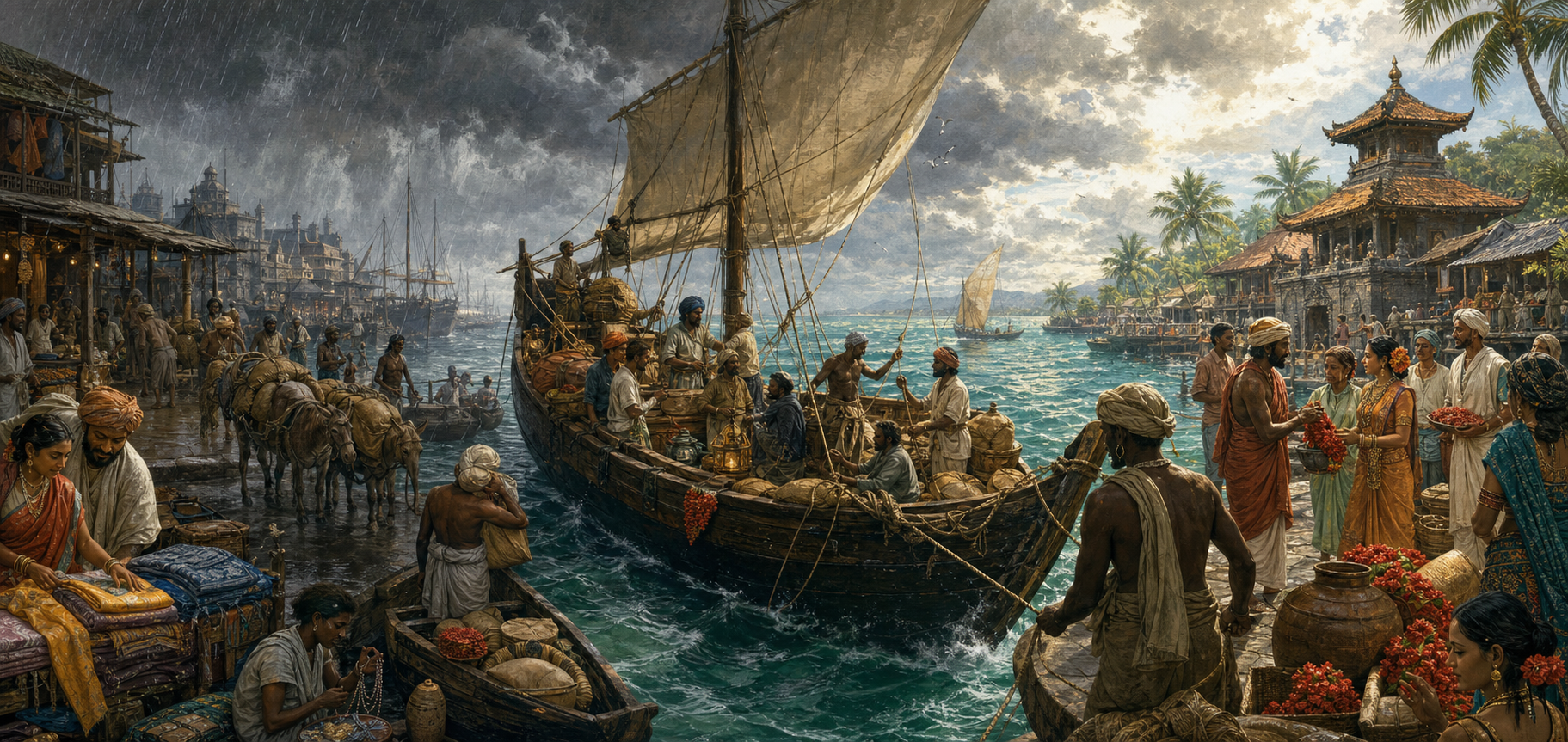
A map of sea routes is not yet a map of religious transmission. To understand how a Śākta power could travel, you have to map the institutions that carried memory, obligation, and ritual from one voyage to the next.
- Begin with ports. Western nodes included Sopara and Bharuch, while eastern and southern circuits included Tamralipta, Satgaon, Muziris, Kollam, Nagapattinam, and Kaveripattinam. These names identify connected commercial environments; they do not by themselves prove Kurukula worship at every location.
- Add merchant organisations. Ayyavole-500, also known as Ainnurruvar, Manigramam, and Anjuvannam operated through peninsular India and into Sri Lanka and Southeast Asia. Their movement, temple gifts, and protective concerns supplied an institutional channel through which ritual practices could travel.
- Add sacred and civic infrastructure. Temples, guild houses, caravanserais, feeding establishments, and travellers’ shelters joined commerce to hospitality and religious merit. A deity’s network could be sustained through these relationships even where no exclusive shrine existed.
- Add the household and quay. Departure customs such as breaking a coconut, fastening turmeric-and-lime protections, and promising an offering after safe return placed maritime religion in family practice rather than only in formal temple liturgy.
- Add the sailing calendar. Seasonal rites mattered because Indian Ocean movement followed monsoon rhythms. Kārtika Purnima observances on the eastern coast, lamps lit near southern jetties, and pre-season consecrations aligned human preparation with sacred timing.
The monsoon was cyclical enough to organise commerce but dangerous enough to resist complacency. Its rhythm concentrated departures into meaningful windows. That concentration also gathered shipowners, crews, priests, relatives, lenders, and suppliers in the same places at the same time. A pre-voyage rite therefore did more than request better weather. It publicly coordinated a community around departure, risk, obligation, and hoped-for return.
This method changes what you notice. A donation made after a successful journey may reveal more about maritime religion than a detached icon. A rest house may disclose the social use of mercantile wealth. A family vow can show how risk was remembered across generations. A guild record can identify the people capable of carrying a ritual idiom between coasts. The network appears when those pieces are placed together, while the degree of certainty attached to each piece remains visible.
Dharmic exchange did not erase religious differences
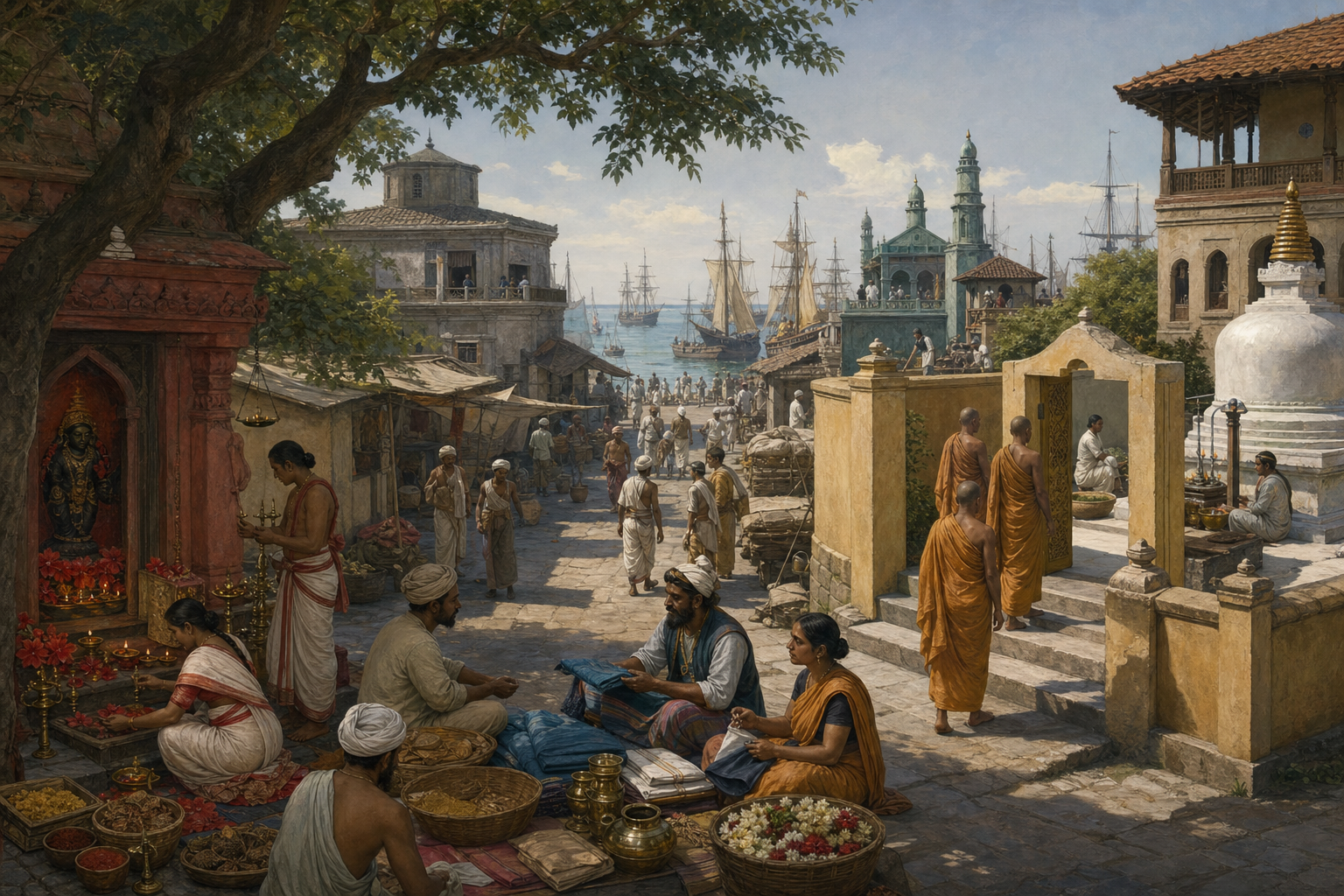
The relationship between Hindu Kurukula and Buddhist Kurukullā is central to this history, but it requires disciplined language. In Vajrayāna settings, Kurukullā appears as a crimson goddess of magnetising activity associated with Tārā. Her worship moved along trade corridors, while Hindu Śākta traditions recognised a closely related name and field of attraction. Shared colour, name, symbols, and function make contact and cross-pollination plausible. They do not establish that every Hindu and Buddhist practitioner understood the goddess in precisely the same way.
When you find Kurukula or Kurukullā in a new setting, ask which tradition names her, which ritual text or lineage frames her, and what function she performs there. Preserve the spelling used by the object or community. Do not silently replace a Buddhist Kurukullā with a Hindu Kurukula, or the reverse. Comparison becomes more meaningful when difference is retained.
The wider Dharmic setting was also plural. Jain merchant communities turned to protective devīs including Padmāvatī and Ambikā while placing ahiṃsā and honesty at the centre of conduct. Sikh teaching later expressed the dignity of upright livelihood through kirat karo. These parallels illuminate a recurring Dharmic judgment: prosperity is not separated from the manner in which it is earned. They should not be misused as evidence that Jain or Sikh communities necessarily worshipped Kurukula.
Chronology matters here. Medieval Hindu, Buddhist, and Jain participation in commercial circuits can be examined as overlapping historical worlds. The Sikh principle is a later ethical parallel, not evidence for an earlier maritime cult. Keeping those categories separate prevents a generous vision of shared Dharma from becoming an inaccurate claim that all traditions possessed the same theology or ritual history.
The Indian Ocean encouraged practical coexistence because merchants of different languages and traditions depended on one another. Sanskrit, Tamil, Malayalam, Kannada, Bengali, Arabic, Persian, and later Portuguese belonged to the cosmopolitan life of ports. A power associated with drawing people together could be intelligible across such boundaries, even when each community located protection within its own religious grammar.
Honour the legacy by joining prosperity to responsibility
Kurukula’s attraction becomes ethically important when it is understood as right relationship. The desired result was not gain detached from obligation. Commercial reputation had to be maintained, promises had to survive distance, and profit had to sustain the communities that made trade possible.
Merchant gifts to temples, food establishments, and shelters converted private success into public merit. This circulation of wealth completed the religious logic of attraction: prosperity was drawn inward, then released outward through service. A request for auspicious trade carried a corresponding duty to deal fairly, remember assistance, and share the fruit of success.
You can apply that principle without pretending to revive a single standardised medieval rite. Before a journey or commercial undertaking, make the ethical vow concrete: state obligations clearly, refuse deceptive terms, place the safety of workers and travellers above avoidable gain, and decide in advance what portion of success will support a temple, food service, shelter, or another genuine community need. These are contemporary applications of the moral pattern, not claims about a universally prescribed Kurukula ritual.
If you are evaluating a historical claim, use five questions before repeating it:
- Is Kurukula actually named, or has she been inferred from general Śākta imagery?
- Can the place, date, language, and religious setting be identified?
- Does the evidence establish worship, or only the presence of merchants and a compatible goddess tradition?
- Is a Hindu form being distinguished from Buddhist Kurukullā?
- Are later ethical parallels being presented as parallels rather than proof of earlier transmission?
If you are tracing a family or port tradition, start a one-page record. Note the local name of the goddess, the exact object or spoken rite, its language, the occupation of the people who preserved it, the season in which it was performed, and any vow connected to safe return. Use Kurukula’s name only where the name or lineage supports it; elsewhere, preserve the local identity and describe the shared function. That small discipline turns reverence into durable cultural memory.