
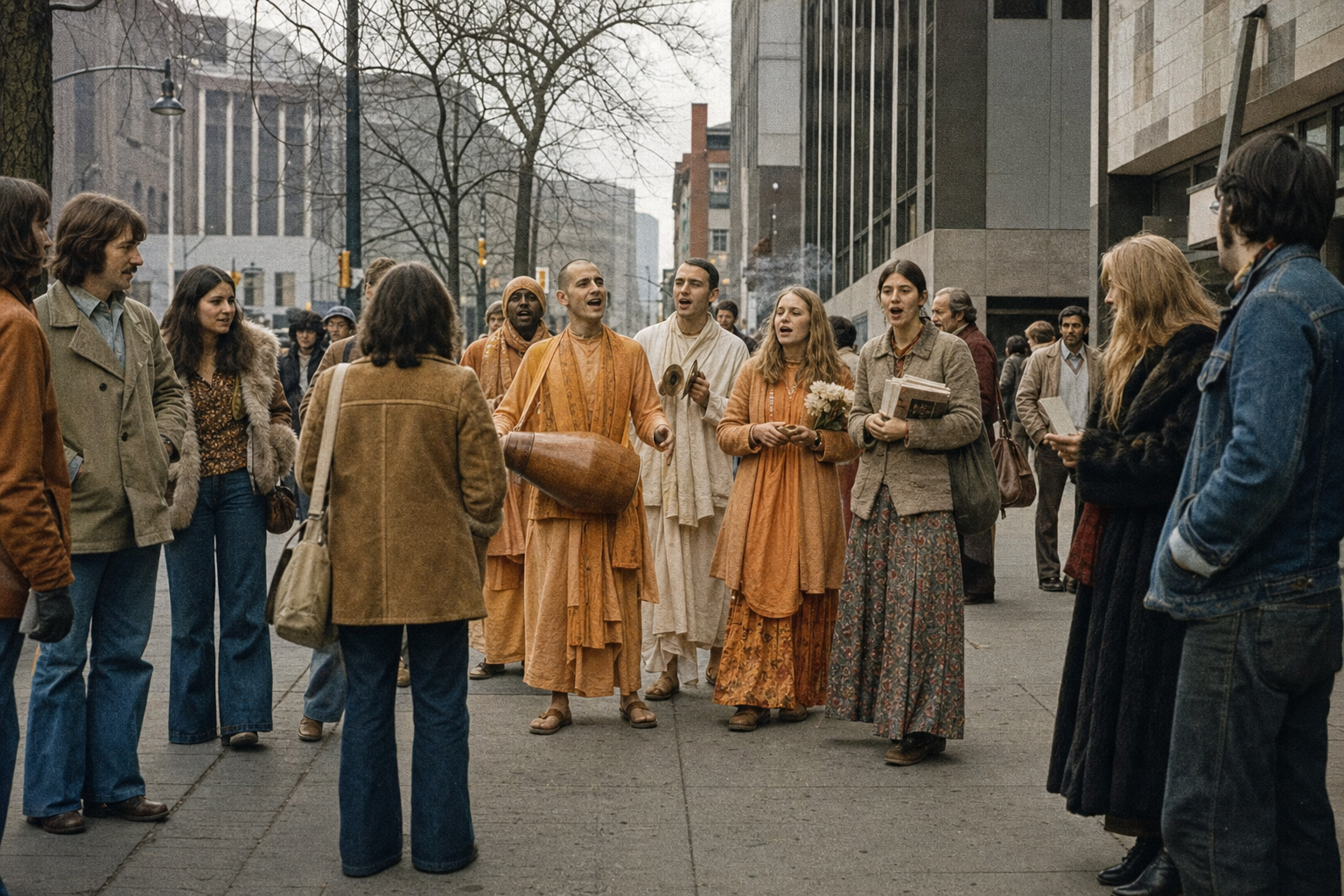
If you are trying to understand what Krishna consciousness looked like in Canada between 1967 and 1977, a list of institutional dates will not be enough. You need to know how the movement entered public space: what devotees carried, where they chanted, how strangers responded, and what counted as a meaningful encounter.
Closely described scenes from Vancouver in 1974 and Montreal in 1975 provide unusually concrete answers. They show devotees using books, magazines, incense, invitations, offered flowers and congregational chanting to meet Canadians where crowds had already gathered. These episodes do not supply a complete national chronology for 1967-1977, but they do reveal how Krishna consciousness became visible and recognizable during the period.
Vancouver: recognition came before explanation
On November 2, 1974, George Harrison opened his North American tour at Vancouver’s Pacific Coliseum. Local devotees entered the arena carrying saffron bags filled with books, magazines and incense. As they moved toward the stage, some concertgoers called out “Hare Krishna.” The response matters because the devotees were not introducing an entirely unfamiliar name to every person they met. Harrison’s association with Krishna consciousness had already made the movement recognizable to at least part of the audience.
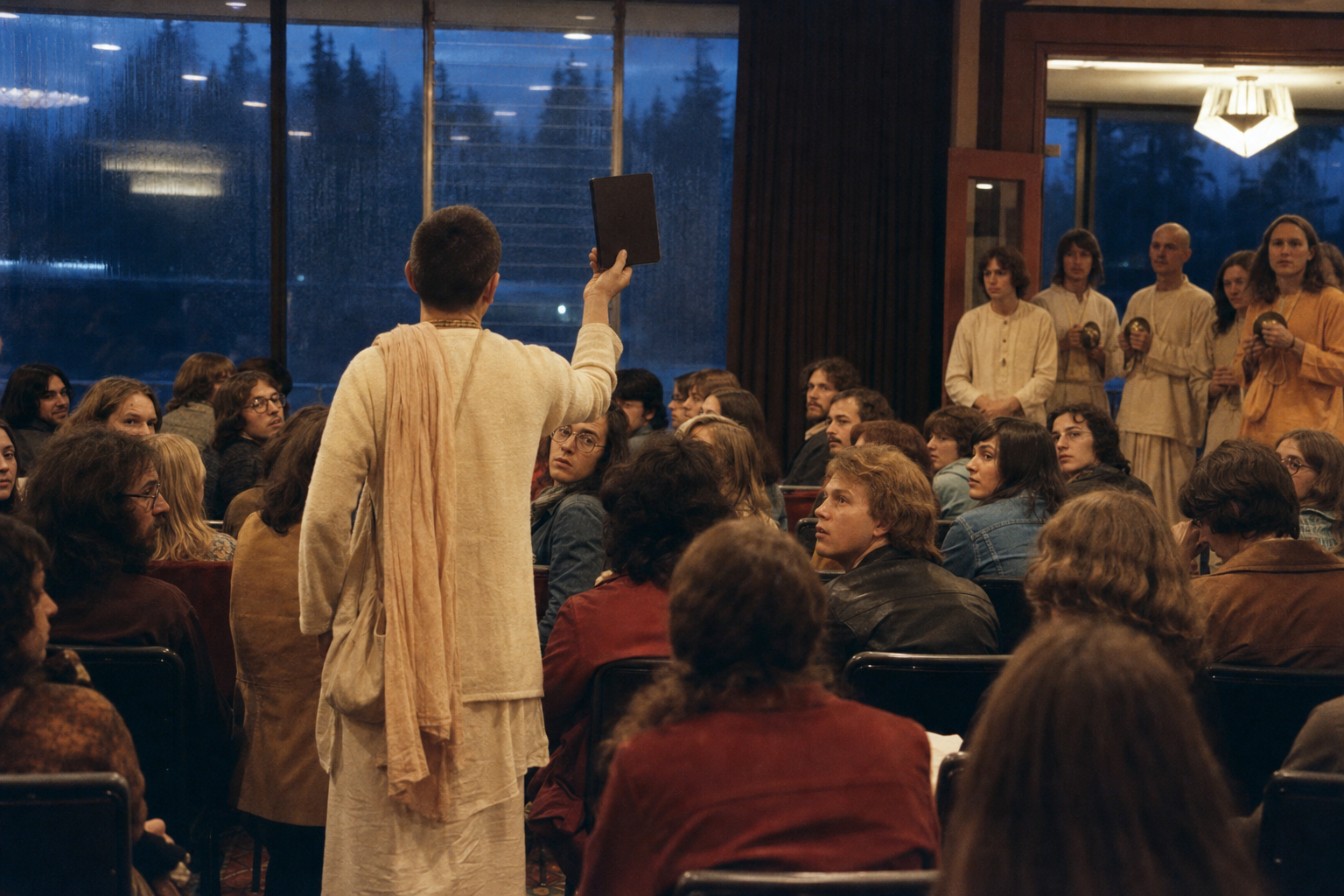
One devotee, Mahesh, raised a hardbound copy of Srila Prabhupada’s Krishna Book near the front of the stage. Harrison had helped its publication through a donation. When he noticed the volume, he smiled and bowed his head. The exchange required no speech, yet the crowd could see a relationship among the sacred book, the musician and the devotees distributing Krishna literature.
It would be easy to reduce this to celebrity history. That would miss its value. The important feature is the sequence by which a religious movement becomes publicly legible:
- Exposure: a person sees devotees, hears the mantra or receives literature.
- Recognition: the person connects those practices with Krishna consciousness.
- Participation: the person chants, accepts an item, visits a temple or begins a conversation.
- Commitment: the person adopts a sustained devotional practice or joins a community.
The Vancouver concert clearly demonstrates exposure and recognition. It does not tell us how many people progressed to commitment. When you assess the growth of Krishna consciousness, keep those stages separate. Familiarity is historically significant, but it is not the same as adherence.
The setting also changes how we should picture early outreach. Krishna consciousness was not encountered only inside a temple or formal lecture hall. A concert floor could become a place of book distribution, and a popular musician could provide a bridge between Sanskrit devotional culture and a Canadian audience. The devotees did not need to turn the concert into a religious meeting. They used a brief opening within an event that already mattered to the people they hoped to reach.
Montreal: contact mattered even when persuasion failed
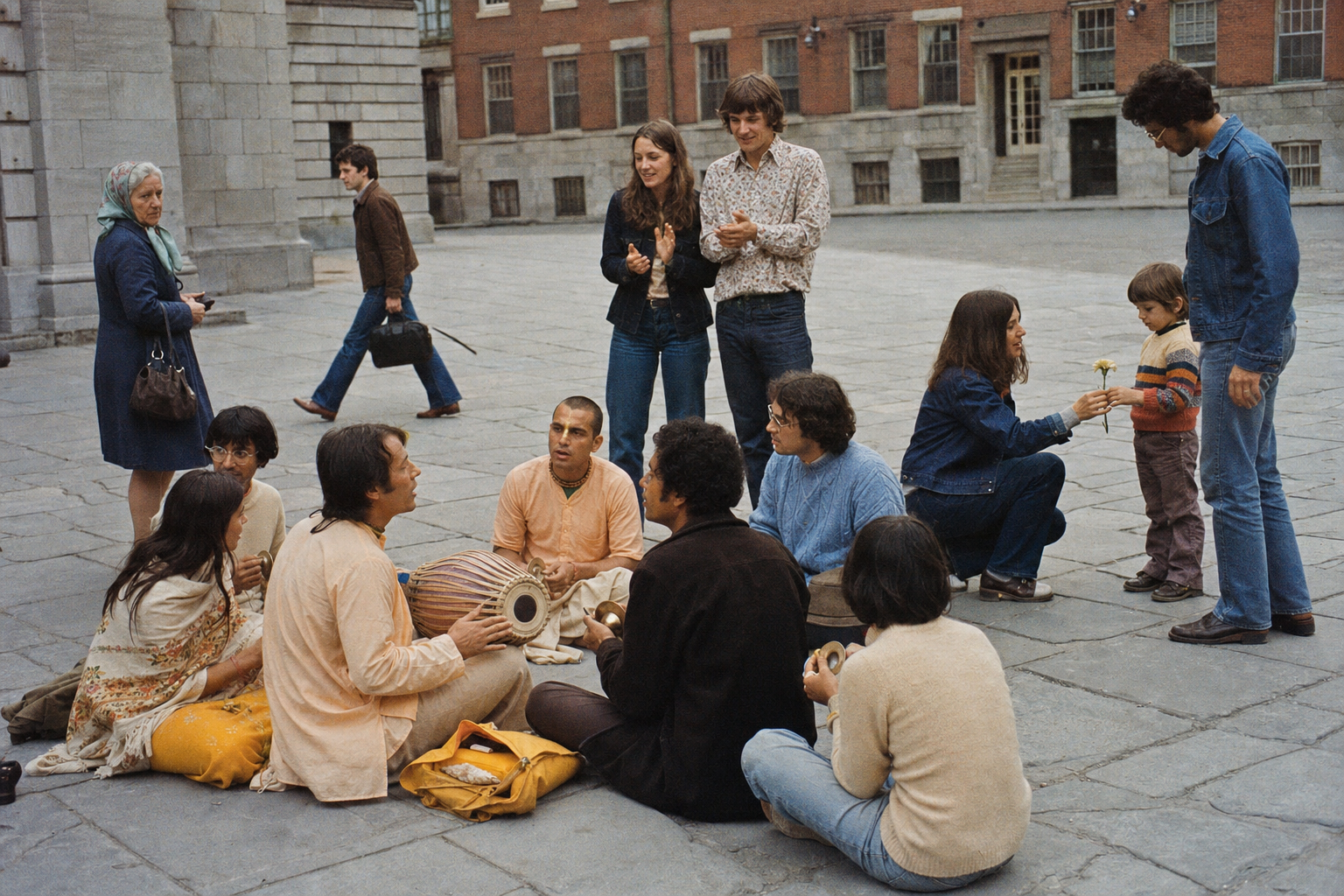
A Montreal episode from 1975 shows why this history cannot be told only through sympathetic celebrities. When Frank Zappa and the Mothers of Invention appeared at the Montreal Forum, devotees organized a large harinama, or public congregational chanting procession, outside the building. One devotee prepared a copy of the Seventh Canto of the Srimad-Bhagavatam, identifiable by its cover image of Lord Nrsimhadeva, along with a temple invitation, mantra card and Back to Godhead magazine.
Zappa’s manager carried the materials backstage and then returned to say that Zappa wanted to meet the devotee. The resulting conversation lasted more than half an hour, but Zappa rejected the book and challenged the devotional claims presented to him. He did, however, keep the invitation. Outside, the chanting continued in the winter cold, and concertgoers enjoyed the kirtan and joined it.
This is a more instructive encounter than an uncomplicated success story. One prominent person refused the central gift, while people outside participated in the chanting. If success is measured only by whether a celebrity accepted a book, the evening looks unsuccessful. If the question is whether Krishna’s names entered a shared public setting and invited participation, the picture changes.
That distinction protects the history from two opposite distortions. We should not call every friendly response a conversion. We also should not call an encounter worthless because it ended without agreement. Public religious life includes curiosity, refusal, debate, enjoyment and partial participation. Montreal displayed several of those responses at the same event.
A second Montreal encounter followed on December 12, 1975, when Bob Dylan’s Rolling Thunder Revue came to the city. Backstage, Joni Mitchell accepted a Back to Godhead magazine and red carnations that had been offered to the Deities. Several performers carried the flowers onto the stage and threw them to the audience. Here the devotional object travelled farther than the devotee did: from temple worship to backstage, then onto a concert stage and finally into the crowd.
The two Montreal scenes reveal a flexible method rather than a fixed script. A book could open a debate, an invitation could survive the rejection of that book, chanting could attract people outside, and offered flowers could pass through a performance without requiring a sermon. The consistent aim was contact with Krishna consciousness; the form changed with the person and setting.
What these episodes establish – and what they cannot
The documented actions support several careful conclusions about Krishna consciousness in urban Canada during the middle of the 1967-1977 period.
- Devotees treated public chanting and the circulation of Srila Prabhupada’s books and magazines as complementary forms of outreach.
- Popular-music venues offered access to concentrated audiences, including people who already recognized the Hare Krishna movement through George Harrison.
- Outreach was materially specific. Devotees carried identifiable books, mantra cards, invitations, incense, magazines and flowers offered in worship.
- Reception varied from reverence and friendly recognition to participation, argument and direct refusal.
- Vancouver and Montreal devotees acted locally while participating in a movement connected to Indian scripture, Sanskrit sacred names and an international popular culture.
These episodes cannot establish the number of Canadian devotees, the size or founding date of each temple, the social background of members, or the movement’s reception in every province. They also cannot make 1974 and 1975 representative of every year from 1967 through 1977. Anyone building a wider history still needs temple records, dated photographs, correspondence, publications, artifacts and testimony from people who were present.
You can read a recollection responsibly by separating three levels. First record the verifiable anchors: date, city, venue, people and objects. Then preserve the witness’s interpretation of what the event meant. Only after that should you draw a broader conclusion about the movement. This prevents a vivid memory from being stretched into a national trend that it cannot prove.
The same discipline applies to famous names. Harrison’s gesture demonstrates respect and public association with Krishna consciousness. Zappa’s refusal demonstrates disagreement. Mitchell’s acceptance of the magazine and flowers demonstrates a gracious exchange. None of these moments, by itself, reveals a person’s entire spiritual life. Their historical value lies in what happened publicly and can be described precisely.
Key takeaways
- Krishna consciousness in 1970s Canada was visible outside temples through harinama, literature distribution and direct engagement at major cultural events.
- The Vancouver concert of November 2, 1974 shows that some Canadian music fans already connected George Harrison with the Hare Krishna movement.
- Montreal in 1975 shows a broad range of reception: respectful acceptance, public participation, argument and refusal could occur around the same outreach effort.
- Books were not merely information products. Their titles, sacred images and connection to Srila Prabhupada made them devotional objects as well as invitations to study.
- A trustworthy history must distinguish public recognition from religious commitment and documented events from later inference.
If you were in Canada, make your memory usable
The early record now depends partly on people who may not think of themselves as historical witnesses. You do not need to have been a temple leader. A brief visit, a street encounter, a concert, a book received at a station, or a photograph with an uncertain date may help connect events that currently survive as isolated scenes.
Before sending your recollection, prepare it so another person can evaluate and preserve it:
- Start with anchors. Give the city, venue or address, year or season, and the reason you were there. If a date is uncertain, mark it as uncertain instead of selecting one that merely seems likely.
- Separate what you saw from what you later heard. Direct memory, another person’s account and a later interpretation can all be valuable, but they should not be merged.
- Name practices and objects precisely. Record whether you remember kirtan, japa, prasada, a lecture, a temple invitation, a particular book or a magazine. Copy inscriptions and temple stamps exactly when they survive.
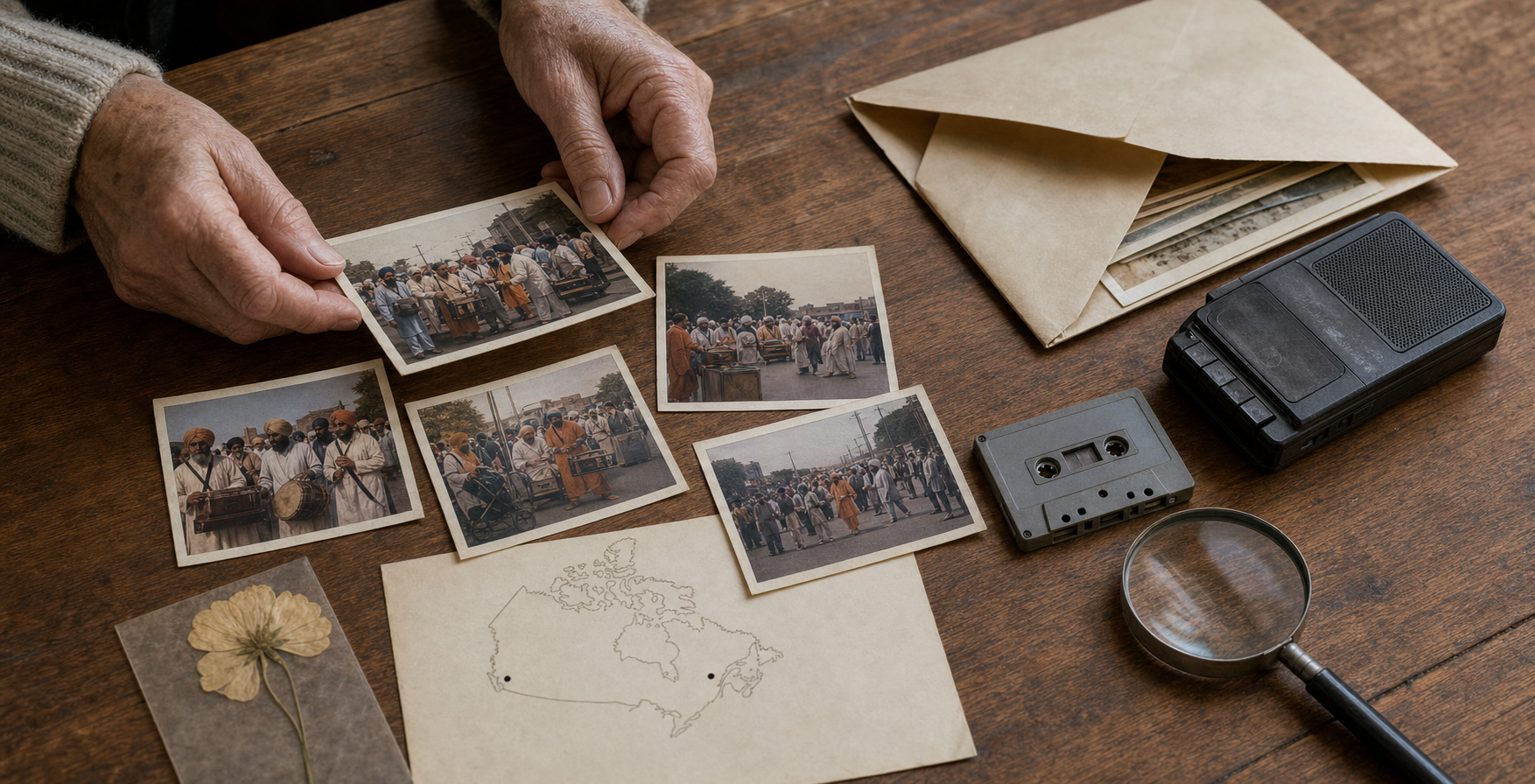
- Preserve the physical context. Scan the front and back of photographs, letters, invitations and flyers. Include title and publication pages from books when they contain dates, signatures or ownership notes. Keep the originals after making digital copies.
- Identify people cautiously. Include remembered names and alternate spellings, but label an identification as tentative when you are not sure.
- Explain permission. State whether your account, name and images may be quoted publicly, archived without publication, or used only after further contact.
Bhaktimarga Swami is seeking recollections from anyone who was in Canada at any point from 1967 through 1977. The requested contact deadline is August 20, 2026. Memories can be sent to bhaktimargaswami@gmail.com, or discussed by telephone at +1 647 530 4273.
If you were present, send what you can establish now rather than waiting for a polished memoir. A modest account with a place, an honest uncertainty and a surviving artifact can do more for the historical record than a confident story with its anchors removed.
References
