
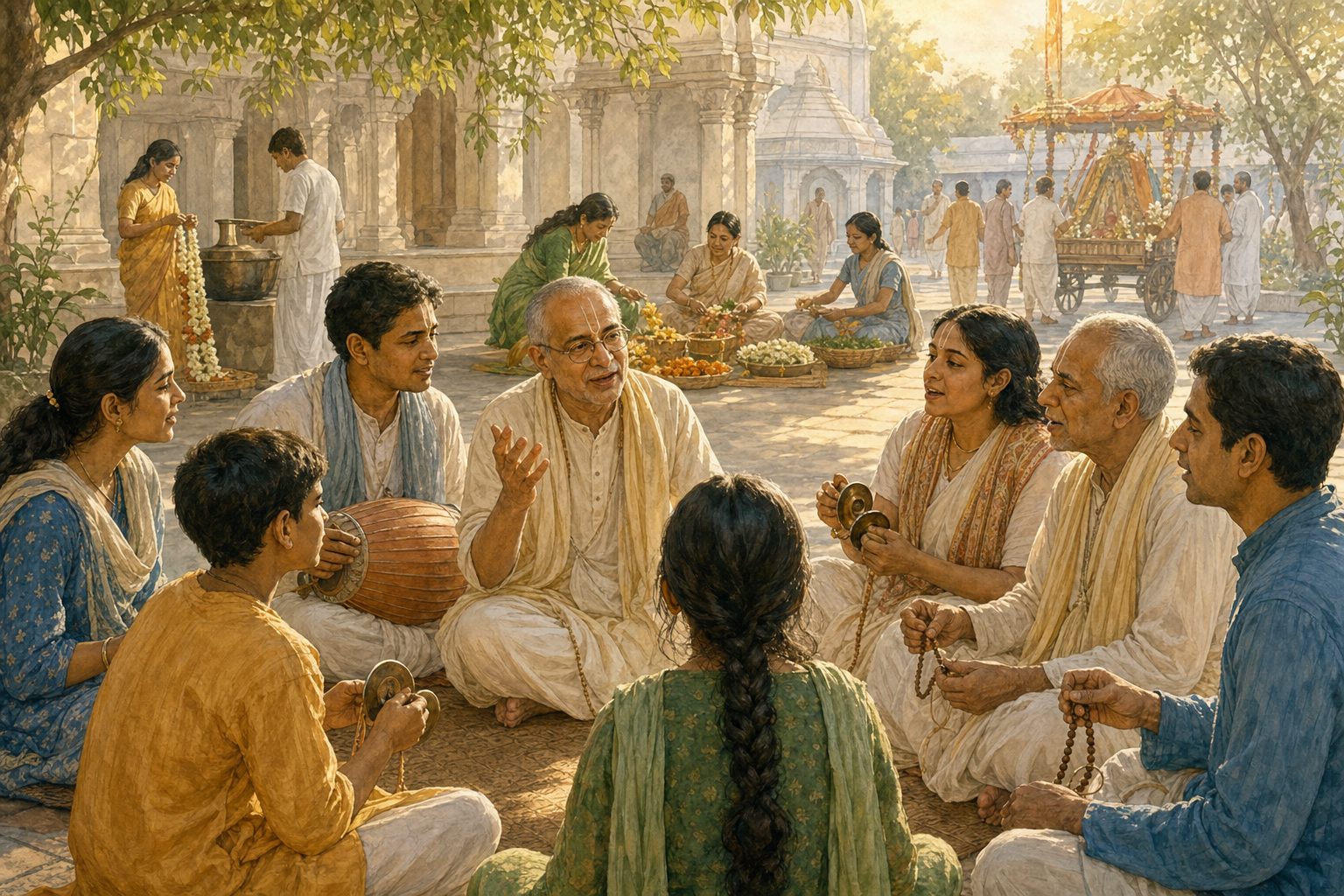
If you have been asked to lead kirtan, explain a teaching, organize a padayatra, or identify yourself publicly as a Vaishnava, the difficult question is not whether you know enough vocabulary. It is whether your words and conduct make the lineage visible without placing your ego in front of it.
A dependable standard has three parts: receive the tradition accurately, let its disciplines form your character, and give others a truthful way to encounter it. This protects you from two opposite errors: treating initiation as a badge of authority and presenting personal invention as inherited teaching.
Name the lineage before you speak for it
Vaishnava is the name of a broad devotional family, not a license to speak as though every sampradaya forms its devotees in the same way. Different lineages share devotion to Vishnu and His forms while preserving their own acharyas, theological language, disciplines, liturgical forms, and standards of authority.
Within Sri Vaishnavism, the fivefold sacred formation known as pancha samskaras gives the tradition a specific framework for forming a Sri Vaishnava. That vocabulary belongs to the Sri Vaishnava setting associated with Ramanujacharya in the 11th-12th century. A Gaudiya Vaishnava discussion of formation may instead foreground nama-sankirtana, the example of Haridasa Thakur, the teachings of Bhaktivinoda Thakur, and service to Srila Prabhupada’s mission. These inheritances can illuminate one another, but they should not be collapsed into an invented universal ceremony.
Before teaching, posting, or organizing an event, identify three things plainly:
- Your lineage: Name the particular sampradaya, acharya tradition, or community whose teaching you are presenting.
- Your actual role: Say whether you are a student, initiated practitioner, organizer, teacher, or formally authorized representative. Use representative only when the community has actually entrusted you with that responsibility.
- The scope of your claim: Say our lineage teaches this when a point is lineage-specific. Do not silently turn it into all Vaishnavas teach this.
A careful introduction might be: I practice within this lineage, this is how our teachers explain the practice, and formal questions should be taken to this qualified teacher. That sentence does not weaken your testimony. It shows that you understand where your authority begins and ends.
If you cannot yet name the lineage behind a claim, pause before publishing it. Ask the teacher or community from whom you received it. Narrowing a statement is better than gaining attention through an inaccurate generalization.
Initiation creates accountability, not personal sovereignty
Formal reception into a tradition is a beginning of disciplined responsibility. It is not proof that every later opinion of the initiate has become sampradaya-siddhanta. The distinction matters most when a person gains an audience, because recognition can make personal preference feel like spiritual insight.
Bhaktivinoda Thakur’s warning is precise: pride after initiation can turn a disciple away from the path of the earlier acharyas and toward a self-made path. The danger is not creativity by itself. The danger is changing the inheritance while continuing to invoke the lineage’s authority.
Use two checks whenever you introduce a new class format, festival element, online explanation, translation, or outreach method:
- Provenance: Can you identify the teacher, established practice, or text from which the teaching came? Can a listener distinguish that inheritance from your own explanation?
- Fruit: Does the change deepen remembrance, practice, humility, and service, or does it mainly make the organizer more visible?
A contemporary presentation does not automatically violate tradition. A microphone, translated handout, livestream, or new meeting format can change how a teaching reaches people without changing what the teaching means. The honest boundary is straightforward: adaptation changes the delivery and acknowledges its responsibility to the lineage; invention changes the teaching and conceals the change.
When you are unsure which side of that boundary you are on, label the uncertain element accurately. Say this is a local arrangement, a personal reflection, or an experimental format. Do not call it an ancient requirement unless you can establish that it is one. Then place the question before someone whom the lineage recognizes as qualified.
Test representation through determination, nama, and compassion
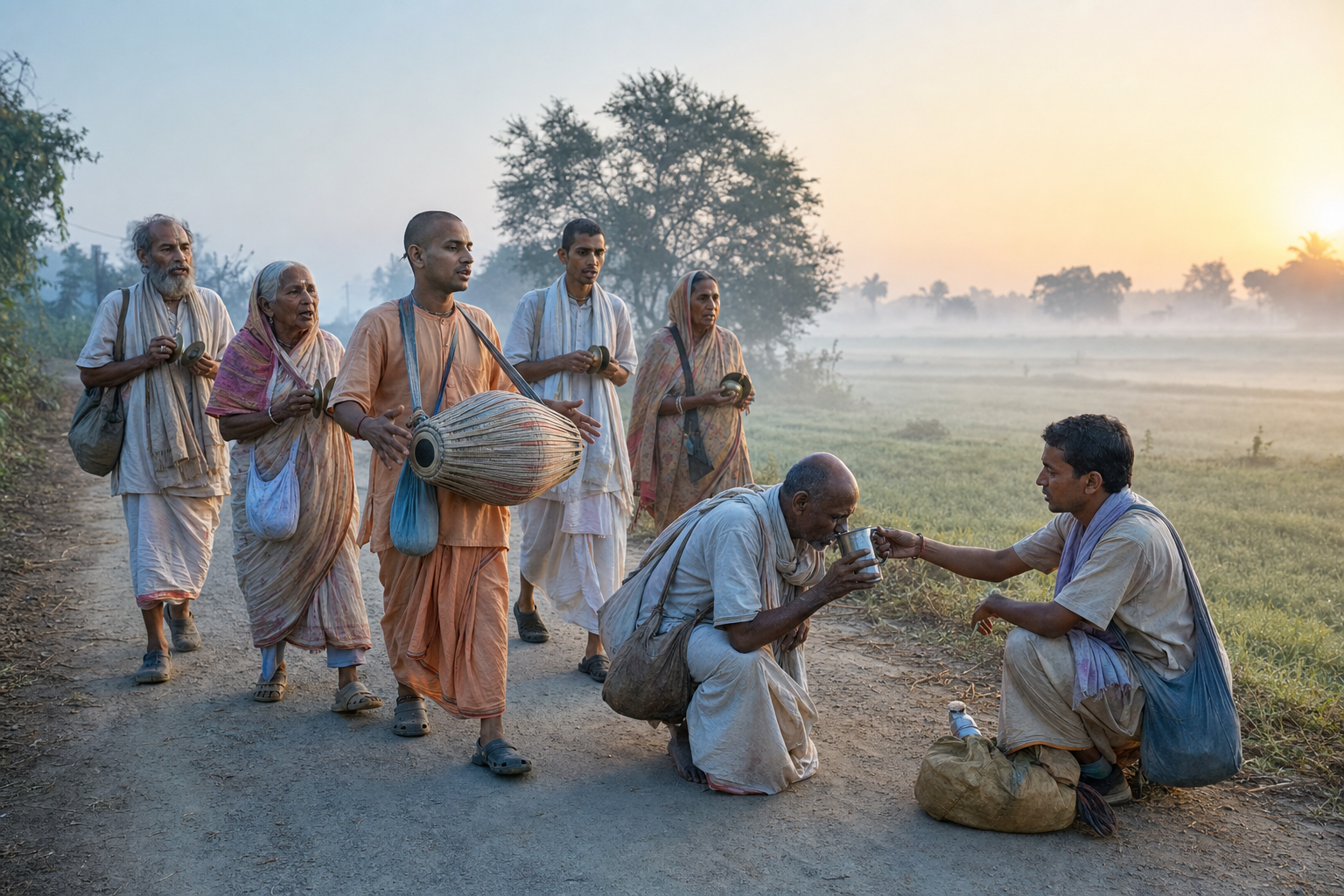
Haridasa Thakur embodies three connected signs of fidelity to the path of the acharyas: determination in spiritual life, sustained chanting of the holy names, and compassion for others. This is a distinctly useful Gaudiya Vaishnava test because it examines practice and motive together. It does not let public orthodoxy substitute for inner discipline.
- Determination asks whether your practice survives inconvenience. A public event can generate enthusiasm for a day or a week. Formation becomes visible when the practitioner continues after the crowd, music, travel, and recognition are gone. Write down the daily or regular commitment you have actually received from your guru or community. If public responsibilities expand while that commitment repeatedly contracts, the role is beginning to deform the formation it is supposed to express.
- Nama asks what remains at the center. In the Gaudiya example, chanting is not background decoration for an organization, personality, or cultural performance. Haridasa Thakur’s defense of audible chanting is explicitly directed toward the welfare of beings who can hear it, not merely toward the private satisfaction of the chanter. At a public gathering, ask whether the holy name remains recognizable as the purpose of the gathering or has become a soundtrack for something else.
- Compassion asks what the encounter gives another person. A newcomer should receive more than volume, spectacle, or an argument. Give the person an understandable explanation, an appropriate text, someone approachable for questions, and a truthful next step. Compassion does not require diluting siddhanta. It requires communicating without contempt and caring what happens after the first encounter.
The three signs correct one another. Determination without compassion can harden into self-righteousness. Compassion without disciplined practice can become sentiment detached from the tradition. Chanting without either can be reduced to performance. A credible representative keeps all three in view.
This also clarifies what loud chanting can and cannot prove. Audibility can serve the outward-giving purpose of sankirtana, but volume alone does not demonstrate compassion. Notice whether your conduct invites people toward Bhagavan’s name, whether questions are treated respectfully, and whether those who decline an invitation are left with dignity.
Build public outreach as an extension of formation
A procession, kirtan, temple program, book table, or online broadcast represents the lineage through more than its stated message. Volunteer conduct, handling of questions, use of sacred names, choice of literature, and follow-through all teach the observer what kind of people the practice is forming.
Before the event
- Assign an accountable leader who knows which lineage the event represents and who can correct theological or practical mistakes.
- Have chants, explanations, handouts, images, and books reviewed by a qualified person in that tradition. A polished design cannot repair an inaccurate teaching.
- Give every volunteer three plain answers: who we are, what we are doing, and where an interested person can learn more.
- Agree on how to handle questions beyond the team’s knowledge. I do not know, but I can connect you with someone qualified is a better representation of parampara than an improvised answer.
- Separate teaching from logistics. Local decisions about routes, schedules, clothing, or volunteer roles should not be presented as eternal religious rules.
During the event
- Keep the central sadhana central. If it is a sankirtana event, do not let speeches, branding, photography, or internal announcements displace the chanting.
- Place at least one informed and approachable practitioner where newcomers naturally stop. That person should be ready to explain the event without pressuring anyone to agree.
- Correct volunteers quietly when possible. Public humiliation may display control, but it does not display a lineage forming people in humility and compassion.
- Offer literature transparently. Identify the title and teacher, explain any requested contribution honestly, and recommend a suitable starting point rather than handing everyone the same material without context.
For communities centered on Srila Prabhupada, making his books available allows a hearer to carry the teaching beyond the immediate sound of sankirtana. Book distribution therefore belongs to the spiritual logic of the event, not merely to its publicity or fundraising. Other Vaishnava communities should offer literature authorized within their own lineage rather than importing a Prabhupada-specific practice and describing it as universally required.
After the event
- Return to the regular practices that made the public service possible. The important measure of determination is whether participants continue the spiritual process after the festival has ended.
- Give interested people one clear next step: an appropriate gathering, reading opportunity, or qualified contact. Do not collect interest that nobody is prepared to serve.
- Record the questions that volunteers could not answer. Have the answers reviewed, then use them to prepare the team for the next program.
- Correct public mistakes publicly when the error affected the public. Quietly changing the next event does not repair a false teaching that remains online or in someone’s understanding.
Notice the common substitutes for fidelity
- External resemblance: Dress, tilaka, vocabulary, and ceremony can identify a tradition, but they do not excuse undisciplined conduct.
- Name-dropping: Repeating the names of gurus and acharyas is not the same as following their path. Ask what obligation the name places on your behavior.
- Novelty presented as inheritance: A new method may be useful, but it should be identified as new. Hidden innovation deprives the community of the chance to judge it honestly.
- Aggression presented as conviction: Firmness concerns commitment to practice and truth. Treating an uninformed or skeptical person with contempt demonstrates neither.
- Reach presented as formation: Attendance, views, noise, or the number of books moved can describe activity. They cannot by themselves show whether practitioners became steadier, more truthful, or more compassionate.
Key takeaways: a six-question lineage audit
Use this audit before you accept a public title, publish a teaching, or approve a Vaishnava event:
- Which specific lineage, teacher, and practice am I representing?
- Which parts of my message are inherited teaching, and which are my explanation or local arrangement?
- Has someone qualified in this tradition reviewed the claims that could be mistaken for doctrine?
- Does my private or regular practice support the public role I am taking?
- Will a newcomer encounter nama, a compassionate practitioner, and an authorized path for learning more?
- What will continue after the event, attention, or enthusiasm has passed?
If one answer is vague, narrow the claim before expanding the platform. Your next step need not be dramatic: identify one public statement you currently make, trace it to the lineage that gave it to you, and revise the wording so that your authority, inheritance, and responsibility are all clear. That small act of accuracy is itself a service to parampara.
References
- Dandavats — Properly representing our Parampara on Padayatra
- Hindu Blog — Pancha Samskaras Of Sri Vaishnavas
