
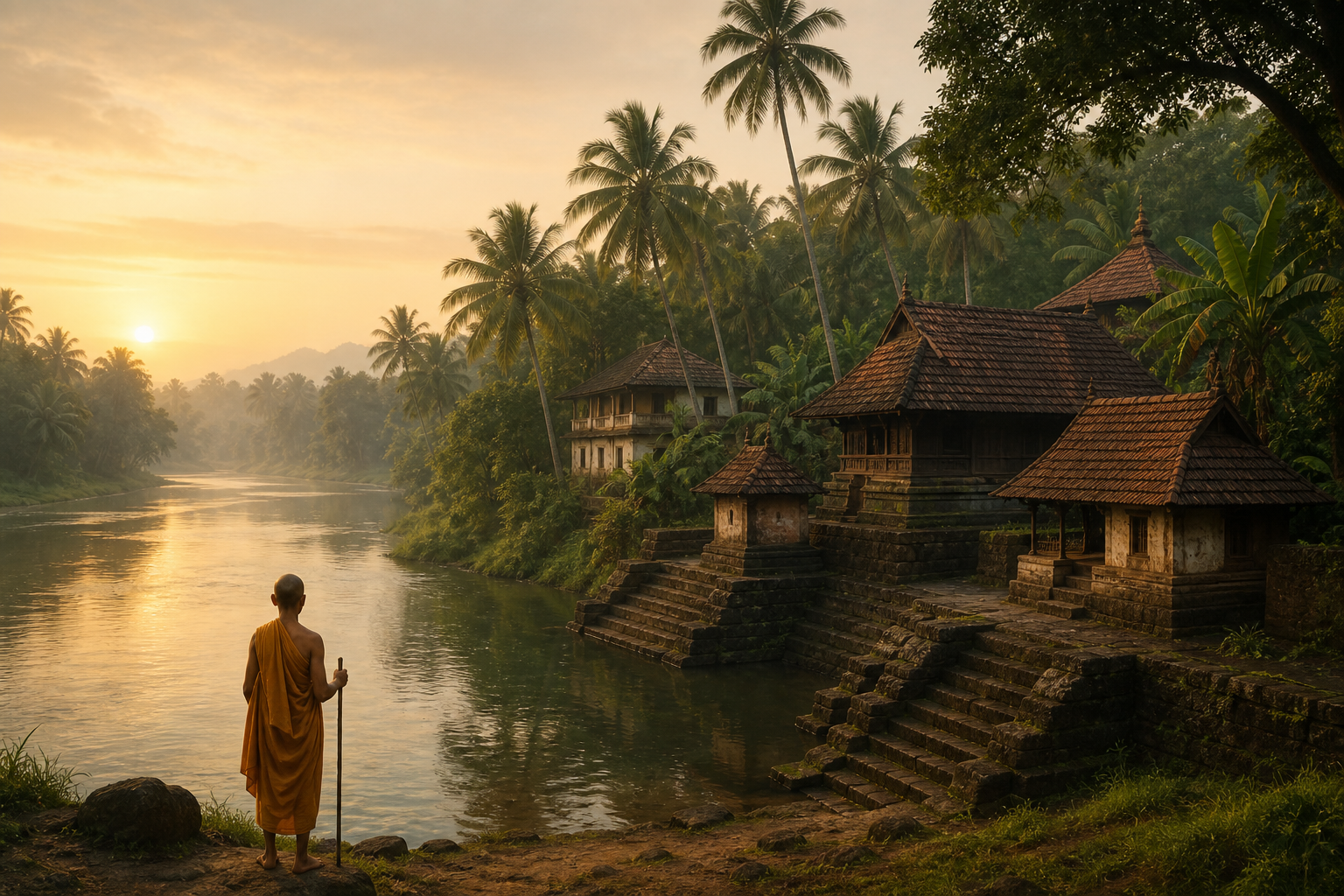
If you know Adi Shankara mainly through Advaita Vedanta, Kalady can seem like a biographical footnote. It is much more. The rediscovery of his birthplace restored the connection between a civilization-shaping acharya and the intimate world from which he emerged: a Kerala home, devoted parents, a sacred landscape and a living culture of learning.
That distinction matters when you decide how to understand Kalady. It is neither merely another temple stop nor a geographical claim that settles every question about Shankara’s life. It is where biography, devotional memory and institutional preservation meet. If you keep those layers distinct, you can approach Kalady with both shraddha and historical clarity.
Rediscovery restored a relationship, not just a location
The word “rediscovery” can create the wrong mental picture. You may imagine an abandoned ruin being uncovered or a forgotten name suddenly appearing on a map. Sacred geography is often recovered differently. A place may remain inhabited while its larger civilizational significance recedes from public attention. Rediscovery then means making the relationship between person, place and tradition legible again.
Kalady is revered as the Kerala birthplace of Jagadguru Adi Shankaracharya, remembered as the eighth-century teacher who gave Advaita Vedanta renewed intellectual and spiritual force. Shankara’s influence belongs to the wider Dharmic world, but his birth belongs to a particular family and landscape. Recovering Kalady brought those two scales back together.
This gives you a useful way to read any recovered tirtha. Look for three layers. The first is topography: the physical place being identified. The second is inherited memory: the people and sacred events associated with it. The third is institution: the shrines, teaching centres and practices through which that memory remains available. Kalady matters because all three now operate together.
Do not confuse this recovery with the rediscovery of Shankara’s philosophy itself. Advaita Vedanta did not become important because a birthplace was recognized. The direction runs the other way: because the acharya and his teachings mattered, recovering his birthplace allowed devotees and students to encounter the human beginning of a pan-Bharatiya legacy.
Shivaguru and Aryamba give Kalady its human scale
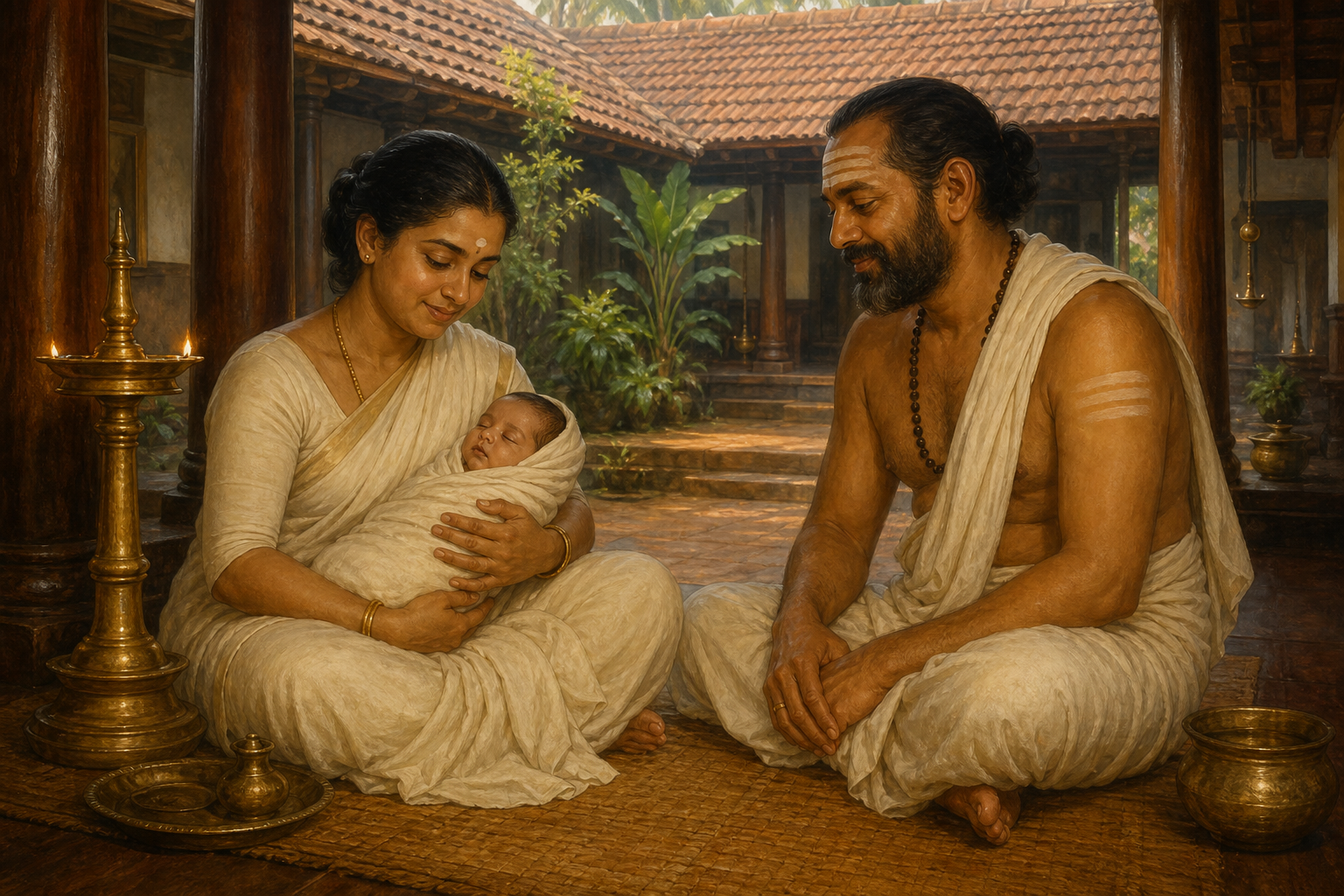
Kalady’s sacred identity begins with Shankara’s parents. The devotional tradition remembers Shivaguru and Aryamba as a devout, childless couple who undertook intense worship at the Vadakkannathan temple near Thrissur. Shiva then appeared in Shivaguru’s dream and promised them an extraordinary son whose earthly life would be brief but whose renown would endure.
This account belongs to the devotional grammar of Shankara’s life. It does not function like a dated inscription or an administrative record, and it should not be forced into that role. Its purpose is to express how the tradition understands his birth: not as an isolated biological event, but as the answer to tapas and the beginning of a divinely ordered mission.
That distinction helps you avoid two equal mistakes. Treating a sacred dream as if it were modern archival evidence flattens the difference between kinds of testimony. Dismissing it because it is not archival evidence erases the meaning that generations of devotees preserved. Historical inquiry can ask when and how a narrative was transmitted. Devotional inquiry asks what the narrative teaches about grace, sacrifice and purpose. You do not have to make one question cancel the other.
Aryamba’s presence is especially important. Great teachers are easily converted into disembodied systems of thought, as though they entered history already holding finished doctrines. Kalady resists that abstraction. The samadhi associated with Aryamba keeps the mother within the sacred landscape. When you encounter it, notice what it does to your understanding of the acharya: Shankara was also a son, and his philosophical life began inside a relationship of nurture, duty and memory.
Read Kalady as a living map of Shankara’s legacy
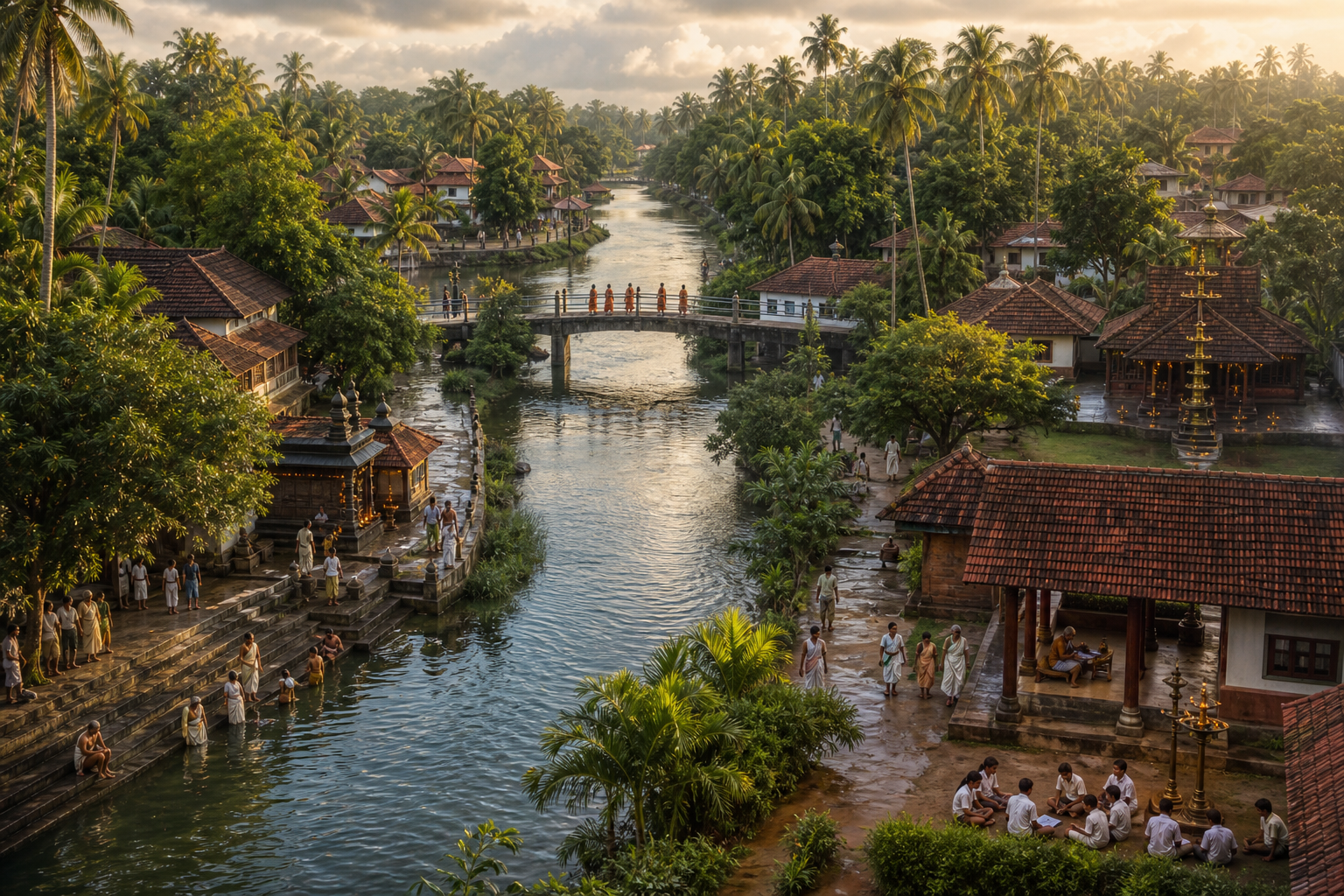
In its present form, Kalady is a spiritually active pilgrimage and educational centre. Its sacred landscape includes temples associated with Adi Shankara and Sharadamba, along with Aryamba’s samadhi and institutions devoted to Vedantic learning. These are not interchangeable attractions. Each preserves a different dimension of memory.
You can therefore approach Kalady through the following conceptual sequence. This is a way of reading the place, not a claim about a prescribed ritual order or the physical route between its institutions.
- Begin with Shankara as a person. At the shrine associated with the acharya, ask what changes when a philosopher is remembered through worship as well as through books. The honorific “Jagadguru” identifies a teacher whose significance exceeds a single locality, while Kalady restores the locality from which his life began.
- Turn from the teacher to knowledge. Sharadamba represents the sacredness of learning. Her presence prevents Advaita from becoming a slogan detached from study. Notice whether your own interest in Shankara rests on repeated phrases about non-duality or on disciplined engagement with the questions those phrases answer.
- Make room for Aryamba. The mother’s samadhi brings family memory into a landscape otherwise dominated by the towering stature of the son. Pause long enough to register that civilizational achievement has a human setting. A teacher’s public mission does not erase the relationships that formed him.
- Look beyond monuments to transmission. Kalady’s role as a centre of Vedantic education shows why restoration cannot end with construction. A shrine can preserve presence, but teaching preserves understanding. Ask what is being studied, how students are formed and how inherited knowledge is being carried forward.
This sequence also clarifies why the rediscovery of a sacred birthplace matters. A recovered site becomes culturally durable only when memory takes institutional form. Temples make devotion possible, memorial spaces protect relationships and educational activity carries ideas into another generation. Remove any one of these and the picture becomes thinner.
Key takeaways
- Kalady’s importance lies in reconnecting Shankara’s pan-Bharatiya legacy with the particular family and Kerala landscape of his birth.
- Rediscovery should not be reduced to finding a coordinate. It includes restoring public recognition, sacred memory and institutions capable of sustaining that memory.
- The tradition of Shivaguru and Aryamba’s tapas explains the spiritual meaning assigned to Shankara’s birth; it should be read as devotional testimony, not disguised as a modern archival record.
- The Shankara and Sharadamba temples, Aryamba’s samadhi and Vedantic educational activity preserve different aspects of the same legacy.
- A responsible visitor can honour sacred tradition while still asking precise historical questions about identification, continuity and restoration.
Ask what “rediscovered” means before repeating a chronology
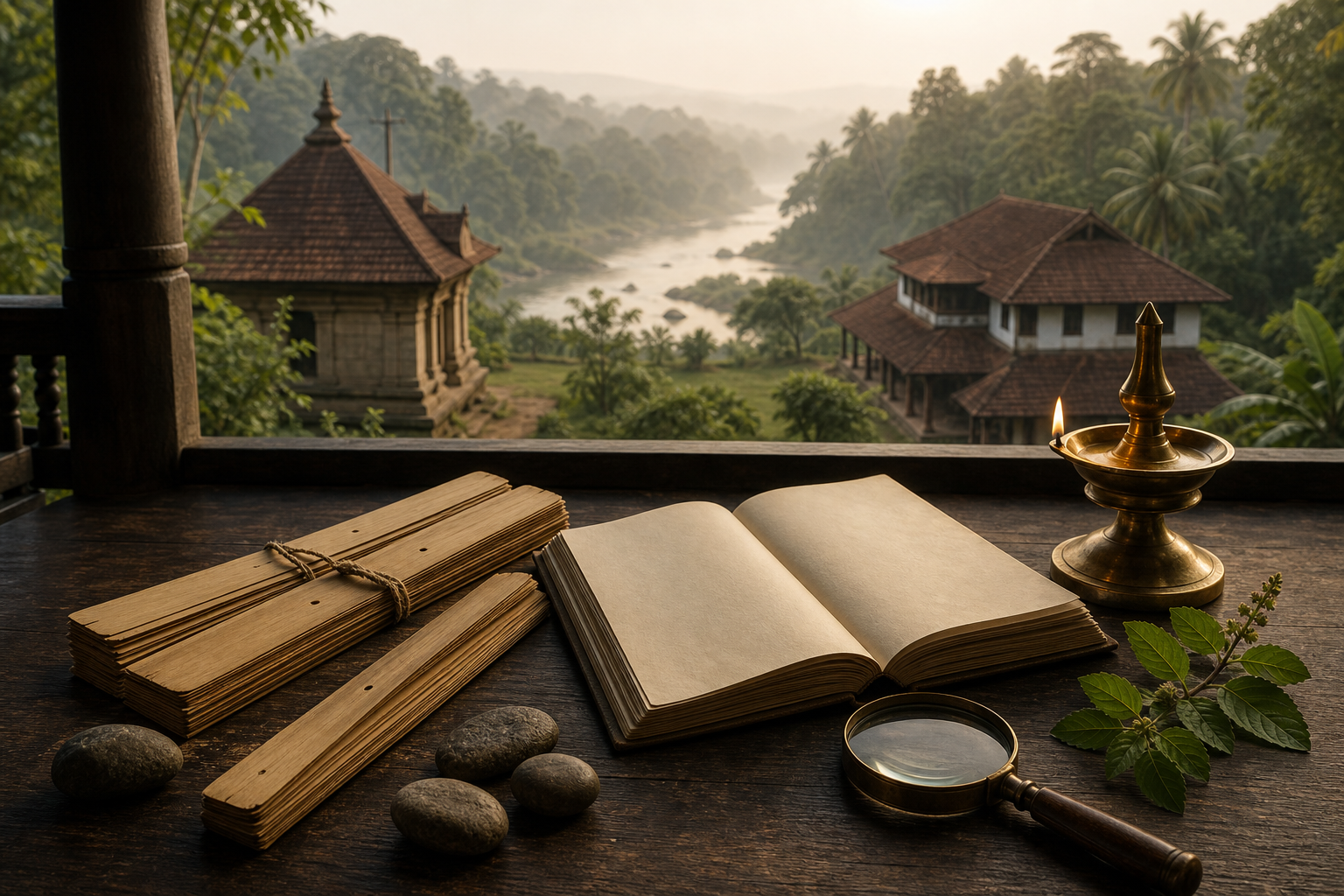
A full history of Kalady’s rediscovery needs more than the word itself. “Rediscovery” can refer to several different developments: identifying a physical location, renewing wider recognition of an existing local tradition, establishing a shrine, organizing pilgrimage or building institutions around the site. Those developments need not have happened at the same time or through the same people.
Before you repeat a precise name, date or heroic recovery story, test it with four questions:
- What exactly was identified? Was it the town, a family location, a shrine, a riverbank or a broader sacred landscape?
- What memory already existed locally? A place can be unknown to a wider public without being forgotten by the community living around it.
- Which act counts as restoration? Recognition, temple construction, consecration and the creation of a teaching institution are distinct events.
- What kind of evidence supports each detail? Separate oral tradition, devotional biography, inscriptions, institutional records and later retellings instead of blending them into one undifferentiated narrative.
What can be stated without manufacturing a missing chronology is narrower but still significant: Kalady is venerated as Shankara’s birthplace; its sacred memory includes Shivaguru, Aryamba and the Vadakkannathan tradition; and it now functions through temples, Aryamba’s samadhi and Vedantic learning. Precise claims about who accomplished each stage of rediscovery, and when, should be attached only after those details are supported by corroborated historical records.
If you visit Kalady, use the same discipline. Keep three kinds of notes: what a dated record establishes, what a local or devotional tradition remembers and what you infer from the place. Do not demote the second category merely because it is not the first, but do not silently convert it into the first either. That simple separation protects historical accuracy without stripping a tirtha of sacred meaning.
Before you go, carry one biographical question about Shankara, one philosophical question about Advaita and one historical question about Kalady’s recovery. Move through the birthplace with those questions in view. You will encounter more than a location on a map: you will see how a civilization remembers a teacher by preserving his land, his mother, his sacred inheritance and the learning he renewed.
References
