
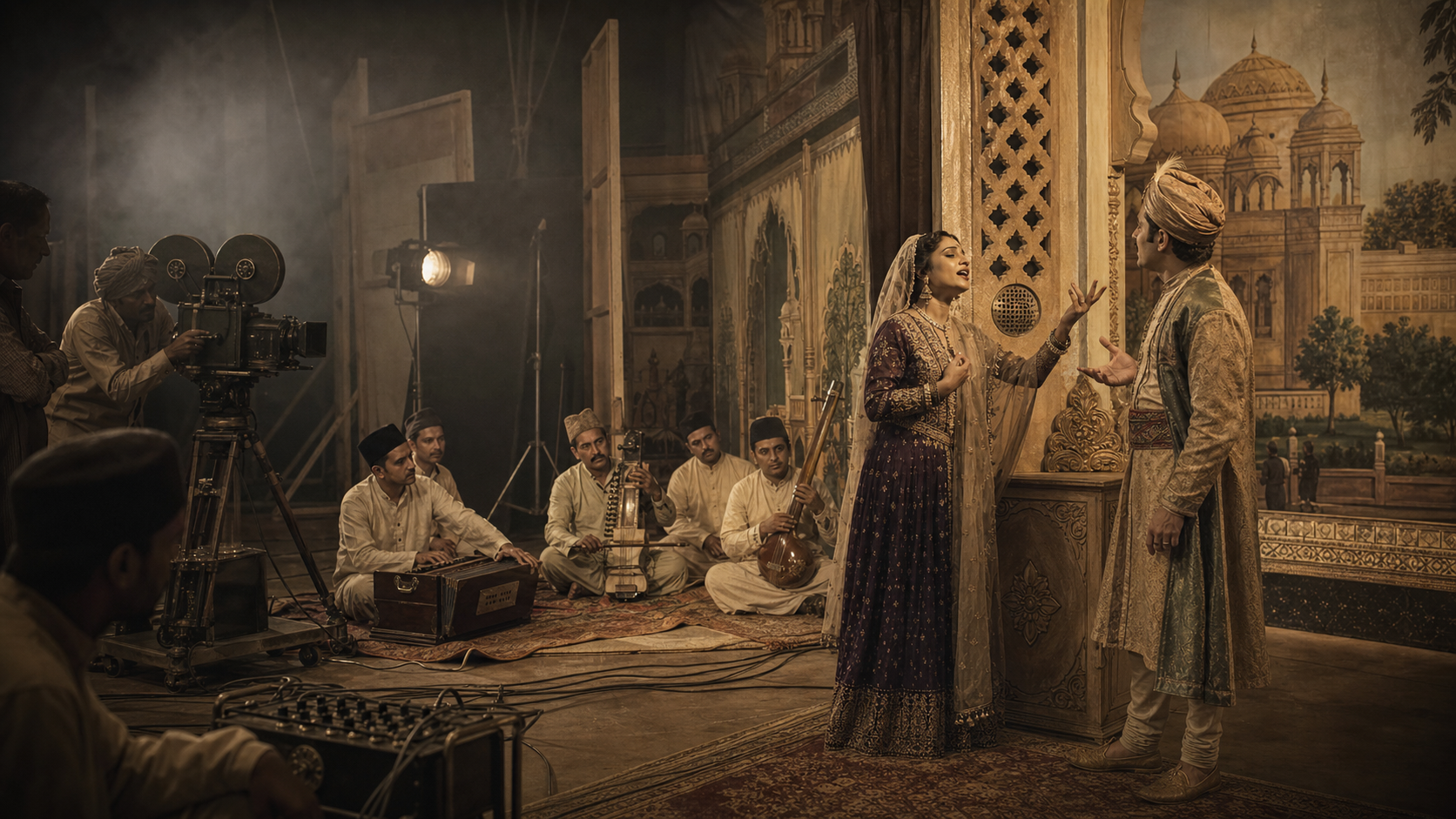
If you listen to songs and dialogue from the first decades of Hindi cinema, you may wonder why an industry called “Hindi” so often sounds Urdu. The useful answer is not that Hindi disappeared, and it is not that the labels mean nothing. Early filmmakers worked within a broad Hindustani speech world, while Urdu-inflected poetry acquired exceptional prestige in songs and elevated dialogue.
That prominence was real, but it did not leave an empty space where Indic traditions had been. Hindi geet, bhakti, mythological narratives, philosophical songs and classical ragas remained active. To understand the balance – and to decide what deserves revival now – you have to separate language, poetic form, music and subject matter before judging them together.
Start with the distinctions the soundtrack requires
Hindustani is most useful here as the shared field of north Indian speech from which both modern Hindi and Urdu draw. In ordinary conversation, the boundary can be fluid. At the literary ends of the spectrum, the difference becomes clearer: one register may reach more often for Sanskrit-derived vocabulary, while another may favor Persian-Arabic vocabulary and Urdu poetic conventions.
A film can therefore be identified as Hindi while a particular lyric leans strongly toward Urdu. That is not necessarily a contradiction. It tells you that the industry’s public label, its conversational base and its elevated artistic diction are three different things.
Poetic form must also be kept separate from musical structure. A ghazal belongs to a literary and performative tradition; a geet is a broader song form; a bhajan is defined principally by devotional orientation. A classical or semi-classical raga can support any of them. Urdu poetry set within an Indic raga framework is not culturally or musically incoherent. It is one of the characteristic combinations that early cinema inherited from theatre and urban performance culture.
Subject matter adds a fourth layer. A song about Krishna may use an accessible mixed vocabulary rather than highly Sanskritized Hindi. A lyric containing the word Khuda may perform a direct moral or charitable function rather than courtly romance. If you classify a song by one word, one script or one religious reference, you will miss how its language, music and dramatic purpose interact.
Key takeaways
- Hindustani is a shared linguistic field, not a single fixed vocabulary. A film song can lean toward either a Hindi or an Urdu literary register.
- Ghazal, geet and bhajan describe different poetic or devotional orientations; they do not by themselves identify the underlying musical system.
- Urdu diction and classical raga can coexist in the same composition. One does not cancel the other.
- Hindi geet, bhakti and mythological cinema survived alongside Urdu-inflected popular forms, even when their mainstream visibility was unequal.
- The prominence of a register is best explained through theatre, technology, markets and cultural institutions together, not through a single-cause story.
Alam Ara reveals both the pattern and the limits of certainty
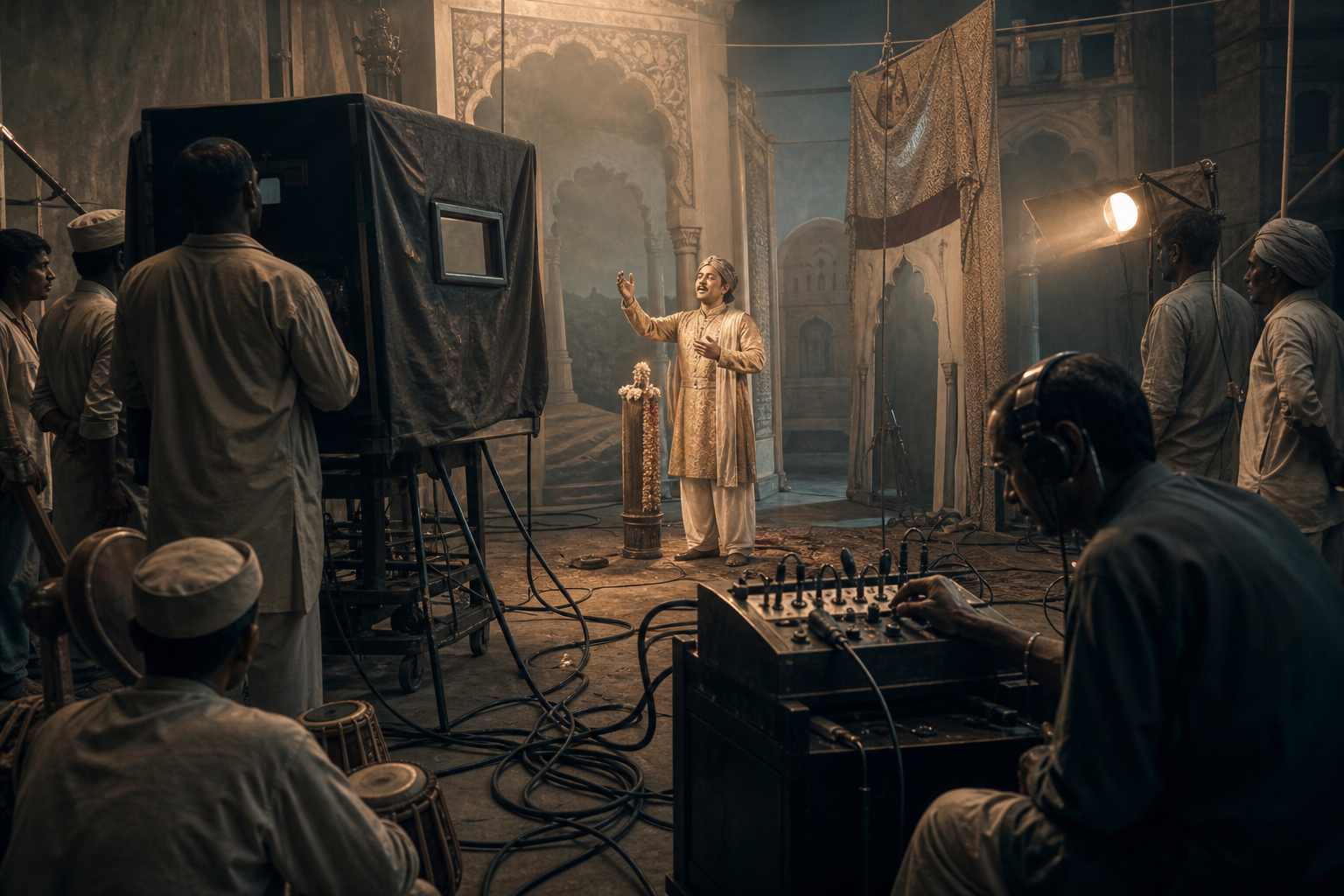
Alam Ara, released in March 1931, inaugurated synchronized dialogue and song on Indian screens. Producer Ardeshir Irani was Pune-born, his family had migrated to India from Iran, and the story came from a Parsi stage play. Its setting was therefore not a linguistically sealed world. It emerged from Bombay’s cosmopolitan theatre and commercial culture, where performers had to reach a socially varied urban audience.
The film’s sound also grew out of severe technical constraints. Large microphones were reportedly concealed in costumes so that speech and music could be captured within the scene. When sound recording is tied so closely to the set and the performer, theatre-tested voices, familiar performance forms and immediately intelligible diction possess an obvious practical advantage. Early talkie language was partly an aesthetic choice, but it was also shaped by what could be performed and recorded successfully.
The best-known song associated with the film, De De Khuda Ke Naam, was rendered by Wazir Mohammed Khan. Its Urdu diction is unmistakable, yet its dramatic purpose is direct and moral: it asks the listener to give generously if able and to ask courageously if in need. That matters because it prevents an easy misreading. Urdu in the first talkie was not confined to elite romance or ornamental court language; it could also carry public instruction in a form designed for immediate audience response.
The repertoire was not uniform. Darasa Bina Tarse Hain Naina stands out as a different linguistic current within the film’s largely Urdu-ghazal palette. A ghazal performed by Zubeida has been associated with Raga Kankan, though Mishra Khamaj is considered the more probable identification. The uncertainty should be preserved, but the larger point is secure: Urdu poetic expression and classical or semi-classical Indic music occupied the same soundtrack.
You should nevertheless resist making Alam Ara prove more than the evidence permits. The film is lost and is not available for direct study in the National Film Archives of India. Surviving documentation can establish important features, but it cannot support a complete scene-by-scene or song-by-song audit. Claims about exact proportions, pronunciation and musical treatment must remain more tentative than claims based on a surviving print.
Playback widened cinema’s voice rather than closing it
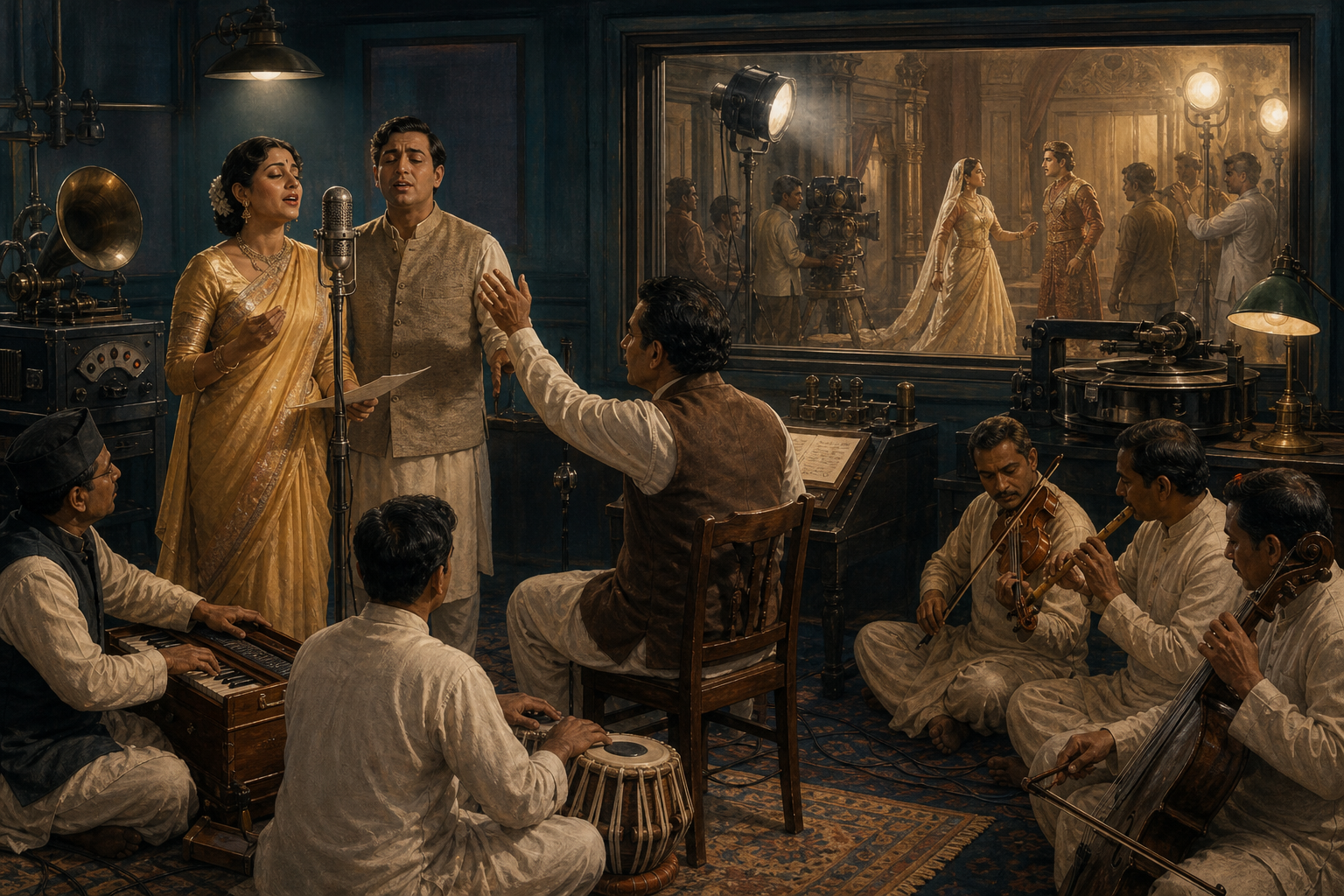
The next major technological turn complicates any story of straightforward linguistic replacement. In 1935, only four years after Alam Ara, Dhoop Chhaon introduced India’s first recognized playback song, Mere Ghar Mohan Ayo. R. C. Boral and Pankaj Mullick composed the music, and Harimati, Supra Sarkar, Parul Ghosh and K. C. Dey supplied the voices.
The title itself announces a devotional world centered on Mohan, a name of Krishna. The composition drew on devotional and philosophical motifs while helping establish the new grammar of playback. Once recording no longer required every vocal performance to be captured in precisely the same way on the dramatic set, cinema could make greater use of specialist singers and more deliberately constructed musical performances.
K. C. Dey, the blind vocalist-actor who was also Manna Dey’s uncle, became a sensation in the mid-1930s. His popularity is a useful corrective to the idea that early film music had already detached itself from bhakti, reflective poetry or classical discipline. These currents were not archaeological remnants. They belonged to the same formative period as the Urdu ghazal idiom.
The films of the 1930s and 1940s likewise included mythological narratives alongside socially progressive cinema. Their songs could be devotional, romantic, reformist, philosophical or realist. The important historical question is therefore not whether Dharmic expression existed. It plainly did. The sharper question is which forms received the most durable prestige, repetition, critical attention and access to mainstream distribution.
A later song can help you hear the contrast, provided you do not mistake it for evidence about 1931. Mukesh’s Hari Bhari Vasundhara Me Neela Neela Ye Gagan from Boond Jo Ban Gaye Moti in 1967 pairs Bharat Vyas’s nature-centered Hindi lyric with Satish Bhatia’s music in a film produced by V. Shantaram. It is a clear example of the geet sensibility many listeners want restored to greater prominence. Use it as a comparison track, not as a statistical stand-in for an earlier decade.
The timeline rules out a one-cause political explanation
Politics and institutions did influence film culture, but chronology matters. Alam Ara appeared in March 1931. The Indian Progressive Writers’ Association took shape in London in 1935 and in Kolkata and Lucknow in 1936. Later progressive networks therefore could not have created the initial presence of Urdu and the ghazal in Indian talkies. Those elements were already embedded in Parsi theatre, urban entertainment, mehfil culture and the commercial language of Bombay.
The progressive movement could, however, strengthen and redirect an existing preference. The Progressive Writers’ Association and the Indian People’s Theatre Association brought writers and artists into influential cultural networks. Faiz Ahmad Faiz, Saadat Hasan Manto and Ismat Chughtai belonged to this wider milieu, while K. A. Abbas later became an important filmmaker and critic. Their socially conscious storytelling helped give particular kinds of dialogue, poetry and political realism institutional energy. In the post-independence period, that activism often converged with the priorities of the Nehruvian moment.
Market incentives worked at the same time. Producers needed paying audiences. Bombay’s urban patrons, theatre circuits, distributors and tastemakers did not merely reflect popularity after it appeared; through repetition and visibility, they helped manufacture it. A form that receives prominent performers, favorable criticism and sustained distribution can become the default sound of an industry even while other forms remain available.
The most defensible explanation therefore has four parts: theatrical inheritance supplied a ready performance language; sound technology rewarded forms that already worked on stage; urban markets encouraged a cosmopolitan register; and later cultural institutions amplified socially prestigious Urdu-Hindustani writing. Each layer operated at a different time and with a different mechanism.
This model allows you to recognize an imbalance without inventing a centralized ban for which the available history does not provide proof. Gatekeeping can operate through commissions, acclaim, distribution and repeated exposure without requiring a single command. Equally, the persistence of bhajans or mythological films does not prove that all traditions enjoyed equal visibility. Existence and prominence are different measurements.
Audit the balance carefully, then build what is missing
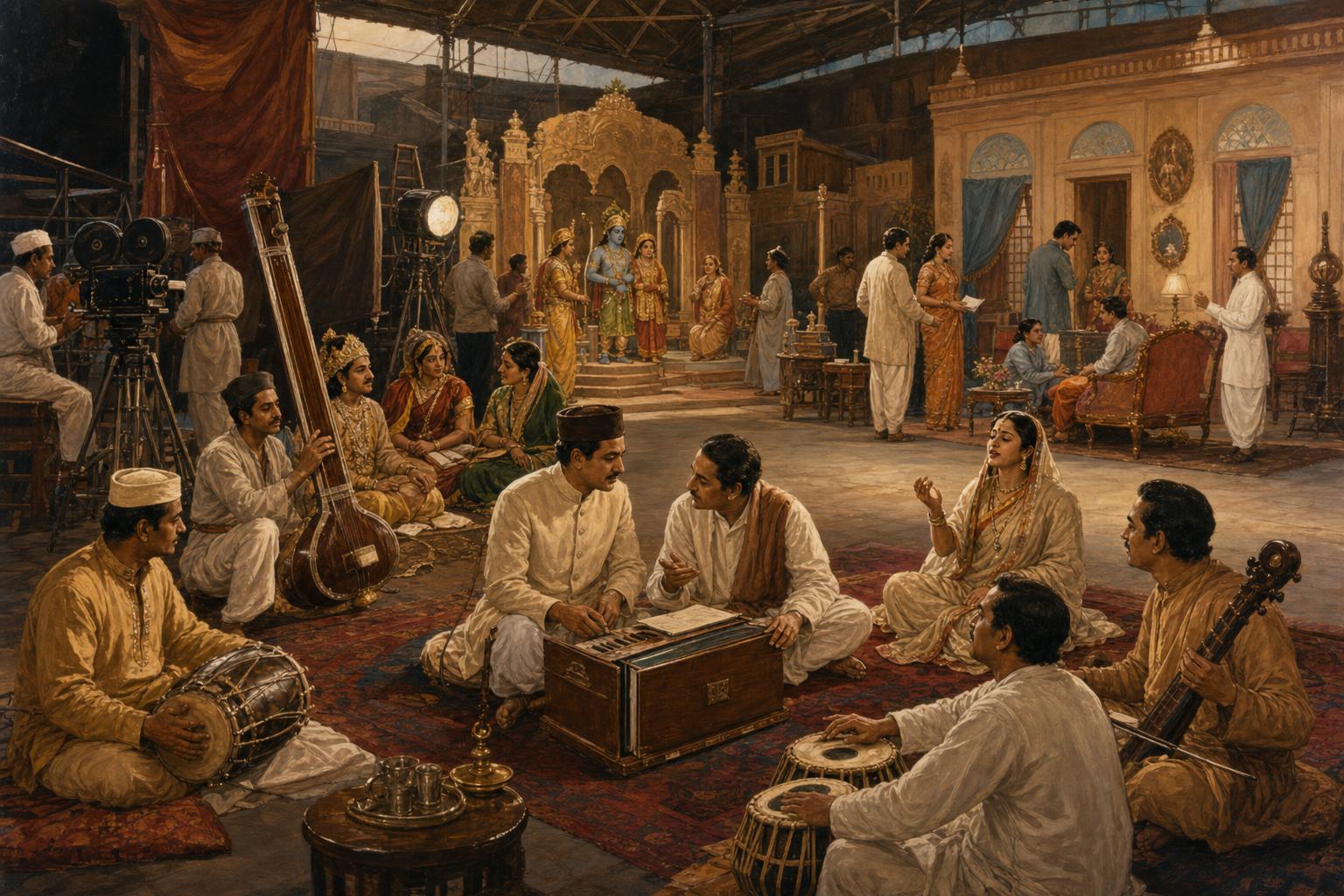
If you want to examine a decade, a composer or a studio for yourself, do not begin by sorting songs into “ours” and “theirs.” Begin with a small, reproducible catalogue. That turns an argument about impressions into a cultural history someone else can inspect.
A five-pass listening audit
- Define one time window. Keep 1931, the middle 1930s, the 1940s and 1967 separate. Mixing them can turn a real shift into a timeless claim.
- Transcribe the actual lyric or dialogue. Mark ordinary shared Hindustani separately from conspicuously Sanskritized or Persian-Arabic literary vocabulary. Do not classify an entire work from its title or one divine name.
- Record poetic form, musical framework and subject matter in separate fields. A ghazal set in a raga and a Krishna song in mixed Hindustani require more than one label.
- Measure prominence as well as presence. Note who performs the song, where it appears in the narrative and whether it became part of the film’s remembered public identity. A surviving minor song and a lost star performance do not carry the same evidentiary weight.
- Compare like with like. Place romantic songs beside romantic songs, devotional songs beside devotional songs and works from the same decade beside one another. Otherwise genre and technology will be mistaken for linguistic preference.
Survival bias needs its own column. A lost film such as Alam Ara cannot be audited at the same resolution as a preserved film. Mark an identification as documented, probable or uncertain instead of silently filling gaps. That one habit will make your conclusions more trustworthy.
Build the missing balance without destroying the inheritance
A Dharmic cultural response does not need to purge Urdu or treat the ghazal as incapable of belonging to India’s history. It can enlarge the field of prestige. An inheritance may be genuinely Indian in its development without representing the full range of Bharat’s civilizational vocabulary.
- Support preservation of early films, recordings, songbooks and production records regardless of linguistic register. Without preservation, honest comparison becomes impossible.
- Commission new Sanskritized Hindi geets, bhajans and shabads alongside ghazals rather than asking one form to disappear before another can flourish.
- Invite lyricists to draw explicitly from Hindu, Buddhist, Jain and Sikh philosophical traditions, then pair those ideas with strong cinematic situations instead of using sacred vocabulary as decoration.
- Program concerts and listening series around raga-based film music. Pair Urdu ghazals, Hindi geets and devotional compositions in the same raga so listeners can hear the shared musical ground and the distinct poetic choices.
- Publish accurate lyric sheets and glossaries. When audiences can see which words are shared, which are literary and what the images mean, preference becomes informed rather than inherited through repetition alone.
Your most useful next step is modest: choose ten songs from one decade and annotate four things – linguistic register, poetic form, musical base and civilizational imagery. That small catalogue will teach you more than a slogan about either cultural conquest or perfect harmony. Then put your attention behind the restorations, performances and new writing that make the neglected strands audible again.
References
- DharmaRenaissance Blog – Discover the Proven Roots of Hindi Cinema’s Linguistic Shift: A Balanced, Unifying History
