
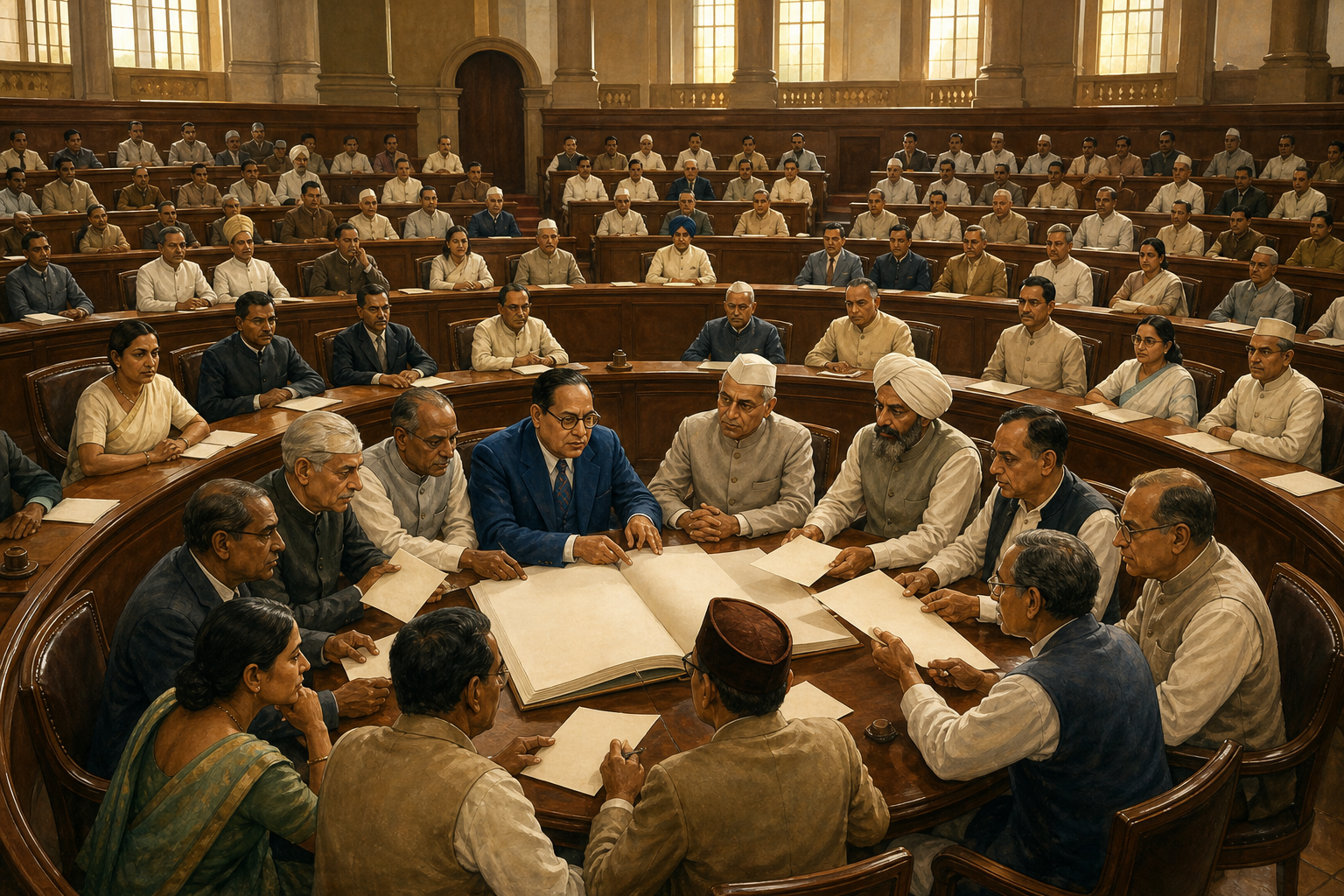
If you have been asked who wrote India’s Constitution, the clean answer is not a single name. Dr. B. R. Ambedkar deserves immense honour, but calling him the sole author turns a demanding institutional achievement into a great-man story.
You can answer without diminishing anyone: the Constituent Assembly framed the Constitution; the Drafting Committee, chaired by Ambedkar, organised and refined its language; and advisers and Assembly members supplied essential legal, political and comparative input. That distinction gives you a historically sound way to speak in classrooms, commemorations and public debate.
Key takeaways
- Institutional authorship belongs to the Constituent Assembly, which worked on the Constitution from 1946 to 1949.
- Ambedkar was the indispensable chairman of the Drafting Committee, not a ceremonial figure and not a solitary author.
- B. N. Rau served as Constitutional Adviser, while Alladi Krishnaswamy Ayyar, K. M. Munshi, T. T. Krishnamachari, N. Gopalaswami Ayyangar and numerous other members contributed to the constitutional enterprise.
- The resulting framework combined Indian legal experience with comparative ideas concerning parliamentary government, federal design, judicial review and Directive Principles.
- Precise credit strengthens Ambedkar’s legacy because it identifies what he actually accomplished instead of replacing history with affectionate shorthand.
Separate institutional authorship from drafting leadership
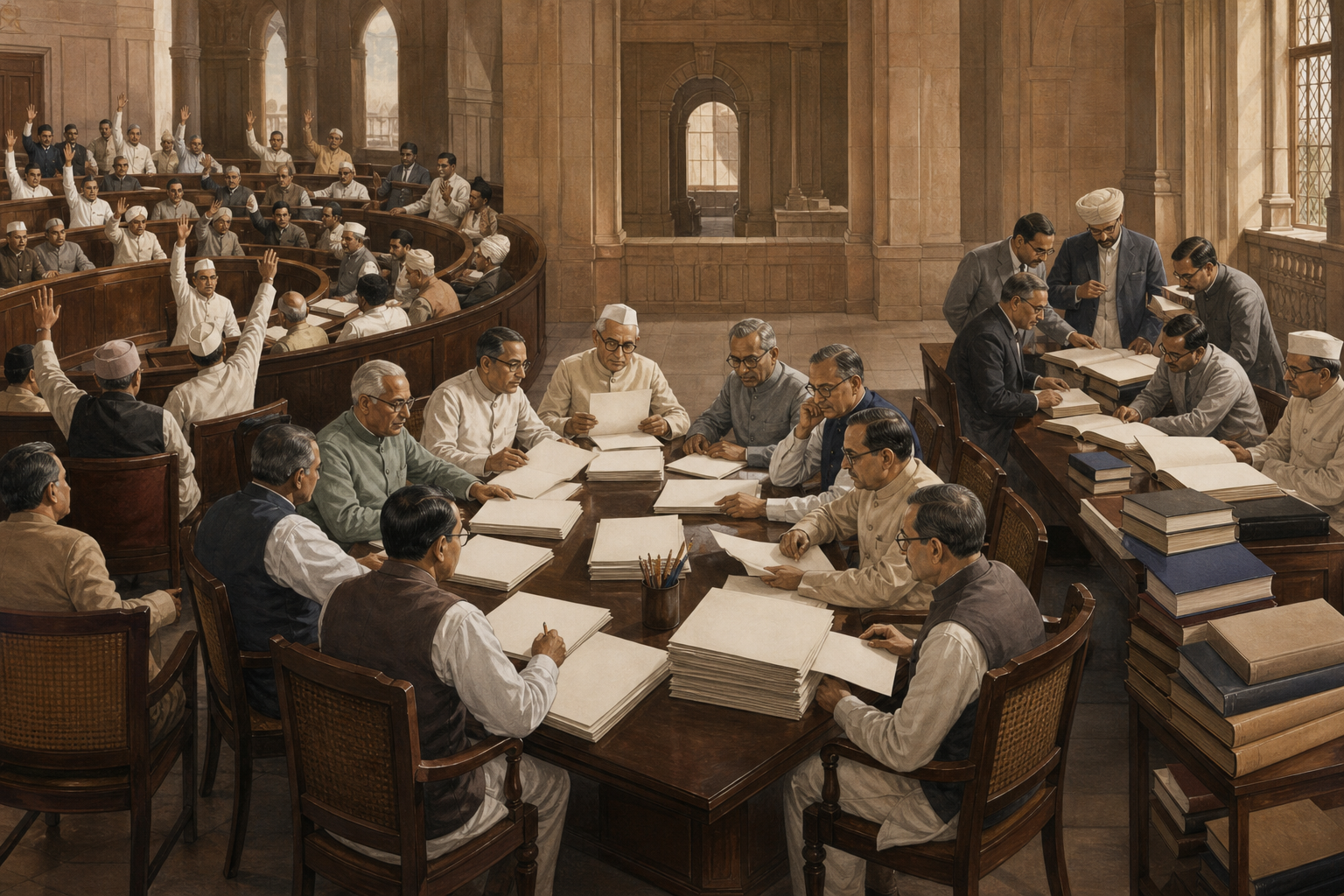
Most confusion disappears once you stop treating the word author as though it described every kind of constitutional work. Framing, drafting, advising, deliberating and drawing upon inherited ideas are related activities, but they are not interchangeable.
| Question | Historically precise answer | Why the distinction matters |
|---|---|---|
| Which body framed the Constitution? | The Constituent Assembly | It identifies the institution with authority over the constitutional settlement. |
| Who led the formal drafting work? | The Drafting Committee chaired by Dr. B. R. Ambedkar | It gives Ambedkar his proper leadership role without erasing the committee or Assembly. |
| Who supplied specialised constitutional advice? | Constitutional Adviser B. N. Rau | It recognises intellectual and preparatory work that a single-name account leaves invisible. |
| Who else helped shape the result? | Assembly members and advisers, including Alladi Krishnaswamy Ayyar, K. M. Munshi, T. T. Krishnamachari and N. Gopalaswami Ayyangar | It restores the range of participation behind the final text. |
| Where did the constitutional architecture come from? | Indian legal continuities, Assembly deliberation and comparative constitutional models | It prevents drafting from being mistaken for creation without precedents, debate or inherited materials. |
The sequence is short enough to remember. The Constituent Assembly undertook sustained deliberative work between 1946 and 1949. Committees and advisers converted competing ideas into workable constitutional language. The final text was adopted on 26 November 1949.
Use that sequence as a quick test. If a claim jumps from Ambedkar’s chairmanship directly to sole authorship, it has omitted the body that deliberated, authorised and adopted the result. If a reaction to that claim barely mentions Ambedkar, it has omitted the leader who carried an extraordinary drafting responsibility. Accuracy requires both parts.
Ambedkar’s legacy is strongest when stated exactly
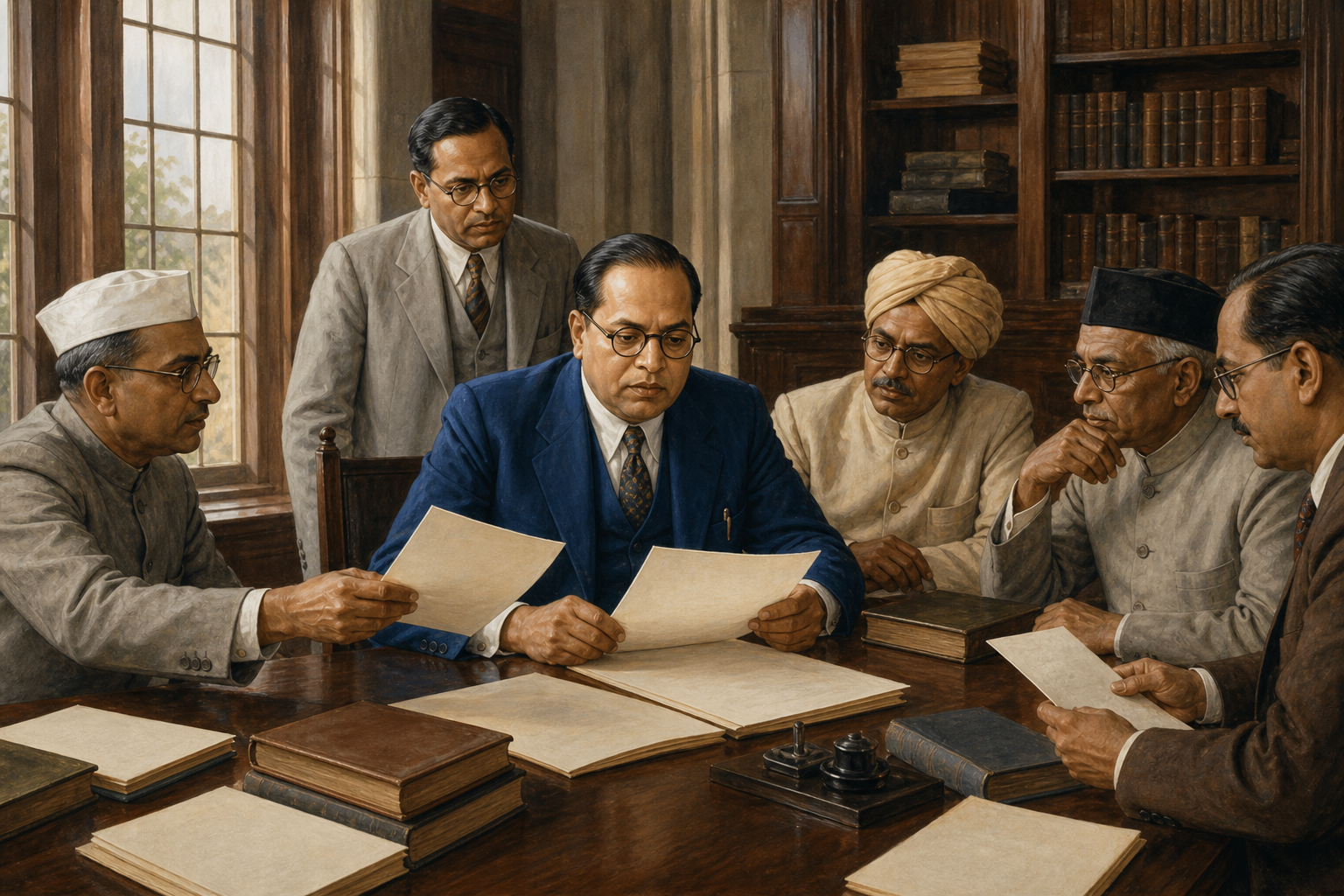
Rejecting sole authorship is not an argument for reducing Ambedkar’s stature. His scholarship, command of constitutional questions and leadership of the Drafting Committee made him central to the final form of the text. His work concerning Fundamental Rights and safeguards for equality remains an essential part of any honest account.
Two opposite errors commonly distort this history:
- Heroic reduction: one revered figure receives credit for a process that required an Assembly, a committee, advisers, debate and synthesis.
- Reactive minimisation: an effort to restore collective credit treats Ambedkar as merely one participant among many and understates the significance of his chairmanship.
You don’t need to choose between them. Use an additive correction: Ambedkar was the indispensable chairman of the Drafting Committee, while the Constituent Assembly collectively framed and adopted the Constitution with essential work from B. N. Rau and many other contributors.
That formulation works because it corrects the category, not the respect. It replaces the vague claim that one person somehow produced an entire constitutional order with identifiable responsibilities. Ambedkar’s achievement becomes clearer, not smaller.
Shared credit produces shared constitutional ownership
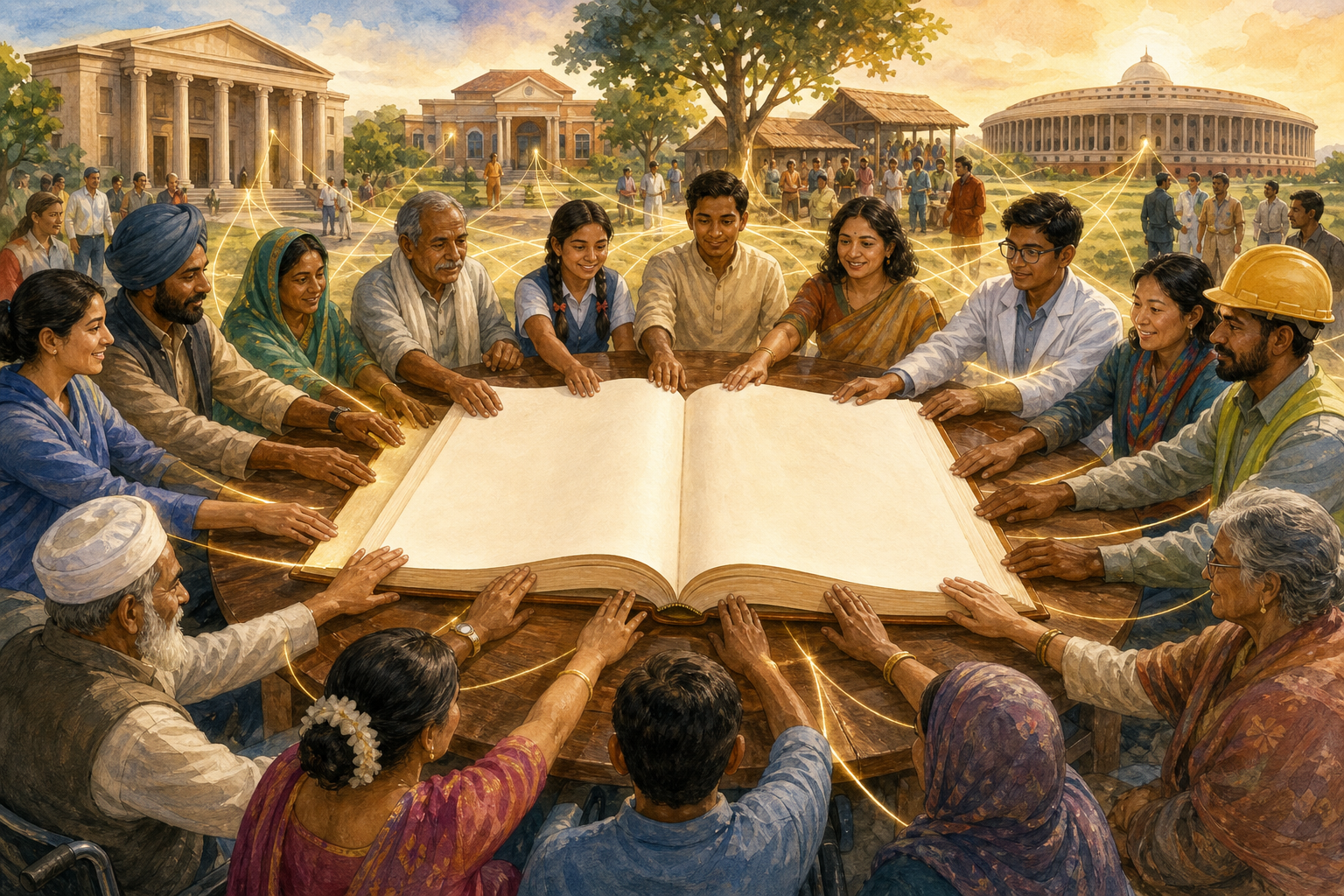
For a Hindu, Buddhist, Jain or Sikh reader, the question is larger than attribution among famous names. India’s Constitution provides a common civic framework within which plural communities and ways of life can coexist. Describing that framework as the possession of one individual weakens the sense that citizens inherit it together.
A Dharmic public ethic has good reason to resist both personality worship and the denial of rightful contribution. Giving each participant appropriate credit is a form of intellectual fairness. Recognising plurality within a shared undertaking also reflects a familiar civilisational discipline: unity need not require sameness, and reverence need not require historical exaggeration.
Collective authorship does not mean every member held the same view, performed the same work or deserves identical prominence. It means the final settlement arose through an institution capable of receiving proposals, debating competing visions and authorising a common text. Ambedkar’s leadership operated within that process and helped make its result coherent.
This distinction also makes constitutional disagreement more disciplined. Who framed the Constitution is a historical question. Whether you approve of a particular constitutional choice is a political, legal or moral question. Don’t rewrite the first to win the second. You can criticise an idea while crediting its origins accurately, just as you can honour a contributor without declaring every constitutional choice beyond debate.
Use language that teaches the process
The easiest way to improve public understanding is to match each verb to the work it describes. Say that the Constituent Assembly framed the Constitution, that the Drafting Committee under Ambedkar drafted and systematised its language, and that B. N. Rau advised on constitutional questions. Don’t use authored when you mean chaired, drafted or advised.
Here are formulations you can use in different settings:
- For a one-sentence answer: India’s Constitution was framed by the Constituent Assembly, with the Drafting Committee chaired by Dr. B. R. Ambedkar.
- For a classroom answer: Explain the three layers – Assembly deliberation and authority, committee drafting under Ambedkar, and advisory and intellectual contributions from B. N. Rau and other members.
- For Constitution Day or Republic Day remarks: Honour Ambedkar’s leadership by naming his actual responsibility, then recognise the Assembly’s collective labour.
- For correcting the phrase ‘Ambedkar’s Constitution’: Acknowledge that it may express affection, then clarify that it is not a complete historical description.
- For a debate about constitutional influences: Distinguish the institution that framed the text from the Indian experience and comparative models that informed its architecture.
Before repeating a claim, ask four questions: Does it name the Constituent Assembly? Does it identify Ambedkar’s chairmanship? Does it leave room for B. N. Rau and other contributors? Does it recognise that deliberation, drafting and intellectual influence are different forms of work? A claim that fails one of these checks probably needs qualification.
The next time the single-author claim appears, don’t answer with another slogan. Name the institution, the committee and the principal roles. That small act of precision honours Ambedkar, restores his colleagues to the history and gives every Indian a stronger basis for treating the Constitution as a shared inheritance.
References
