

You have opened a Sanskrit edition because you want the text itself, and the first page has already complicated the plan: continuous sound changes, dense compounds, a commentator’s gloss, or perhaps a script you did not expect. The problem is rarely a lack of seriousness. It is usually that the word Sanskrit has been made to cover several different reading tasks.
You can avoid years of unfocused study by separating those tasks at the beginning. Decide which Sanskrit you are facing, learn the sound system that holds its words together, parse grammar before guessing from word order, and place the work within its particular literary and historical lineage. This approach gives you a usable path while preserving Sanskrit’s place as a shared inheritance of Hindu, Buddhist, Jain, and Sikh intellectual life.
Key takeaways for choosing your Sanskrit path
- Name your task precisely: Vedic recitation, Classical Sanskrit reading, philosophical analysis, poetry, manuscript work, and inscriptional history require overlapping but different skills.
- Keep language, linguistic register, script, and historical date separate. Devanagari is a script, not a synonym for Sanskrit.
- Learn pronunciation and sandhi before treating declension and conjugation tables as the centre of the language.
- Use morphology to establish relationships among words. Sanskrit has a usual subject-object-verb tendency, but endings carry more weight than English-style word position.
- Approach Sanskrit as a shared medium without treating Dharmic traditions as interchangeable. The same term can acquire a different technical meaning in a Hindu, Buddhist, Jain, or Sikh scholastic setting.
Choose the Sanskrit you actually need
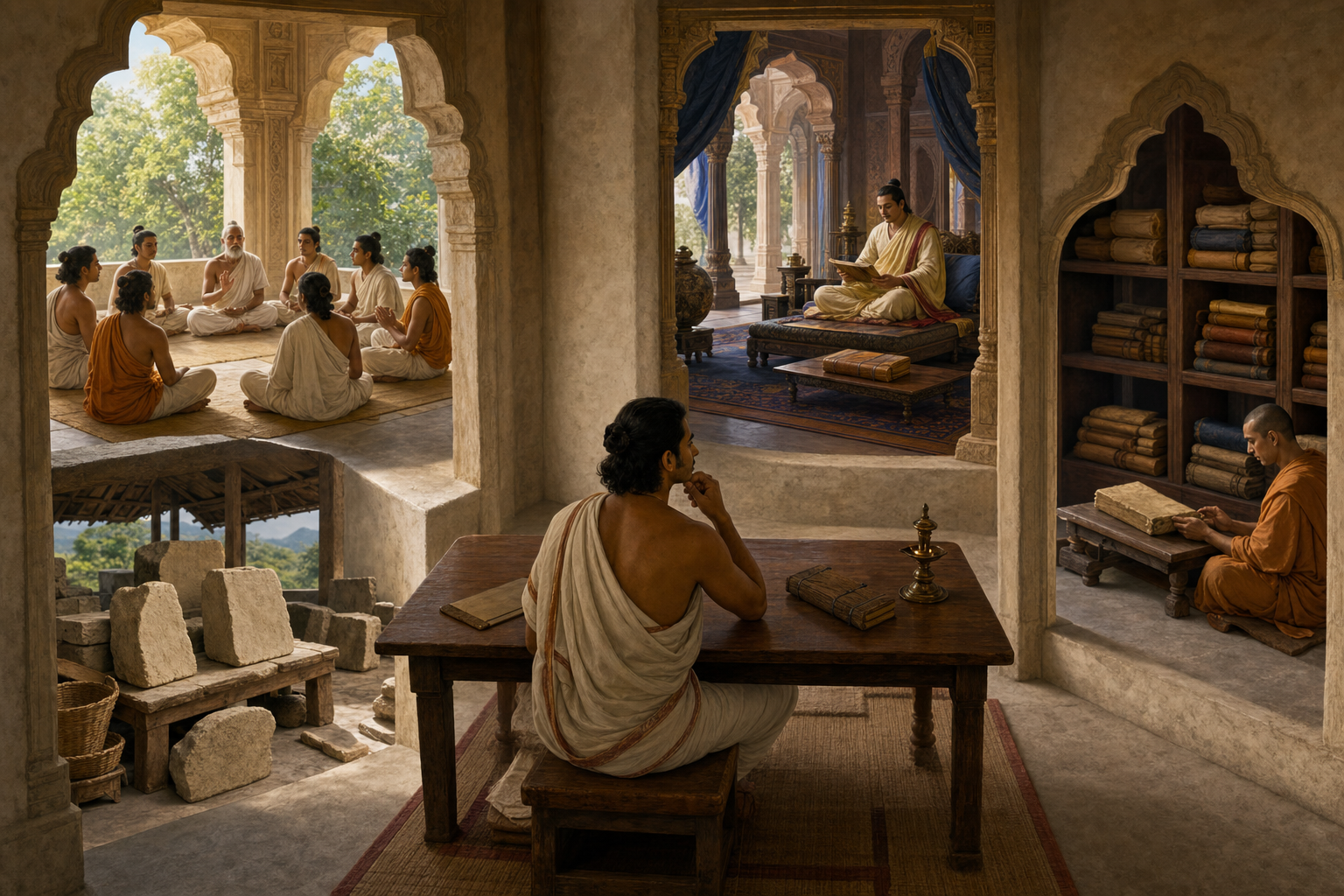
Your first decision is not which textbook to buy. It is which sentence you want to be able to complete: recite a Vedic passage accurately, read Classical poetry, follow a philosophical argument, compare a base text with its commentary, or inspect a manuscript or inscription. Each answer changes what you should learn first.
Vedic and Classical Sanskrit are connected, but they are not identical stages with interchangeable rules. Vedic Sanskrit preserves pitch accent, older verbal categories, and syntactic patterns that become less prominent later. Classical Sanskrit was given an exceptionally stable grammatical description through the Pāṇinian tradition. Buddhist Hybrid Sanskrit represents another recognised register, while Prakrits, Pali, and Apabhraṁśa belong to a wider linguistic ecology in which authors moved among languages according to audience and purpose.
| Your aim | What you are likely to encounter | What to learn first | Common wrong turn |
|---|---|---|---|
| Recite Vedic material | Vedic Sanskrit with accent, metre, and an oral transmission discipline | Sound production, pitch accent, recitational segmentation, and guidance within a competent lineage | Assuming ordinary Classical pronunciation or unmarked Roman transliteration is sufficient |
| Read poetry, drama, narrative, or śāstra | Classical Sanskrit in prose or verse | Sandhi, nominal and verbal morphology, compounds, prose order, and metre where relevant | Trying to translate by following the printed word order from left to right |
| Study Buddhist Sanskrit works | Classical Sanskrit, Buddhist Hybrid Sanskrit, or a Sanskritised form with earlier Middle Indo-Aryan features | The register used by the particular edition and its relationship to parallel translations or commentaries | Correcting every non-Classical form into a Pāṇinian one before asking what the work actually transmits |
| Study Jain intellectual traditions | Sanskrit śāstra alongside Prakrit and Apabhraṁśa literary worlds | The author’s selected register, technical vocabulary, and commentarial setting | Treating Sanskrit and Prakrit as isolated or mutually exclusive traditions |
| Follow Sanskritic learning in Sikh history | Sanskrit vocabulary and pedagogy, especially in scholastic settings such as the Nirmalā tradition | The specific lineage, work, and use of Sanskrit concepts | Turning a real scholastic connection into a claim that the whole Sikh textual tradition is simply Sanskrit |
| Work with a manuscript or inscription | Sanskrit written in one of several regional or historical scripts | Language identification, script identification, palaeographic context, and editorial conventions | Dating or classifying the language solely from the script used in a later copy or edition |
Use the table as a filter. If a course cannot tell you which row it serves, inspect its first lessons. A programme centred on accent and recitation may be excellent for Vedic practice but inefficient for someone who needs to parse philosophical prose. A course built around simplified Classical sentences may give you a reading foundation but cannot, by itself, qualify you for Vedic recitation or manuscript dating.
Do not mistake this specialisation for fragmentation. Sanskrit endured precisely because oral discipline, grammatical analysis, literary creation, and commentary supported different uses of the language. You are choosing an entrance, not reducing the whole tradition to that entrance.
Build from sound to sandhi before memorising paradigms
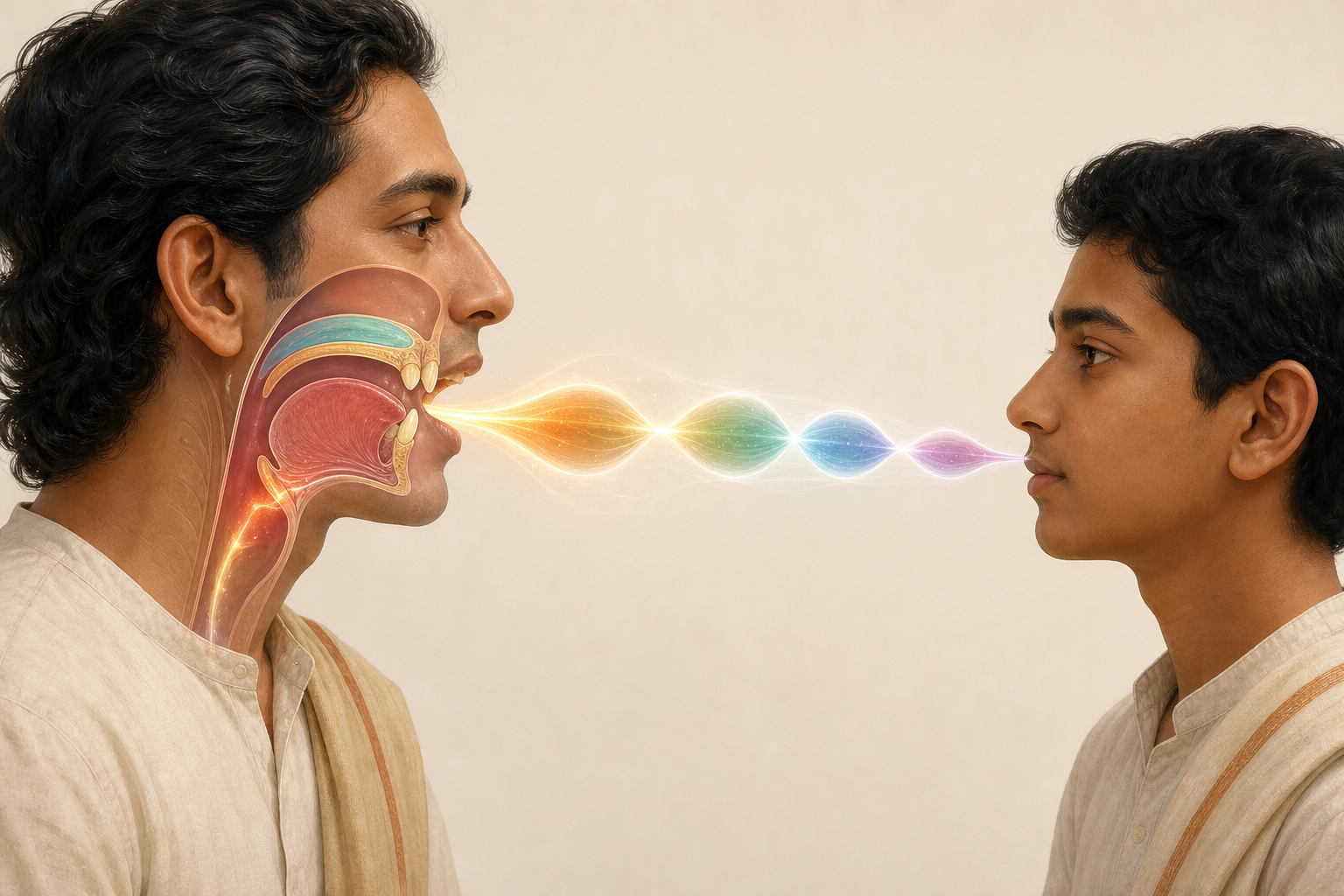
Sound is not a decorative preliminary to real grammar. It is part of the mechanism by which Sanskrit words take their visible and audible forms. If you skip it, familiar dictionary entries can become unrecognisable as soon as they meet neighbouring sounds.
The consonants are organised through a place-and-manner grid. Retroflex sounds form a distinct series, and aspiration is contrastive rather than an optional puff of breath. Vowels, consonants, and their combinations also determine syllable weight in verse. Classical prosody distinguishes light and heavy syllables, while Vedic and classical metres organise them into repeatable structures. Pronunciation, grammar, and metre therefore reinforce one another.
Sandhi is the next bridge. It describes predictable changes where sounds meet, both within a word and across word boundaries. A printed line can consequently conceal the boundary you need for dictionary lookup. Your task is not merely to remember a finished combined form; it is to recover the underlying members and explain why the surface form arose.
- Learn the sound grid by articulation. For each consonant, know where it is produced and whether aspiration distinguishes it from its neighbour.
- Read short forms aloud while preserving vowel length and consonant contrast. Do not allow familiarity with Devanagari letter shapes to substitute for pronunciation.
- Keep a three-column sandhi notebook: underlying forms, the applicable sound change, and the resulting form. Reverse the process during reading practice.
- Mark possible word divisions before opening a dictionary. If the meaning fails, reconsider the division instead of forcing the first gloss to fit.
- If your aim is verse, mark light and heavy syllables and identify the metre. Metrical expectations can expose a mistaken reading or division.
- If your aim is Vedic recitation, study accent and oral procedure with someone qualified to teach that corpus. Ordinary unaccented reading practice does not replace it.
The Vedic tradition developed several mutually reinforcing recitation arrangements, including padapāṭha, kramapāṭha, jaṭā, and ghana. These methods protected wording, sound, prosody, and sequence through disciplined oral transmission. You do not need every advanced recitation pattern in order to begin reading, but you should understand why Vedic learning treats exact sound as textual knowledge rather than ornament.
A useful diagnostic is simple. If you can recognise a word in a vocabulary list but repeatedly miss it in connected text, more vocabulary may not be the remedy. Test sandhi first. If you can read the letters but cannot distinguish the consonant series aloud, return to the sound grid before adding more paradigms.
Parse Sanskrit as a system of relationships
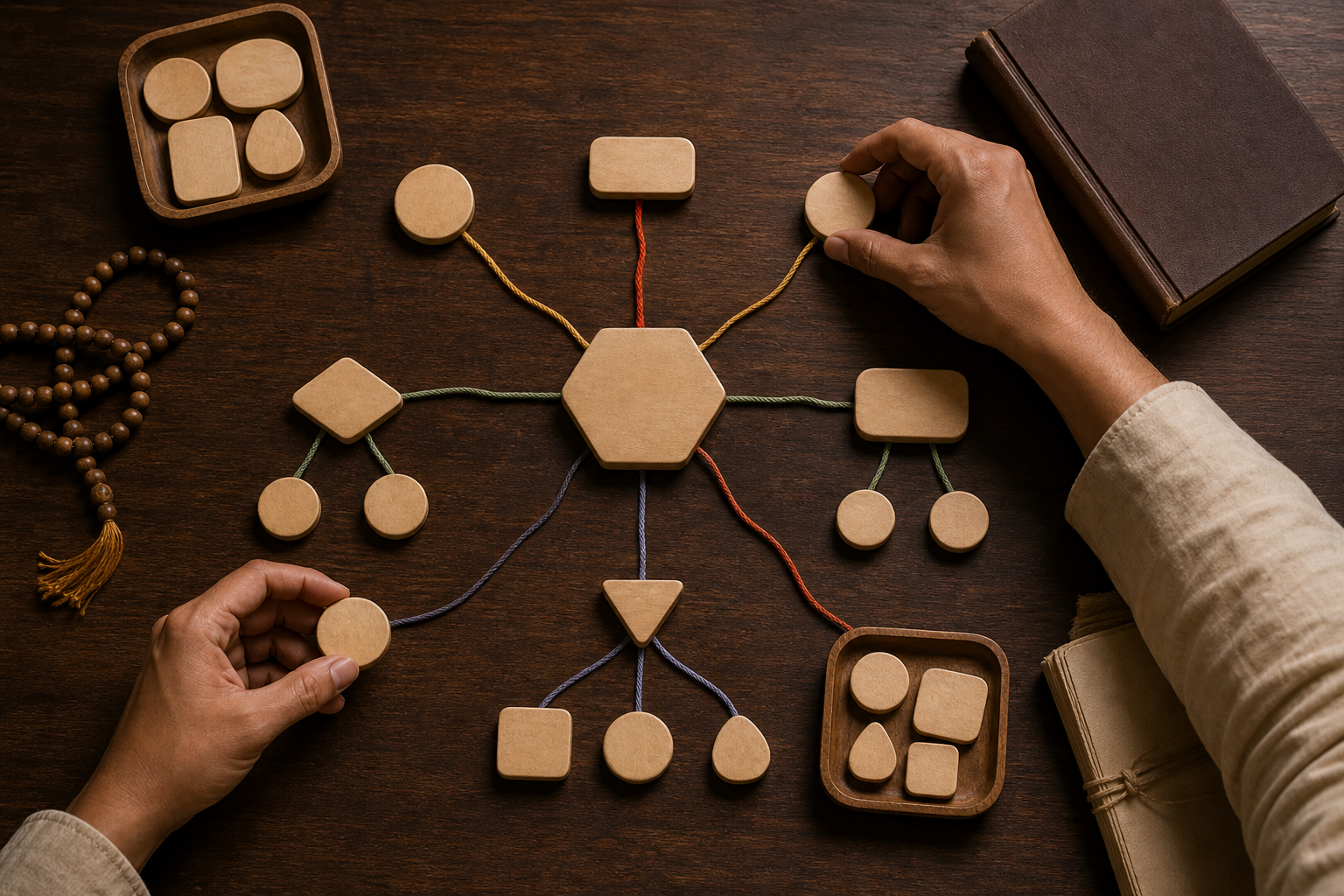
English encourages you to assign grammatical roles from position. Sanskrit gives you more freedom, so that habit becomes unreliable. A subject-object-verb order is common, but information structure, metre, and rhetoric can rearrange the constituents. Poetry uses this freedom aggressively; technical prose generally restrains it, but does not surrender morphology.
Begin with endings and formations. Nominal morphology encodes case, number, and gender. Verbal morphology carries person, number, voice, and tense-aspect-mood information, while participles, absolutives, and gerundives let a sentence organise several actions without multiplying finite verbs. Primary and secondary derivatives can move a root into a new grammatical and semantic role. Causative, desiderative, and intensive formations modify the verbal idea in systematic ways.
Compounds demand a separate habit of attention. Tatpuruṣa, karmadhāraya, bahuvrīhi, and dvandva are not labels to display after translation; they represent different relationships among members. The final member normally supplies the visible inflection for the compound as a whole, so the information you need about the earlier members may be compressed. Expand a compound into a provisional phrase before polishing its English meaning.
A dependable parsing routine
- Copy the line exactly. Preserve vowel length, visarga, anusvāra, avagraha, and accent marks where the edition supplies them.
- Propose word boundaries by reversing external sandhi. Keep alternatives visible when more than one split is possible.
- Locate the finite verb. If there is none, test whether a participle, gerundive, or nominal construction carries the main predication.
- Identify each nominal stem and ending. Record its possible case, number, and gender before assigning a role.
- Use agreement and the verb’s argument structure to test semantic roles. Pāṇinian kāraka analysis is especially useful when a simple English case label does not explain the construction.
- Open every compound. Name its members, propose their internal relationship, and check whether the surrounding sentence supports that interpretation.
- Reconstruct a plain prose sequence, often called anvaya in pedagogical settings. This is an analytical aid, not a claim that the poet wrote badly ordered prose.
- Translate twice: first a close grammatical version that exposes the structure, then a readable version that preserves the point. Do not let elegance hide an unresolved form.
- Consult the commentary after making your own provisional parse. Record exactly where the commentator changes your understanding: division, grammar, technical definition, implied argument, or doctrinal context.
This sequence prevents a common circular error. A reader guesses the meaning, assigns grammar that would produce that meaning, and then treats the grammar as confirmation. Keeping morphology, syntax, and interpretation in separate notes makes uncertainty visible.
When to approach Pāṇini directly
Pāṇini’s Aṣṭādhyāyī is not simply a compact school grammar. Its derivational system uses sound classes formed from the Śiva Sūtras, pratyāhāras, technical markers, operational rules, and metarules. Kātyāyana’s Vārttikas and Patañjali’s Mahābhāṣya belong to the continuing analytical tradition around that system.
Approach this architecture directly when you want to explain how forms are generated, study vyākaraṇa as an intellectual discipline, or follow an argument that presupposes its metalanguage. If your immediate goal is access to narrative, poetry, or introductory philosophy, begin with a pedagogical grammar that teaches recognition and parsing. You can then enter the Aṣṭādhyāyī with concrete forms already in hand. Starting with the most compressed formulation is not a test of devotion.
This also changes how you use a dictionary. Do not search only for the exact surface sequence on the page. Reverse sandhi, remove inflection, identify the stem or verbal root, and test whether a derivative or compound accounts for the remaining material. Dictionary skill in Sanskrit is largely the skill of asking what sequence of operations produced the form.
Read the Sanskrit library with its history attached

Choose by genre rather than prestige
Not every Sanskrit work is scripture, and not every Dharmic scripture is Sanskrit. The distinction matters because a mantra, a philosophical sūtra, a courtly poem, a medical compendium, and a dramatic scene ask you to read in different ways.
The Vedic collection includes Saṁhitās, Brāhmaṇas, Āraṇyakas, and early Upaniṣads. The broad smṛti world includes the Mahābhārata, Rāmāyaṇa, Purāṇas, and Dharmaśāstra. Kāvya and nāṭya cultivate metre, ornament, suggestion, and rasa. Technical śāstras organise fields as different as polity, dramaturgy, poetics, architecture, music, medicine, astronomy, mathematics, logic, and philosophy. The Sanskrit knowledge tradition includes the six classical darśanas as well as works such as the Arthaśāstra, Nāṭyaśāstra, Āryabhaṭīya, Caraka Saṁhitā, and Suśruta Saṁhitā.
Match your reading method to the genre:
- For a Vedic passage, record recension, accent, recitation practice, and textual layer before discussing meaning.
- For a philosophical sūtra, keep the root statement, bhāṣya, and later ṭīkā visibly separate. A commentator may define the question as much as answer it.
- For kāvya, identify metre, reconstruct prose order, and note figures of speech before flattening the verse into a paraphrase.
- For drama, notice which characters speak Sanskrit and which use another register. Language choice can be part of characterisation and social setting.
- For a technical śāstra, build a glossary of definitions internal to that work. A familiar Sanskrit word may function as a tightly controlled technical term.
- For an inscription, separate formulaic praise from the donation, privilege, genealogy, or institutional act being recorded.
A celebrated but ill-matched first text can waste your effort. If you want basic reading competence, choose a short passage with reliable word division, grammatical help, and a commentary you can distinguish from the base text. Save highly compressed sūtra prose, elaborate court poetry, and uncertain manuscript readings for the skills they actually require.
Use Sanskrit as a bridge, not a blender
Sanskrit carried Hindu ritual, philosophy, narrative, and technical learning, but its civilisational range was wider than any single sect. Many Mahāyāna and tantric Buddhist works circulated in Sanskrit, and Buddhist thinkers such as Dignāga and Dharmakīrti used it for demanding epistemological arguments. Jain scholars produced substantial Sanskrit philosophy and grammar while also sustaining Prakrit and Apabhraṁśa literatures; Hemacandra’s grammatical work is one prominent example. Sikh scholastic circles, especially the Nirmalā tradition, engaged Sanskritic concepts and pedagogy without erasing the distinct language, scripture, and institutions of Sikh life.
This history gives you a disciplined way to compare traditions. Place parallel terms beside one another, but copy each definition from its own textual setting. Then ask whether the traditions agree on the referent, the means of knowledge, the spiritual problem, or merely the inherited vocabulary. Shared words establish a field of conversation; they do not establish identical doctrine.
The same discipline applies to Prakrit and Pali. Sanskrit often served as a high scholarly register, but authors selected other languages for doctrinal, literary, and pedagogical reasons. Sanskrit, Prakrits, Pali, and later Apabhraṁśa interacted through translation, adaptation, and multilingual learning. Do not arrange them into a moral ladder of pure and corrupt speech. Ask who was being addressed, what genre was being used, and why that register served the work.
Do not date a language by its script
Sanskrit has no single exclusive script. Early inscriptions appear chiefly in Brāhmī and Kharoṣṭhī. Later manuscript cultures used Devanagari, Grantha, Śāradā, Nandināgarī, Telugu-Kannada, Bengali-Assamese, Newar, and other scripts. Siddhaṃ carried Sanskrit mantras and tantric material into East Asia, while Tibetan orthographic practice supported the translation and representation of Indic sounds.
That distinction prevents several mistakes. A Sanskrit work printed in Devanagari is not thereby northern in origin. A southern-script manuscript is not thereby composed in a Dravidian language. A modern printed script tells you how an editor presents the work, not necessarily how its earliest witnesses looked. Record the language and the script in separate fields every time.
Inscriptions provide firmer chronological anchors than an undated manuscript copy, but they still need precise description. The Junāgaḍh inscription of Rudradāman I, around 150 CE, is among the earliest extended inscriptions in Classical Sanskrit. Later Gupta-era epigraphy displays an abundant Sanskrit record combining public acts with polished literary expression. Such evidence establishes Sanskrit’s inscriptional use at a particular time and place; it does not, by itself, date every linguistic feature or surviving literary work.
A broad linguistic chronology distinguishes Old Indo-Aryan, including Vedic Sanskrit; Middle Indo-Aryan, including Prakrits and Pali; and New Indo-Aryan languages. This is a map of linguistic development, not a simple story in which one language disappears the moment another arrives. Classical Sanskrit continued as a learned medium while Middle Indo-Aryan and regional forms flourished beside it.
Historical linguistics conventionally places Sanskrit within Indo-European and, more closely, Indo-Iranian. Debates about population movement and language contact in Bharat remain contested. Keep three questions apart: what linguistic relationships show, what textual or inscriptional evidence dates, and what wider historical interpretation someone builds from them. A grammatical correspondence is not, on its own, proof of a complete theory about people, homeland, or civilisational identity.
Make a record for the next text you open
Before your next lesson, take one page from the work that brought you to Sanskrit and write a short record containing:
- your exact goal: recitation, grammatical reading, literary appreciation, doctrinal study, translation, or historical analysis;
- the probable linguistic layer or register;
- the tradition and genre;
- the base text, commentary, and translation, each identified separately;
- the script of the witness or edition;
- the page’s main obstacle: sound, sandhi, morphology, compounds, syntax, metre, vocabulary, or context;
- one unresolved form that you will analyse through the parsing routine above.
Let that obstacle choose your next lesson. If it is sandhi, do not buy another vocabulary list. If it is a compound, expand it before reading another translation. If it is doctrinal context, follow the commentary and compare definitions within the relevant lineage. This is a modest way to approach a vast inheritance, but it is also how Sanskrit becomes a language you can hear, analyse, and read rather than a monument admired from a distance.
References
