
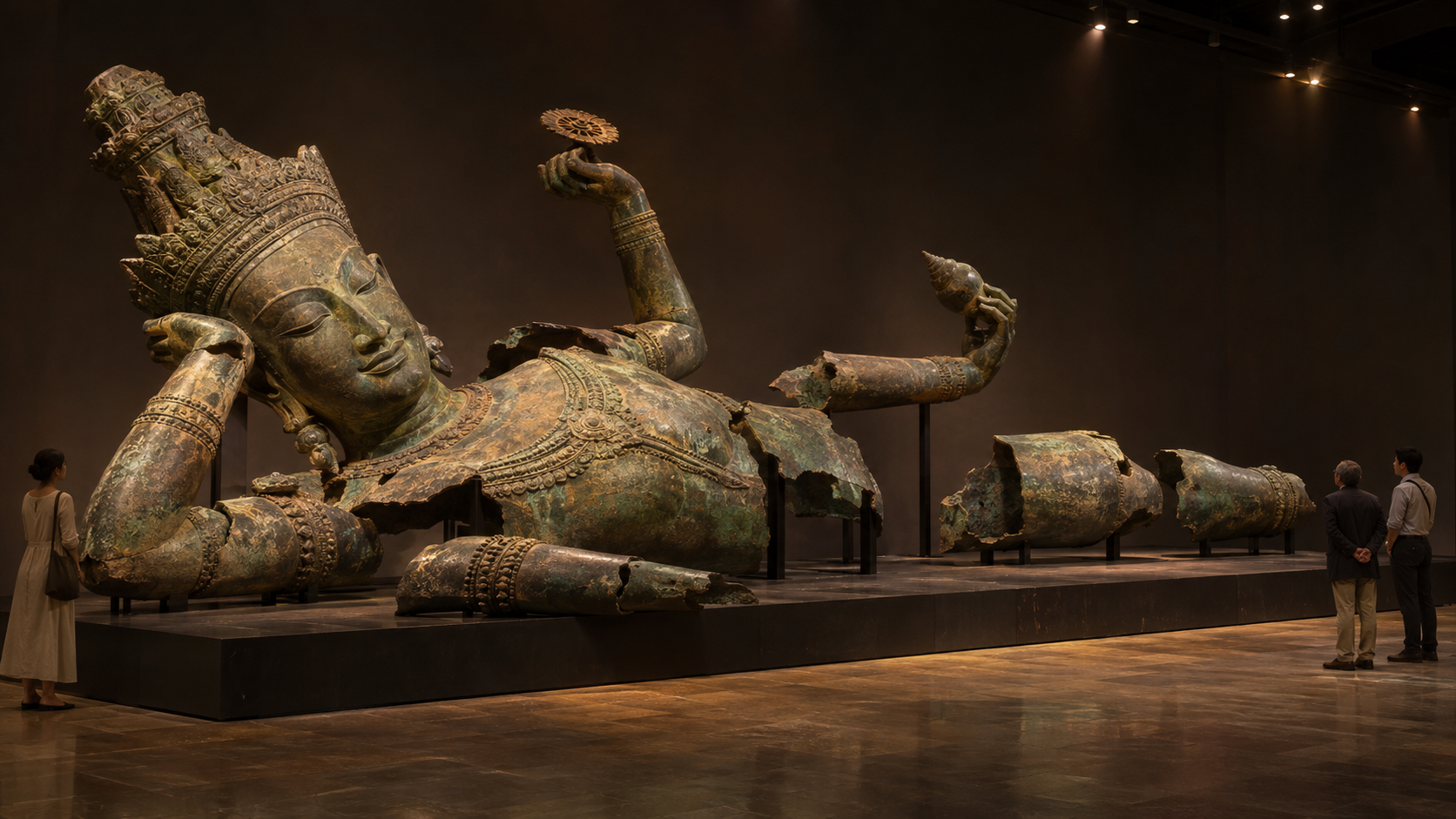
If you are deciding whether this exhibition deserves a special trip, its importance is larger than the rarity of one bronze. Angkor’s reclining Bhagwan Vishnu brings sacred cosmology, Khmer water engineering and royal power into the same field of view.
Go prepared to examine those connections, and you will see more than an impressive museum object. You will encounter a Cambodian expression of Dharma that also reveals how far Bharatiya civilisational ideas travelled, and how creatively another civilisation made them its own.
The practical window for seeing the murti
Vishnu’s Cosmic Ocean is being presented at the Asian Art Museum in San Francisco. It opened on October 23, 2026, and is scheduled to run through January 25, 2027. If you would need to travel, confirm the museum’s current opening hours, admission arrangements and accessibility information before committing to a date; those operational details can change independently of the exhibition period.
The reclining Vishnu comes from Cambodia’s West Mebon temple. It is on loan from the National Museum of Cambodia and will return to Cambodia after the exhibition. That distinction matters. San Francisco is its temporary host, while the murti remains part of Cambodia’s national heritage.
Its scale gives you another reason to see it directly: it is described as the largest ancient bronze sculpture discovered in Southeast Asia. A superlative can attract attention, but size alone is not the real lesson. The useful question is why Khmer patrons placed such extraordinary artistic and material ambition behind this particular sacred form.
Read the sculpture through three connected lenses
A museum can make a murti appear self-contained: bronze inside a case, followed by a label and a date. Resist that narrowing effect. The exhibition becomes much more intelligible when you hold three lenses together rather than treating religion, engineering and government as separate subjects.
First, encounter a sacred form
The word murti is important. It identifies a sacred form, not merely a decorative representation. Even within a museum, a Hindu visitor need not surrender that vocabulary or adopt an exclusively archaeological gaze.
Bhagwan Vishnu is shown reclining on the cosmic ocean. Do not interpret the reclining posture as ordinary inactivity. The cosmic-ocean setting supplies the theological centre of the exhibition, asking you to consider repose at the scale of cosmic order. Begin by standing back and noticing how the horizontal posture changes your sense of divine presence. Then move closer and observe what survives of the bronze without mentally reconstructing details that are not actually before you.
Second, follow the meaning of water
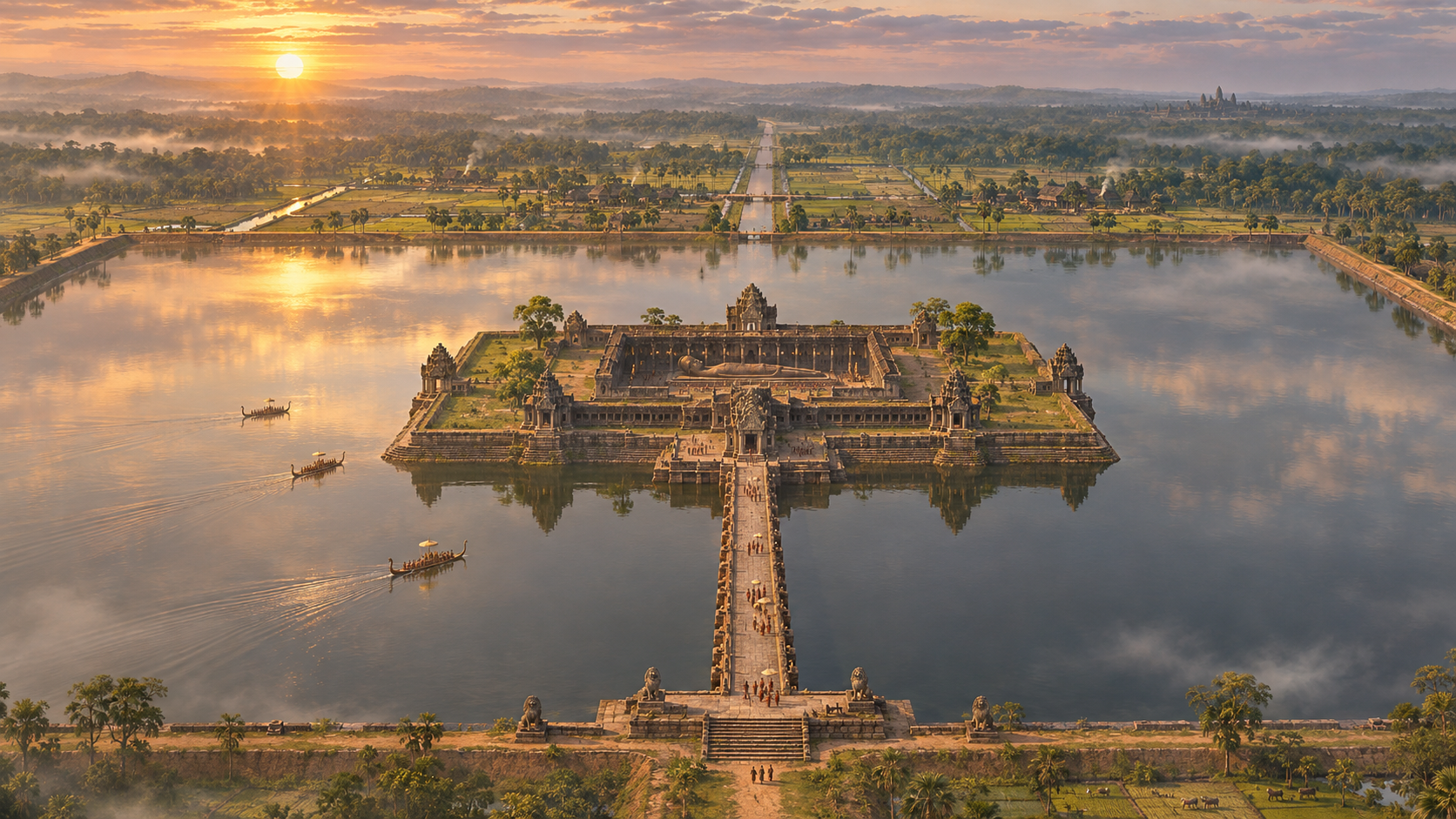
Water operates in two registers here. It is the cosmic setting associated with Vishnu, but it is also a material problem that Khmer rulers and communities had to manage. The exhibition explicitly connects Hindu belief with the water-management systems associated with Khmer civilisation.
That connection should change how you read the engineering. Do not relegate it to a technical footnote after looking at the sculpture. Read the gallery information for the physical water works it identifies, the responsibilities such systems required and the place of West Mebon within that interpretation. Keep a clean boundary between what the display establishes and what you infer from it.
The central question is simple: what happens when the water of sacred cosmology and the water managed by human institutions become part of one public landscape? That question takes you closer to the Khmer worldview than a list of artistic features would.
Third, ask what the image communicated about kingship
The exhibition also links water management to the power of ancient Khmer kings. This does not mean that a sacred image can be reduced to political propaganda. It means that royal authority, public works and cosmic order could reinforce one another within the same civilisational framework.
As you read the labels, test three possible functions. Did managing water demonstrate practical competence? Did the sacred setting associate royal rule with a larger order? Did the monument bring those claims together? Treat these as questions to investigate, not conclusions to impose. The most revealing details will be the ones that show how the exhibition itself supports or limits each interpretation.
The civilisational lesson without erasing Cambodia
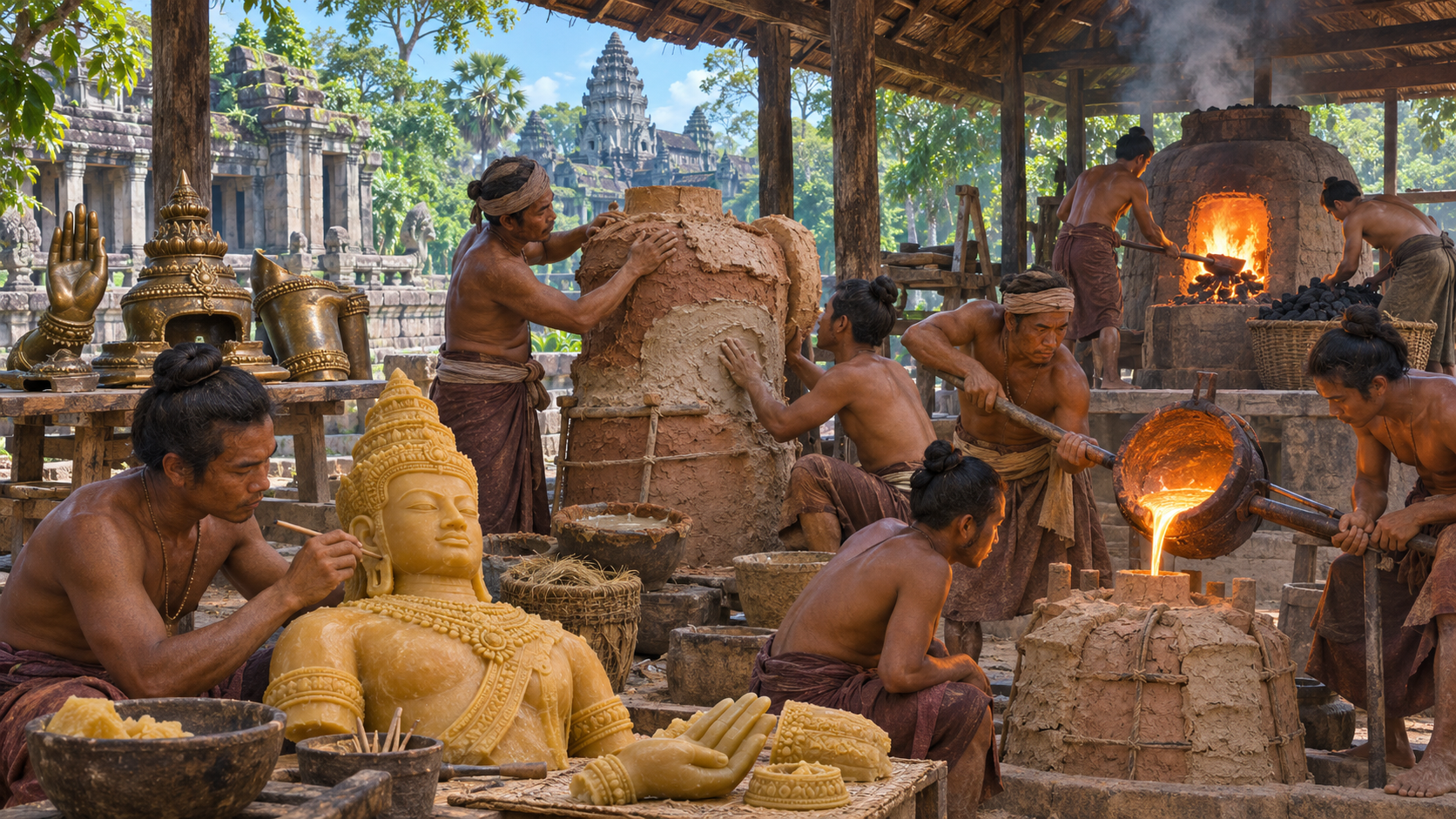
The most accurate description is also the most illuminating: this is a Cambodian Khmer murti of Bhagwan Vishnu, originating at West Mebon, held by the National Museum of Cambodia and temporarily displayed in San Francisco.
Calling it simply an Indian statue found in Cambodia would erase the Khmer civilisation that created and sustained its setting. Treating its Hindu identity as an incidental foreign decoration would make the opposite mistake. The murti is evidence that a Dharmic sacred vocabulary travelled far beyond Bharat and became part of Cambodia’s own monumental culture.
This gives you a better way to discuss Bharatiya influence. Civilisational transmission is not the same thing as modern political ownership. An idea can have roots in Bharat while its Cambodian expression remains authentically Khmer. Recognising one side does not require denying the other.
The temporary loan makes that balance especially visible. A Western museum can introduce the murti to new viewers, but its Cambodian custody and scheduled return remain part of the story. When you speak or write about the exhibition, name both the Dharmic connection and the Cambodian provenance. Precision is more respectful, and more powerful, than a sweeping claim.
Key takeaways
- The exhibition is at San Francisco’s Asian Art Museum through January 25, 2027; verify day-specific visitor information before travelling.
- The reclining Vishnu is a temporary loan from the National Museum of Cambodia and is expected to return to Cambodia afterward.
- Its importance lies not only in being the largest ancient bronze discovered in Southeast Asia, but in the relationship among Vishnu, water management and Khmer royal power.
- Read the murti successively as a sacred form, part of a water-centred cultural landscape and an expression connected with kingship.
- Describe it as both Cambodian and Dharmic. That wording preserves Khmer agency while acknowledging the reach of Bharatiya civilisation.
Turn the museum visit into something you retain
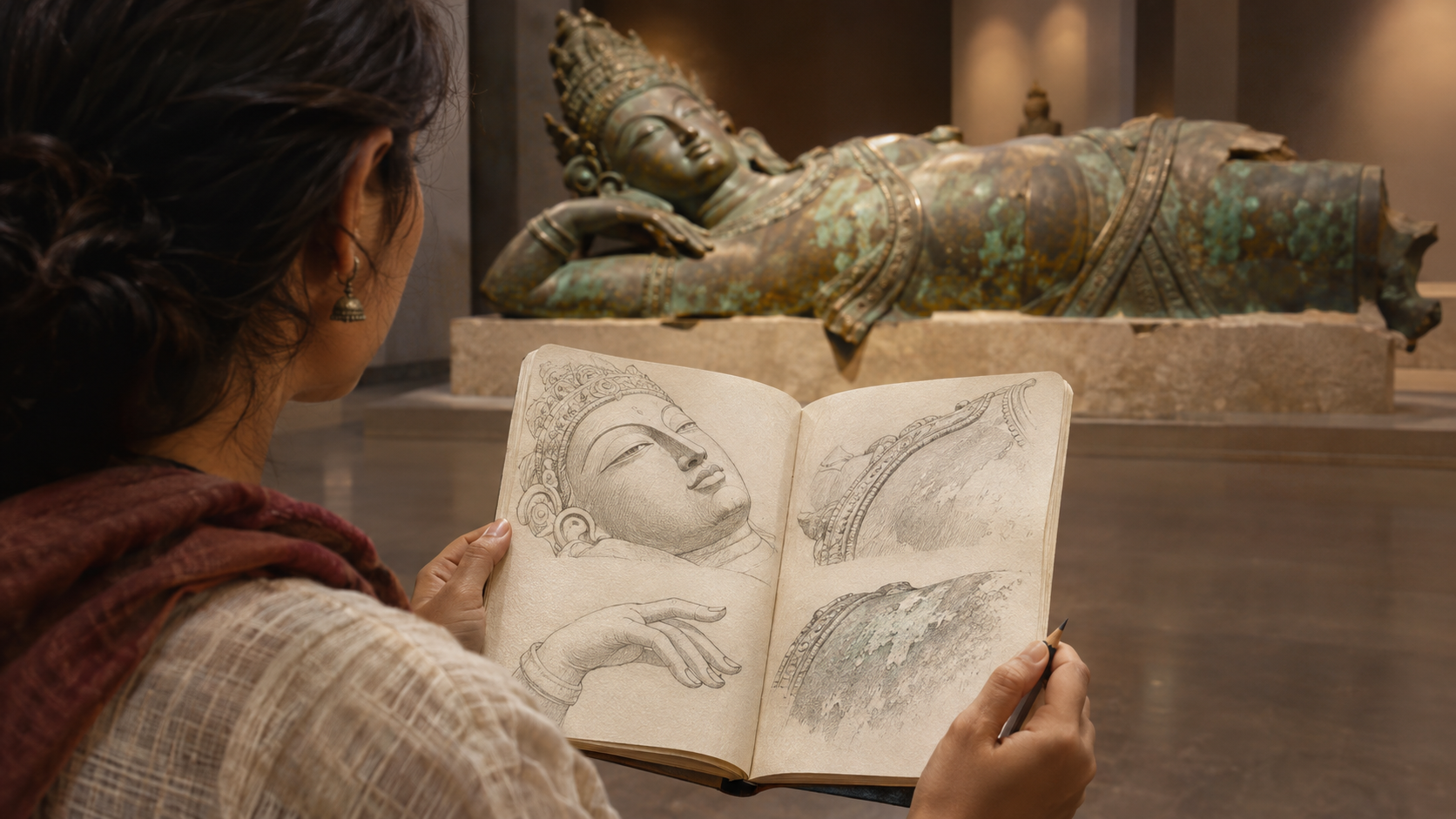
A quick photograph will not preserve the most important part of this encounter. Use a deliberate sequence instead:
- Look before reading. Notice the reclining posture, the scale of the surviving bronze and the response the form produces in you.
- Read for evidence. Record the exact claims the gallery makes about West Mebon, the cosmic ocean, water management, Khmer kingship, provenance and the loan.
- Look again with those claims in mind. Decide which visible or contextual details connect the sacred image to the wider system around it.
- Before leaving, formulate one sentence about theology, one about infrastructure and one about political power. If any sentence lacks support, revise it into a question.
If you are visiting with a child, student or friend, ask one productive question rather than delivering a lecture: why would a civilisation connect an image of Vishnu’s cosmic ocean with the human work of managing water? Let the other person look for an answer in the exhibition.
When you later share the visit, avoid presenting the murti as a curiosity that somehow appeared far from India. Name Bhagwan Vishnu, West Mebon, Khmer Cambodia and the National Museum of Cambodia. Those names turn a photograph into a truthful account of civilisational exchange.
If the exhibition is within your reach before January 25, go with these three lenses already in mind. The bronze will give you an uncommon opportunity to see Dharma not as an abstract influence, but as a sacred language that entered Khmer art, infrastructure and ideas of rule while becoming unmistakably Cambodian.
References

Leave a Reply
You must be logged in to post a comment.