
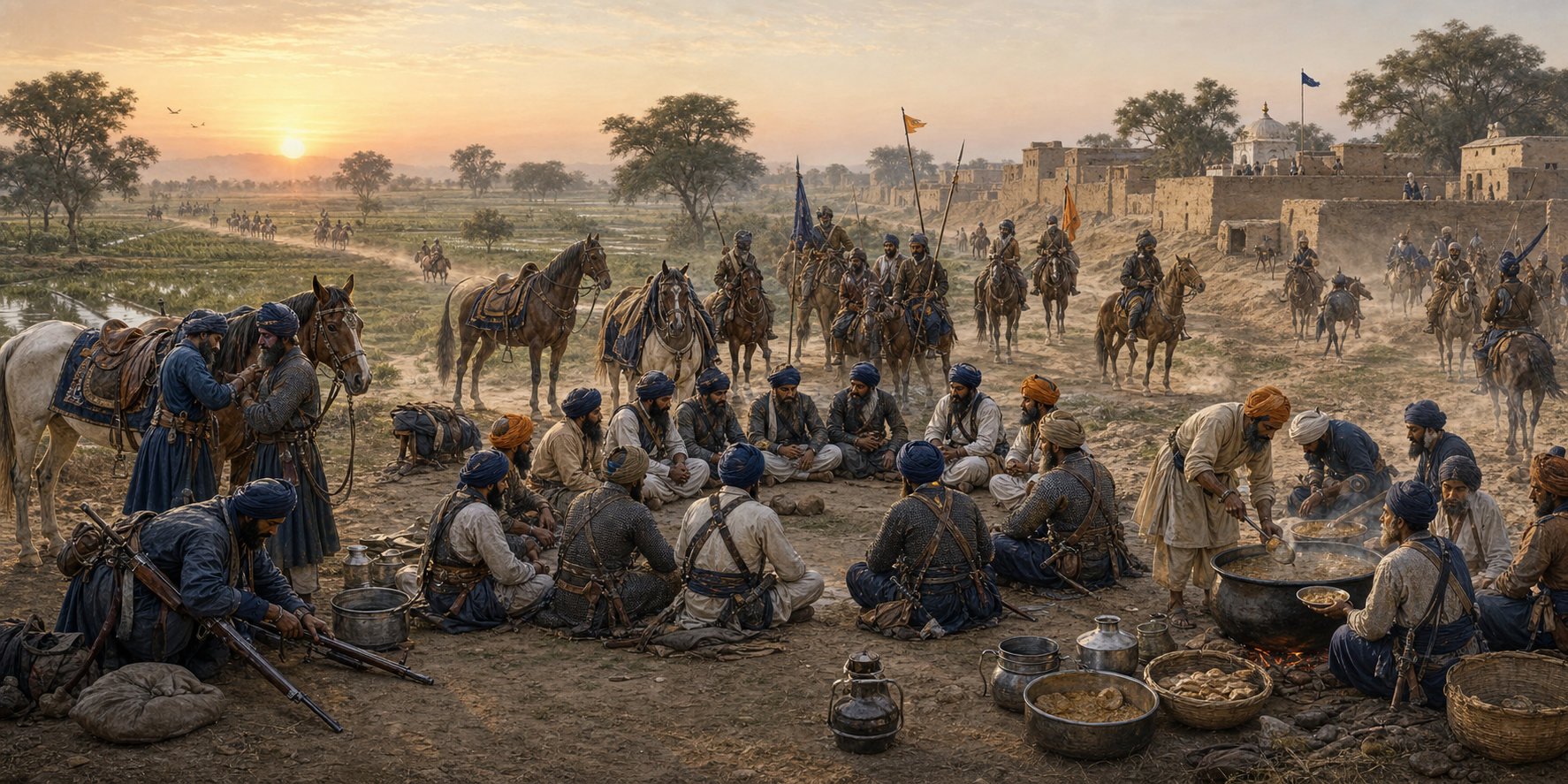
If you are trying to understand how a persecuted community became Punjab’s leading political force, do not begin with a crown. By the time Ranjit Singh secured Lahore in 1799, Sikh power already rested on a century of discipline, armed resistance, collective decision-making, social provision, and repeated institutional recovery.
That change in starting point changes the whole explanation. Battlefield success mattered, but victory alone cannot explain the rise. The decisive advantage was the ability to disperse without disintegrating, regroup without waiting for a monarch, and turn sacred institutions into durable centers of authority and public trust.
The Khalsa made political capacity portable
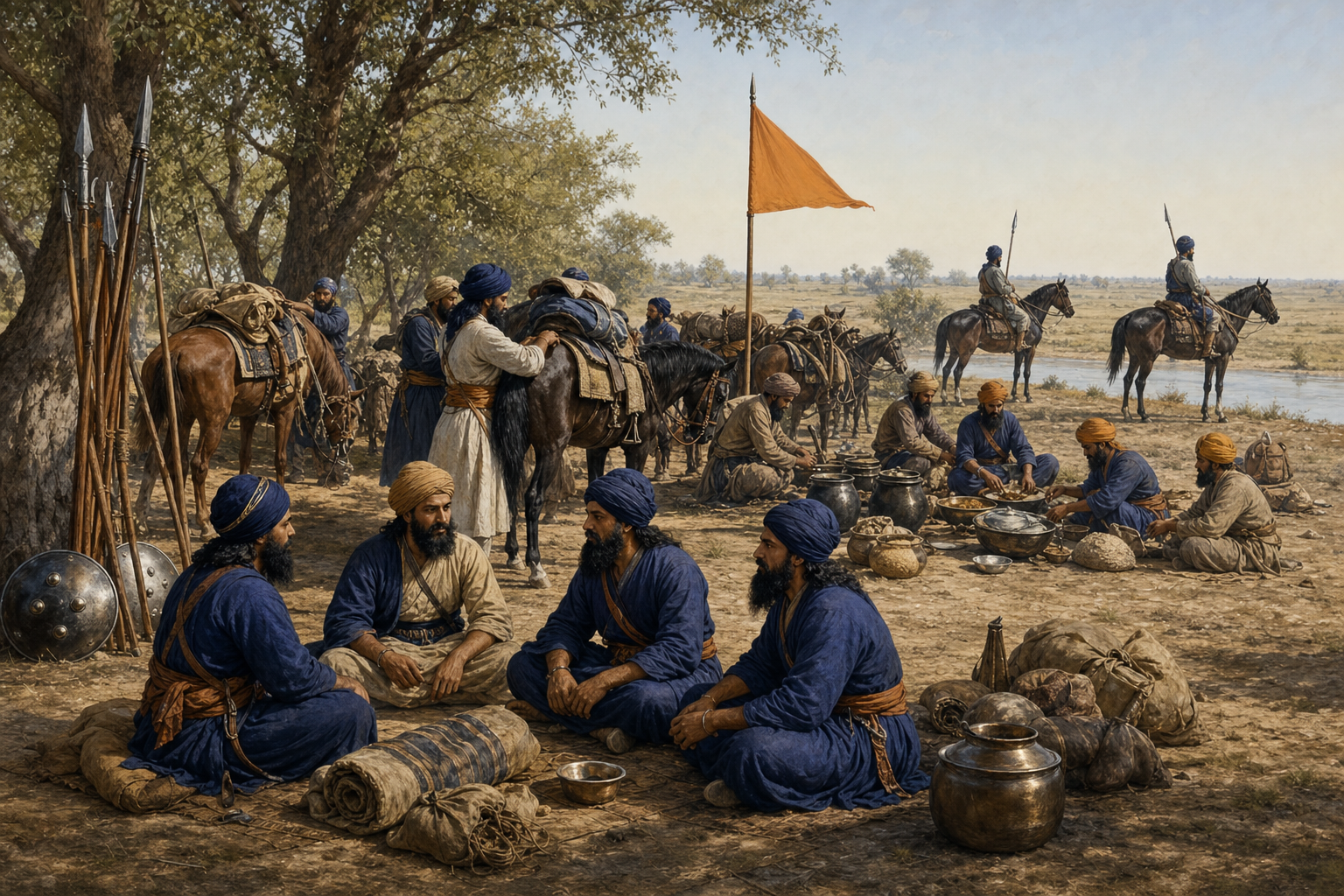
The political foundations of the eighteenth-century rise were laid before the century began. At Anandpur Sahib in 1699, Guru Gobind Singh inaugurated the Khalsa, joining spiritual devotion to disciplined Kshatra. Its saint-soldier ideal did not treat worship, service, and defense as unrelated duties. Seva, courage, a common rahit, and responsibility for the vulnerable belonged to one way of life.
This was politically consequential because the Khalsa did four jobs at once:
- It gave Sikhs a shared identity that could travel across villages and regions.
- It established obligations that did not depend on the presence of a single temporal ruler.
- It linked military readiness to an ethical discipline rather than to conquest for its own sake.
- It supported mutual defense and community welfare through practices such as seva and langar.
A court can collapse when its sovereign is removed. A disciplined community is harder to extinguish because its members can reproduce its code wherever they assemble. That distinction is essential. Sikh political power first existed as a network of people, duties, sacred memory, and mutual support; continuous rule over territory came later.
Banda Singh Bahadur’s campaign demonstrated the possibilities and costs of the new political confidence. His uprising from 1709 to 1715 asserted Sikh autonomy and advanced agrarian reform and peasant rights. The movement was defeated, and Banda Singh Bahadur was martyred in 1716, but the episode changed what cultivators and local communities could imagine about authority in the Punjab plains.
Do not force this phase into the shape of the later Sikh Empire. It did not create a lasting territorial state. Its importance lies elsewhere: it showed that imperial authority could be challenged, that political action could reach beyond established elites, and that the Khalsa could generate organized power after Guru Gobind Singh.
When you assess this first stage, ask four concrete questions. Could the community preserve a common code after losing a leader? Could it provide food and mutual aid while under pressure? Could dispersed groups still recognize shared authority? Could defeat leave behind political expectations that a later generation might revive? In the Sikh case, the answer to each was yes.
Persecution changed the form of Sikh power, not its purpose
A simple rise-and-fall timeline misses the central feature of the period. Sikh power did not grow in a straight territorial line. At several moments, survival required withdrawal, concealment, and mobility. Those apparent retreats were not the opposite of political development. They tested whether Sikh institutions could function without secure possession of towns, forts, or revenue centers.
During the severe persecution surrounding the Chhota Ghallughara of 1746, Sikhs dispersed into forests and deserts. Langar, kinship ties, rahit, and small mobile groupings helped preserve collective life. Chardi kala, the discipline of maintaining an ever-rising spirit, gave suffering a response other than surrender or despair.
It is tempting to read chardi kala as morale alone. In this setting, it also had an institutional effect. A community that continues to gather, feed people, observe its code, and remember its obligations can restore political organization when conditions change. Hope becomes politically serious when it sustains conduct.
The Vadda Ghallughara of 1762 brought another devastating massacre amid Afghan invasions. Yet the destruction did not produce a permanent political ending. Sikh jathas dispersed, recovered, returned to Amritsar, rebuilt damaged shrines, and openly restored collective rites. The important fact is not that the losses were somehow small; they were not. It is that the institutions needed for reassembly survived the loss of people and places.
This gives you a better way to read persecution in the period. Separate three questions that are often collapsed into one:
- Territorial control: Who occupied a town or district at a particular moment?
- Mobilizing capacity: Could Sikh groups still gather people, provisions, intelligence, and armed strength?
- Institutional recovery: Could the community reclaim sacred centers, renew collective decisions, and restore public practices?
A defeat might reverse the first without destroying the other two. That is why neither the absence of a throne nor the loss of a city proves the absence of politics. Eighteenth-century Sikh power often survived first as an organized capacity to return.
The misl federation joined local initiative to common authority
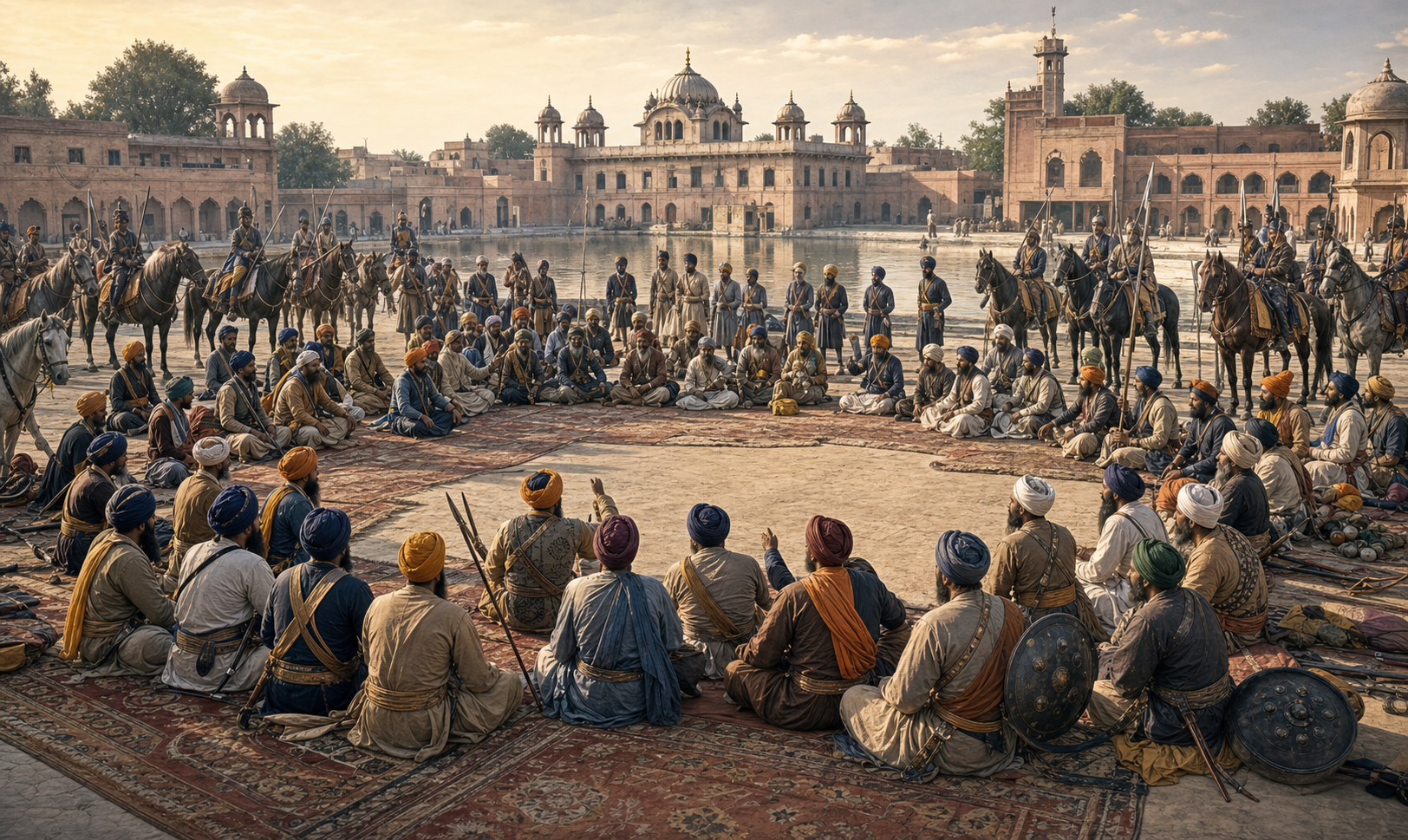
Survival through dispersion solved one problem but created another. Mobile groups could resist and recover, yet regional power required coordination across many leaders and local bases. The decisive reorganization came at Amritsar in 1748, when the Dal Khalsa was institutionalized and Sikh forces were consolidated into misls.
The resulting order was neither a unitary monarchy nor an assortment of unrelated war bands. It was a layered federation. Each institution handled a different political need:
| Institution or practice | Primary function | What it made possible |
|---|---|---|
| Khalsa | Shared spiritual and ethical discipline | Trust and common obligations across locality and lineage |
| Dal Khalsa | Collective military coordination | Cooperation among armed Sikh groupings |
| Misls | Federated local and regional leadership | Initiative without dependence on one central ruler |
| Sarbat Khalsa and gurmata | Collective deliberation and binding resolutions | Common direction on matters affecting the wider community |
| Akal Takht and Harmandir Sahib | Sacred authority, assembly, and service | A recognized moral center above competing temporal interests |
Nawab Kapur Singh and Jassa Singh Ahluwalia helped shape this federated structure. Its strength came from combining two qualities that can easily pull apart: local freedom to act and an accepted framework for collective decisions. The misls provided resilience and speed. Sarbat Khalsa deliberation and gurmata supplied common direction. The Akal Takht and Harmandir Sahib anchored both in sacred authority.
This arrangement explains why decentralization worked as more than a temporary expedient. Decentralized power can fragment when local command loses any higher obligation. In Punjab, the common Khalsa identity, shared rites, collective assemblies, and reverence for Amritsar kept autonomy connected to a larger whole. Coordination did not require every decision to pass through a royal court.
The rakhi system extended protection into unstable areas. This matters because political legitimacy is not created merely by defeating an opponent. People must be able to associate an authority with practical security. Where Sikh groupings could protect communities amid disorder, military capacity began to acquire a public function.
Amritsar supplied the federation with something even more durable than a strategic headquarters. After the destruction of 1762, the reconstruction of Harmandir Sahib and the continued openness of langar restored worship, service, assembly, and public confidence in the same place. Rebuilding a shrine was therefore not separate from rebuilding political life. It demonstrated that invaders could damage the physical center without cancelling the community’s claim upon it.
When you encounter a campaign or territorial change in this era, look beyond the map. Ask who could convene an assembly, whose resolutions carried weight, who protected ordinary people, where food and service remained available, and which sacred center rival leaders continued to honor. Those indicators reveal political order before a formally unified kingdom appears.
Ranjit Singh consolidated a system already in motion
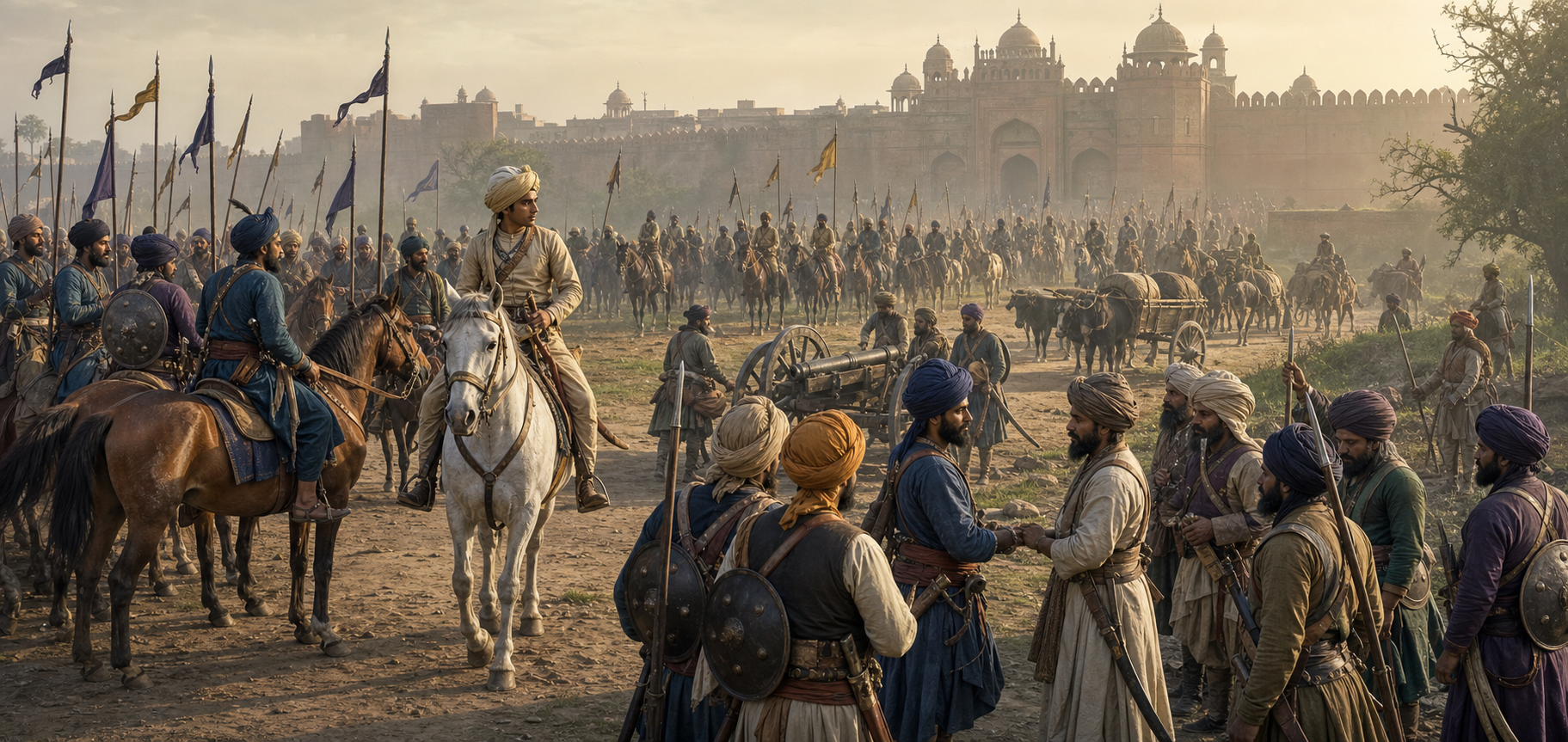
Ranjit Singh’s achievement becomes clearer, not smaller, when you distinguish creation from consolidation. He did not manufacture Sikh power out of a political vacuum. He inherited misls, armed experience, sacred institutions, collective memory, and a population accustomed to organizing through Khalsa networks. His task was to convert that distributed strength into a more stable state.
The chronology helps maintain that distinction. Ranjit Singh secured Lahore in 1799 and was proclaimed Maharaja in 1801. Lahore belongs to the closing moment of the eighteenth-century rise; the proclamation marks the opening of a new phase of imperial consolidation. Treating 1801 as the beginning of the whole story erases the institutions that made the kingship possible.
He brought the misls together through a calibrated combination of diplomacy and limited force. He also modernized the army with assistance from European officers. Centralization now offered capabilities that a federation of mobile powers could not provide as consistently: more unified strategy, greater administrative continuity, and a clearer territorial center.
Yet consolidation did not require the ruler to present himself as the ultimate source of authority. Coinage honored Guru Nanak rather than carrying the Maharaja’s personal name. The symbolism placed temporal rule beneath a spiritual inheritance and connected the state to a legitimacy older than the dynasty.
The administration also included Hindu, Muslim, and Sikh officials; Fakir Azizuddin became a notable representative of that plural practice. Stability, trade, agrarian productivity, predictable revenue practices, and measured taxation were treated as responsibilities of rule. Pluralism was therefore not merely a courtly ornament. It was expressed through appointments and joined to the practical work of governing a diverse Punjab.
Three standards help you judge this consolidation more precisely:
- Continuity: Did centralization preserve the moral and sacred institutions that had sustained the community before monarchy?
- Legitimacy: Could people of more than one faith participate in administration and receive the protection of the state?
- Performance: Did rule make cultivation, trade, revenue, and security more predictable?
These standards also clarify the dharmic significance of the Sikh rise. Sikh praxis affirmed resistance to tyranny through Dharma-Yuddha while binding martial responsibility to seva and care for the vulnerable. Compassion, selfless service, and righteous conduct resonate with Hindu, Buddhist, and Jain traditions, but those shared values should not be used to blur Sikh institutions into a generic religious category. The Khalsa, Sarbat Khalsa, gurmata, Akal Takht, and langar must be understood in their own Sikh historical setting.
The balance is important for a pro-dharma reading of Punjab’s history. Shared ethical ground helps explain Hindu-Sikh bonds across households and guilds, as well as the possibility of community defense without sectarian hatred. Historical respect, however, requires preserving distinctions alongside affinities. Unity becomes credible when it does not demand erasure.
Key takeaways for reading the Sikh political rise
- The rise began with the Khalsa’s portable discipline in 1699, not with Ranjit Singh’s kingship.
- Banda Singh Bahadur’s uprising did not establish the later empire, but it asserted autonomy and widened political expectations among cultivators.
- The massacres of 1746 and 1762 were catastrophic without being politically final because Sikh networks retained the capacity to disperse, regroup, and restore institutions.
- The 1748 organization of the Dal Khalsa and misls gave local initiative a federated structure, while Sarbat Khalsa, gurmata, and Amritsar supplied common direction.
- Harmandir Sahib, the Akal Takht, langar, and collective rites were part of political resilience because they joined sacred authority, public service, and assembly.
- Ranjit Singh’s advance into Lahore in 1799 consolidated a power system already built through decades of sacrifice, coordination, and recovery.
- The resulting state gained legitimacy through more than military strength: plural administration, stable revenue, cultivation, trade, and the subordination of personal rule to the Guru tradition all mattered.
As you read any episode from eighteenth-century Punjab, make two notes: identify the shock, and then identify the institution that survived it. If a narrative can name conquerors and battles but cannot explain how Sikhs continued to assemble, decide, serve, protect, and rebuild, it has described events without explaining the rise. Follow those capacities from Anandpur to Amritsar and then to Lahore, and the political transformation becomes much easier to see.
References
