

If you are asking whether the IPL should bar every Bangladeshi player in response to violence or political hostility, the defensible answer is no, unless individual responsibility, a clear rule, and a fair process can be shown. A passport is not evidence of misconduct. You can demand firm action against violence without accepting collective guilt.
The IPL 2026 dispute has gathered around reports that Bangladeshi pacer Mustafizur Rahman was excluded, while public commentary has also drawn in Kolkata Knight Riders, co-owner Shah Rukh Khan, and Hindu Janajagruti Samiti. The wording matters. A reported exclusion is not the same thing as a published disciplinary finding. Until the responsible decision-maker supplies a formal reason, you should resist turning suspicion into a verdict.
The strongest principle does not justify every proposed remedy
Hindu Janajagruti Samiti has argued that violence and sport cannot coexist and has called for a complete ban on players from Bangladesh. The moral principle deserves serious support. The remedy deserves separate examination.
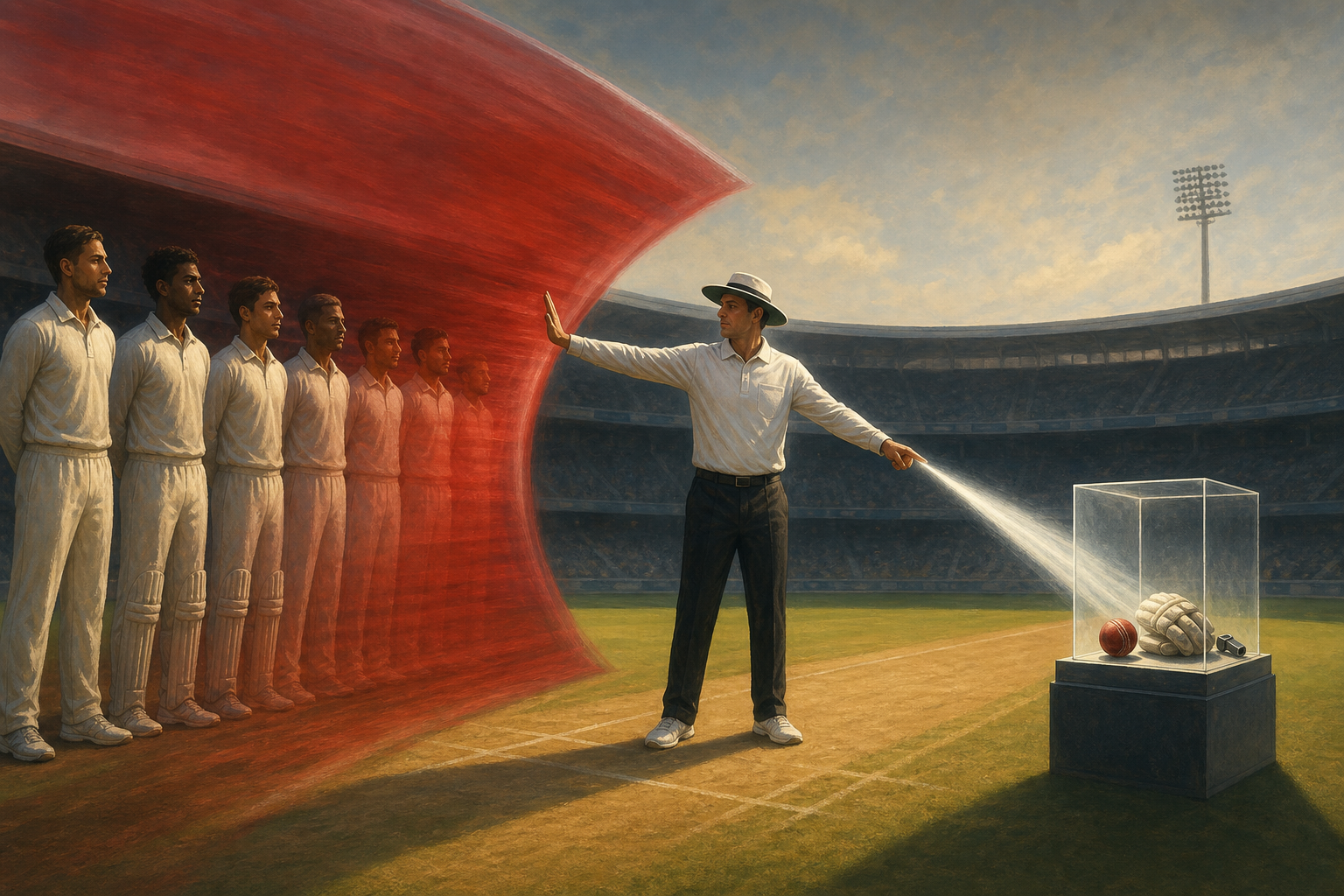
This distinction is essential because a good end does not make every means just. Preventing violence is a legitimate objective. Punishing every player who holds the same nationality as an alleged perpetrator changes the basis of responsibility from conduct to identity. That is collective punishment, even when it is presented as a show of resolve.
Sporting authorities generally preserve that distinction by disciplining individuals, teams, or associations after evidence-based proceedings. The relevant unit is the person or institution connected to the breach. A nationality-wide restriction should therefore face a much higher test than an individual sanction.
Before supporting any ban, ask five concrete questions:
- What precise act of violence, incitement, or rule-breaking is alleged?
- Who verified it, and what evidence connects the affected player, team, or association to it?
- Which published rule authorizes the proposed restriction?
- Has the accused party received notice and a meaningful chance to respond?
- Why is this scope necessary? Would an individual, team-level, venue-level, or security measure address the risk more directly?
If those questions have no clear answers, the case is not ready for punishment. That does not prove every allegation false. It means moral outrage has moved ahead of accountable judgment.
Separate selection, discipline, security, and state policy

Much of the confusion disappears once you identify what kind of decision is actually being made. Four different questions are being compressed into a single word: exclusion.
- Sporting selection: A player has no automatic entitlement to an IPL contract or place in a side. A franchise can make a cricketing decision based on performance, role, balance, availability, or strategy. It need not publish every competitive detail, but it should not allow an ordinary selection decision to be misrepresented as a disciplinary verdict.
- Discipline: If a player is accused of violating a code of conduct, the authority must identify the rule, examine evidence, hear the response, and issue a proportionate finding. Nationality is not a substitute for that chain of proof.
- Safety: A credible threat to players or spectators requires an immediate operational response. Enhanced security, crowd controls, liaison arrangements, and de-escalation protocols can protect people without presuming that every member of a nationality is dangerous.
- Governmental or regulatory eligibility: If a public authority or the BCCI imposes a broader eligibility rule, the responsible institution, legal or regulatory basis, scope, and duration should be stated openly. A franchise should not be left to carry or conceal a policy that it did not make.
Mustafizur Rahman’s swing, death-overs skill, and memorable IPL performances are relevant to his sporting reputation. They do not guarantee him a place in IPL 2026. Equally, his nationality does not establish misconduct. Both statements can be true at once.
The same discipline should govern claims about KKR and Shah Rukh Khan. Public figures have a responsibility to encourage calm conduct, but attaching a famous name to a controversy is not evidence that the person ordered, prevented, or endorsed a particular decision. If a specific allegation exists, state it precisely and test it through the same process that should apply to everyone else.
A dharmic response joins ahimsa to accountable judgment

Hinduism, Buddhism, Jainism, and Sikhism express their teachings in distinct ways, yet non-violence, restraint, dignity, and responsible conduct form a shared ethical meeting ground. That common ground does not demand passivity. It demands control over both the harm we oppose and the means we use to oppose it.
Ahimsa cannot mean leaving athletes, spectators, or ordinary supporters exposed to danger. Nor can it mean transferring blame from an offender to unrelated people. The practical dharmic task is to stop harm without manufacturing a second injustice.
You can apply that ethic through four tests:
- The conduct test: Does the decision respond to something the affected person or institution actually did, enabled, or failed to prevent?
- The truth test: Are verified facts being distinguished from reports, allegations, assumptions, and social-media repetition?
- The restraint test: Is the remedy narrow enough to protect innocent people while still restraining the responsible party?
- The consistency test: Would you accept the same standard if an Indian player were accused or excluded in another country?
A policy that passes only when the affected player is foreign is not a stable moral principle. It is a partisan exception. Dharma asks for a standard that survives reversal.
This also explains why sporting contact has value beyond entertainment. Children imitate bowlers they admire, families gather around matches, and supporters form attachments that do not follow diplomatic boundaries. Cricket can create familiarity where politics creates distance. That bridge should not excuse violence, but neither should violent actors receive an automatic veto over peaceful contact.
Unity is not sentimental indulgence. It is one of the things a careful security and disciplinary policy should preserve. A blanket ban may appear decisive while deepening the very division that agitators exploit. Targeted accountability is harder work, but it is morally clearer and usually more informative: it tells the public what happened, who was responsible, and which rule will govern the next case.
What trustworthy IPL governance would look like

The BCCI, franchises, security authorities, and media do not have the same role. Trust breaks down when one actor’s responsibility is quietly shifted onto another. A workable process should proceed in this order:
- Label the decision: State whether the matter concerns sporting selection, discipline, safety, or a broader eligibility policy. Do this before debating whether the outcome is fair.
- Identify the decision-maker: Name the franchise, BCCI body, security authority, or other institution that made the call. Ownership, public prominence, and institutional authority are not interchangeable.
- Investigate alleged misconduct independently: Preserve relevant records, review available footage or official reports, and obtain responses from the affected parties. Rumour should not become evidence merely through repetition.
- Connect the finding to a rule: A reasoned outcome should identify the relevant obligation and explain how the established conduct breached it.
- Target the responsible level: Individual misconduct calls for an individual response. A team or association failure calls for review at that level. A venue threat calls for a security plan. Broader punishment requires correspondingly broader evidence.
- Publish a concise rationale: Officials need not disclose sensitive security material or franchise strategy, but they should state the category of decision, its authority, scope, duration where applicable, and route for review.
- Reduce the chance of repetition: Use cross-border liaison, athlete and supporter conduct charters, de-escalation protocols, and joint education to prevent the next incident instead of merely reacting to the last controversy.
This sequence prevents a common error: announcing a sweeping remedy before establishing the event, the responsible party, and the governing rule. It also allows authorities to act quickly on immediate safety while reserving final blame for a completed review.
A quick check before you share a claim
You do not control the BCCI’s process, but you do control what you amplify. Before forwarding a clip, boycott call, or allegation, check the following:
- Is this a direct statement from the decision-maker, or someone else’s description of the decision?
- Does the wording say reported, alleged, confirmed, investigated, or ruled? Those words describe different stages.
- Is a player’s personal conduct identified, or is nationality doing all the argumentative work?
- Does the proposed response protect anyone from a specific risk, or does it mainly display anger?
- Would you defend the same process if the affected player, team, or country were one you supported?
When a claim fails this check, do not improve it with your own certainty. Ask for the formal statement, rule, or finding. That small act of restraint is part of sports ethics, not an escape from it.
Key takeaways
- The principled position is to oppose violence firmly and collective guilt equally firmly.
- A reported exclusion is not a published finding of misconduct; keep selection claims and disciplinary claims separate.
- Nationality-wide punishment requires more than anger or association. It requires a clear authority, rule, evidentiary basis, defined scope, and fair review.
- Due process is not softness toward violence. It is the method that identifies the right offender and makes a sanction credible.
- Immediate danger should be met with immediate protection. Final blame should follow an impartial investigation.
- A dharmic standard must still appear just when the nationalities are reversed.
For IPL 2026, adopt a position you can apply consistently: ask the BCCI or franchise to identify the kind of decision made, wait for evidence before assigning personal blame, and support measures directed at verified conduct rather than nationality. If violence threatens a match, protect people first. Once the immediate danger is controlled, insist that investigation narrow the circle of responsibility instead of allowing anger to widen it.
References
- Hindu Janajagruti Samiti – Can Violence and Sport Coexist? HJS Demand Spurs Debate on Bans, Fair Play, and Unity
- Struggle for Hindu Existence – IPL 2026 Row: Mustafizur Rahman’s Exclusion, SRK Allegations, and a Call for Peaceful Sport
