
If you are trying to understand how Bhartrhari reached Europe, the crucial questions are not merely when a European edition appeared. You need to know who carried the verses across languages, what was selected, what was left out, and why the first European publisher wanted the material.
The route began in Pulicat with an Indian scholar named Padmanabha. It then passed through Portuguese mediation, Dutch paraphrase, missionary print, and later European philology. Once you follow that chain, Bhartrhari’s European reception stops looking like a sudden discovery and becomes a history of translation, selection, power, and often-unacknowledged Indian intellectual labour.
Follow the chain, not a European discovery myth
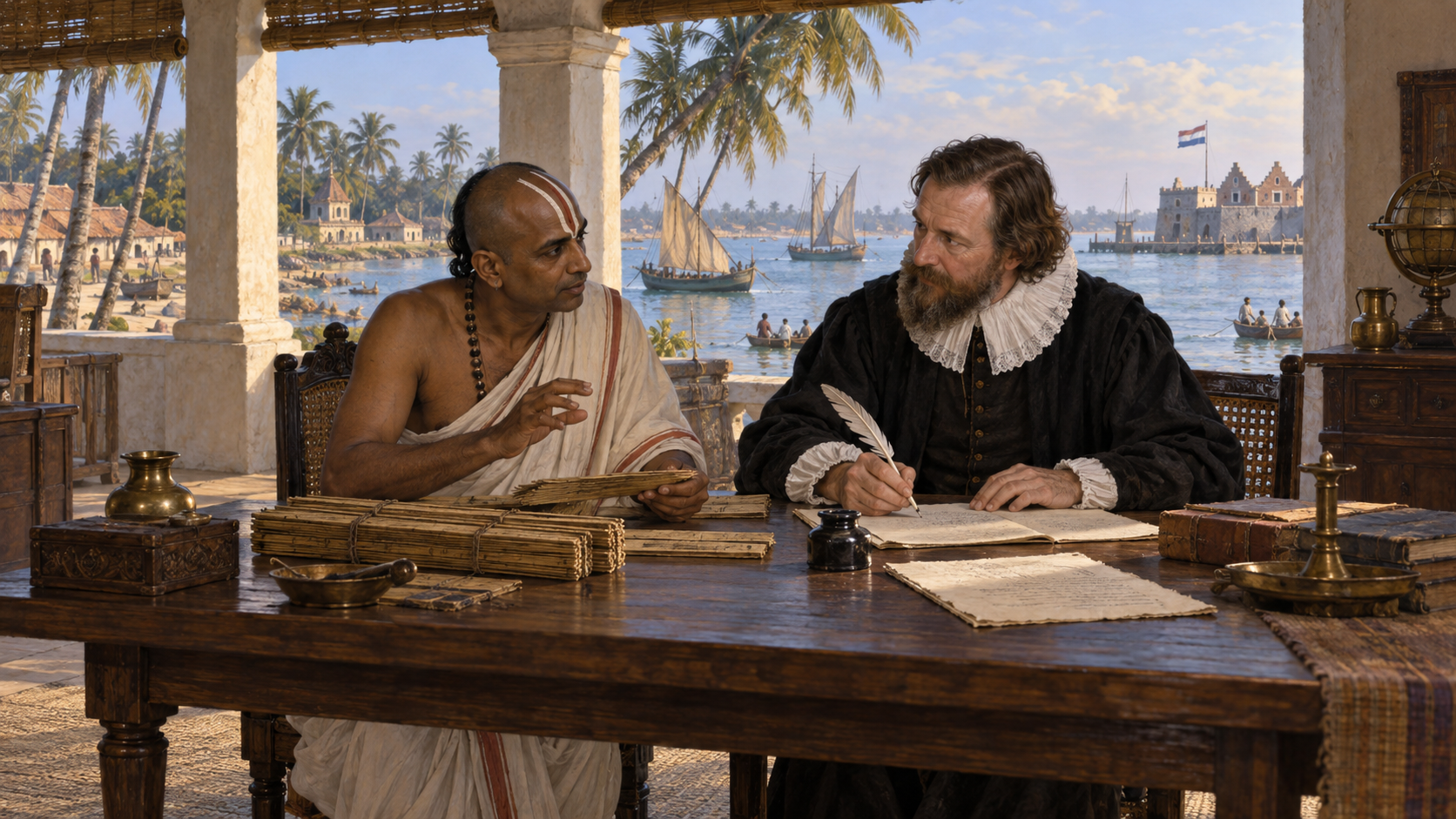
On 17 September 1632, the Calvinist chaplain Abraham Rogerius arrived at Pazhaverkadu, or Pulicat, on the Cholamandalam coast. The Dutch East India Company had sent him to replace another minister. During a ten-year stay, he travelled along the coast and into the Malayala region, studied Sanatana philosophy, observed Tamil Hindu society, and pursued Christian missionary work.
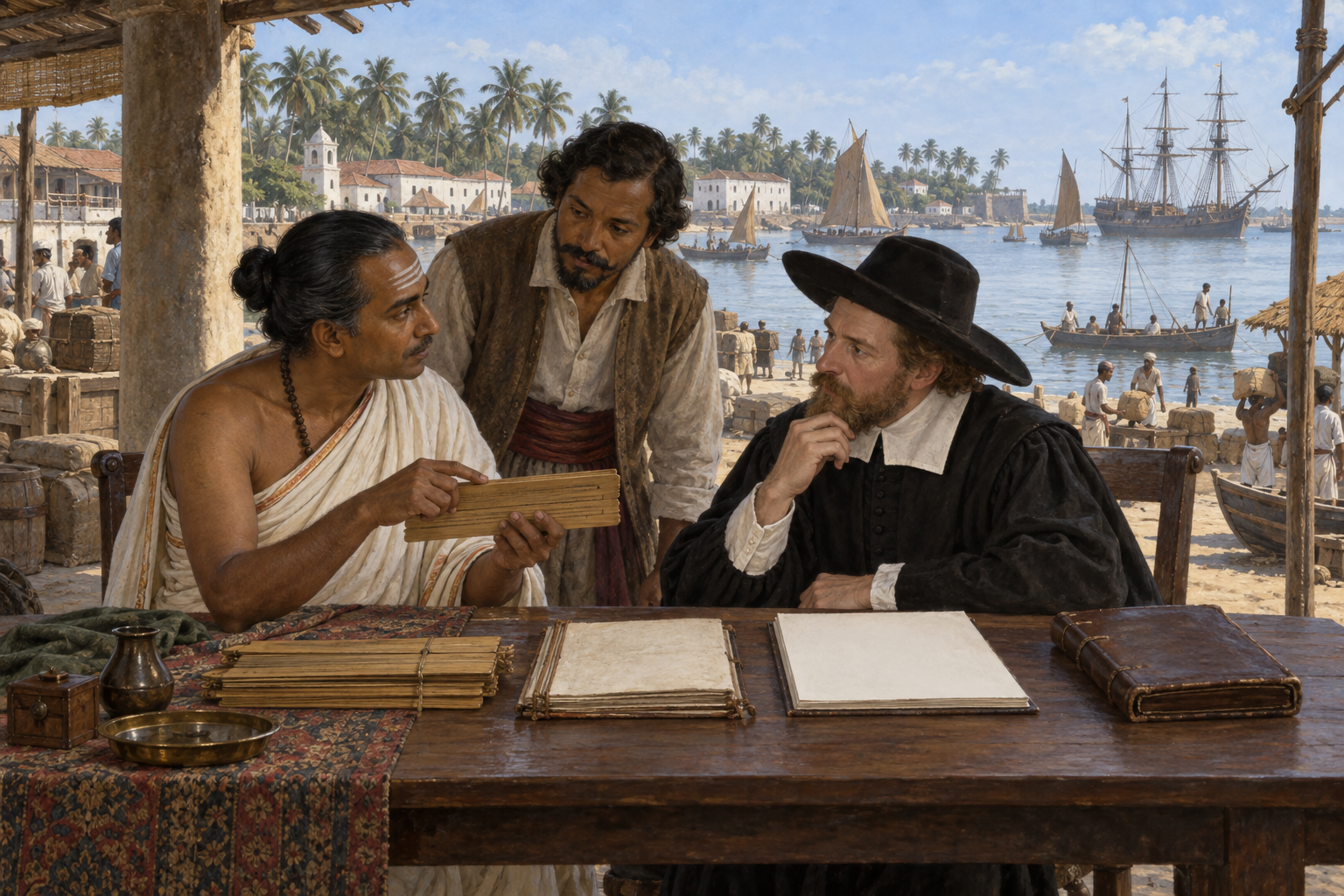
Pulicat became the hinge in Bhartrhari’s passage to Europe because Rogerius met Padmanabha there. Padmanabha was a Sri Vaishnava Brahmana and a polyglot. He supplied the intellectual access without which Rogerius could not have presented Bhartrhari to Dutch readers.
- The Sanskrit inheritance: Bhartrhari’s śataka-traya comprised three verse collections associated with nīti, vairāgya, and śṛṅgāra.
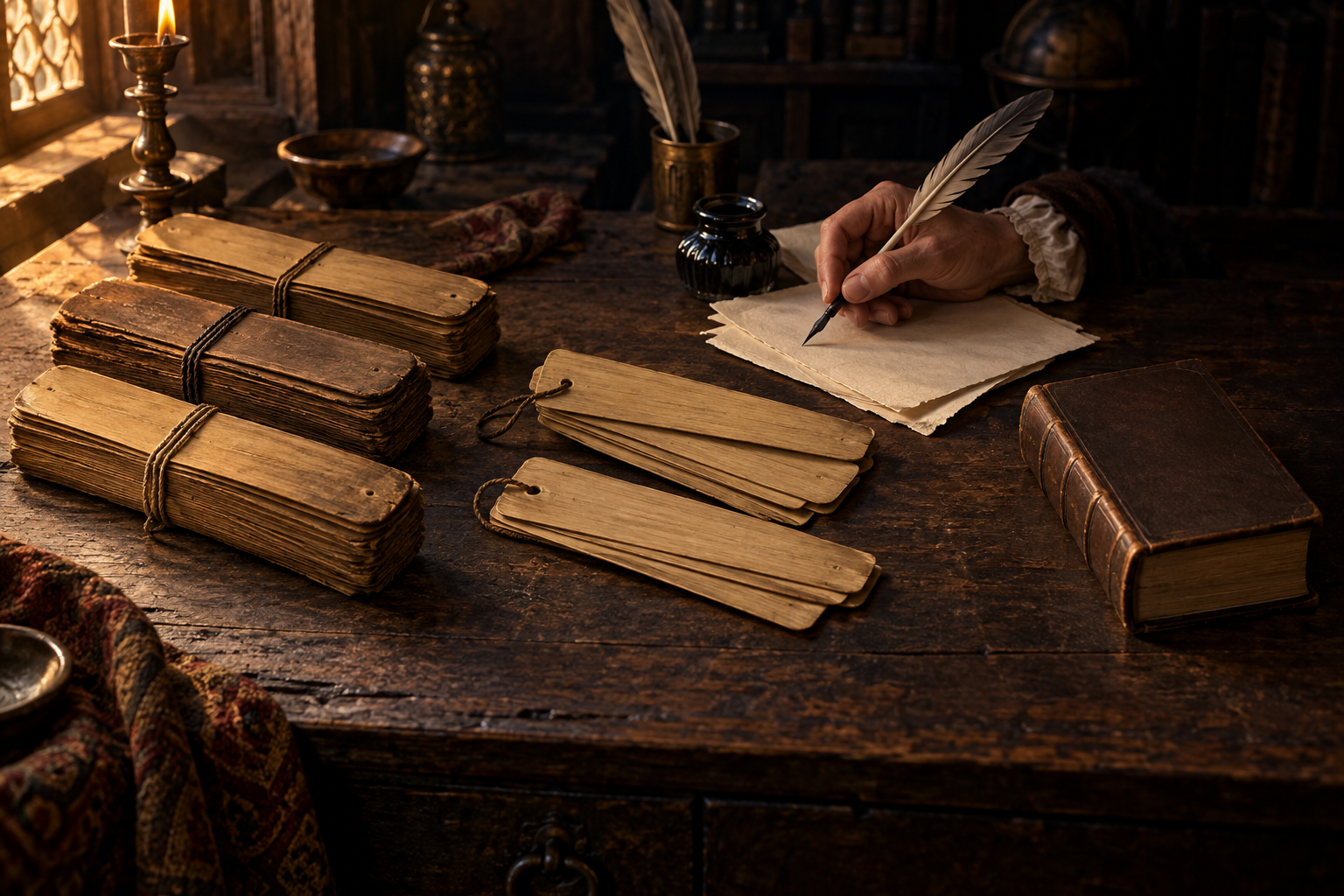
- Padmanabha’s Portuguese rendering: Padmanabha translated the Nīti and Vairāgya śatakas into Portuguese. He did not include the Śṛṅgāra śataka because of its strongly erotic content.
- Rogerius’s Dutch paraphrase: Working from Padmanabha’s Portuguese, Rogerius rendered selected verses from the two included collections into Dutch. This was a paraphrase, not a direct Sanskrit-to-Dutch translation.
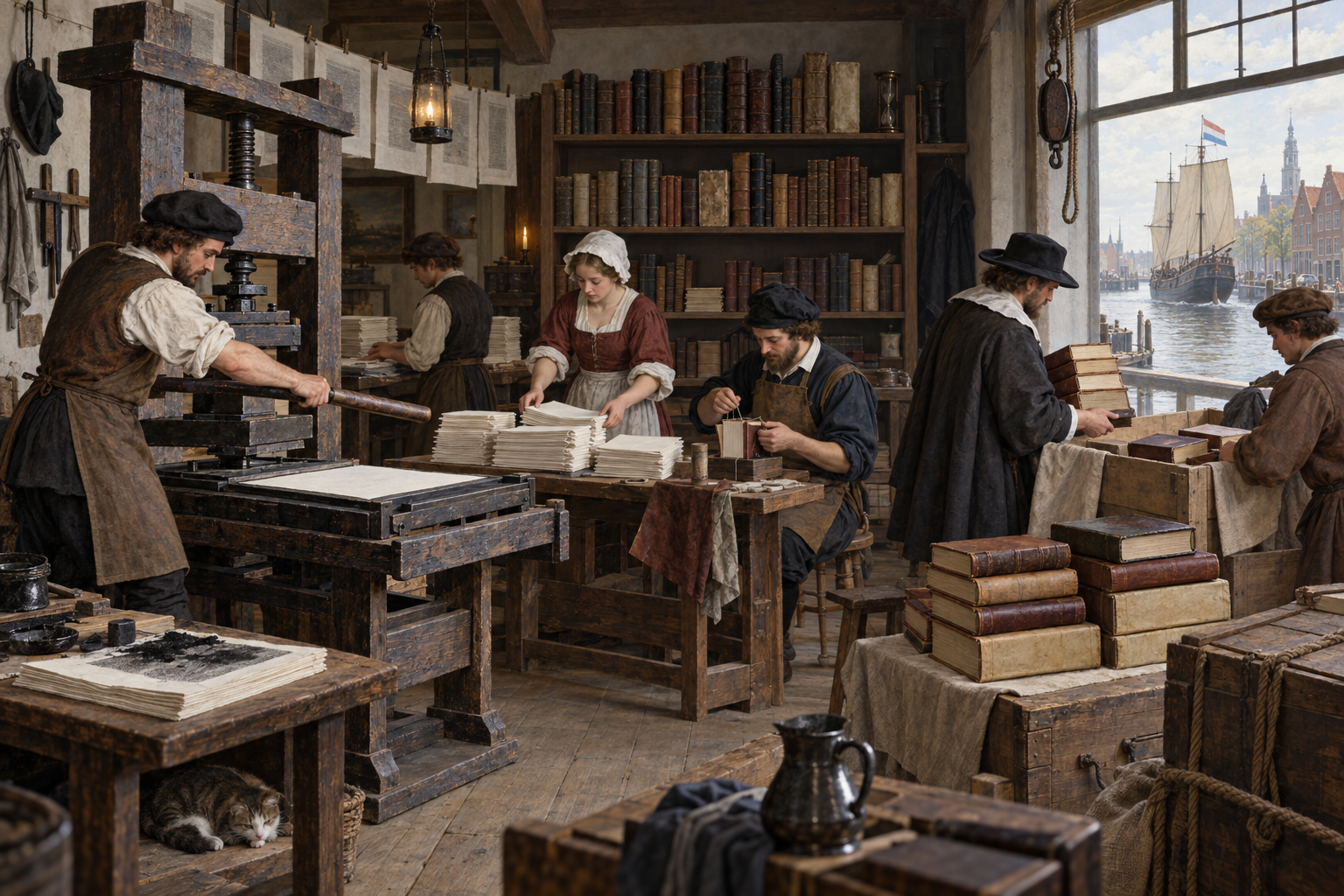
- The printed appendix: The selections appeared as the first appendix to De Open-Deure Tot Het Verborgen Heydendom, commonly rendered in English as The Open Door to Hidden Heathendom. The book was published in 1651, two years after Rogerius died.
The accurate transmission formula is therefore Sanskrit Bhartrhari to Padmanabha’s Portuguese, then to Rogerius’s selected Dutch paraphrase, and finally into European print. Each stage matters. Removing Padmanabha from the account turns a collaborative and unequal encounter into a misleading tale of solitary European discovery.
The appendix is regarded as the first fairly extensive Sanskrit work to reach Western readers. That historical importance belongs to the entire Pulicat chain. Rogerius controlled the European publication, but Padmanabha made the textual passage possible.
Read the first European Bhartrhari as a partial text
A śataka is a collection organised as a century of verses. Bhartrhari’s three collections address distinct but related domains: nīti concerns ethical and worldly discernment, vairāgya concerns dispassion and renunciation, and śṛṅgāra concerns erotic love. European readers in 1651 did not encounter all three domains.
They received a filtered Bhartrhari in three separate senses:
- A corpus filter: the erotic Śṛṅgāra collection was omitted, leaving only Nīti and Vairāgya.
- A selection filter: Rogerius paraphrased selected verses rather than reproducing every verse in the two remaining collections.
- A language filter: the path ran from Sanskrit through Portuguese into Dutch, creating two points at which diction, imagery, doctrine, and tone could shift.
This distinction changes how you should cite the early material. A line found in the 1651 appendix should not be introduced as Bhartrhari’s exact wording. Describe it as a Dutch paraphrase based on Padmanabha’s Portuguese rendering of a selected Sanskrit verse. That wording may seem cumbersome, but it prevents a mediated European expression from silently replacing the Sanskrit text.
The treatment of the opening benedictory verse of the Vairāgya collection illustrates the problem. In the transmitted paraphrase, Śiva appears as the lamp of knowledge who dispels delusion in those seeking liberation, while desire is figured as a fluttering moth consumed by fire. The philosophical centre remains recognisable, but every English rendering of that Dutch passage stands several steps away from Bhartrhari’s Sanskrit expression.
Selection also shaped Bhartrhari’s early European reputation. Ethics and renunciation entered print while erotic poetry remained outside the door. You should not mistake that initial profile for the range of Bhartrhari’s corpus. The omission tells you about the transmission process, not about an absence within the Indian literary tradition.
Keep the missionary purpose visible
Rogerius did not arrive in Pulicat as a disinterested student of Sanskrit literature. His study of Hindu philosophy and society served an openly Christian missionary project. He wanted knowledge that could help missionaries lead Hindus toward the Gospel. The European doorway through which Bhartrhari first passed was therefore built for conversion, not for an equal dialogue between traditions.
There was a revealing tension inside that project. Rogerius opposed Hindu religion, yet he also recognised that it did not rest upon loose foundations and that Hindus did not live without God or worship. Close engagement forced an acknowledgement of intellectual and religious structure even when the surrounding vocabulary reduced Sanatana traditions to heathendom.
The later French title made the polemical frame even harder to miss: The Theatre of Idolatry, or the Open Door to Arrive at the Knowledge of Hidden Paganism. The Dutch book was translated into German in 1663 and French in 1670, with missionary usefulness in India continuing to drive its circulation.
You can use this early record without adopting its categories. Apply three checks whenever you read it:
- Separate contribution from framing. Padmanabha supplied and translated the Hindu intellectual material; Rogerius selected, paraphrased, framed, and published it for a European Christian audience.
- Treat religious labels as arguments. Terms such as idolatry, paganism, and heathendom disclose the missionary’s theology. They are not neutral descriptions of Sanatana Dharma.
- Investigate every absence. The missing Śṛṅgāra collection resulted from a choice in transmission. An omitted theme must not be turned into a claim about the original corpus.
Restoring Padmanabha’s name is more than a symbolic courtesy. It repairs the causal account. Without his command of languages and his knowledge of the tradition, there would have been no Portuguese bridge for Rogerius to cross. A responsible history should therefore begin with Padmanabha at Pulicat rather than with the European printing press in 1651.
Distinguish missionary transmission from later philology
Bhartrhari’s European afterlife entered a different phase during the nineteenth century. The verses were no longer confined to an appendix inside a missionary account of Hindu society. They began to appear as independent works and as objects of specialised Indological study.
- 1833–34: Peter von Bohlen published the first standalone Latin translation of the śataka-traya under the title Bhartriharis sententiae et carmen quod Chauri nomine circumfertur eroticum.
- 1835: Bohlen followed the Latin publication with the German Die Sprüche des Bhartriharis.
- 1875: the French Indologist Paul Regnaud published Les Stances: Erotiques, Morales et Religieuses De Bhartrhari.
- 1877: C. H. Tawney published the English Two Centuries of Bhartrhari.
These dates mark more than additional languages. The 1651 Bhartrhari served as an appendix to missionary intelligence about Hindu life. By the nineteenth century, Bhartrhari had become a standalone subject of European Sanskrit scholarship, with Germany emerging as an important centre of that work.
The institutional setting changed, but the imbalance did not disappear automatically. Explicit conversion was less central in the later translations, while colonial assumptions continued to influence how Indian literature was classified and judged. Philological interest could preserve, organise, and circulate Sanskrit works while still treating the civilisation that produced them as an object to be examined from above.
That history does not require you to discard every European translation. It requires you to ask the right question of each one. If you are studying Bhartrhari’s thought, verify important wording against Sanskrit and do not make a layered paraphrase carry more authority than it can bear. If you are studying European reception, the omissions, titles, paraphrases, and missionary categories are themselves valuable evidence because they show how Europe constructed its image of Hindu learning.
It also helps to keep two bibliographic tracks. Place the Padmanabha–Rogerius material and its seventeenth-century German and French descendants under the Pulicat-mediated missionary phase. Place Bohlen, Regnaud, and Tawney under the nineteenth-century philological phase. Collapsing the two conceals the change from conversion-oriented knowledge gathering to colonial academic study.
Key takeaways
- Bhartrhari did not move directly from Sanskrit into a European language. Padmanabha translated two collections into Portuguese, after which Rogerius paraphrased selected verses in Dutch.
- The first European presentation was incomplete: it excluded the erotic Śṛṅgāra śataka and contained selections from Nīti and Vairāgya.
- The verses entered European print in 1651 as an appendix to a work intended to support Christian missionary activity.
- German and French versions followed in 1663 and 1670, while standalone Latin, German, French, and English treatments appeared during the nineteenth century.
- Padmanabha belongs at the centre of the transmission history because his linguistic and intellectual mediation made the European publication possible.
- Early translations can illuminate European reception, but their wording and framing should not be treated as transparent substitutes for Bhartrhari’s Sanskrit.
The next time you encounter a European rendering of Bhartrhari, check four things before quoting it: its date, the collection represented, the language chain behind it, and the purpose of the publication in which it appeared. That small discipline keeps Pulicat and Padmanabha inside the history—and lets you use European translations without surrendering the Indian origin, range, or authority of the tradition.
References

Leave a Reply
You must be logged in to post a comment.