
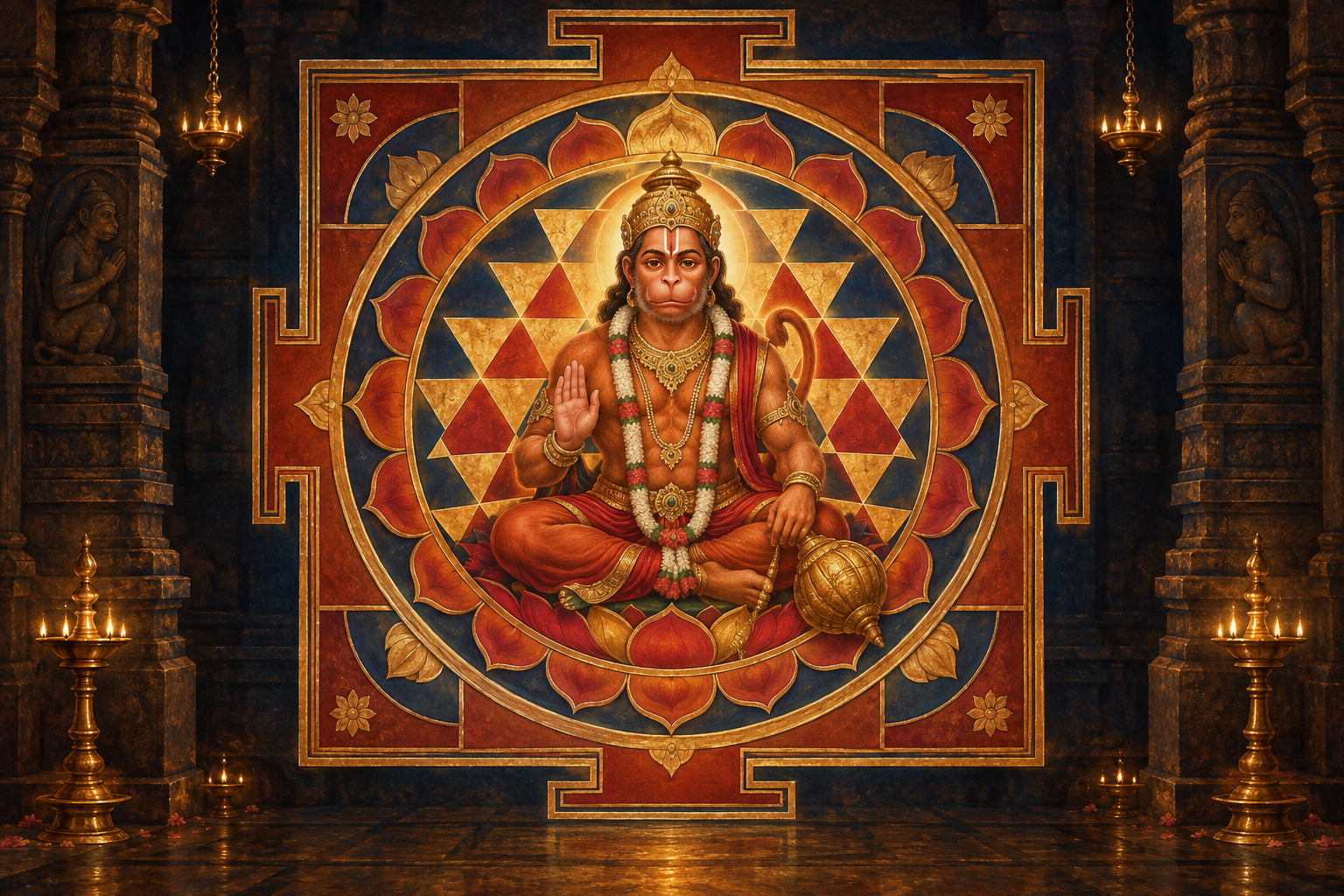
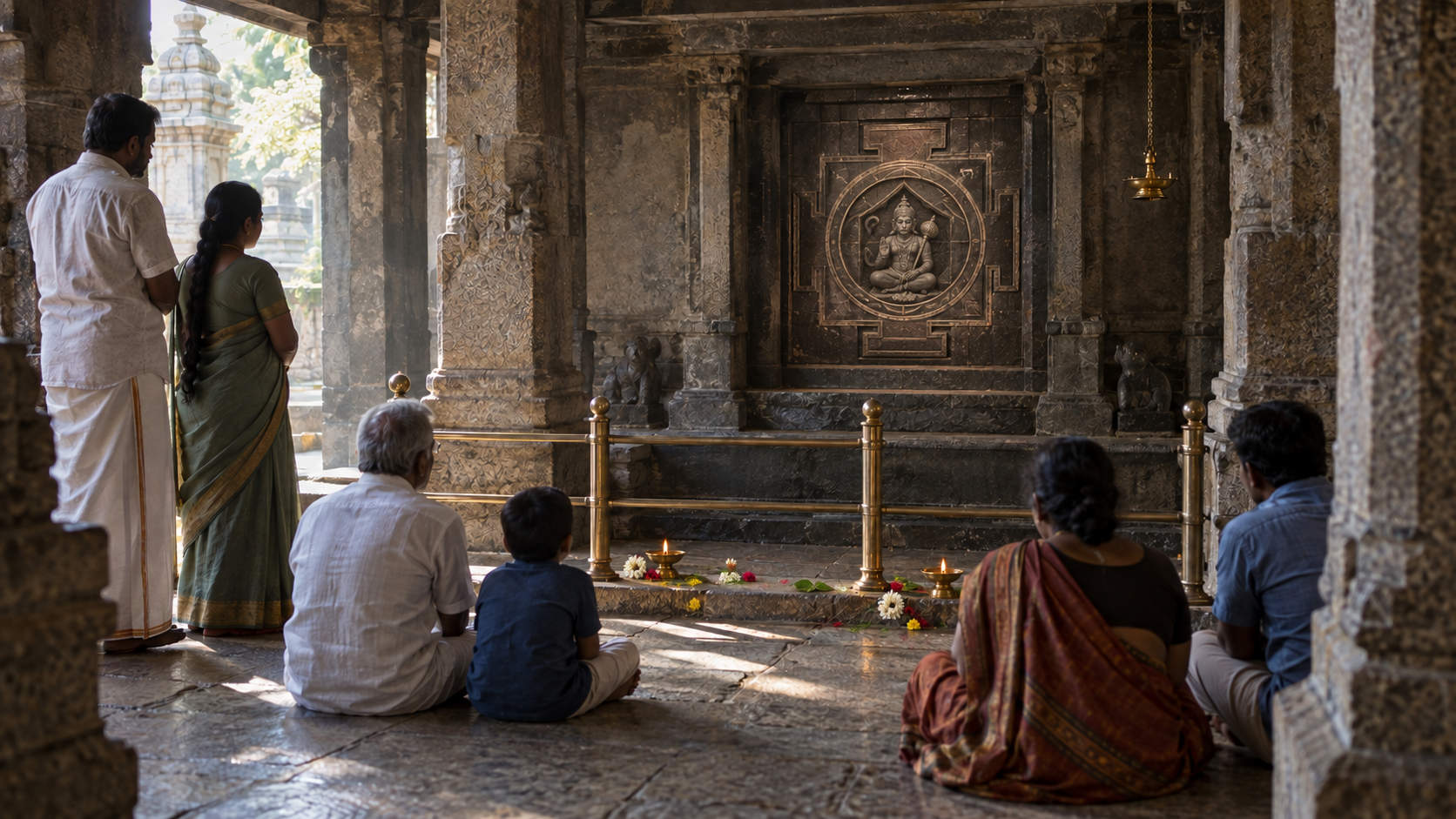
You may have paused before an image of Hanuman enclosed by a precise geometric form and wondered what you were meant to see. Is the diagram a boundary, a source of power, a map for meditation, or simply an ornate frame? The most useful first question is simpler: why have Hanuman and the geometry been made inseparable?
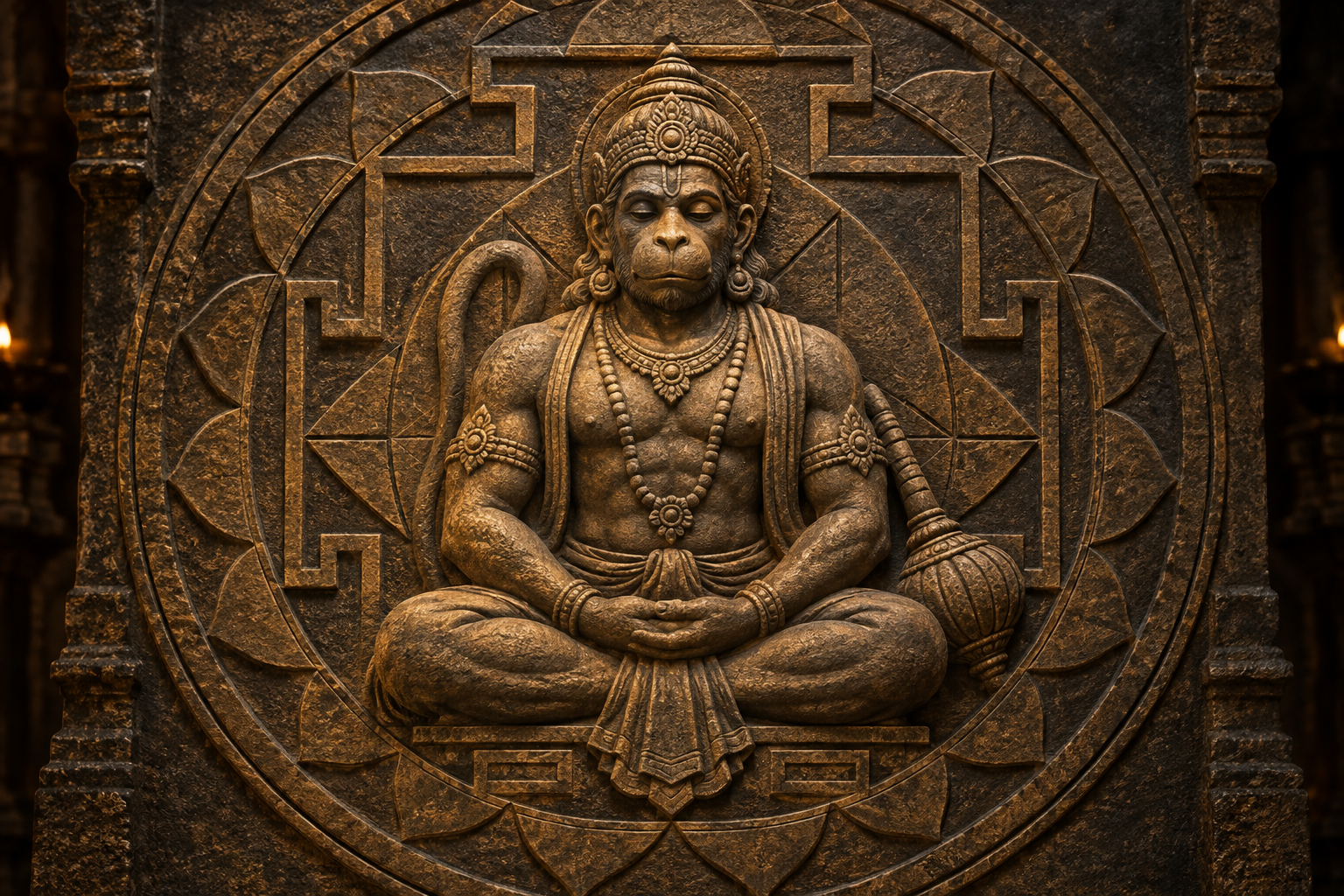
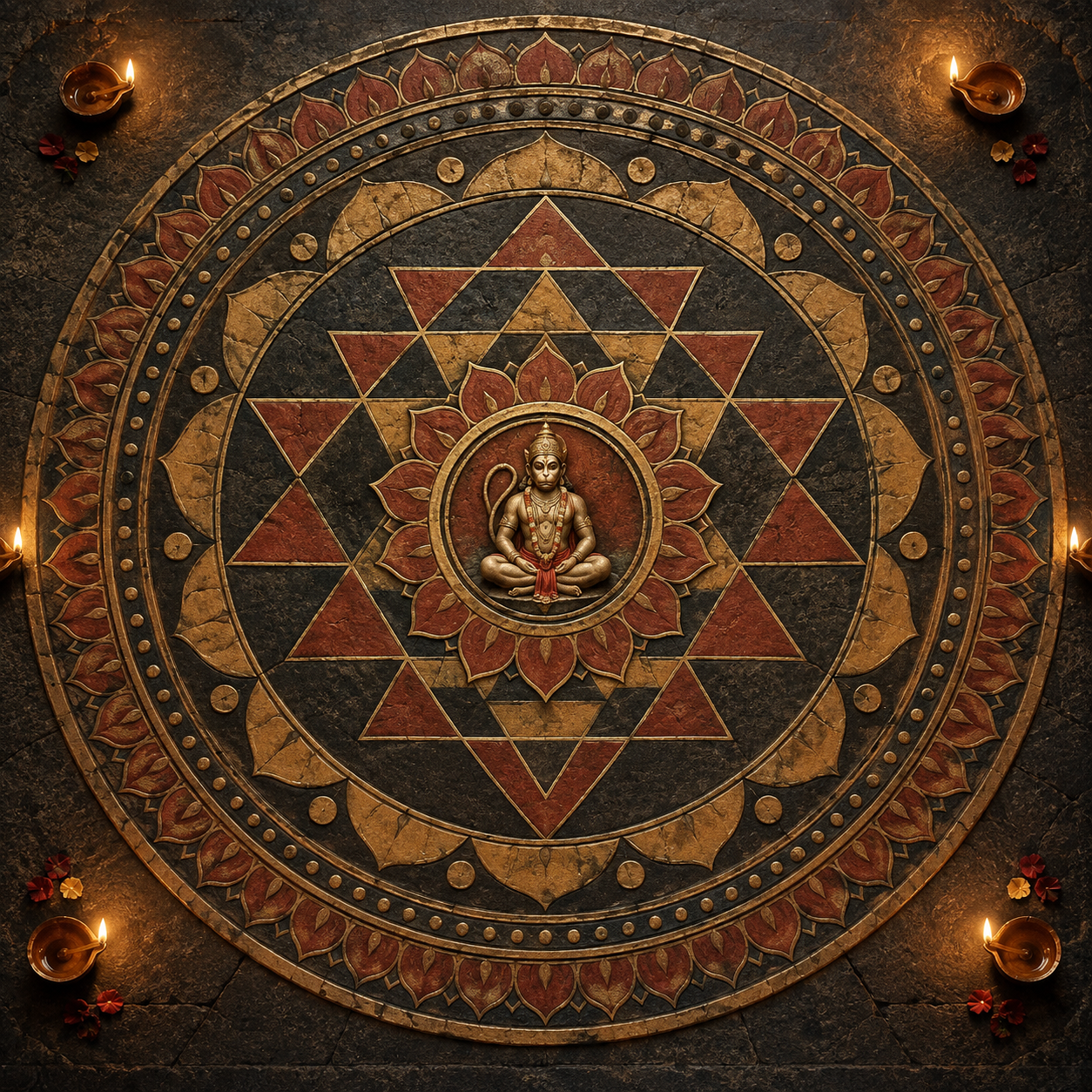
In rare temple forms preserved across India, Hanuman appears seated or standing within a yantra. The combined image brings strength, protection, devotion, order, and concentration into one field of vision. Once you understand that relationship, you can approach the form without inventing a secret meaning for every line.
The deity and the geometry do different work
A murti gives sacred presence a personal form. You encounter Hanuman as someone toward whom devotion, prayer, remembrance, and service can be directed. A yantra organizes sacred space through boundaries, direction, symmetry, repetition, and a governing center. It does not tell a story in the same manner as a narrative painting.
When the two are joined, neither becomes secondary. Hanuman is not merely an illustration placed over a diagram, and the yantra is not decorative architecture around him. The personal and the geometric interpret each other. Hanuman gives the ordered space a recognisable devotional center; the yantra presents his power as gathered, directed, and held within sacred order.
The name Yantrodharaka reinforces this relationship. Yantra can mean an instrument or ordered sacred diagram, while dharaka carries the sense of bearing, supporting, or holding. The name therefore directs your attention to Hanuman in relation to the yantra, not to Hanuman on one side and an unrelated pattern on the other.
This distinction prevents two common mistakes. The first is treating the geometry as a cage. Sacred enclosure need not imply imprisonment; it can indicate concentration, protection, or a field set apart from ordinary disorder. The second mistake is reducing the yantra to visual decoration. If removing the geometry would change how you understand the deity’s presence, then the geometry is carrying meaning.
Try a direct test when you next see the image. Cover the outer geometry mentally and notice what is lost. Then imagine the geometry without Hanuman and notice what is lost again. The first view may retain a beloved divine personality but lose the sense of ordered concentration. The second may retain structure but lose the personal focus of devotion. Yantrodharaka Hanuman holds those two modes together.
Read the form from its boundary toward its center
You do not need an improvised dictionary of symbols to begin. Start with relationships that the image actually shows. This method is useful during darshan, while studying a photograph, or when deciding whether an explanation of the iconography is credible.
- Find the outer limit. Notice what separates the sacred field from the space around it. Let that boundary mark a transition in your own attention: for this moment, unrelated worries remain outside.
- Follow the pattern inward. Observe symmetry, repeated lines, crossings, or directional movement without immediately assigning each feature a fixed theological meaning. First see how the parts establish order.
- Locate the governing center. Ask whether your eye arrives naturally at Hanuman. If it does, the geometry is functioning as a visual discipline: many lines direct attention toward one presence.
- Notice Hanuman’s posture. A seated form can be approached through collected strength and interior steadiness; a standing form can bring readiness and protective action to the foreground. Treat these as attentive viewing cues, not as universal rules that override a temple’s own teaching.
- See the whole image again. Do not finish with an isolated line or shape. Return to the complete relationship among boundary, pattern, center, posture, and deity.
This outside-to-center movement matters because a yantra is easily mishandled as a puzzle. A puzzle rewards the person who accumulates the most correspondences. A sacred image asks for a different kind of intelligence: sustained attention, respect for transmitted meaning, and an ability to let the whole govern the parts.
Be cautious when someone claims that every visible line always has one universal translation. Yantric meanings can depend on the particular tradition, ritual setting, and form being used. A local explanation preserved by the temple or its recognised tradition deserves priority over a generic chart found elsewhere. If no transmitted explanation is available, describe what you can actually observe and leave uncertain details open.
The same caution applies to images sold as interchangeable spiritual devices. Visual resemblance does not prove identical ritual identity. Do not transfer a mantra, seed syllable, installation rule, or promised result from one yantra to another merely because their geometry looks similar.
Hanuman turns geometric order into an ethical demand
Geometry by itself can be admired at a distance. Hanuman does not allow the encounter to remain merely aesthetic. His familiar associations with courage, disciplined strength, protection, devotion, and service turn the ordered image into a question about how you use your own capacities.
- If courage stands out to you, ask which duty you have been postponing because discomfort has become larger than responsibility.
- If strength stands out, ask whether your strength is governed or merely reactive. Controlled power can protect; uncontrolled force adds to disorder.
- If protection stands out, identify the boundary that actually needs guarding. It may concern your time, attention, family responsibilities, religious practice, or willingness to refuse what is adharmic.
- If devotion stands out, name the service through which loyalty becomes visible. Admiration that never changes conduct remains incomplete.
- If concentration stands out, remove one distraction from the next duty in front of you. The movement from many competing impulses toward one rightful center is something you can practise immediately.
This is where the yantra’s enclosure becomes especially meaningful. Hanuman’s might is not presented as scattered energy seeking an outlet. It is power held in relation to a center. For a devotee, that offers a demanding model: capacity becomes Dharmic only when purpose, restraint, and service direct it.
Choose the question that exposes a real decision in your life, not the quality that sounds most impressive. If you are already acting forcefully but without reflection, the image may call you toward steadiness rather than more force. If you understand your responsibility but keep avoiding it, the same image may call you out of contemplation and into action. Sacred symbolism becomes useful when it corrects your imbalance.
A practical way to approach Yantrodharaka Hanuman
You can use the combined form as a disciplined structure for darshan without pretending to possess specialised ritual knowledge. The aim is not to extract a guaranteed benefit from the image. It is to bring sight, attention, devotion, and conduct into alignment.
- Pause before directing your attention to details. Let your breathing and posture settle naturally.
- Acknowledge the boundary of the yantra. Mentally set aside concerns that do not belong to this act of worship.
- Allow your gaze to move through the geometry toward Hanuman. Do not rush to label every element.
- Rest your attention on the relationship between the ordered field and Hanuman’s presence. Notice whether the form communicates stillness, readiness, protection, or concentrated strength to you.
- Select one Dharmic quality that your present circumstances require. State it plainly: courage for a duty, restraint in a conflict, loyalty in service, or vigilance at a boundary.
- Leave with a corresponding action. Make the delayed call, complete the neglected obligation, decline the harmful demand, or give undivided attention to the service already entrusted to you.
At a temple, local practice comes first. Observe rules concerning entry, photography, offerings, touching sacred objects, and movement around the shrine. If a priest or authorised custodian explains a feature of the yantra, keep that explanation attached to that particular form rather than turning it into a rule for every yantra.
At home, distinguish respectful contemplation from formal ritual installation. You may contemplate an image and allow it to shape your conduct without claiming that a printed design has been ritually consecrated. If you want to undertake a tradition-specific mantra or yantra practice, seek instruction within the relevant sampradaya or temple tradition instead of assembling procedures from unrelated images and fragments.
Avoid transactional promises. The sacred form should not be treated as a machine that guarantees victory, removes every obstacle, or substitutes for responsible action. Hanuman’s symbolism points in the opposite direction: protection requires vigilance, courage requires duty, and devotion requires service.
Key takeaways
- Yantrodharaka Hanuman unites a personal deity with an ordered sacred diagram; neither element is incidental.
- Read the image from boundary to center before trying to decode individual shapes.
- The yantra should not automatically be read as a cage, decoration, or universally interchangeable symbol.
- Temple-specific teaching takes precedence over generic online interpretations of similar-looking geometry.
- The most useful response is ethical and practical: direct strength, attention, and courage toward a concrete Dharmic duty.
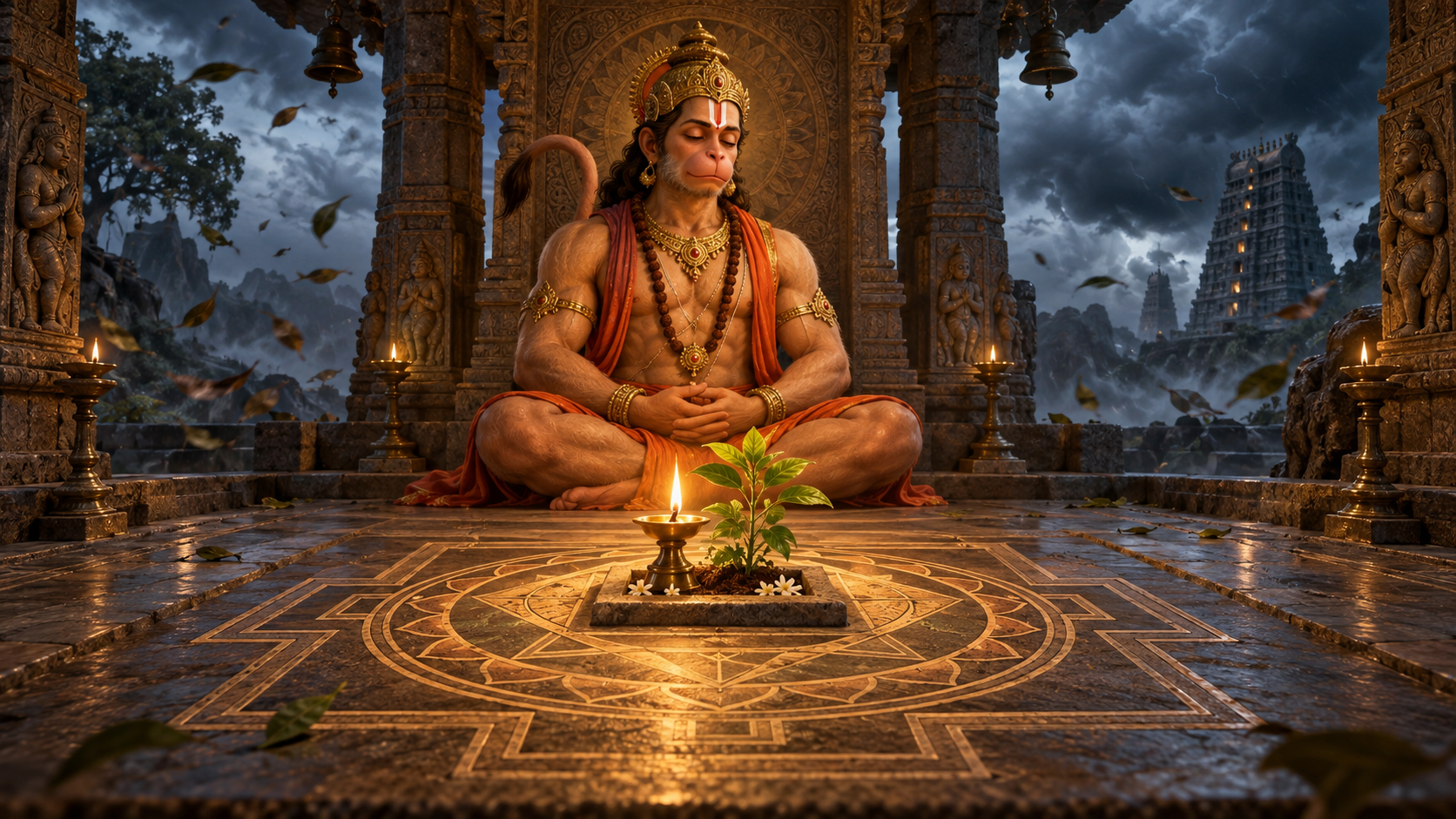
When you next encounter Yantrodharaka Hanuman, do not begin by hunting for a hidden code. Notice the boundary, follow the order inward, meet Hanuman at the center, and decide what in your own life must now become less scattered. Then carry that decision beyond the image.
References

Leave a Reply
You must be logged in to post a comment.