
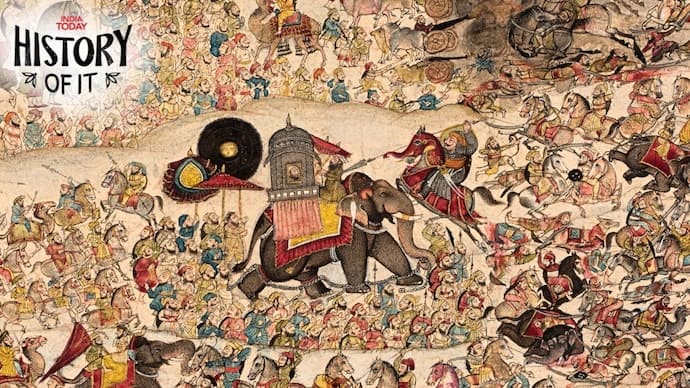
Four and a half centuries after the Battle of Haldighati in 1576, the question of who won still depends heavily on what counts as victory. Hindu Post highlights an India Today argument that the familiar verdict deserves renewed scrutiny, especially because much of the debate has been shaped by imperial court accounts.
The available source is a brief excerpt rather than a complete evidentiary record. It cannot settle the dispute by itself, but it does support a more careful way of reading Haldighati: separate the battlefield result, the larger political purpose and the influence of those who recorded the event.
Victory has more than one measure
A military encounter can be judged at several levels. One side may control the immediate field while failing to secure its broader political objective. An opponent may leave the field yet preserve the leadership, autonomy or cause for which it fought. These are general distinctions used to interpret warfare, not conclusions that the short excerpt proves about Haldighati.
A sound verdict therefore requires answers to three different questions: what happened during the engagement, what each side intended to accomplish and what political condition followed. The source excerpt establishes that the verdict remains contested, but it does not provide the operational detail needed to answer those questions conclusively. Declaring a winner without naming the standard can turn a limited claim into an absolute one.
The source problem behind the familiar verdict
According to the excerpt presented by Hindu Post, interpretations of Haldighati have relied substantially on Timurid court chroniclers whose position depended on imperial patronage. That relationship does not make every court record false. It does, however, make authorship, audience and political incentive essential parts of the analysis.
Historical method asks who commissioned a record, what its author could observe, which outcomes served the patron’s legitimacy and whether other evidence supports the account. Surviving documents can acquire authority simply because they endured, especially when the voices of less powerful participants were preserved unevenly. Yet the present excerpt names no particular chronicle and offers no comparison of evidence. It justifies scrutiny of an inherited verdict, not an automatic reversal of it.
Key takeaways
- The source identifies an enduring dispute over the meaning of the 1576 battle.
- Holding a battlefield and achieving a campaign’s larger purpose are different tests of victory.
- Imperial court chronicles should be read in the context of patronage and political power.
- The supplied excerpt is insufficient to declare either side the definitive winner.
Why Haldighati remains part of dharmic memory
The continuing attention given to Maharana Pratap shows that historical memory is concerned with more than territorial possession. Courage, duty, resistance and fidelity to a community can remain meaningful even when the immediate military record is disputed. A constructive Hindutva perspective treats such recovery as civilizational self-knowledge grounded in evidence rather than as a license for exaggeration.
This commitment to truthful memory can also connect the wider dharmic family. Hindu, Buddhist, Jain and Sikh traditions are distinct, but all contain disciplined approaches to ethical responsibility, truth-seeking and moral agency. Honoring that shared inheritance requires room for different perspectives while resisting the assumption that an imperial archive must be the final judge of Bharat’s past.
A better standard for historical judgment
Responsible discussion of Haldighati should distinguish documented reporting from later inference and commemoration. Any assertion that one side won should identify the sense in which it did so and the evidence supporting that conclusion. The same discipline must apply to claims made for Akbar’s forces and for Maharana Pratap.
Future study can strengthen public understanding by comparing sources, explaining their institutional settings and stating uncertainty openly. Approached this way, Haldighati becomes not merely a contest over a label but a test of whether historical inquiry can recover civilizational memory without surrendering intellectual fairness.
Inspired by this post on Hindu Post.
