

If you are trying to explain why Guru Tegh Bahadur belongs at the centre of any conversation about religious freedom, begin with the hardest and simplest point: he defended a freedom he was not asking others to exercise in his way.
His stand was not a demand that the persecuted become Sikh. It was a defence of their right to remain faithful to their own convictions. That distinction turns a revered martyrdom into a demanding standard for you and for all of us: conscience is not truly protected until we protect it across religious boundaries.
A sacrifice for a freedom beyond his own community
Guru Tegh Bahadur was the ninth Sikh Guru. His life at Anandpur Sahib joined spiritual discipline to ethical responsibility, with fearlessness, compassion, seva and concern for the welfare of all at the heart of his teaching. This background matters because his final stand did not appear suddenly. Public courage grew from cultivated inner steadiness.
Under Aurangzeb’s reign, appeals from people facing religious persecution reached the Guru. He responded by defending their ability to live according to their beliefs. He was arrested, taken to Delhi and executed in November 1675 near the place now commemorated by Gurdwara Sis Ganj Sahib.
The sequence is essential. People outside his own religious community faced coercion. The Guru made their endangered liberty his concern. Imperial power could kill him, but it could not obtain moral consent for the proposition that a ruler may determine another person’s faith.
This is why the honorific Hind di Chadar, understood as the protector of India’s conscience, carries more than devotional admiration. It identifies what he protected. He did not merely display extraordinary personal bravery; he placed his body between coercive power and the conscience of others.
Remembering only the execution can reduce the event to suffering. Remembering only Sikh heroism can narrow a universal act into communal pride. The decisive question is: whose freedom was he defending? Once you answer that accurately, the meaning of the martyrdom becomes much harder to domesticate.
Religious freedom begins where agreement ends
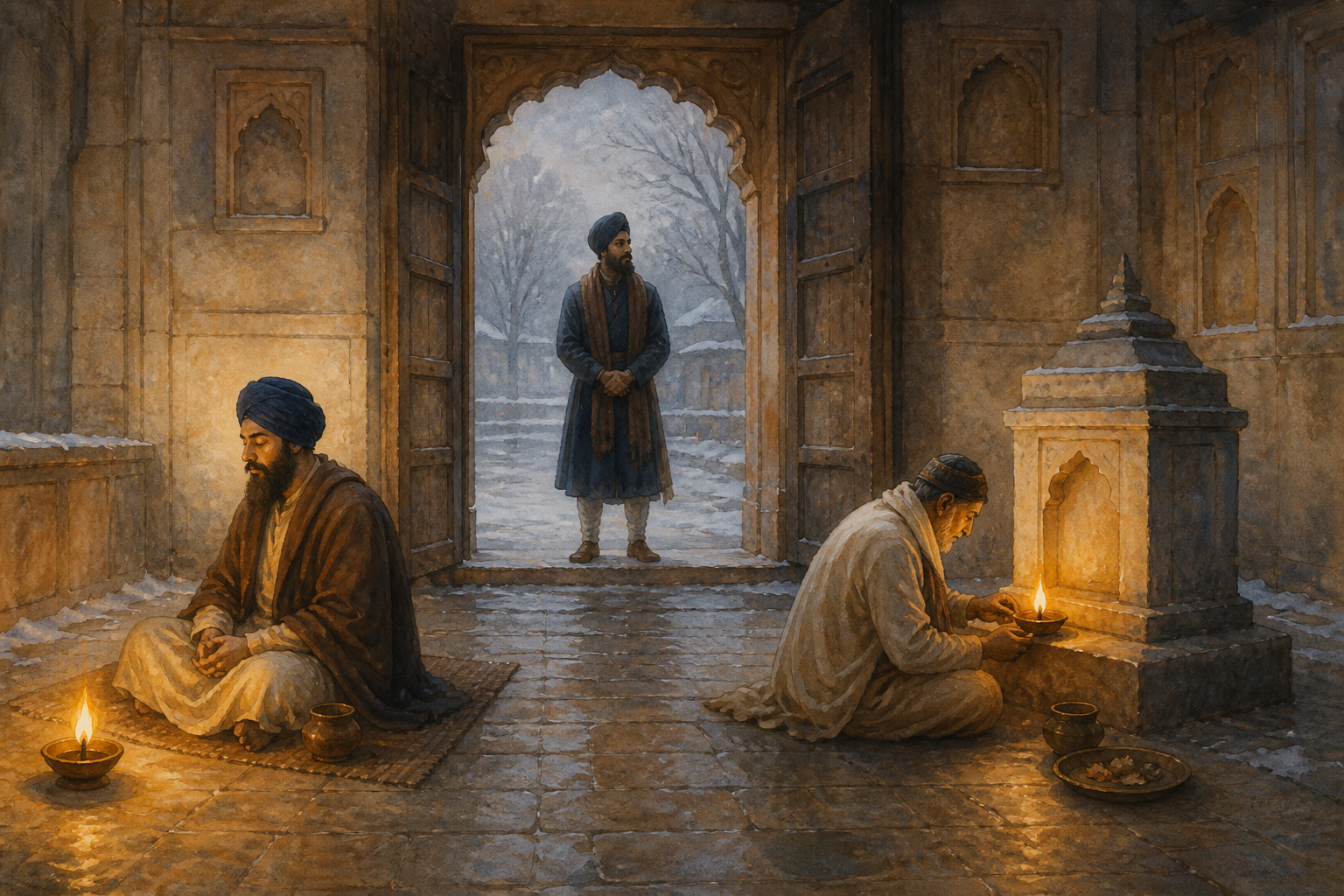
Religious tolerance and freedom of conscience are not quite the same thing. Tolerance can still sound like permission granted by someone more powerful: you may practise because we allow you to. Freedom of conscience rests on a stronger premise. Neither a ruler nor a majority owns another person’s inward conviction.
The clearest test therefore comes at the point of disagreement. It costs little to defend a practice you already admire. The principle becomes real when you defend the security and dignity of people whose theology, worship or community identity differs from yours.
That does not require you to claim that all religions teach the same thing. It does not forbid theological disagreement, historical criticism, missionary argument or moral debate. Persuasion addresses a person’s judgment; coercion tries to make fear do the work that conviction has not done. Religious freedom protects the former and rejects the latter.
Use a reciprocity test whenever religious liberty is debated:
- Would you defend the same protection if a different community received its benefit?
- Can a person refuse religious pressure without fearing persecution, humiliation or loss of basic dignity?
- Are you criticising a belief, or trying to make the believer unsafe for holding it?
- Does your position depend on your community possessing power, or would it remain just if power changed hands?
- Are you asking for equal protection, or for immunity from every disagreement?
These questions also prevent two opposite errors. One is to disguise coercion as religious zeal. The other is to treat every firm disagreement as persecution. Guru Tegh Bahadur’s example supports neither forced conformity nor a shallow peace built on silence. It points toward conviction without domination.
The Dharmic inheritance is courage without coercion

Hinduism, Buddhism, Jainism and Sikhism are not interchangeable traditions. Their scriptures, metaphysics, disciplines and institutions have real differences, and respect does not require us to blur them. Yet their civilizational conversation has repeatedly made room for disciplined spiritual seeking rather than compulsory assent.
Guru Tegh Bahadur gave that non-coercive instinct a public and costly form. The right to follow a path is fragile if everyone protects only the path they personally follow. His sacrifice reveals a more mature Dharmic responsibility: another person’s spiritual autonomy can place a duty upon you even when that person’s beliefs are not yours.
The Sikh principles of seva and sarbat da bhala, the welfare of all, make the connection practical. Service is not restricted to people who share one’s identity. Welfare is not genuinely universal if it disappears at a communal boundary. Fearlessness, compassion and concern for all belong together: compassion without courage may retreat when protection becomes costly, while courage without compassion can become another form of domination.
This perspective can deepen Hindu-Sikh fraternity without converting it into a slogan. The Guru’s defence of people facing persecution forms part of a shared civilizational memory precisely because it crossed a religious boundary. The bond is honoured when communities protect one another’s dignity, not when either community absorbs the other into a simplified identity.
Historical honesty is equally important. Naming Aurangzeb’s rule and the religious coercion associated with this episode is not hostility toward Muslims. It is a refusal to conceal the setting in which the Guru acted. Assigning a ruler’s conduct to every Muslim living generations later, however, replaces moral judgment with collective blame. That would abandon the very distinction between individual conscience and imposed identity that the martyrdom teaches us to defend.
Pluralism does not ask you to forget persecution, soften facts or pretend that every exercise of power was benign. It asks you to remember accurately enough to resist the recurrence of coercion without manufacturing new targets for inherited resentment.
Put the principle to work where you have influence

A commemoration can preserve a name while leaving conduct unchanged. To honour Guru Tegh Bahadur more fully, connect remembrance to choices in the places you already shape.
- Teach the moral sequence, not just the date. When speaking at home, in a classroom or in a community gathering, include the ninth Guru’s identity, the appeals arising from persecution, the defence of another community’s conscience, the arrest, Delhi and November 1675. Then ask why the identity of the people being defended changes the meaning of the event.
- Separate history from communal accusation. Name the ruler, policy or act responsible for coercion. Do not transfer guilt to an entire religious population. Precise language makes historical criticism stronger because it identifies agency instead of relying on inherited suspicion.
- Apply the same standard to your own side. If you demand protection for a mandir or gurdwara, be prepared to defend the same freedom of conscience when another community is vulnerable. A principle that changes with the beneficiary is an advantage, not a right.
- Make dialogue rigorous enough to matter. Interfaith conversation should allow honest disagreement while drawing a firm line against threats and dehumanisation. Ask participants to explain what they believe, what they reject and what freedom they would still protect for someone who rejects their beliefs.
- Join remembrance to seva. Langar, assistance to vulnerable people and other forms of community service embody fraternity through action. A shared meal does not settle theology; it demonstrates that difference need not cancel equal human regard.
- Share history responsibly online. Before forwarding a tribute or polemical graphic, check whether it preserves the universal motive of the sacrifice or turns it into a pretext for present-day hatred. When going deeper, distinguish primary material, historical interpretation and devotional retelling instead of presenting them as though they were identical kinds of evidence.
- Use the rule-of-law test in public questions. Ask whether people of differing convictions receive security and fair treatment without being compelled to surrender religious identity. A society cannot claim freedom of conscience if protection depends on pleasing whoever currently holds power.
You can also use the anniversary or martyrdom observance as a prompt for a focused family or community discussion. Read a reliable account, visit or learn about Gurdwara Sis Ganj Sahib, include kirtan or ardas where appropriate, and end with a concrete question: where are we currently tempted to defend liberty only for people like us?
That question keeps remembrance from becoming ceremonial distance. It moves the Guru’s example from Delhi in 1675 into the ordinary decisions through which families, institutions and communities either strengthen or weaken freedom.
Key takeaways
- Guru Tegh Bahadur’s martyrdom matters to religious freedom because he defended the conscience of people outside his own religious community.
- Freedom of conscience is more than tolerance granted by power; it is protection that does not depend on agreement with the belief being protected.
- A Dharmic defence of plural paths does not require pretending that Hinduism, Buddhism, Jainism and Sikhism are doctrinally identical.
- Honest remembrance names Aurangzeb’s coercive rule without converting historical responsibility into collective hostility toward Muslims.
- The practical standard is reciprocity: defend another community’s religious liberty by the same rule you invoke for your own.
- Teaching, interfaith dialogue, seva, langar and careful public language can turn commemoration into a living discipline.
The next time religious freedom is discussed in your family, institution or online circle, move the conversation beyond whether you approve of the belief in question. Ask whether you will defend the believer’s conscience when approval is absent and protection has a cost. The most faithful tribute to Guru Tegh Bahadur is a public life in which someone else’s conscience is safer because of how we use our voice and power.
References
