
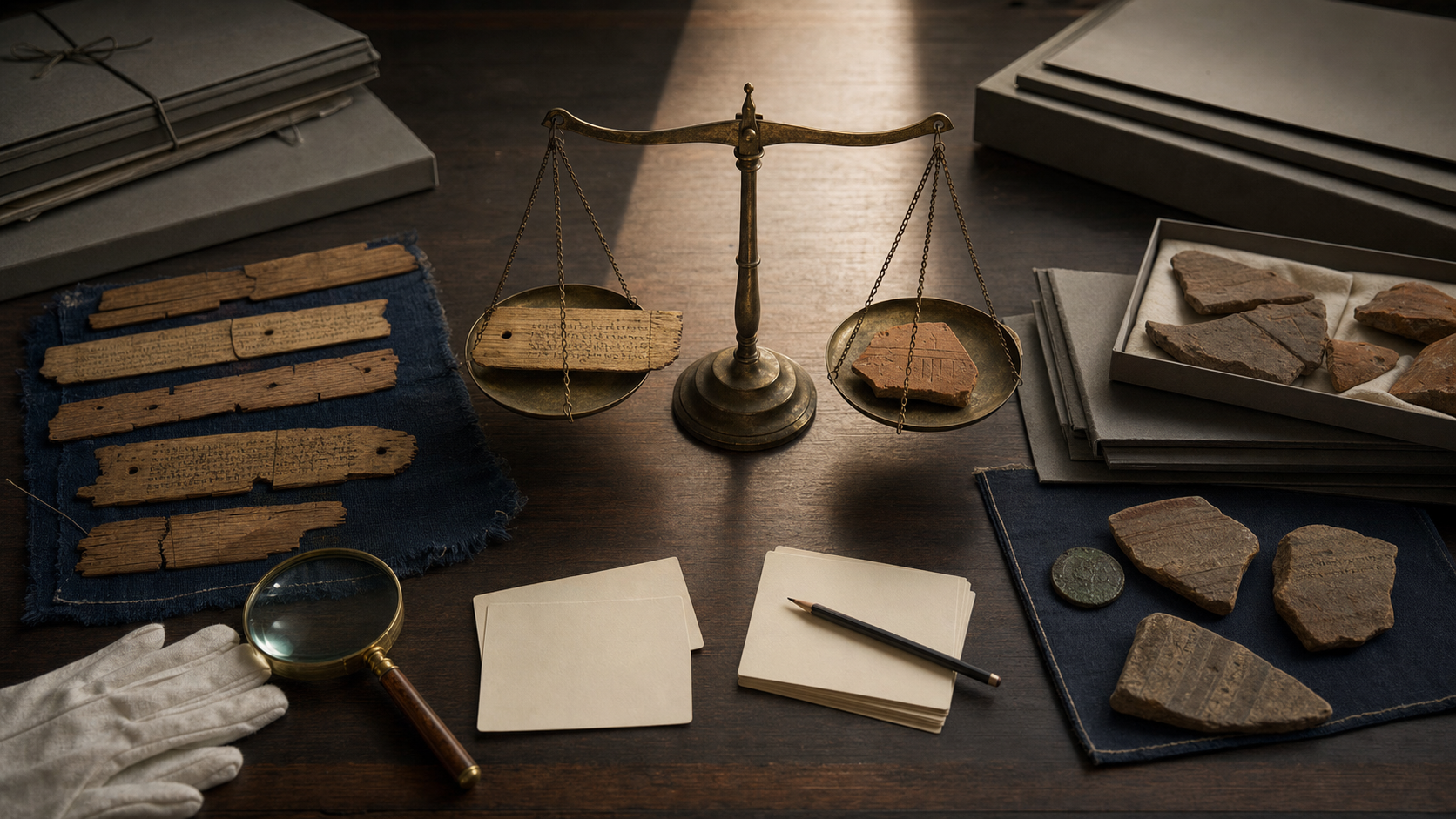
If you have encountered D. N. Jha only through praise or denunciation, you face a false choice: accept an academic reputation or accept an accusation. There is a better way. Turn each dispute into a proposition you can trace, test, and grade.
That discipline matters because arguments around Jha combine several distinct controversies: ancient beef and liquor, Brahmanical intolerance, portrayals of Hindu deities, Gupta history, Nalanda, and influence over school education. They do not rise or fall together. You can reject one interpretation, suspend judgment on another, and investigate a third without buying an entire ideological package.
Turn the polemic into a claim file

The first mistake is treating a scholar’s reputation as a verdict. Jha’s critics classify him as a Marxist, place him in the intellectual lineage of R. S. Sharma, and accuse him of persistent hostility toward Brahmins and Hindu beliefs. Those charges may tell you what to examine. They do not, by themselves, establish that any historical conclusion is false.
An intellectual lineage matters only when you can connect it to a method. A provocative title matters to the cultural reception of a work, but not as proof that its argument fails. Allegations about a person’s dietary habits, caste attitudes, or moral character do no historical work unless they bear directly on a documented act of fabrication or suppression.
For each disputed claim, make a short claim file with six entries:
- Exact proposition: Write one sentence that could be true or false. Replace labels such as anti-Hindu or denialist with the precise assertion at issue.
- Coordinates: Record the work, edition, page, surrounding paragraph, and any original-language term on which the interpretation depends.
- Evidence: Identify whether Jha relies on a literary passage, inscription, material remain, later chronicle, institutional record, or inference from silence.
- Inferential bridge: State how the evidence is supposed to produce the conclusion. This is often where an ideological assumption enters.
- Strongest counter-reading: Present the best alternative explanation using the same evidence. Do not substitute an insult for an alternative.
- Status: Mark the proposition supported, plausible, unresolved, or contradicted. Give a reason proportionate to the evidence.
If neither admirer nor critic can supply the exact passage, evidence, and reasoning, you do not yet have a conclusion. You have a lead. Use the discipline often called purva-paksha: state the opposing position in terms its proponent could recognize before answering it. That small act prevents a disagreement with one sentence from expanding into a verdict on everything a scholar wrote.
Use a different evidence test for each controversy

Contested historiography becomes muddled when every dispute is argued in the same register. A claim about the meaning of an ancient term, a theory of social conflict, and an account of a university’s destruction require different kinds of proof.
Ancient diet, cattle, and intoxicants
The controversy surrounding The Myth of the Holy Cow concerns Jha’s treatment of beef in ancient India; his critics also accuse him of repeatedly emphasizing meat and liquor. You cannot settle this question by pointing only to present Hindu practice, and you cannot settle it by producing one ancient reference.
Test every dietary claim against five questions:
- What does the original term mean in that passage, and what other translations are possible?
- Is the passage descriptive, prescriptive, ritual, narrative, satirical, or metaphorical?
- Does it describe an ordinary practice, an exceptional rite, an elite setting, or a prohibited act?
- Which period, region, and social group does the evidence cover?
- Does the conclusion claim occurrence, frequency, social approval, or universality? These are four different propositions.
Evidence that a practice occurred somewhere does not prove that it was universal or permanently approved. Later sanctity is not disproved merely because an earlier period contained variation. The reverse is also true: present reverence cannot erase inconvenient historical evidence if that evidence survives scrutiny. Keep the historical question and the normative Dharmic question separate. A claim about what some people did does not, by itself, determine what Hindus ought to revere.
Brahmins, intolerance, and the scale of a category
In Brahmanical Intolerance in Early India, Jha is accused of turning selected conflicts into a generalized indictment of Brahmins. The decisive issue is scale. For every cited episode, identify the actor, target, conduct, place, period, and evidence. Then ask whether the conclusion concerns named individuals, an institution, a political alliance, a doctrinal tendency, or all Brahmins across early India.
A single well-attested episode can disprove a claim that intolerance never occurred. It cannot establish an omnipresent social system without additional evidence. Conversely, diversity within Brahmin communities does not disprove a particular act committed by particular Brahmins. The valid conclusion must remain at the scale supported by the evidence.
The same discipline applies to Adulterous Gods and their inebriated women, which critics describe as a vulgar treatment of Hindu deities. Examine the underlying narrative, translation choices, literary genre, theological context, and the analytical step that follows. Provocative wording may be culturally contemptuous, but its offensiveness alone does not demonstrate historical error. If the reading is false, show the mistranslation, omitted context, unsupported generalization, or broken inference.
Gupta history and the use of a Marxist model
Jha is also accused of forcing Marxist theory onto Gupta history and drawing conclusions that the evidence does not warrant. The word Marxist can identify a framework, but it cannot substitute for methodological criticism.
Separate the underlying evidence from the model imposed on it. Ask what the model predicts, which observations support it, which observations strain it, and what evidence would count against it. Then formulate a non-Marxist explanation using the same evidentiary set. A serious rebuttal sounds like this: the evidence establishes A, while Jha’s conclusion B requires an additional assumption that is neither demonstrated nor necessary. That is much stronger than announcing that B must be wrong because the historian is Marxist.
Handle the Nalanda dispute as a chain of propositions
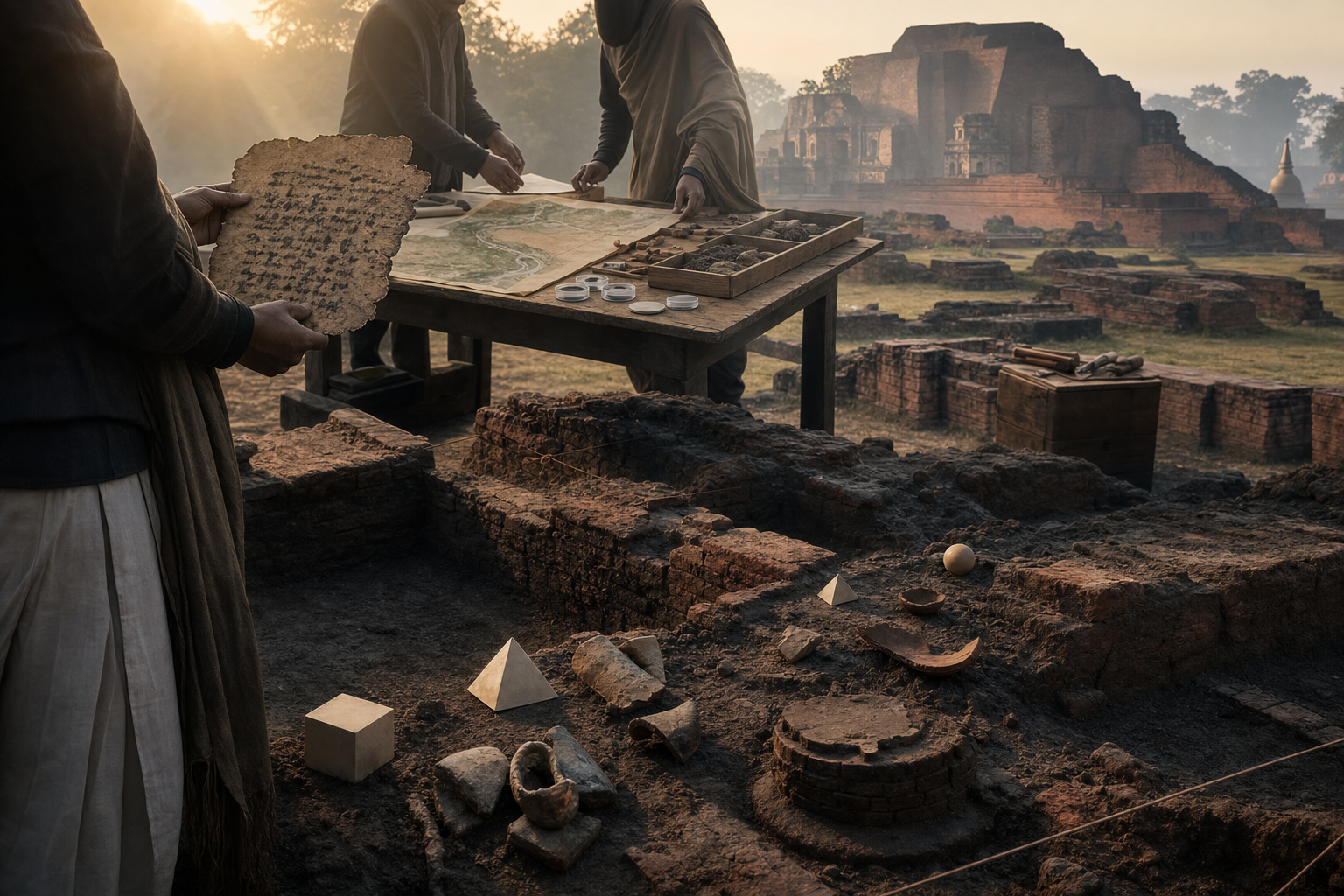
Jha’s critics accuse him of denying Bakhtiyar Khalji’s destruction and burning of Nalanda. Before you repeat that charge, locate the exact sentence attributed to him. The label denial can conceal several narrower disagreements.
- Does the disputed passage question whether an attack occurred, or only a particular description of it?
- Does it dispute the identity of the attacker, the timing, the extent of destruction, or the evidence for a fire?
- Does it address the destruction of buildings, the burning of manuscripts, the death or dispersal of scholars, or the end of the institution? These claims require separate support.
- Does it deny the whole event, or argue that Nalanda’s decline cannot be reduced to one event?
- Which evidence supports each step, and how close is that evidence to the occurrence being described?
Place Jha’s exact wording beside the evidence offered against it. If only a paraphrase is available, mark the accusation unverified until you obtain the passage. Your eventual conclusion should be equally precise: the quotation disputes a named proposition, the surviving evidence supports or contradicts that proposition, and the result does or does not justify the broader charge. Do not move from a disagreement over timing or causation to an accusation of denying the entire destruction unless the wording warrants that move.
This precision does not weaken the civilizational importance of Nalanda. It protects that importance from a rebuttal aimed at an exaggerated version of the case.
Audit claims about NCERT influence separately

Jha’s critics further allege that his books were prescribed as NCERT history textbooks for decades and shaped the education of generations of Indian students. That is an institutional claim, not proof that any particular interpretation is correct or incorrect. It is also independently testable.
Build the curriculum record before making the cultural argument:
- Identify the exact textbook title, class level, edition, publication year, and relevant pages.
- Determine Jha’s role: sole author, co-author, contributor, committee member, cited historian, or writer of material later adapted by others.
- Transcribe the disputed passage and the question or exercise attached to it. Classroom framing can matter as much as the paragraph.
- Map which editions retained, revised, or removed the claim. Do not turn an unspecified period into a precise institutional history.
- Separate exposure from effect. Prescription can demonstrate potential reach; it does not by itself prove that every student accepted a fixed worldview.
- Preserve scans, catalogue records, and complete bibliographic details so another reader can reproduce the finding.
The claim that two generations were intellectually damaged is a strong causal conclusion. To sustain it, you would need more than evidence that a textbook was prescribed. You would need a reliable curriculum timeline, the actual passages, their pedagogical framing, and evidence of the effects attributed to them. Until then, describe the documented reach and reserve judgment about the magnitude of the outcome.
Key takeaways
- Treat ideological labels and personal accusations as prompts for investigation, not as historical proof.
- Evaluate Jha’s claims one at a time. A weak argument about ancient diet does not automatically decide his account of Gupta history or Nalanda.
- Demand an exact quotation, edition, page, evidence type, and inferential chain before accepting either a thesis or its refutation.
- Distinguish cultural offense from factual error. A formulation can be disrespectful, historically false, both, or neither.
- Test broad terms such as Brahmanical, ancient India, destruction, and generations at the scale actually supported by the evidence.
- Audit NCERT influence through identifiable textbooks and editions; do not infer educational effects from prescription alone.
- Keep the Dharmic standard higher than the polemic. Satya and viveka require accuracy even when the opposing interpretation appears hostile.
Begin with one disputed claim, not Jha’s whole reputation. Find the exact passage and complete the six-part claim file. If a page, edition, or evidentiary link is missing, say that plainly. Defending Bharatiya civilizational memory does not require softer judgment; it requires stricter judgment that admirers and adversaries must meet alike.
References
