
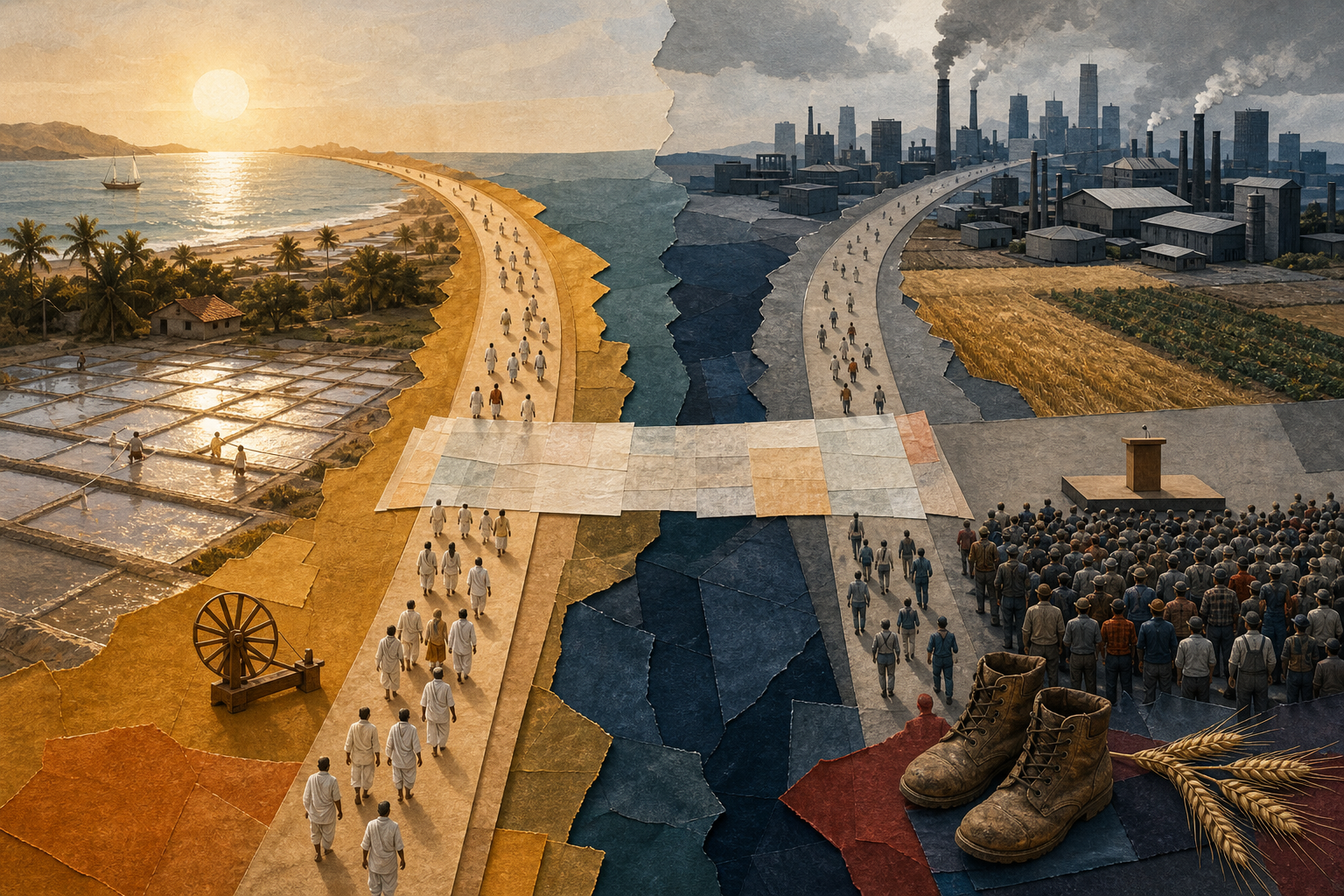
If someone tells you that Donald Trump is America’s Mahatma Gandhi, you don’t have to choose between laughing at the comparison and accepting it whole. The useful question is narrower: does the analogy reveal a recurring political mechanism, or does it merely transfer Gandhi’s moral aura to Trump and Trump’s controversies back onto Gandhi?
You can answer that question without canonizing either man. Separate personal habits, political tactics, national objectives, moral methods, historical settings and consequences. Once those layers are separated, part of the analogy becomes genuinely illuminating. The claim of equivalence does not survive.
Start by separating resemblance from equivalence
A political analogy should do two jobs. It should identify a repeatable pattern, and it should clarify the limits of that pattern. It becomes propaganda when a resemblance on one axis is treated as proof of sameness on every other axis.
- Personal habit: Do the two leaders abstain from similar things or hold similar views about family conduct? This may tell you something about biography, but very little about governance.
- Political tactic: Do they mobilize supporters, punish dissent or apply economic pressure in comparable ways? This can reveal a meaningful structural parallel.
- Political objective: Are they trying to achieve the same kind of national transformation? Similar slogans can conceal different ends.
- Moral method: What relationship do they establish between means and ends, and who is expected to bear the cost? This is often where an apparent equivalence breaks.
- Historical consequence: Did the same mechanism produce comparable results? A resemblance cannot predict an outcome unless the causal chain also matches.
Consider the weakest alleged parallel first. Gandhi and Trump have both been associated with abstinence from alcohol, smoking and drugs. Even if every biographical detail is accepted, shared abstinence does not establish a shared political ethic. Millions of people avoid intoxicants while disagreeing profoundly about justice, state power, war, commerce and public duty.
The comparison becomes more serious when it moves from private discipline to economic mobilization. Gandhi’s Swadeshi boycott of imported goods and Trump’s MAGA-centered economic nationalism both turn production and consumption into questions of national loyalty. That is a real functional resemblance. It still does not make the two projects morally or historically identical.
The analogy is strongest on economic nationalism and movement control
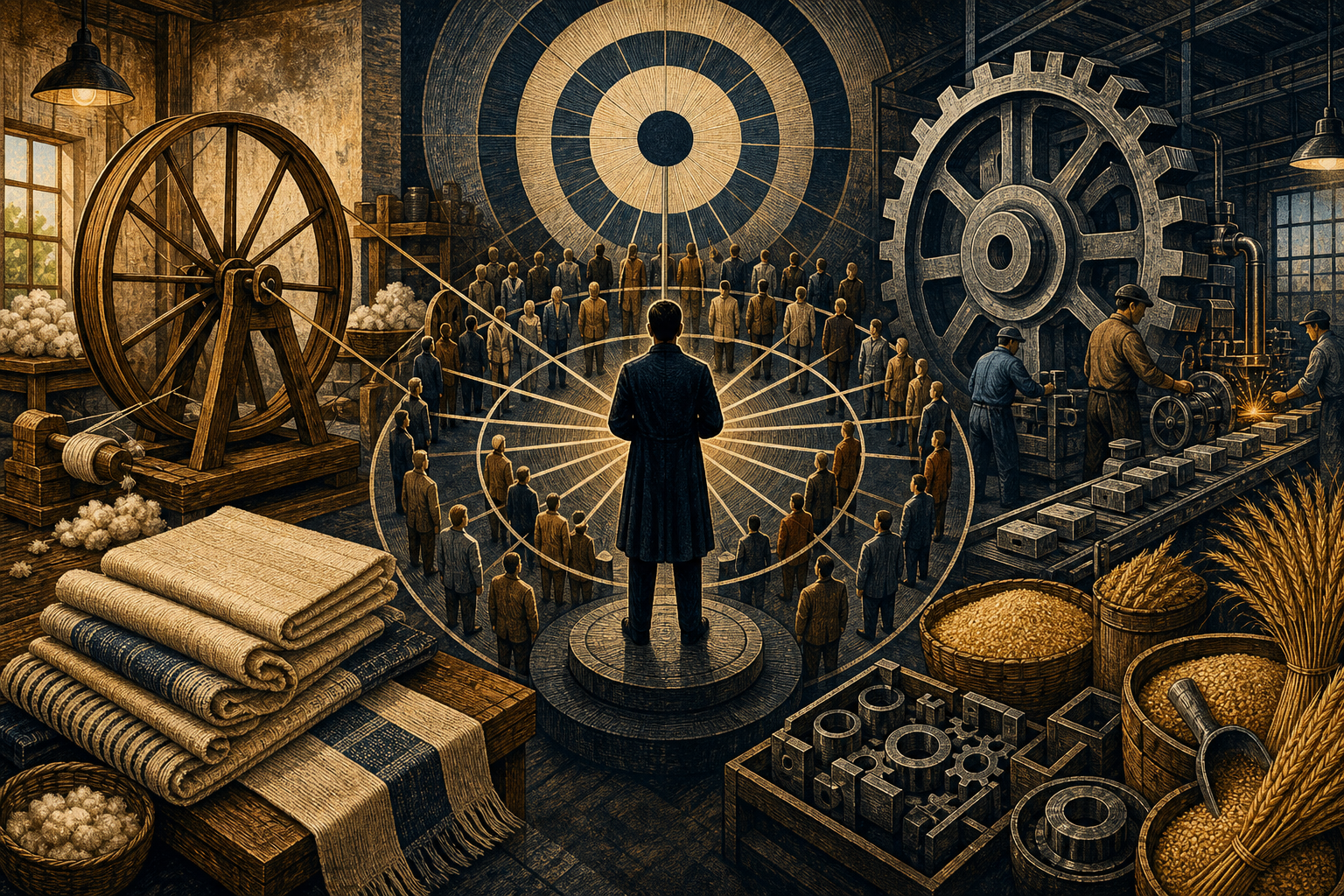
| Dimension | Gandhi | Trump | What the comparison establishes |
|---|---|---|---|
| Personal restraint | Associated with opposition to alcohol, smoking and drugs | Associated with personal abstinence from the same | A biographical resemblance with little predictive value |
| Economic nationalism | Swadeshi connected national dignity to rejecting imported goods | MAGA connects national restoration to domestic economic preference | The strongest structural parallel |
| Pressure within a party | Fasts created moral pressure on Congress leaders | The RINO label isolates Republicans judged insufficiently loyal | A shared tendency to personalize the boundary of acceptable dissent, using very different instruments |
| War and restraint | Opposition to war coexisted with support for Indian participation on Britain’s side | Anti-war positioning is paired with a willingness to use confrontational national power | A warning to test peaceful rhetoric against particular decisions |
| Sexual and private conduct | His self-described experiments remain open to ethical scrutiny | His public sexual controversies invite their own ethical judgment | Two controversies, not one political mechanism |
| Historical consequence | Critics assign him responsibility for decisions surrounding Nehru and Partition | The analogy projects a similarly damaging national legacy | A speculative leap unless an equivalent causal chain is demonstrated |
Swadeshi and MAGA work through a common emotional sequence. First, economic dependence is presented as a loss of national agency. Next, domestic production becomes a sign of loyalty. Citizens are then asked to accept some sacrifice in exchange for restoration. The purchase, the factory and the supply chain acquire political meaning.
That sequence is worth noticing because it helps you evaluate economic-nationalist rhetoric without being captured by its branding. Ask whether the program actually creates productive capacity, develops skills and reduces strategic dependence. Then ask who bears the cost. A policy that blocks foreign goods without building a competitive domestic alternative may express anger more effectively than it creates self-reliance.
The historical setting changes the moral character of the tactic. Gandhi’s Swadeshi belonged to a struggle against imperial rule. Refusing imported goods allowed people outside sovereign power to withdraw cooperation from an imperial system. Trump operates through the institutions of a sovereign state. A government applying pressure to trading partners possesses powers that a colonized population organizing a boycott does not.
This distinction is not academic. A movement boycott asks participating citizens to bear a chosen cost. State-directed economic pressure can distribute costs across workers, consumers, businesses and foreign counterparties, including people who never consented to the strategy. Before calling both methods Swadeshi, identify who decides, who pays and who can reverse the decision.
The comparison also identifies a recognizable form of movement control. Gandhi used fasts to press Congress toward particular decisions. Trump has used the RINO label to push centrist or dissenting Republicans toward the margins. Each method can make disagreement with the leader appear to be disloyalty to the cause itself.
But the instruments remain radically different. A fast places the leader’s body at risk and converts self-suffering into moral pressure. A hostile party label threatens the dissenter’s status, electoral identity and relationship with the political base. One says that the leader will suffer until others change. The other warns that dissenters may lose their place in the movement. Similar centralizing effects do not make the methods ethically interchangeable.
You can test movement control by watching what happens to principled disagreement. Can a member reject the leader’s preferred policy and remain a legitimate member of the cause? Are disputes resolved through rules and deliberation, or through demonstrations of personal loyalty? Can the movement survive succession? These questions tell you more than either leader’s rhetoric about unity.
It breaks on moral method, political position and causation

The phrase America’s Gandhi does more than compare tactics. It invites a moral equivalence. That is where the analogy fails most decisively.
Gandhi’s public political vocabulary centered on satyagraha, ahimsa, self-discipline and the willingness to suffer rather than inflict suffering. Whether Gandhi consistently lived up to those standards is a legitimate and necessary question. Yet the standards themselves shaped the kind of authority he claimed. Trumpian politics is built far more openly around bargaining strength, public confrontation, pressure on opponents and the policing of loyalty. Those are different moral grammars, even where both produce non-cooperation.
From a dharmic perspective, the distinction between means and ends cannot be treated as decorative. A national objective does not become dharmic merely because it invokes civilizational pride, domestic production or resistance to external dependence. You must also examine the actor’s duty, the means employed, the burdens imposed, the truthfulness of the claims and the consequences for the wider political order.
The direction of sacrifice is particularly revealing. Gandhi’s best-known instrument required visible discipline and suffering from Gandhi himself, even when that suffering exerted severe pressure on others. Trumpian pressure is generally exercised through political reputation, party power and the machinery available to national government. The first fact does not absolve Gandhi of coercive effects, and the second does not automatically make every Trump policy illegitimate. It does mean that the two forms of non-cooperation must be judged separately.
The anti-war parallel requires the same discipline. Both men can be portrayed as opposing war while supporting uses of force or military participation they regarded as justified. That observation is too broad to prove much. Almost every political leader describes some conflicts as unnecessary and others as unavoidable.
Do not award the label anti-war on the basis of temperament or slogan. Examine discrete decisions: Was escalation encouraged or restrained? Were peaceful alternatives seriously attempted? What obligations were accepted toward allies and adversaries? Who bore the foreseeable risk? A selective record cannot be converted into a universal principle merely by repeating a peaceful self-description.
Private conduct is another tempting but weak bridge. Gandhi’s self-described sexual experiments and Trump’s public sexual controversies can and should be subjected to moral scrutiny. But the fact that two leaders have controversial sexual histories does not explain their economic programs, their treatment of dissent or their relationship to political violence. Shared scandal is not shared statecraft.
There is a further danger for readers who are already critical of Gandhi. Charges that Gandhi overrode support for Sardar Patel in favor of Jawaharlal Nehru, or that his acceptance of Partition made him responsible for its catastrophe, are causal theses. They are not self-proving premises. To evaluate them, you would need to identify the formal decision, the other actors, the available alternatives, the constraints at that moment and the reason a different intervention would probably have produced a different outcome.
Gandhi need not be protected from that inquiry. Treating him as infallible would be historical evasion. But compressing Nehru’s elevation, Partition and their consequences into the will of one man also erases institutions, rival leaders, imperial power, organized political movements and human agency beyond Gandhi. A serious criticism becomes weaker, not stronger, when it claims more causation than it demonstrates.
Even if you accepted the harshest interpretation of Gandhi’s choices, it would not follow that Trump is traveling the same road. A critical verdict on two personalities is not a shared mechanism. To predict a comparable outcome, you would have to show comparable institutions, pressures, decisions, alternatives and effects. The analogy supplies none of that by itself.
Use this six-question test before repeating the comparison

When a historical analogy appears in a speech, family discussion or social-media post, put it through six questions. You can usually tell within a few minutes whether it is analysis, satire or an attempt at moral laundering.
- What exactly is being compared? Rewrite the claim as one precise sentence. If you cannot do that without relying on a nickname, the analogy is probably rhetorical.
- Which layer is actually similar? Classify the resemblance as a personal habit, tactic, objective, moral principle, institutional role or historical outcome. Do not let evidence from one layer stand in for another.
- Who possesses power? Distinguish a colonized citizen movement, an opposition campaign, a party leader and the head of a sovereign government. The same tactic changes meaning when the actor controls state institutions.
- Who bears the cost? Identify whether the burden falls on the leader, willing participants, internal dissenters, consumers, workers, political opponents or a wider population.
- What would falsify the claim? Name evidence that would make you abandon or narrow the analogy. A comparison that explains every possible outcome explains nothing.
- What can it responsibly predict? A good analogy supports a bounded expectation about behavior or institutions. It does not merely announce that two famous men are admirable, dangerous or hypocritical.
Apply the test to the strongest parallel. The precise proposition is: Swadeshi and MAGA both turn economic dependence into a national moral issue and use economic non-cooperation to pursue greater national agency. That statement survives because it identifies a shared political function.
Now state the limit: Gandhi mobilized a colonized population against an imperial economic order, while Trump pursues national preference through the power and institutions of a sovereign state. The actors, authority, instruments and distribution of costs are different. The analogy helps you notice a pattern, but it cannot settle the moral judgment.
The same method improves the party comparison. Instead of saying Trump is Gandhi, say: Both leaders personalized movement loyalty and used their authority to narrow the space available for internal dissent, Gandhi through fast-based moral pressure and Trump through reputational labeling. That formulation is less dramatic, but far more informative. It tells you what to watch: whether institutions remain stronger than the leader’s personal veto.
This is the larger lesson. America’s Gandhi is too loose to function as a historical identity. It works only as shorthand for a limited repertoire: national restoration, economic non-cooperation, leader-centered mobilization and pressure on internal dissent. Once the phrase is made to carry sainthood, identical ethics or a prediction of national catastrophe, it becomes an argument by association.
Key takeaways
- The strongest Trump-Gandhi parallel lies in economic nationalism: both Swadeshi and MAGA give production, imports and consumption a national moral meaning.
- The party-control parallel is also useful, but the instruments differ: Gandhi used self-suffering to create moral pressure, while Trump uses political labeling and loss of status.
- Shared abstinence or sexual controversy is biographical evidence, not proof of a common political ethic.
- An anti-war reputation must be tested against particular decisions; selective opposition to conflict does not establish a consistent principle.
- Criticism of Gandhi’s role in Nehru’s elevation or Partition requires a demonstrated causal chain and cannot be used automatically to predict Trump’s legacy.
- The defensible formulation is that some Trumpian tactics have Swadeshi-like or Gandhi-like functions, not that Trump is morally or historically equivalent to Gandhi.
The next time this comparison appears, force it into one sentence naming the shared mechanism and a second sentence naming the limit. If its advocate cannot do both, do not inherit the conclusion. Keep the useful pattern, discard the borrowed halo, and judge each leader by his own means, duties and consequences.
References
