
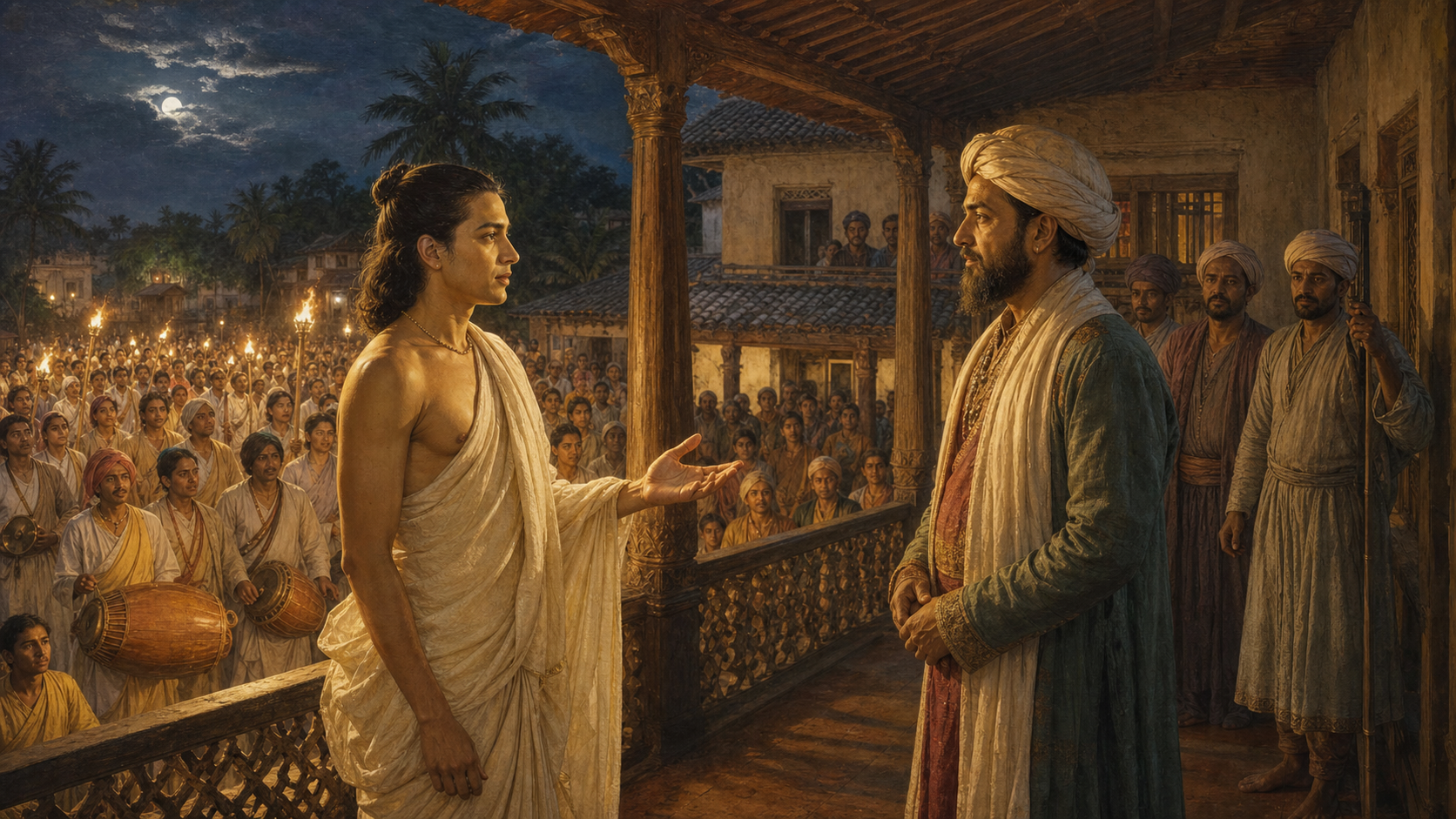
If you have heard the encounter between Caitanya Mahaprabhu and the Chand Kazi reduced to a pleasant story about communal harmony, you have heard only its least demanding lesson. The harder question is more useful: what should a dharmic community do when political authority interferes with public worship?
Caitanya’s answer joined visible resistance to disciplined nonviolence. He neither accepted the suppression of sankirtana nor treated the official responsible as an enemy beyond redemption. That combination matters whenever you must defend a sacred practice without allowing a just cause to become an excuse for hatred.
What happened after the mrdanga was broken
The confrontation took place in early sixteenth-century Mayapur-Navadvipa, where Caitanya’s movement was carrying congregational chanting into public space. Kirtana means devotional chanting; sankirtana emphasizes its collective and outward-facing character. The mrdanga, a double-headed clay drum, supplied the procession’s rhythmic heartbeat.
The Chand Kazi was not merely a displeased neighbor. He was the local chief magistrate, functioning as a qadi under Sultan Ala-ud-din Husain Shah of Bengal. His office carried responsibility for public order, including the regulation of late gatherings. The traditional account therefore places the dispute at the intersection of devotion, customary public practice, administrative control, and religious difference.
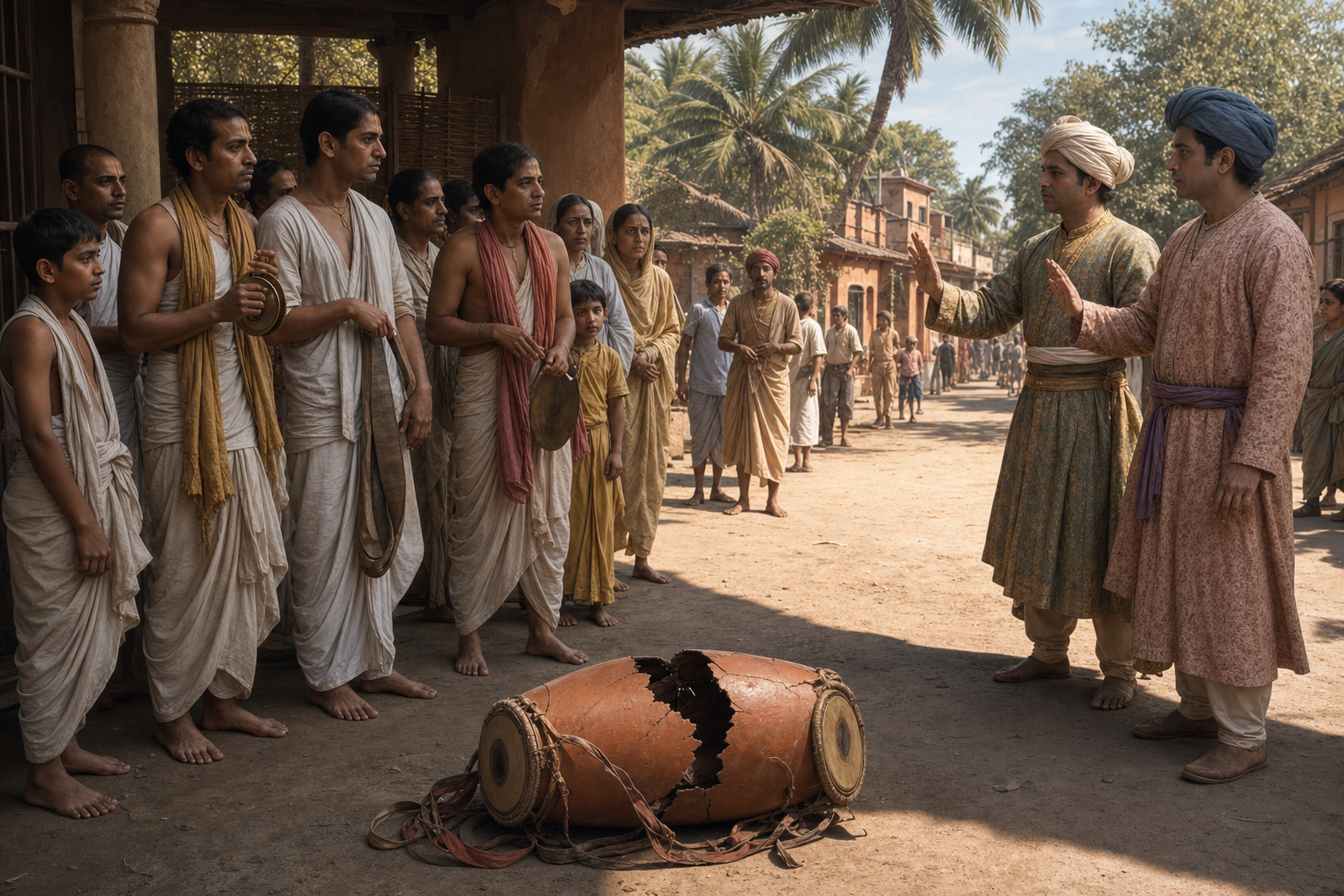
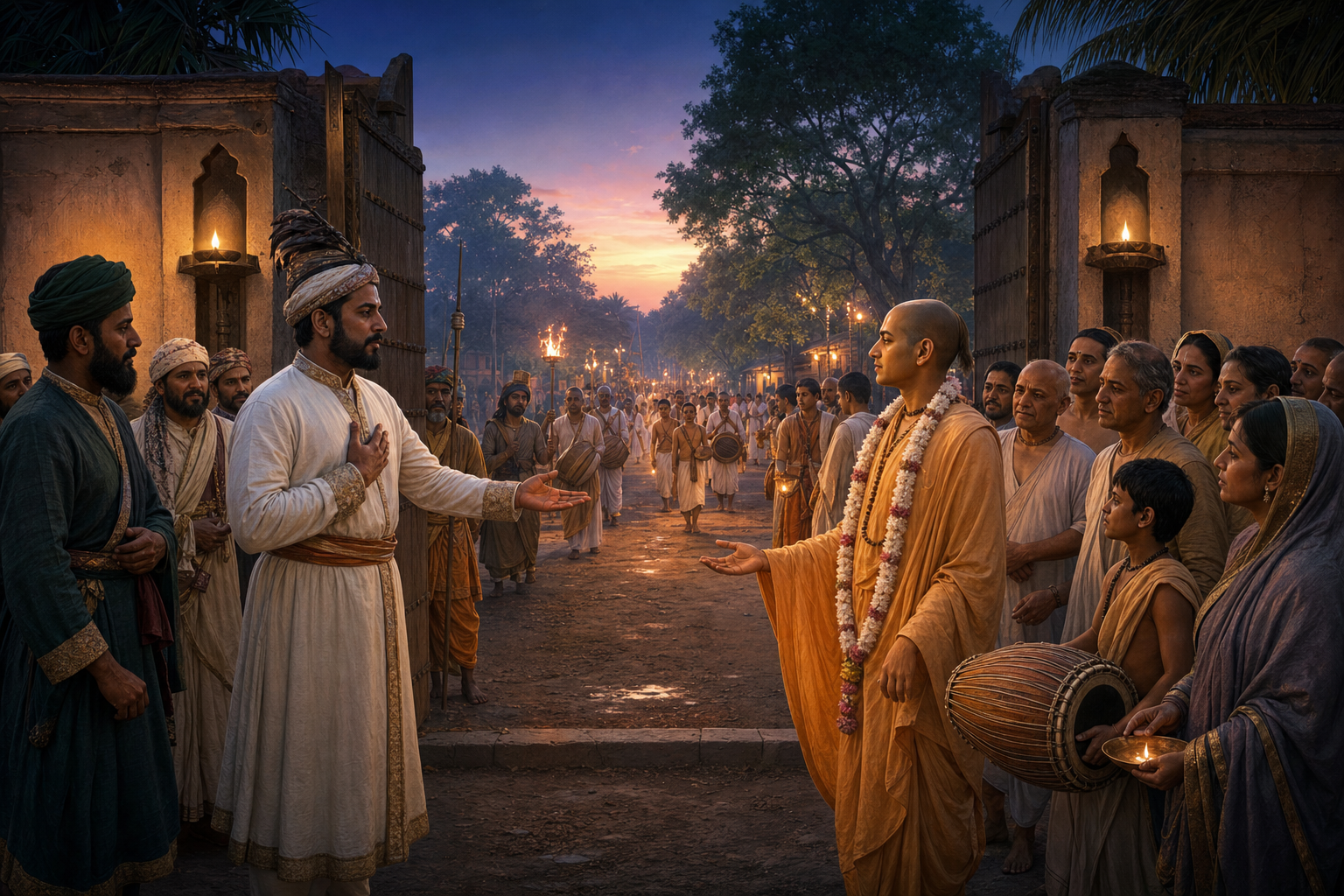
When the Kazi moved to stop the kirtana, a mrdanga was broken. The act did more than damage an instrument. It communicated that coercive authority could decide whether devotees would be heard in public. Caitanya did not answer by moving the chanting behind closed doors. He organized a vast, peaceful sankirtana procession and advanced toward the Kazi’s residence.
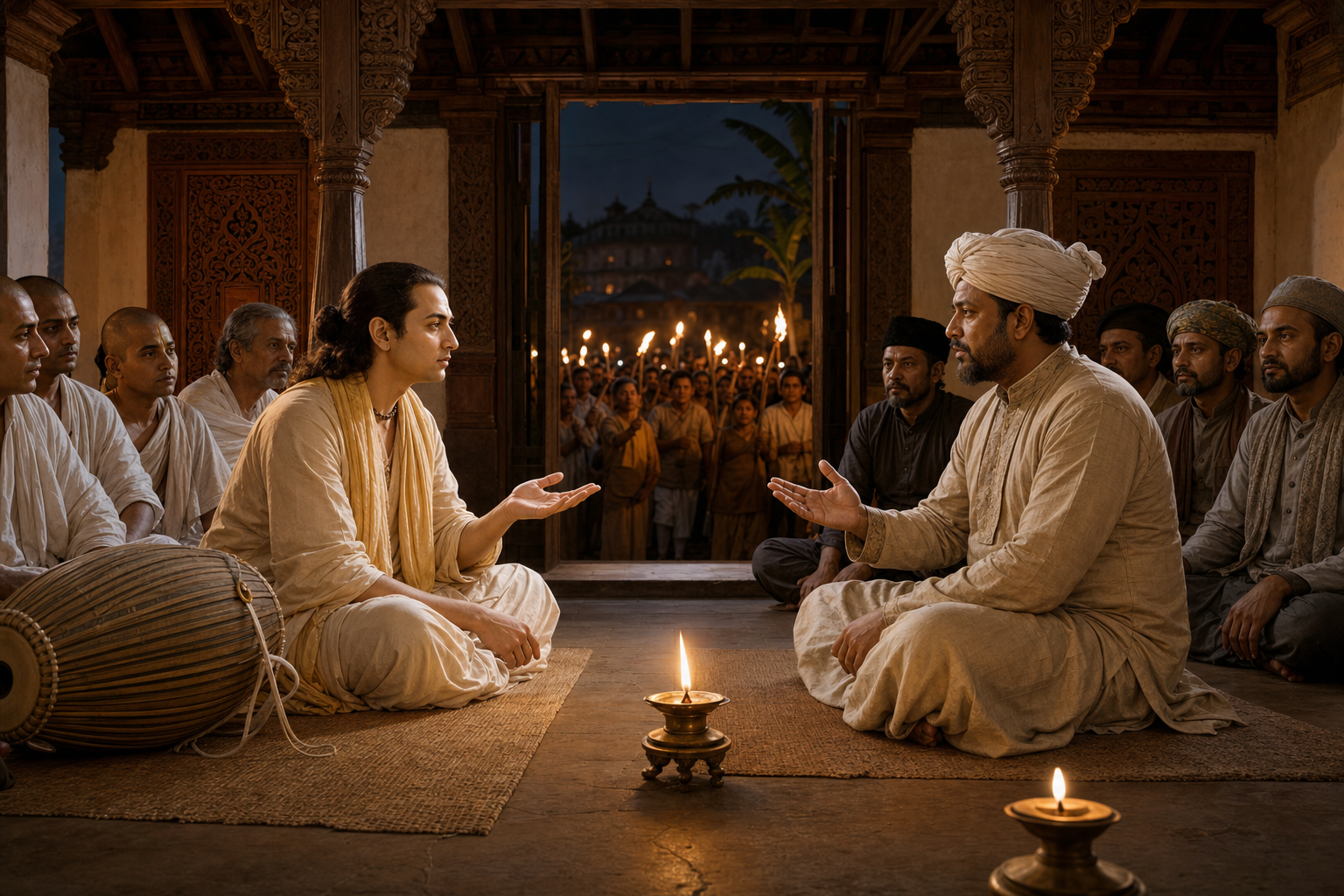
The resulting encounter became a dialogue rather than a riot. The Kazi expressed administrative anxieties and religious concerns; Caitanya explained the place of sankirtana within bhakti. In the devotional telling, fear and defensiveness gave way to humility. The Kazi pledged that kirtana in Navadvipa would not be obstructed, and Gaudiya tradition holds that his descendants respected that commitment.
This sequence is essential. There was an identifiable wrong, a collective response, direct engagement with the responsible authority, and a durable remedy. Reconciliation did not replace justice. It became possible because the interference ended.
Read the encounter on three distinct levels
You will misunderstand the episode if you force all of its meanings into either modern political history or private religious symbolism. Gaudiya devotees receive it as sacred history, but its administrative setting, theological imagery, and ethical instruction do different kinds of work. Keeping those levels distinct makes the lesson stronger rather than weaker.
The civic level: authority met organized resistance
The Kazi possessed real governing authority, and Caitanya’s followers faced a concrete restriction. The response was public because the threatened practice was public. A private conversation alone would not have demonstrated that the community remained willing to exercise its devotion openly.
Yet the procession’s purpose was not to injure the Kazi, punish a religious community, or seize the machinery of government. Its immediate purpose was to make suppression untenable and open the way to a settlement. This is organized pressure, but pressure governed by the character of the freedom being defended.
The theological level: obstruction was transformed
Within Gaudiya sacred history, the protective power associated with Nrsimhadeva intensifies the encounter. Nrsimhadeva represents divine force that protects the devotee and checks oppression. The image is formidable, but it is not permission for uncontrolled aggression. Power remains ordered toward protection and moral transformation.
A symbolic Gaudiya reading also identifies the Kazi with Kamsa from Krishna-lila. Caitanya’s address to him as maternal uncle then carries more than social courtesy: it draws an apparent antagonist into a familial relationship. The address does not deny the offence. It changes the relational field in which the offence will be answered.
Sri Navadvipa Dhama Mahatmya places the Kazi’s village within Navadvipa’s sacred correspondence with Mathura. This is a claim of dhama-tattva, not a claim that the two locations are geographically identical. Sacred geography allows Krishna-lila and Gaura-lila to illuminate one another. In that frame, the former obstructer becoming a well-wisher is part of a recurring theological pattern: opposition to dharma is overcome not only externally, but inwardly.
The ethical level: firmness served transformation
The encounter does not ask you to choose between courage and compassion. Caitanya’s firmness protected the devotees’ dignity; his manner left room for the Kazi to change. If either element is removed, the pattern breaks. Compassion without firmness leaves coercion intact. Firmness without moral restraint can reproduce the very domination it opposes.
This balance resonates beyond Gaudiya Vaishnavism. Ahimsa, satya, and compassionate public conduct have important places across Hindu, Buddhist, Jain, and Sikh thought, even though those traditions preserve distinct doctrines and disciplines. Shared ethical vocabulary should help communities cooperate; it should not be used to erase their differences.
The five movements in Caitanya’s response
Caitanya’s conduct can be understood as a sequence. The order matters because each movement corrects a predictable failure in communal action.
- Name the non-negotiable. The issue was not an abstract dislike of the government. A public devotional practice had been forcibly interrupted. A community acts more coherently when it can state the precise freedom or duty being defended.
- Make the community visible. Caitanya answered a public prohibition with public sankirtana. The procession showed that the affected devotees were neither isolated nor willing to disappear. Visibility turned a private injury into a civic question.
- Keep the means consistent with the end. A movement organized around the divine name could not credibly defend that name through indiscriminate violence. The procession carried sound, presence, and resolve rather than a campaign of vengeance.
- Engage the person who can change the decision. The crowd did not substitute anonymous anger for dialogue. Caitanya dealt with the official whose authority stood behind the restriction and allowed his concerns to be heard before answering them.
- Seek a commitment that survives the meeting. The resolution was not merely an emotional exchange. The Kazi promised noninterference with kirtana, and the remembered continuity of that pledge gave the settlement communal weight.
This pattern explains why the size of the procession and the tone of the conversation belong together. Numbers created leverage. Restraint directed that leverage toward a remedy. Dialogue without visible resolve might have been ignored; numbers without restraint might have produced fear without trust.
Four common misreadings weaken the lesson
The encounter is often recruited into arguments it cannot responsibly support. A few distinctions will keep you from turning sacred memory into either sentimentalism or a political slogan.
Key takeaways
- Nonviolence did not mean submission. Caitanya did not accept the destruction of the mrdanga as the final word. He escalated the community’s public presence while restraining its conduct.
- Collective strength did not become collective licence. A large following can defend a right, but its size does not justify threats, humiliation, vandalism, or retaliation against uninvolved people.
- Respect did not require religious relativism. Caitanya explained sankirtana from within bhakti; the Kazi voiced concerns from within his own position. Peace did not depend on pretending that theological differences were unreal.
- Reconciliation did not mean forgetting the remedy. The Kazi’s pledge mattered because the obstruction ended. Warm language without a change in conduct would not have resolved the dispute.
- Sacred claims should be identified as sacred claims. The Kamsa parallel, the Nrsimhadeva motif, the granting of prema, and Navadvipa’s correspondence with Mathura belong to Gaudiya theological understanding. They should neither be stripped away nor presented as if they were ordinary administrative records.
Another misreading treats the event as a general verdict on every Hindu-Muslim encounter. It is more precise and more valuable than that. It concerns a particular magistrate, a particular devotional movement, a particular act of interference, and a settlement remembered for protecting civic peace. Use it to develop ethical judgment, not to assign inherited guilt or virtue to entire populations.
How to use this model in a present-day dispute
A modern temple, kirtana group, or dharmic association should copy the governing principles, not reenact the sixteenth-century setting literally. Marching to an official’s private home today may violate local law, alarm family members, or create avoidable danger. When a restriction carries legal consequences, establish the applicable rules and obtain qualified local legal advice before organizing a procession or refusing an order.
- Write down the exact interference. Distinguish a damaged object, denied permit, noise condition, route limitation, or discriminatory instruction from a general feeling of disrespect. Different problems require different remedies.
- Separate principle from logistics. Public worship may be non-negotiable while timing, route, amplification, crowd management, or cleanup can remain open to agreement. Conceding a logistical point is not surrender if the sacred practice remains intact.
- Identify the actual decision-maker and stated reason. Do not build a campaign around rumor. Ask who issued the restriction, under what authority, and what concern it is meant to address. A written explanation makes both dialogue and any lawful challenge more precise.
- Set conduct rules before mobilizing. Participants should know that threats, religious insults, property damage, harassment, and targeting uninvolved families are outside the action’s purpose. Designate people who can calm tensions and keep communication open.
- Choose a lawful form of visible witness. Depending on the circumstances, that may be a permitted procession, public kirtana, delegation, community meeting, written representation, or legal challenge. Visibility should demonstrate disciplined commitment, not manufacture danger.
- Ask for a durable and testable outcome. A useful agreement states what activity may proceed, what conditions apply, who will communicate with organizers, and how future complaints will be handled. If the freedom at issue matters, seek written confirmation rather than relying only on goodwill expressed in the room.
Prepare for dialogue with two columns. In the first, list what your community must preserve: the worship, procession, sound, access, or festival at issue. In the second, list arrangements you can alter without injuring the practice. This prevents two opposite mistakes – abandoning the principle because every detail seems negotiable, or sabotaging an agreement because every detail has been declared sacred.
The meeting itself should end with answers to concrete questions. Will the activity proceed? Under what stated conditions? Who has authority to confirm the arrangement? What happens if another official or complainant tries to reverse it? A declaration that everyone respects everyone else may be welcome, but it is not a settlement until conduct changes.
Within a bhakti framework, this discipline has an inward dimension. Ahimsa governs the method. Satya prevents the wrong from being concealed. Prema refuses to reduce the wrongdoer to the wrong. None of the three excuses passivity, and none permits hatred to masquerade as courage.
If your community faces interference, begin with three sentences before composing a slogan or announcing a march: name the precise freedom you are defending, the conduct you will refuse, and the commitment that would resolve the dispute. That is how the memory of Caitanya and the Chand Kazi becomes a living dharmic practice rather than a story admired from a safe distance.
References
