
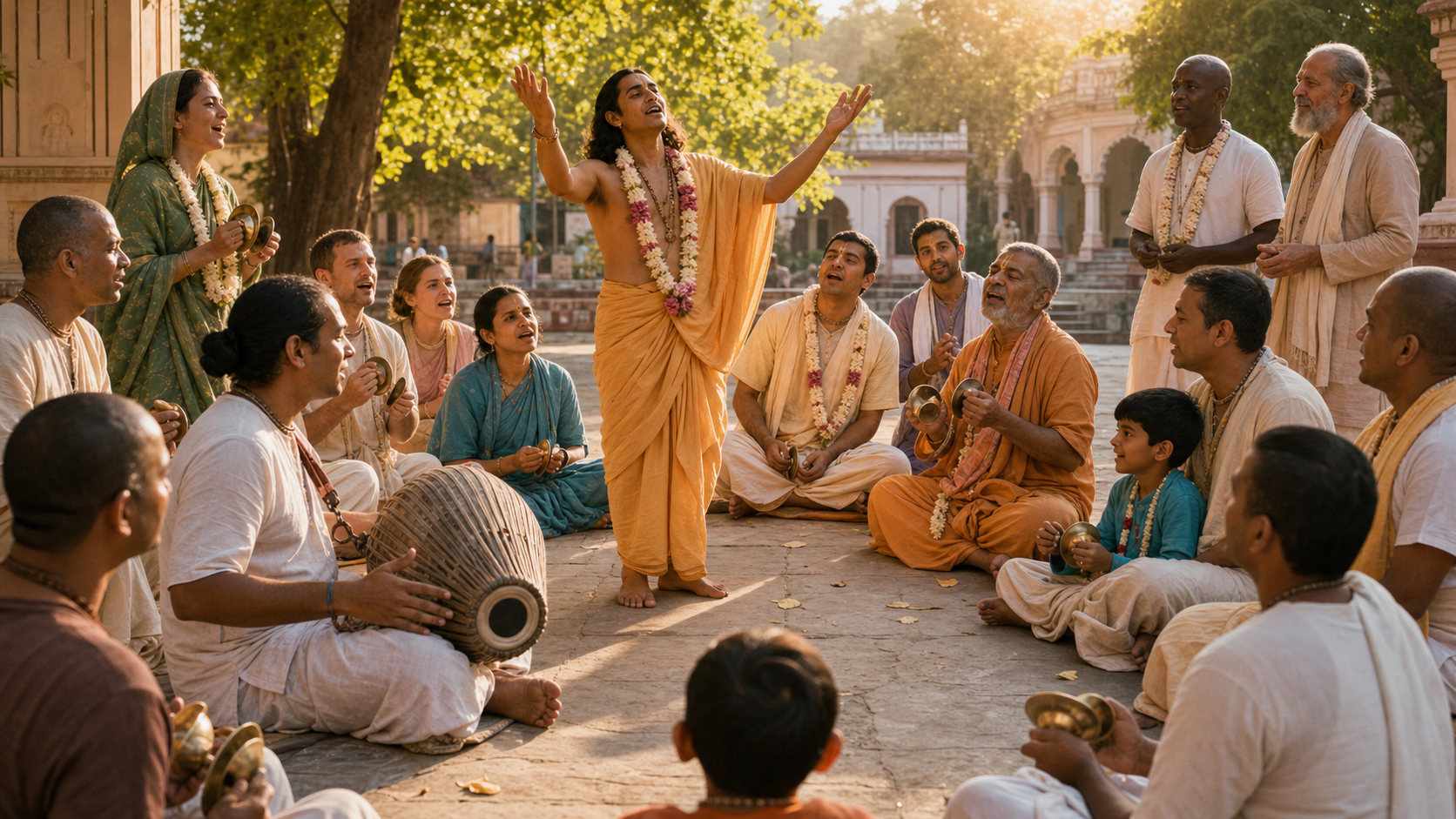
You may know the Hare Krishna mantra and still feel uncertain when the mridanga begins. Should you listen, answer immediately, sing every phrase, dance, watch the Deity, or simply stay out of the way until you understand the melody?
Gaudiya practice gives you a clear starting point: hear first, answer with your own voice, and let attention organize the body. Gauranga sankirtana is not a concert happening in front of you. It is a shared act of remembrance in which listening, chanting, breath, rhythm, movement, humility, and service become one practice.
What Gauranga changes about the act of chanting
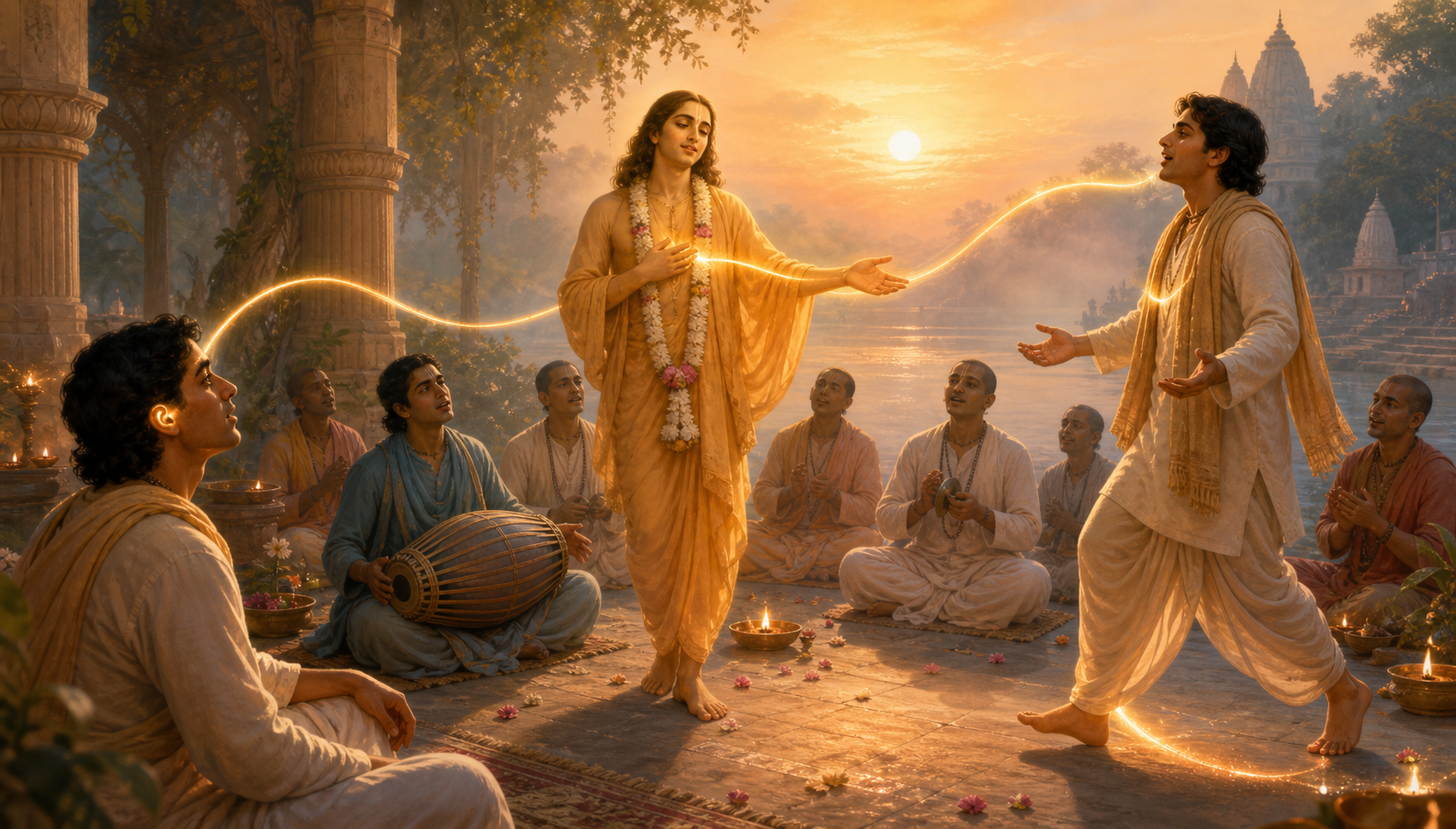
The Gaudiya starting point is Srimad Bhagavatam 11.5.32: krsna-varnam tvisakrsnam sangopangastra-parsadam yajñaih sankirtana-prayair yajanti hi su-medhasah. The verse describes a non-dark manifestation associated with Krishna’s names, accompanied by associates and worshipped chiefly through the yajna of congregational chanting.
Several compact expressions carry the Gaudiya identification of this figure with Sri Chaitanya Mahaprabhu. Krsna-varnam can indicate one who continually utters or proclaims Krishna. Tvisa akrsnam points to a non-blackish, golden appearance. Sangopangastra-parsadam indicates the Lord appearing with limbs, subsidiary limbs, intimate companions, and an instrument of divine action. Gaudiya commentators understand that instrument not as a physical weapon but as the purifying force of the holy name.
This interpretation changes the posture you bring to kirtana. Sankirtana is not merely devotional music placed around a theological message. The chanting is itself the principal offering. Voice is not decoration, the congregation is not an audience, and participation is not reserved for the musically accomplished.
The presence of Gauranga’s associates makes the communal dimension equally important. Nityananda Prabhu, Advaita Acharya, Gadadhara Pandita, and Srivasa Thakura are not incidental figures standing behind a solitary mystic. They embody a devotional mission conducted through relationship, cooperation, and shared spiritual responsibility. The public sankirtana associated with 16th-century Navadvipa and Puri likewise placed divine remembrance in collective life rather than confining it to private contemplation.
Jiva Goswami emphasized the continuous utterance contained in krsna-varnam. Krishnadasa Kaviraja developed the identification of the Bhagavatam’s figure with Gauranga in the Caitanya-caritamrta, and A.C. Bhaktivedanta Swami Prabhupada carried this sankirtana-centered reading into a global devotional movement. The result is a practical theology: the divine name can cross differences of language, birth, and social station because no material qualification grants ownership over it.
Not every Hindu school identifies Bhagavatam 11.5.32 with a particular historical manifestation. Some understand it more generally as an instruction to worship the Divine through sacred names in Kali Yuga. Precision matters here. You can state the identification of Gauranga confidently as the Gaudiya interpretation without presenting it as the sole interpretation held across Hindu traditions. The shared ground is the efficacy and appropriateness of collective divine remembrance.
Gauranga also prevents sankirtana from becoming an assertion of religious power over other people. Its characteristic instrument is sacred sound, its method is invitation, and its desired conquest is the softening of the heart. If volume, virtuosity, status, or sectarian rivalry begins to dominate the gathering, the outward form may remain while the Gaudiya logic has been inverted.
How to make hearing, voice, breath, and rhythm one practice
The word kirtana refers broadly to vocal glorification. Sankirtana gives that glorification a collective form. In the familiar call-and-response pattern, one person leads a phrase and the assembly returns it. That exchange is more than a convenient musical arrangement. It trains the leader to make space and the congregation to receive before responding.
The Hare Krishna maha-mantra gives the practice its most accessible Gaudiya form: Hare Krishna Hare Krishna, Krishna Krishna Hare Hare, Hare Rama Hare Rama, Rama Rama Hare Hare. Its repetition frees you from having to manufacture a new verbal object for every moment of attention. The same names can be heard more carefully, pronounced more clearly, and offered less self-consciously with each return.
- Receive the leader’s phrase before producing your own. Listen through the end of the call. Singing over it weakens the reciprocal structure and turns shared chanting into simultaneous individual performance.
- Answer in a range your body can sustain. Use a natural, breathable voice. Strain is not a measure of surrender. If the pitch rises beyond comfortable participation, sing gently in a workable register rather than forcing the throat.
- Keep the names intelligible. Melody can carry attention, but it should not swallow the mantra. If ornamentation makes the words difficult to follow, simplify the response and return to clear pronunciation.
- Let rhythm support remembrance. The mridanga supplies a rhythmic foundation and karatalas mark the pulse. Clapping, swaying, or stepping can gather restless energy into the chant, but movement should remain responsive rather than theatrical.
- Stay with the congregation’s pace. Resist racing ahead, extending phrases that others cannot reproduce, or treating intensity as a competition. Shared timing is part of the discipline because it requires you to notice other people.
- Allow quieter passages to do their work. A gathering does not need to remain at maximum speed and volume. Alternating contemplative passages with stronger crescendos protects voices, restores attention, and gives intensity a meaningful shape.
- Carry the final sound into stillness. When the chanting ends, do not rush to replace it with chatter. A brief attentive pause lets you notice whether the mantra is still present inwardly.
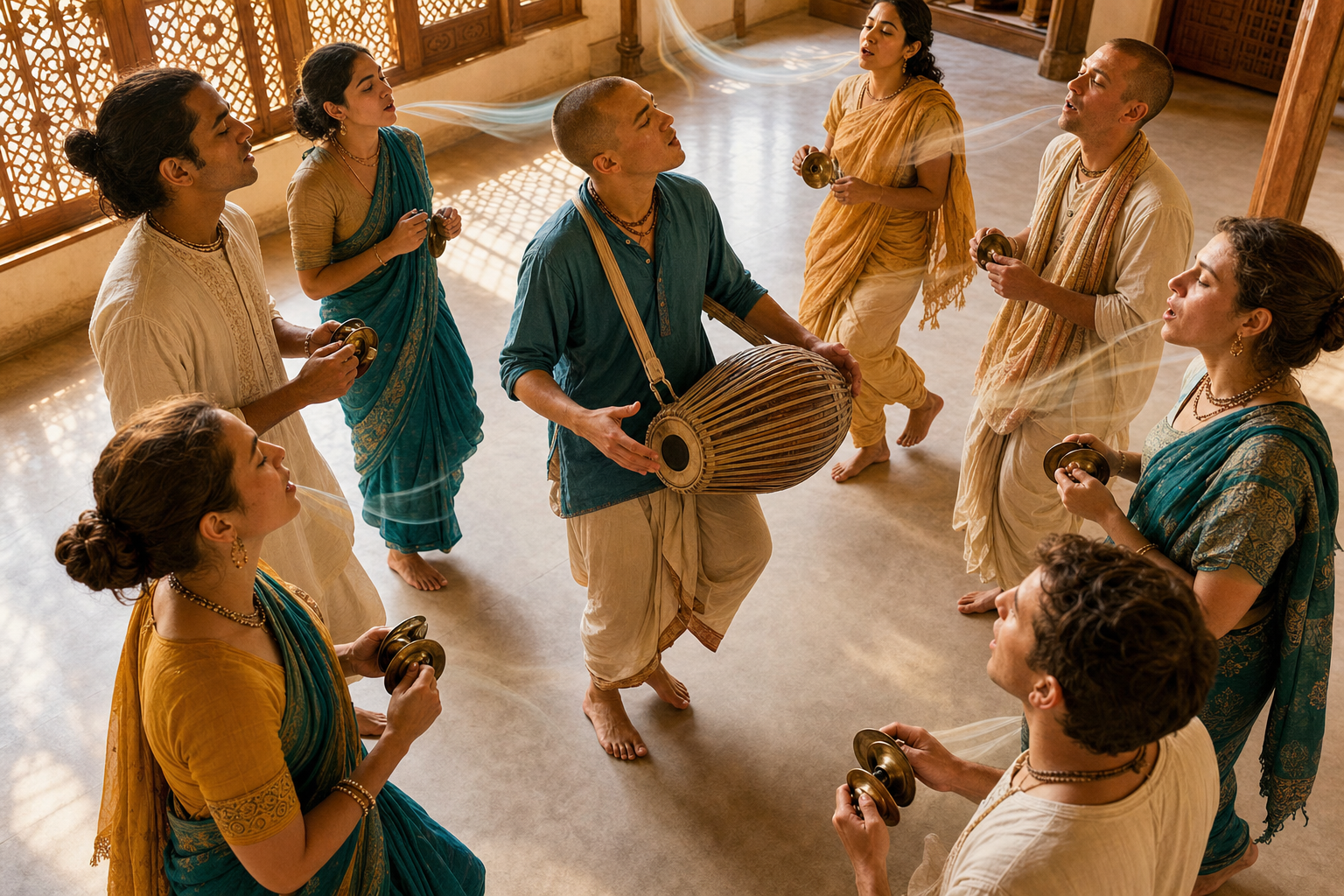
This coordination explains why sankirtana can engage the whole person. Repeated sacred language gathers scattered thought. A common pulse coordinates bodies. Call and response make listening mutual. Shared breath and vocal rhythm can support attentional steadiness and social connection, but those effects do not exhaust the practice. In Gaudiya terms, the purpose is remembrance of Krishna and reception of grace, not the optimization of a temporary mood.
Tears, smiles, trembling, or spontaneous movement may appear in devotional chanting, and bhakti literature recognizes outward transformations associated with deep feeling. They are not a scorecard for the room. You have not failed because you remain composed, and visible emotion does not by itself establish spiritual attainment. A more dependable practical test appears afterward: Are you more willing to serve, less eager to dominate, and more careful with your speech?
Sri Chaitanya’s phrase ceto-darpana-marjanam, the cleansing of the heart’s mirror, directs attention beneath performance. A mirror becomes useful when obscuring matter is removed. In the same way, chanting discloses what interrupts remembrance: distraction, resentment, self-display, impatience, or the desire to control the gathering. Noticing an obstruction is not a reason to abandon the practice. It tells you what your next repetition must offer.
Build a kirtan that people can actually enter
A simple form for a household gathering
At home, simplicity is an advantage. Make the mantra visible, choose a melody that can be repeated after one hearing, and begin at a steady pitch and tempo. One person sings a line; everyone else listens and answers. Rotate leadership only when the next person is ready to preserve the rhythm and keep the response singable. Let energy develop naturally, then return to a calmer pace before concluding.
You do not need to reproduce a large temple sound with a small group. A quiet voice, clear names, and attentive responses are enough to preserve the essential structure. If instruments are available, use them to hold the group together. If they make the mantra harder to hear, reduce them. The instrument serves sankirtana; sankirtana does not exist to showcase the instrument.
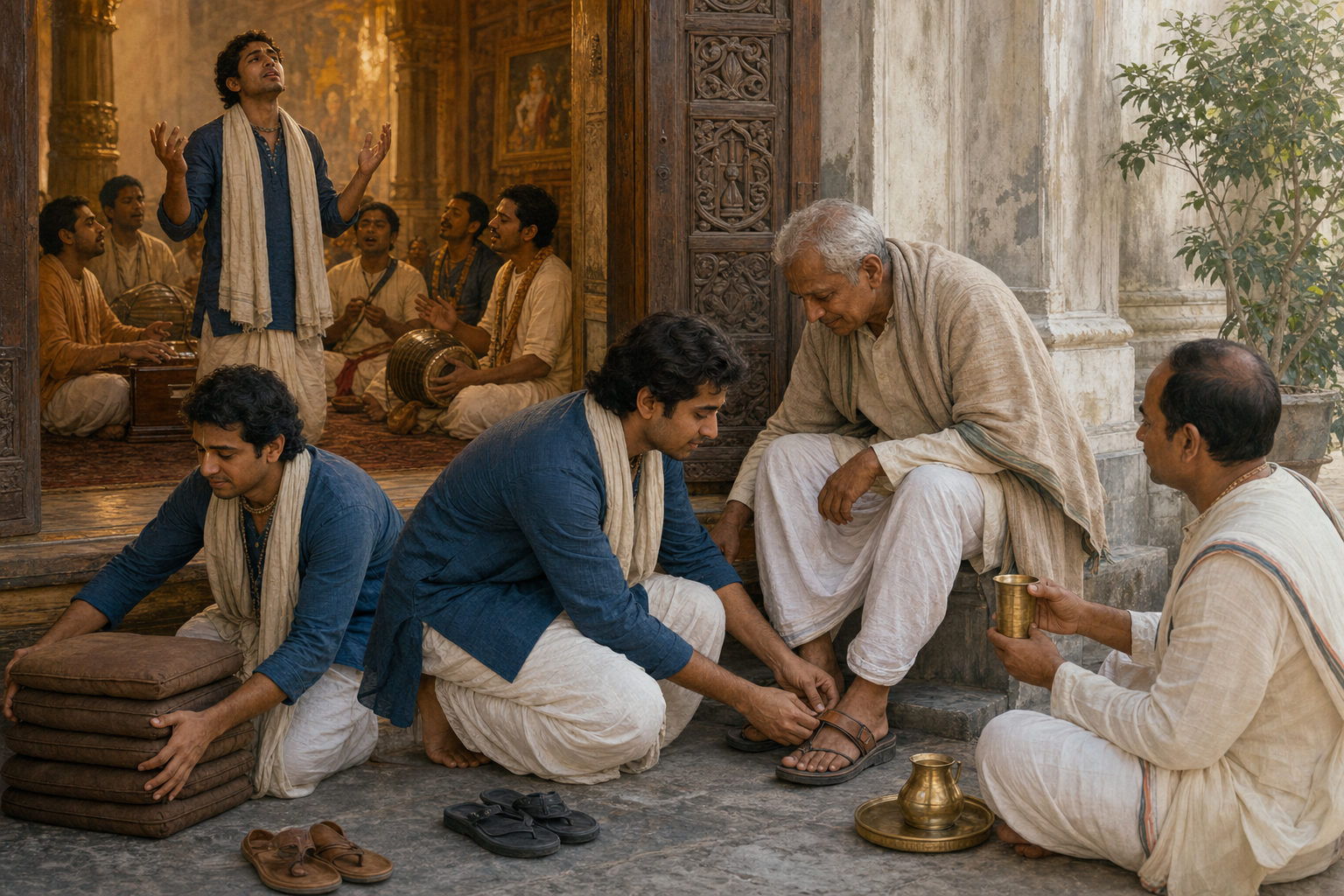
Complete the gathering with a small act of seva. Prepare or serve prasada, clear the worship space, wash the vessels, or help someone who attended. This prevents the elevated atmosphere from being sealed off as a pleasant devotional episode. The sound has begun to enter conduct when the person who wants another song is also willing to clean after it.
A participation check for temples and public programs
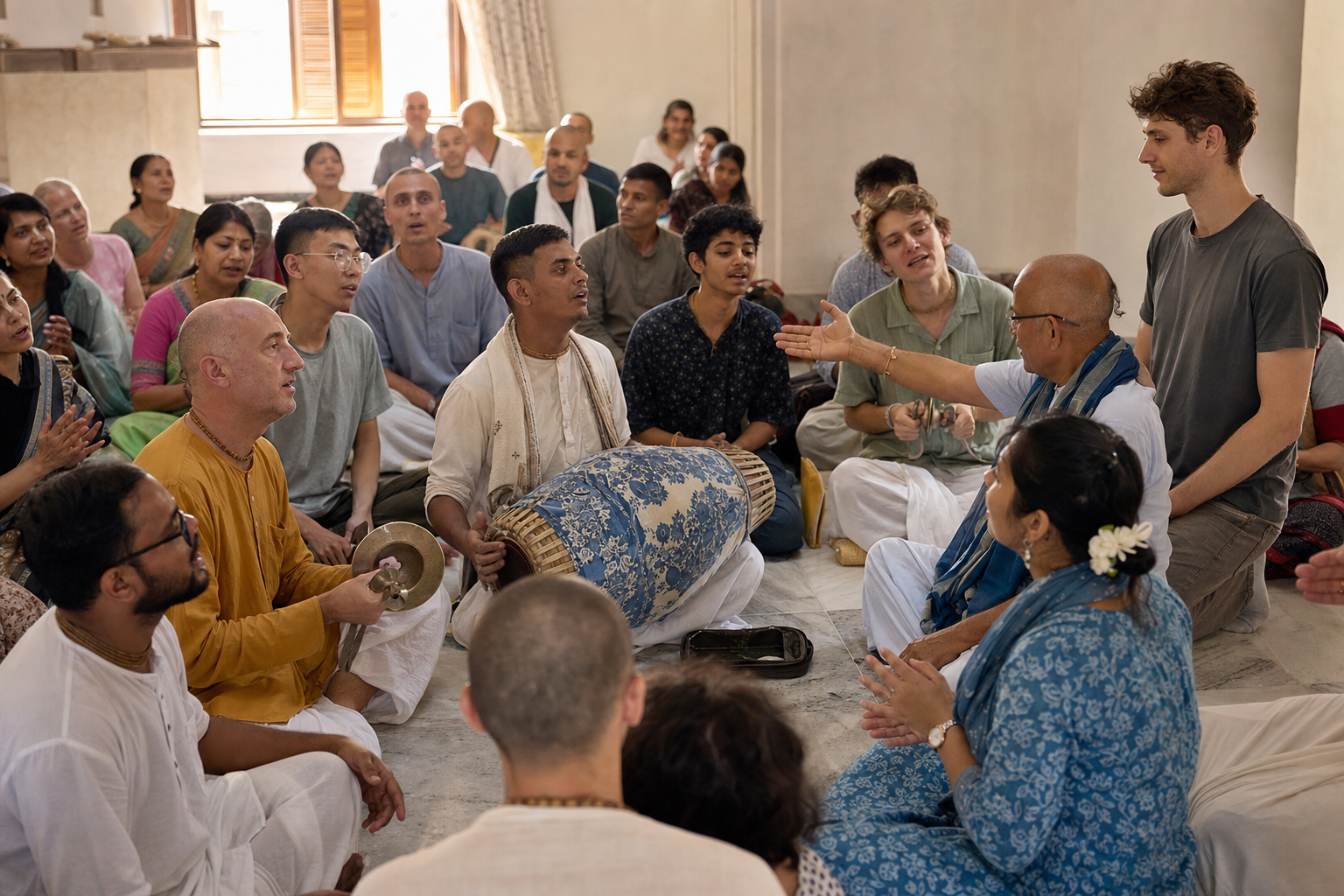
A large gathering needs deliberate hospitality. The invitation to chant is incomplete if a newcomer cannot see the words, hear the response, understand when to enter, or find a form of participation that does not require confident singing or dancing.
- Make the text visible. Provide a clear transliteration and, where useful, more than one local language. Do not assume that everyone can read the same script.
- Begin with a leadable melody. Complexity can develop later. The opening should teach the room how to participate.
- Balance voices and instruments. The congregation should be able to hear the mantra above the mridanga, karatalas, and amplification.
- Choose a breathable pitch. A leader’s personal range may not suit the assembly. Adjust before vocal strain spreads through the room.
- Leave a complete space for every response. The leader should not fill the congregation’s turn with extra singing.
- Rotate leadership thoughtfully. Shared leadership can widen participation, but each leader remains responsible for a stable pulse, audible words, and a melody the room can answer.
- Permit different bodily responses. Some people will dance; others will stand, sit, clap, or listen before joining. Invitation is more faithful to sankirtana than social pressure.
- Explain unfamiliar actions before they begin. A short orientation helps first-time participants enter the ritual without interrupting it for continual correction.
Steady tempos, calibrated volume, rotating leaders, accessible space, and multilingual transliteration are not merely event-management preferences. They determine whether the theology of an open, shared holy name becomes perceptible in the room.
The same standard applies to public sankirtana. A procession can be confident without becoming coercive. Keep entrances passable, sound at a responsible level, and participation voluntary. Gauranga’s sonic instrument is aligned with ahimsa when it opens a space for remembrance instead of using sacred sound to overpower those nearby.
After the program, evaluate more than attendance or musical energy. Ask whether a newcomer could learn the response without embarrassment, whether the quieter voices remained audible, whether service was shared, and whether people of different backgrounds were treated as participants rather than decorative evidence of inclusivity. Those observations reveal the actual communal form of the kirtan.
Let abhisheka and seva carry the sound into action
Abhisheka complements sankirtana by giving devotion a material grammar. The hands prepare and offer; the eyes behold the Deity; the ears receive mantra and kirtana; the body waits, assists, and serves. The rite should not become a visual spectacle loosely accompanied by music. Sound and offering belong to a single devotional intention.
A customary pancamrta sequence uses milk, yogurt, ghee, honey, and sugar. Fragrant waters, herbal preparations, or sandalwood may follow according to the temple and lineage practice. The wider liturgical movement commonly includes sankalpa, a formal intention; dhyana, meditative attention; and mantra-guided libations. The collected sanctified liquid may then be distributed as caranamrta.
These details are meaningful, but they are not a universal do-it-yourself recipe. Temples may follow particular standards for the Deity, substances, mantras, purity, preparation, and distribution. If you are unfamiliar with the rite, ask the pujari or responsible devotee how to assist. Chanting attentively and handing an item when requested is better service than improvising a role during worship.
- Before the abhisheka, understand the intention. Learn whom the community is worshipping, which offerings will be used, and what participants are expected to do.
- During the bathing, keep sound aligned with the rite. Use a pace and volume that permit the ritual mantras to be heard. The kirtan should support the offering rather than compete with it.
- Handle sacred materials under local guidance. Pass, pour, receive, or distribute only in the manner established by those responsible for the worship.
- Afterward, receive and serve respectfully. Follow the community’s practice for caranamrta and prasada, then help with the ordinary work of cleaning, arranging, and caring for participants.
That final work is spiritually revealing. It is easy to seek the sensory fullness of bells, flowing offerings, fragrant substances, and rising kirtana. Embodied bhakti also includes carrying a vessel, wiping the floor, protecting another person’s space, and remaining attentive when the visually impressive moment has passed. Seva keeps rasa from being confused with consumption.
The ethical extension continues outside the temple. Krishna’s names evoke a world of relationship, compassion, courage, friendship, and grace. Repetition becomes transformative when those remembered qualities begin to discipline speech and action. Before the next disagreement, recall the sound you were willing to sing with others. Then ask whether your next sentence preserves truth without discarding humility.
Practical FAQ for joining or hosting sankirtana
Do I need a trained singing voice?
No. You need enough attention to hear the call and enough care to return the names clearly. Musical skill can serve the gathering, but it does not confer greater ownership of the mantra. If you are unsure, begin softly, follow the congregation, and increase your voice only when the melody and rhythm feel stable.
Is sankirtana simply japa sung aloud?
No. Both center remembrance through the divine name, but their embodied structures differ. Japa ordinarily gives you an individual discipline of repeated mantra. Sankirtana makes hearing and response explicitly communal. You adjust to another person’s phrase, share a pulse, support the assembly, and sometimes accept leadership. That relational demand is part of the sadhana, not a distraction from it.
Does strong emotion prove that the chanting is working?
No. Emotion may arise, but trying to manufacture or display it redirects attention toward the self. Look for a more durable movement: steadier remembrance, clearer hearing, reduced contempt, greater patience, and a willingness to perform unglamorous service. A powerful musical experience can disappear quickly; a softened habit of speech has entered daily life.
Can sacred sound create Dharmic solidarity without erasing differences?
Yes, if the traditions are named accurately. Sikh kirtan and naam-simran, Buddhist mantra and paritta recitation, and Jain stavan and the Namokar or Navkar Mantra all demonstrate disciplined communal relationships with sacred sound. Their theologies and ritual purposes are not therefore identical to Gaudiya sankirtana. At a shared gathering, explain each practice in its own terms instead of claiming that every name, object of refuge, or devotional relationship is interchangeable. Respectful kinship is stronger than vague sameness.
At your next kirtan, adopt one discipline: hear the leader’s entire phrase before answering. If you are hosting, make one structural correction: choose an opening melody that a newcomer can repeat and place the words where everyone can see them. Gauranga’s sankirtana becomes a living path through such repeated acts of attention, hospitality, and service.
References
- Dandavats — Srimad Bhagavatam 11.5.32 Decoded: Chaitanya’s Sankirtana as Kali Yuga’s Transformative Path
- Dandavats — The Transformative Science of Kirtan and Abhishek: Glories of Lord Gauranga at ISV
