
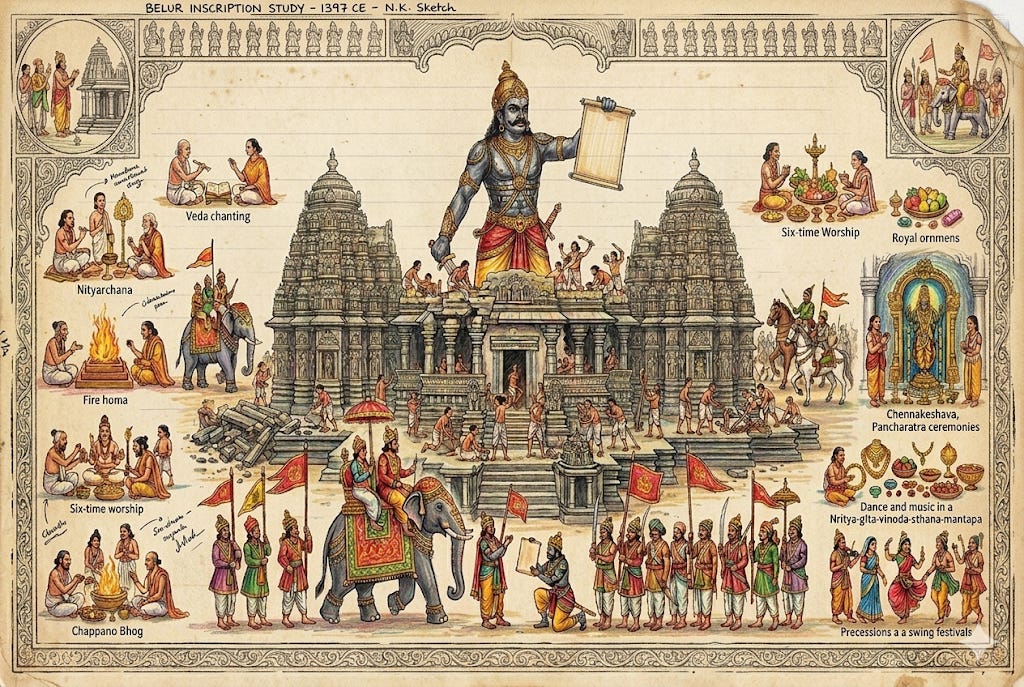
The Belur Inscription of 1397 CE deserves a place among the most consequential records in Indian epigraphy, comparable in civilisational significance to the corpora at Mandasor, Mehrauli, Vidisha, Girnar, Mathura, Allahabad, Damodarapura, Junagarh, Gwalior, Nasik, Talagunda, Konark, Talakad, Aihole, Motupalli and Thanjavur. Read in context rather than in isolation, it illuminates the material reconstruction, ritual continuity and social resilience that underpinned the endurance of sacred spaces in peninsular India.
The inscription captures a critical historical inflection point. By the late 14th century, the political power that had consolidated over much of the Uttarāpatha was projecting influence south of the Vindhya-Parvata. In that milieu, the emergence and consolidation of the Vijayanagara Sāmrājya functioned as a stabilising force in the Dakshināpatha, enabling the safeguarding and revival of institutions that embodied Sanatana cultural memory, law, and learning.
On the surface, the Belur record narrates the restoration and reconsecration of the Chennakeshava Temple. A closer, epigraphically informed reading, however, reveals a miniature universe of Sanatana culturepiety anchored in ritual canons, solidarities spanning guilds and local assemblies, and a consciously nurtured social order in which temple, town and agrarian hinterland were interdependent.
When restoration commenced under the leadership of Gunda Dandanāyaka (also known as Gunda Dandanatha), the sanctuary lay in grievous disrepair. The mahādvāra had been reduced to cinders, the tower was razed, sculptural programs lay broken and dispersed, and the Mūla mūrti stood defaced and ritually defiled. The inscription’s matter-of-fact phrasing accentuates the severity of loss while foregrounding the resolve to rebuild.
Gunda Dandanāyaka’s designationdandanāyaka, a high-ranking military-administrative officesignals Vijayanagara’s characteristic response to crisis: coordinated civil and ritual reconstruction executed under state patronage but reliant on local artisanal, mercantile and agrarian networks. Internal evidence and chronology place his activity in the reign of Harihara II (r. 1377–1404), a phase when Vijayanagara consolidated authority across key Kannada-speaking regions.
The structural program at Belur conformed to the established grammar of Hoysala architecture while accommodating necessary repairs and replacements. Works encompassed the rebuilding of the main entrance, stabilization of the superstructure, resetting of fallen architectural members, and systematic restoration of sculptural panels. Master-stoneworkers familiar with chloritic schist (soapstone) rearticulated friezes, cornices and door-jamb mouldings to match the temple’s intricate profiles and eaves.
The ritual program was no less rigorous. Agamic prescriptionsdrawn from the Vaikhānasa and/or Pañcharātra traditions that guide Vaiṣṇava worshipwere applied to cleanse defilement, re-sanctify precincts and, where required, perform punar-pratiṣṭhā of the principal icon. Ceremonies such as kumbhābhiṣeka, homa, and prescribed prāyaścitta restored the temple’s ritual life-cycle, ensuring that liturgy, festival calendars and endowments could resume within a legitimate canonical framework.
Epigraphically, the 1397 CE date aligns with the Saka era system (CE – 78), a common convention in South Indian inscriptions of the time. The textlikely composed in Kannada with Sanskrit benedictory and titular formulaefollows familiar epigraphic protocols: invocation, royal genealogy and eulogy, identification of the responsible official (Gunda Dandanāyaka), description of damage and works executed, references to grants or endowments, and closing imprecations safeguarding the record.
The broader geopolitical canvas clarifies both the cause of damage and the urgency of repair. The Bahmani–Vijayanagara frontier, fluid and frequently contested in the late 14th and early 15th centuries, witnessed cycles of raiding and counter-raiding. In that environment, restoration at Belur registers as part of a wider civilisational strategy: to secure sacred sites, reconstitute ritual economies, and re-anchor communities amid recurrent military turbulence. The language of the inscription avoids polemic; its emphasis rests on remedy and resilience.
Comparative evidence strengthens this reading. The post-raid revivals attested at Srirangam, Kanchipuram and other centresmemorialised in inscriptions and texts such as the Madura Vijayamexhibit a shared pattern: strategic reconquest, administrative normalisation, temple reconstruction, ritual reconsecration and renewed patronage streams. Belur’s 1397 CE record is a key southern Kannada counterpart in that arch of recovery.
Architecturally, the Chennakeshava Temple at Belurcommissioned c. 1117 CE by the Hoysala ruler Viṣṇuvardhanais among the subcontinent’s most accomplished stellate-plan monuments. Its lathe-turned pillars, madanika brackets, narrative friezes and rhythmic horizontal cornices articulate a refined sculptural idiom in chloritic schist. The inscription’s testimony that the tower and doorway required rebuilding underscores how exposed components were uniquely vulnerableand how faithfully Vijayanagara-era ateliers could replicate Hoysala profiles when needed.
Socio-economically, such restorations were never merely architectural. Temple economies in medieval South India integrated agrarian revenues, craft guild outputs and mercantile circuits. Repairs at Belur would have reactivated land-grant management, festivals as redistributive events, artisanal employment and charitable kitchensreweaving the local fabric through tangible work and intangible rites.
Seen through a civilisational lens, the Belur inscription also exemplifies a dharmic ethic that resonates across Hindu, Jain, Buddhist and later Sikh traditions: safeguarding spaces of learning, worship and community service as a duty that combines kṣatra (protective responsibility), dāna (generosity) and śāstra (normative guidance). The Vijayanagara Sāmrājya operationalised that ethic through policy and patronage, while local communities sustained it through participation and stewardship.
From an epigraphic-method perspective, the record offers a compact tutorial in reading inscriptions for layered meaning: not only what was built or repaired, but how rites re-legitimised space, how officials were embedded within administrative hierarchies, and how formulae signal legal protections for grants and future custodianship. Its terse phrases, when triangulated with contemporary inscriptions and chronicles, yield a granular picture of institutional continuity under stress.
The inscription’s contemporary resonance is unmistakable. The Chennakeshava Templetoday part of the Hoysala Sacred Ensembles recognised on the UNESCO World Heritage Liststands as a palimpsest of Hoysala creation and Vijayanagara conservation. The 1397 CE narrative is a reminder that heritage endurance relies on timely repair, ritual fidelity, community consensus and enlightened governance.
In sum, the Belur Inscription of 1397 CE documents far more than a construction project. It records the restoration of sacred order in the wake of violence, the reanimation of a ritual economy, and the reaffirmation of civic life around a temple that had long anchored identity and memory. Through Gunda Dandanāyaka’s stewardship, Vijayanagara translated cultural will into infrastructural and liturgical facta blueprint of resilience with durable relevance for the stewardship of India’s cultural heritage today.
Read as history, it clarifies chronology and causation. Read as heritage science, it demonstrates how architecture, ritual and law cohere to revive complex systems. Read as civilisational testimony, it affirms a dharmic unity of purpose that has repeatedly integrated diverse pathsHindu, Buddhist, Jain and Sikharound the shared imperative to protect and nourish sanctuaries of wisdom, worship and service.
Inspired by this post on Dharma Dispatch.
