
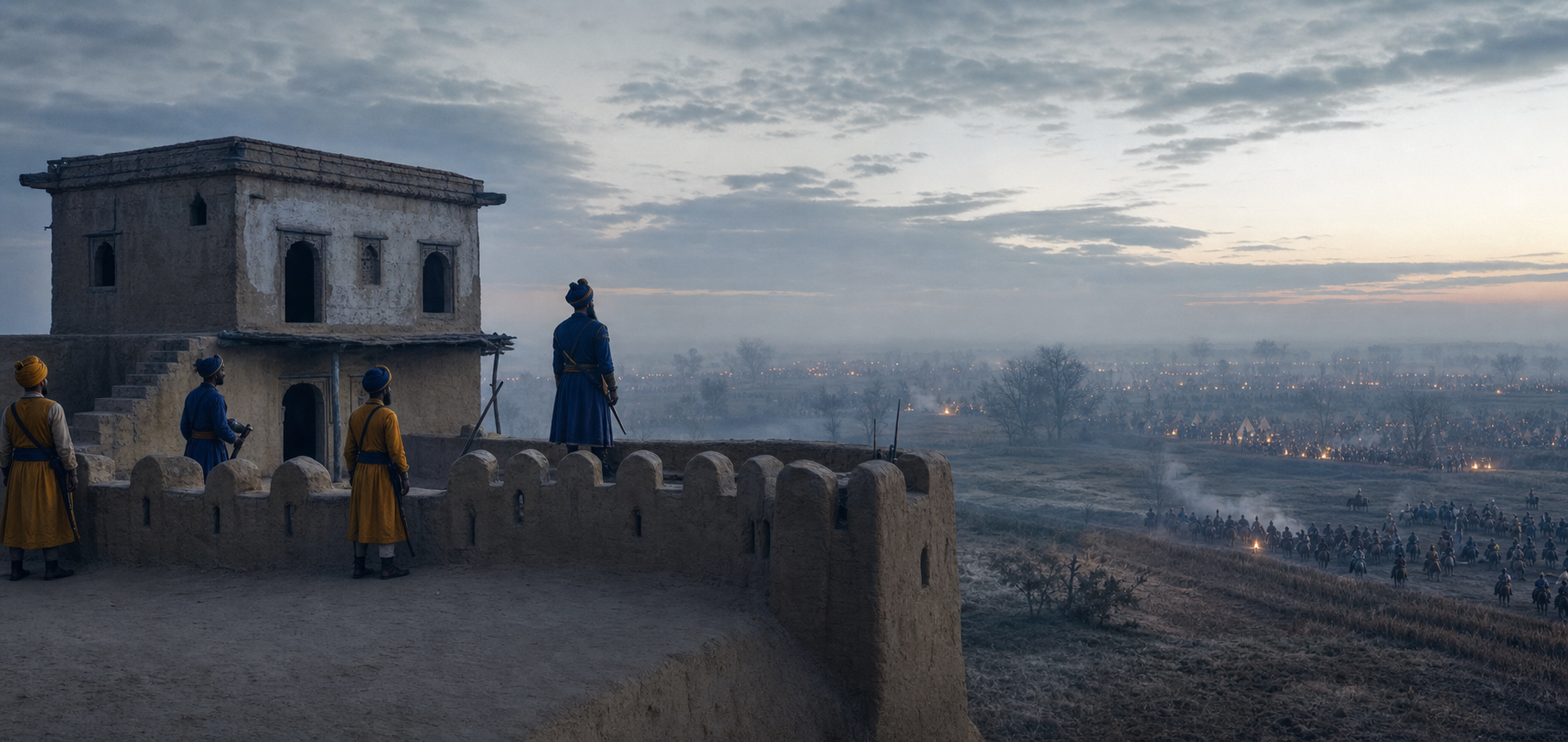
If you have heard Chamkaur invoked with reverence but know it only as a story of a few warriors against a vast army, you are missing the part that makes it morally demanding. The episode asks what you owe truth, dignity, and freedom of conscience when safety, numbers, and worldly success all point the other way.
You can read Chamkaur clearly by keeping three things distinct: what happened, what the Sahibzadas chose, and what their remembrance asks of you. That distinction prevents the history from becoming either a bare military tale or an emotional legend detached from ethical responsibility.
Begin with the order of events, not the legend
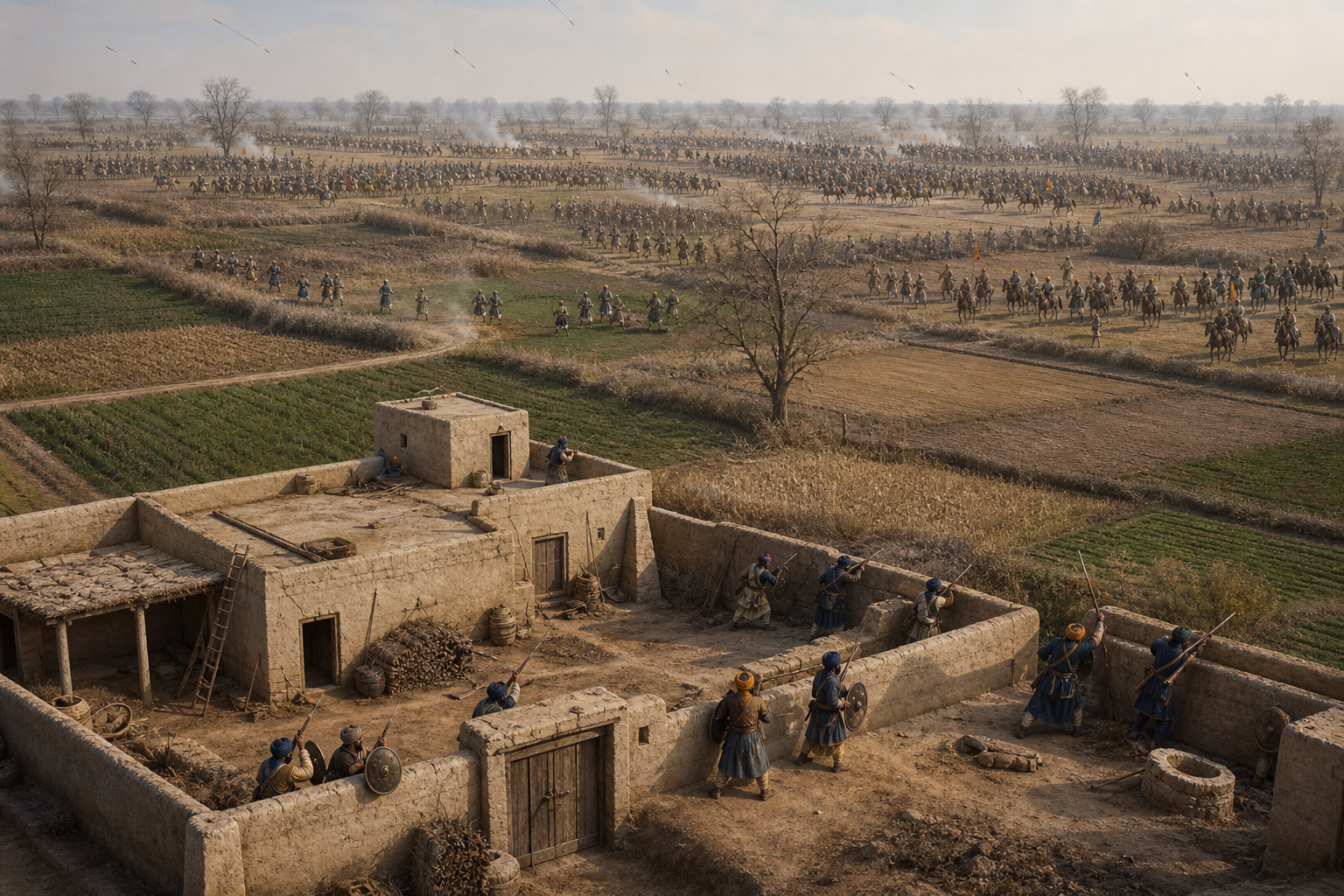
The confrontation unfolded in the winter of 1704, following the siege of Anandpur Sahib. Under severe pressure, Guru Gobind Singh and a small Khalsa contingent withdrew toward Chamkaur. There, inside a fortified structure known as the garhi, a handful of defenders confronted a vastly larger force.
The sequence matters. If you begin directly with battlefield heroism, the stand can sound like a contest in fearlessness. Begin with Anandpur, the forced withdrawal, and the refuge at the garhi, and you see people responding to a crisis they did not choose. Their courage appears within duty, discipline, and the defence of a community under pressure.
Being outnumbered does not automatically make any cause righteous. Numerical weakness can attract sympathy, but it cannot establish moral legitimacy. Chamkaur carries ethical weight because the resistance is remembered as a defence of justice, dignity, and freedom of conscience, conducted with resolve rather than cruelty for its own sake.
If someone asks you what happened, a careful short answer is enough: after the siege of Anandpur Sahib in the winter of 1704, Guru Gobind Singh and a small Khalsa group reached the garhi at Chamkaur, where disciplined defenders faced overwhelming forces. That account preserves the historical frame without filling gaps with invented numbers, speeches, or dramatic embellishment.
Ajit Singh and Jujhar Singh made principle personal
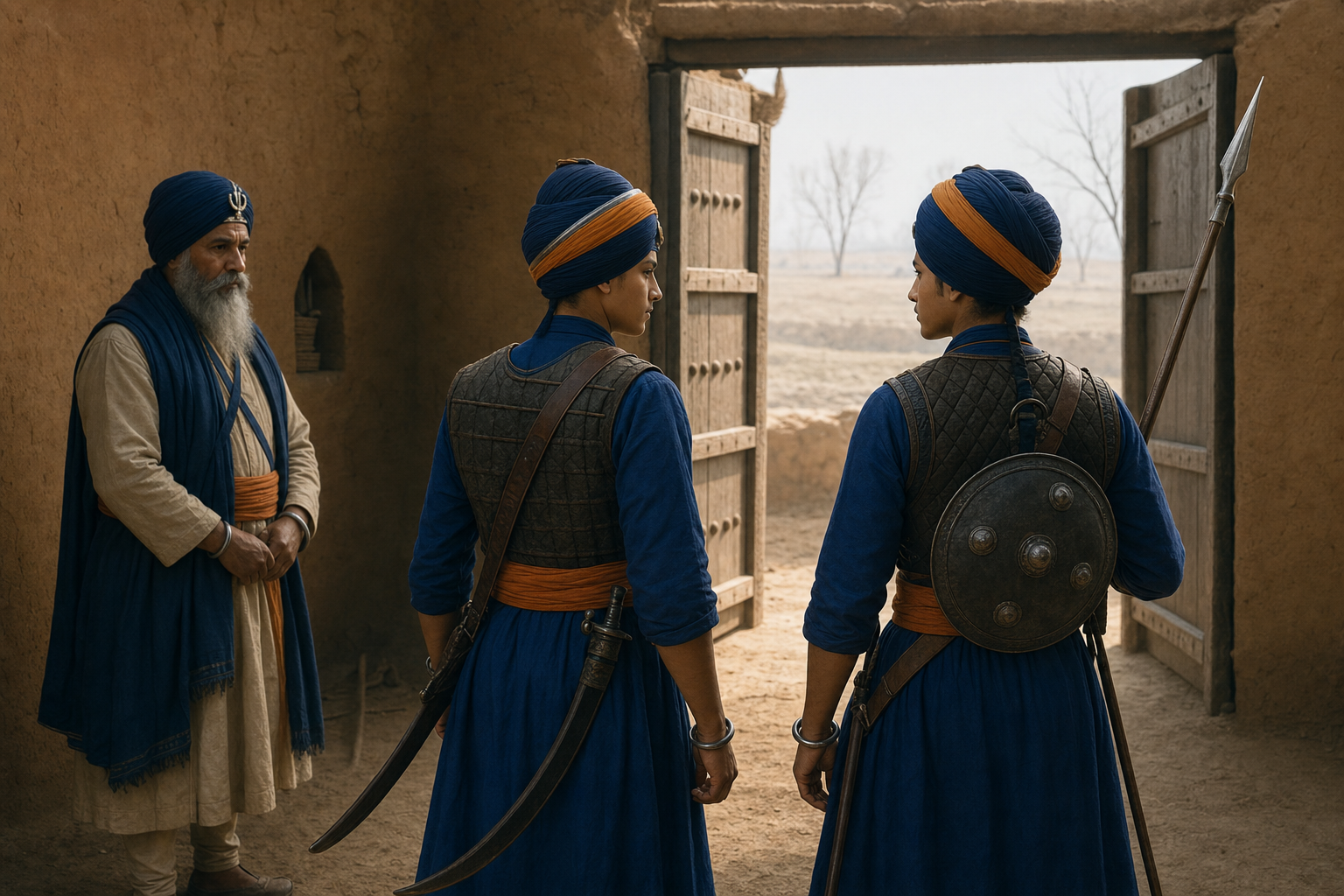
The Sahibzadas, Ajit Singh and Jujhar Singh, are not supporting characters added to make the battle more poignant. Their participation and martyrdom reveal the cost of the principles being defended. The sons of Guru Gobind Singh were young, yet they accepted the danger faced by the Khalsa rather than treating their position in the Guru’s family as an exemption from duty.
Their filial devotion should not be reduced to passive obedience. Their loyalty joined several relationships at once: commitment to the Guru, love within a family, solidarity with the Khalsa, and fidelity to dharma. That is why their remembrance reaches beyond admiration for physical bravery. They placed conviction above personal safety when the two could no longer be reconciled.
Three common misreadings can obscure that meaning:
- Sacrifice is not a fascination with death. The moral centre is willingness to bear a grave cost for righteousness, not a desire for suffering.
- Youth does not make the Sahibzadas mere symbols without agency. Their willingness is precisely why Sikh memory preserves their names and choices rather than treating them as anonymous casualties.
- Reverence does not require exaggeration. The known circumstances already carry immense force. Unsupported dialogue, inflated figures, or sensational violence can distract from the decision that deserves attention.
When you bring Chamkaur into your own life, asking whether you could reproduce its battlefield sacrifice is usually too theatrical to help. Ask a nearer question: what rightful duty do you evade because it may cost approval, convenience, or status? You may need to speak truth when your group prefers silence, defend another person’s freedom of worship, refuse to participate in humiliation, or stand beside someone being isolated. These acts are not equivalent to martyrdom. They are the ordinary ground on which moral courage is trained.
Dharma-yuddha is a discipline, not a licence for violence
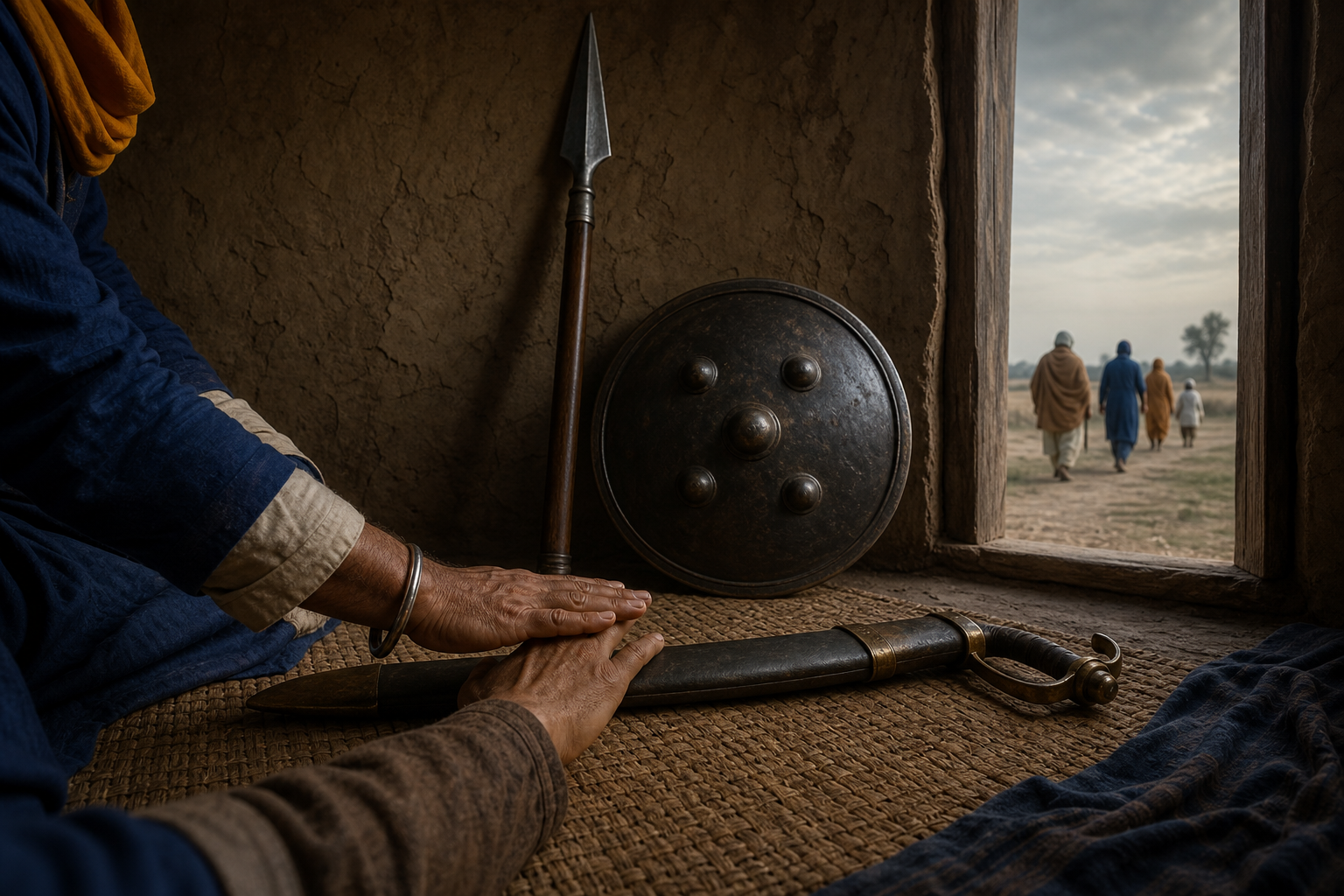
Chamkaur is often understood through dharma-yuddha, a righteous struggle governed by moral purpose. The term should never become a sacred label pasted onto any conflict one already favours. A struggle can claim religious language and still be driven by hatred, domination, vengeance, or contempt for human dignity.
Use four questions before describing resistance as dharmic:
- What is being defended? At Chamkaur, the ethical frame is the protection of truth, dignity, justice, and freedom of conscience.
- How is resistance governed? Discipline and restraint matter. A righteous cause does not make every act committed in its name righteous.
- Who bears the cost? Duty begins with willingness to accept responsibility oneself; it is corrupted when leaders glorify sacrifice while treating other people as expendable.
- What inner posture guides the stand? Courage joined to humility differs from rage that seeks an enemy to hate.
This framework also explains why Chamkaur can speak across dharmic traditions without erasing Sikh distinctiveness. Hindu thought contributes the language of duty and righteous action. Buddhist traditions keep compassion and non-harming before the conscience. Jain dharma presses the radical seriousness of ahimsa and courageous truthfulness. Sikh tradition joins devotion and humility to an insistence that injustice must be confronted.
These are resonances, not interchangeable doctrines. Hindu, Buddhist, Jain, and Sikh traditions do not make identical prescriptions about armed resistance. Chamkaur remains a Sikh historical and sacred memory. A shared dharmic lens is useful when it sharpens questions about duty, restraint, compassion, and justice; it becomes careless when it dissolves the differences among traditions.
This distinction gives you a practical test for public rhetoric. If Chamkaur is invoked to cultivate courage, responsibility, and protection of conscience, the memory is being approached through its ethical centre. If it is used to excuse cruelty or inflame indiscriminate hatred, its language has been separated from the discipline that gives dharma-yuddha meaning.
Remember Chamkaur without turning suffering into spectacle
Family storytelling, education, gurdwara imagery, and Ardas keep Chamkaur present across generations. Each setting can deepen understanding, but only when remembrance does more than produce a moment of strong emotion. If you are teaching the episode, use a simple sequence that protects both accuracy and meaning:
- Establish the setting. Name the siege of Anandpur Sahib, the winter withdrawal, the garhi at Chamkaur, and the imbalance between the Khalsa defenders and the opposing army.
- Name the people. Say Guru Gobind Singh, Ajit Singh, and Jujhar Singh. Personal names prevent sacrifice from becoming an anonymous abstraction.
- Separate fact from devotional elaboration. If you cannot verify a precise number, quotation, or battlefield detail, do not present it as established history. A family tradition may still be shared honestly as family memory.
- Ask ethical questions. What was being protected? What made the stand righteous? How can courage retain humility? Where is restraint visible in the ideal being remembered?
- Return memory to practice. Listen attentively when the Sahibzadas are recalled in Ardas, ask an elder how the story was taught in the family, study the imagery displayed in a gurdwara, or read a Punjabi telling of Saka Chamkaur with someone who can help you hear its cultural cadence.
When you are telling the story to children
Adjust the emphasis, not the truth. A child does not need graphic detail to understand that the Sahibzadas faced mortal danger. Centre the ideas they can examine: keeping one’s word, refusing to abandon others for personal comfort, protecting another person’s dignity, and acting from principle when fear is real.
Do not ask a child to promise the same sacrifice. That turns remembrance into a loyalty test and confuses moral formation with dramatic performance. Ask for one action within the child’s actual world: include someone being excluded, tell the truth after making a mistake, refuse to join mockery, or learn why another person’s freedom of conscience deserves protection.
It also helps to explain that courage is not the absence of fear. Steadfastness means that fear and danger do not receive the final authority over one’s conduct. That lesson honours the Sahibzadas without inviting children to romanticise violence or imagine that seeking danger is a spiritual achievement.
Key takeaways
- For historical clarity, begin with the siege of Anandpur Sahib, the winter 1704 withdrawal, and the stand inside the garhi at Chamkaur.
- For Sikh meaning, keep Ajit Singh and Jujhar Singh at the centre as moral agents whose willingness joined family devotion, Khalsa solidarity, and duty to dharma.
- For an ethical reading, judge a struggle by what it protects, how it is conducted, who accepts its cost, and whether courage remains joined to humility.
- For a shared dharmic understanding, recognise common concerns such as duty, compassion, ahimsa, truthfulness, and justice without pretending that different traditions teach identical responses to conflict.
- For living remembrance, convert admiration into one specific act that protects truth, dignity, or freedom of conscience in the circumstances actually before you.
Choose one way to keep Chamkaur active rather than ceremonial. Read the Punjabi narrative with your family, ask what is being recalled during Ardas, or identify one situation in which someone near you needs principled support. You do not honour the Sahibzadas by searching for a battlefield. You honour them by refusing to let comfort make your moral decisions for you.
References
