
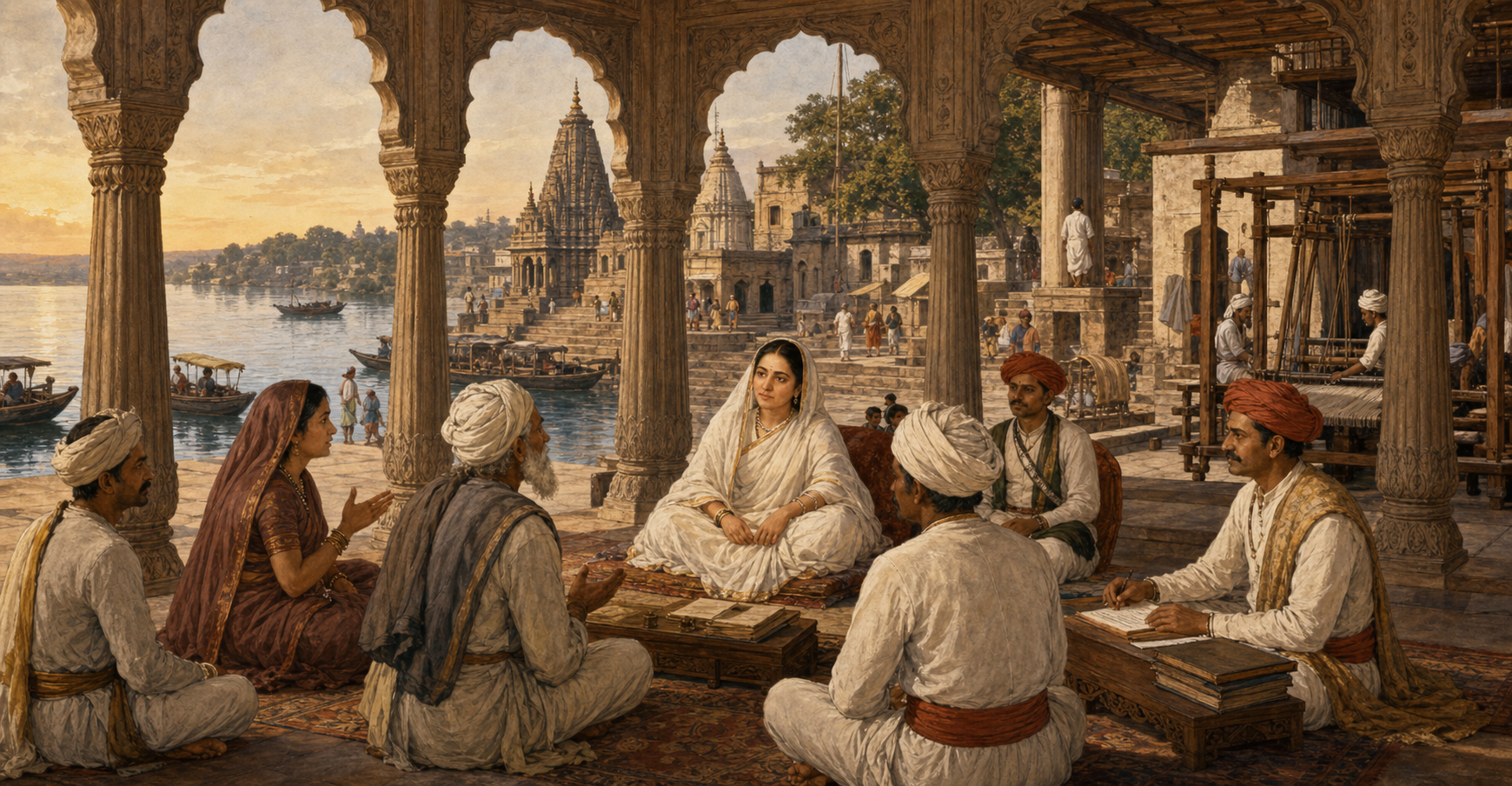
If you want to know whether dharmic governance means more than a ruler’s personal devotion, look at what happens when an ordinary person approaches the court, cultivates a field, travels to market or undertakes a yatra. Ahilyabai Holkar’s reign gives you a practical standard: power should make justice more accessible, livelihoods more secure and sacred life easier to sustain.
That is also the right way to understand her temples. They were not isolated monuments added after the serious work of government was complete. Temples, ghats, waterworks, rest houses, roads, markets and artisan communities belonged to one civic vision. Her legacy asks us to judge dharmic rule by the relationship it creates between spiritual responsibility and the common good.
The first test of dharmic rule is how power meets suffering
Ahilyabai was born at Chondi on 31 May 1725. She married Khanderao Holkar, son and heir of Malhar Rao Holkar. When Khanderao died at Kumbher in 1754, she declined sati with Malhar Rao’s support. She then assumed growing administrative responsibilities and, after Malhar Rao’s death in 1766, took charge of the Holkar polity in 1767.
Personal suffering does not automatically produce good government. What matters is how a person converts experience into judgement. Ahilyabai did not make bereavement the centre of her public identity. She developed the discipline required to hear disputes, manage revenue, protect productive life and maintain political order. That distinction is important whenever her story is told: her tragedies reveal the obstacles she crossed, but her administrative choices establish her stature.
Maheshwar, on the Narmada, became her capital. From there she developed a form of rule associated with nyaya, daan and maryada: justice, generosity and proper restraint. Regular darbar made the sovereign accessible, while careful land-revenue assessment sought to protect cultivators from burdens that could destroy the productive base of the state. Her administration also used drought relief and public works to answer hardship with more than ceremonial sympathy.
This gives you a useful test for any government described as dharmic. Do not begin with its slogans. Ask four concrete questions:
- Can a person with a grievance reach someone empowered to resolve it?
- Is revenue collected with regard for the cultivator’s ability to remain productive?
- Does relief arrive when drought or disruption threatens ordinary life?
- Does the ruler exercise authority within maryada, or treat power as personal entitlement?
These questions prevent dharma from being reduced either to private piety or to a modern political label. In governance, dharma becomes visible at points of contact between authority and vulnerability. An open court matters because justice delayed by distance or privilege is justice denied in practice. Prudent taxation matters because a state that consumes the cultivator’s capacity undermines the society it is meant to protect.
Justice, revenue and infrastructure formed one system
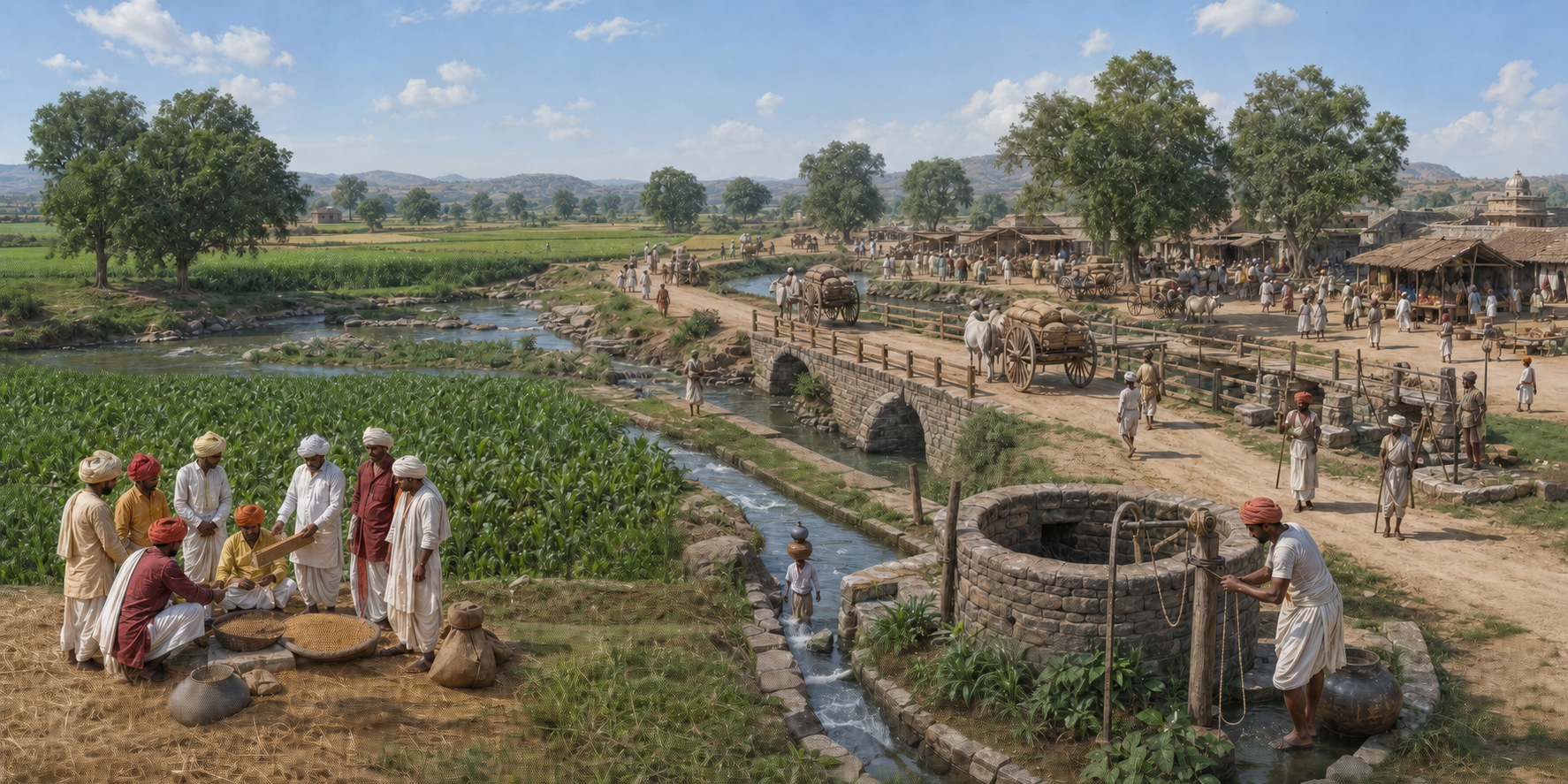
It is tempting to divide Ahilyabai’s work into separate boxes: religious patronage, economic policy, welfare and administration. Her achievement becomes clearer when you see how those functions reinforced one another.
Wells, ghats, irrigation facilities and caravanserais supported both agrarian and commercial life. Roads, sarais and market facilities helped connect Indore, Ujjain and trade centres in the Deccan and Rajputana. Safer and more dependable movement allowed agricultural produce, artisanal goods, merchants and pilgrims to travel through the same regional network.
The mechanism is straightforward. A cultivator needs water and a revenue demand that does not erase the value of cultivation. A merchant needs a usable road, a place to rest and reasonable safety. A pilgrim needs water, shelter and access to a sacred site. An artisan needs buyers and a route by which finished work can reach them. Building only the final destination leaves every one of these people exposed to failure along the way.
Ahilyabai’s governance addressed the route as well as the destination. That is why a sarai or well should not be treated as a minor footnote beside a great temple. A temple can draw a community together, but the surrounding infrastructure determines who can reach it, who can remain there and whether the settlement around it can prosper.
This integrated approach also corrects a common misunderstanding about charity. Daan is not only the transfer of wealth at a sacred moment. Properly directed, it can create durable public capacity. Waterworks continue to serve after the donor has departed. Irrigation preserves cultivation. A rest house turns a hazardous journey into a manageable one. Market facilities help producers meet buyers. The gift becomes more valuable because its benefit can be used repeatedly.
When you evaluate a heritage or pilgrimage project now, therefore, do not ask only how impressive the principal structure will look. Ask whether the plan includes water, access, sanitation, rest, safe movement, local commerce and long-term maintenance. Architecture attracts attention; a functioning civic system allows the sacred place to remain alive.
Her temple programme reconnected Bharat’s sacred geography
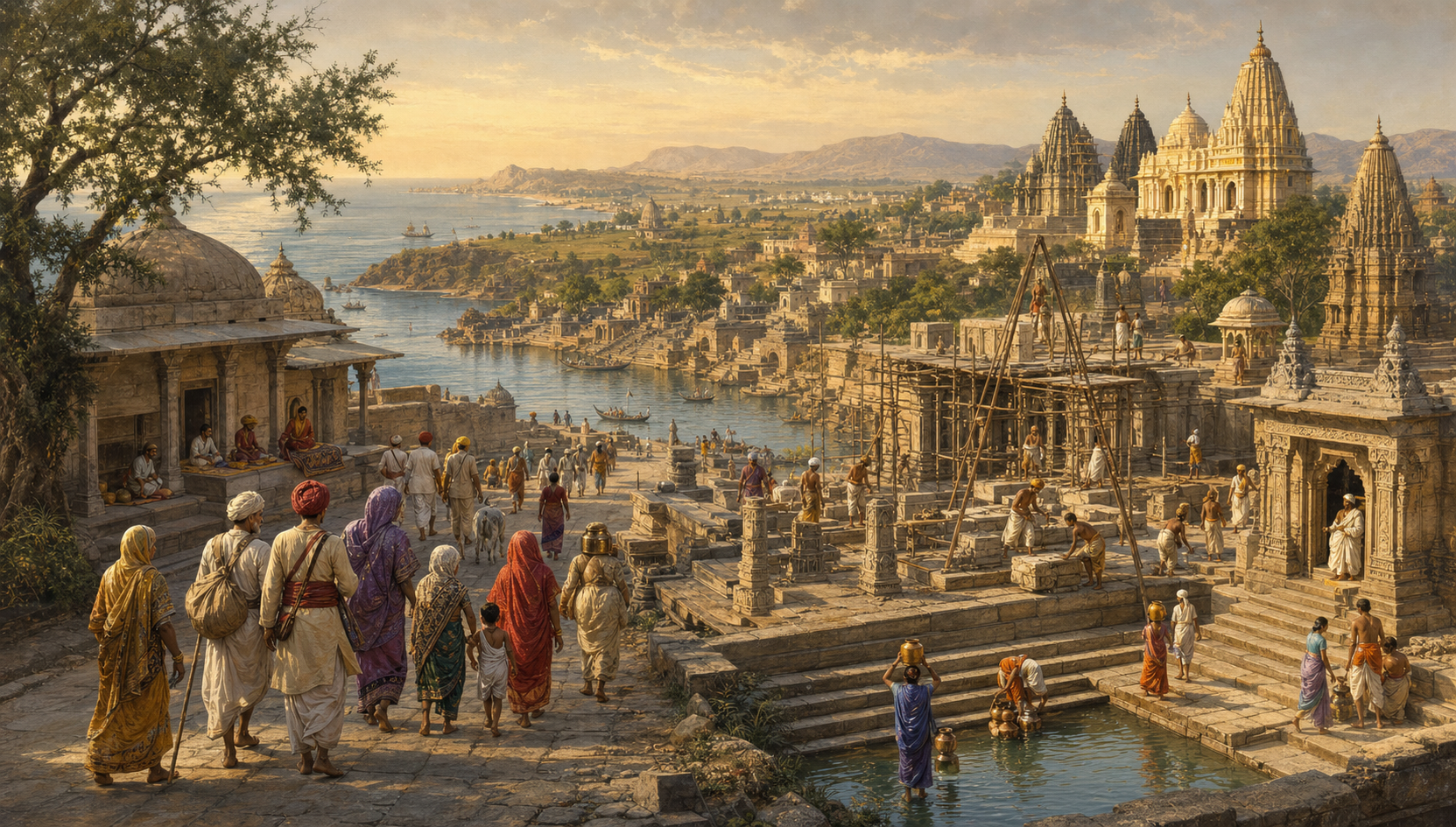
Ahilyabai’s best-known religious interventions reached far beyond Malwa. She rebuilt the Kashi Vishwanath Temple in 1780 and undertook the reconstruction of Somnath at Prabhas Patan in 1783. Her wider patronage included ghats, mathas, dharmashalas, facilities for food and water, and other forms of pilgrim support at sacred centres such as Kashi, Gaya, Dwarka and Somnath.
The importance of this work cannot be measured by counting buildings alone. Kashi and Somnath are geographically distant from Maheshwar, and neither restoration was necessary for the immediate embellishment of her capital. Supporting them expressed a wider idea of responsibility: a ruler situated in one region could still accept obligations toward the sacred inheritance of Bharatavarsha.
That responsibility operated on three connected levels:
- The temple protected a living centre of worship and civilizational memory.
- The ghat, rest house, water facility and food provision made pilgrimage physically possible for more people.
- The network of supported destinations strengthened a shared geography larger than any single kingdom.
This is why the phrase “temple builder” is accurate but incomplete. Ahilyabai was renewing relationships: between worshippers and tirthas, between regions and a common sacred inheritance, and between royal patronage and public service. Stone gave those relationships permanence, while pilgrim facilities gave them daily use.
Her facilities were also conceived within a capacious dharmic culture. Rest houses, ghats and waterworks served travellers and seekers from Hindu, Buddhist, Jain and Sikh communities. This did not erase the distinct identities of their traditions or turn every sacred site into the same kind of institution. It showed that seva could cross boundaries while each path retained its particular practices.
That distinction matters today. Dharmic unity need not mean theological uniformity. It can mean recognising a family of traditions shaped by reverence, self-discipline, pilgrimage, learning, service and respect for sacred places. Shared infrastructure is one of the most practical ways to express that relationship. A well does not ask which sampradaya a thirsty traveller follows. A safe route can carry many forms of devotion without confusing one with another.
Her temple legacy therefore offers a more serious response to the claim that religious patronage is merely symbolic. Symbolism is part of public life, especially when communities need continuity and dignity. But Ahilyabai joined symbolism to utility. The shrine preserved memory; the ghat provided access; the dharmashala offered shelter; the food facility embodied hospitality. Each component made the others more meaningful.
Maheshwar joined sacred beauty to productive work
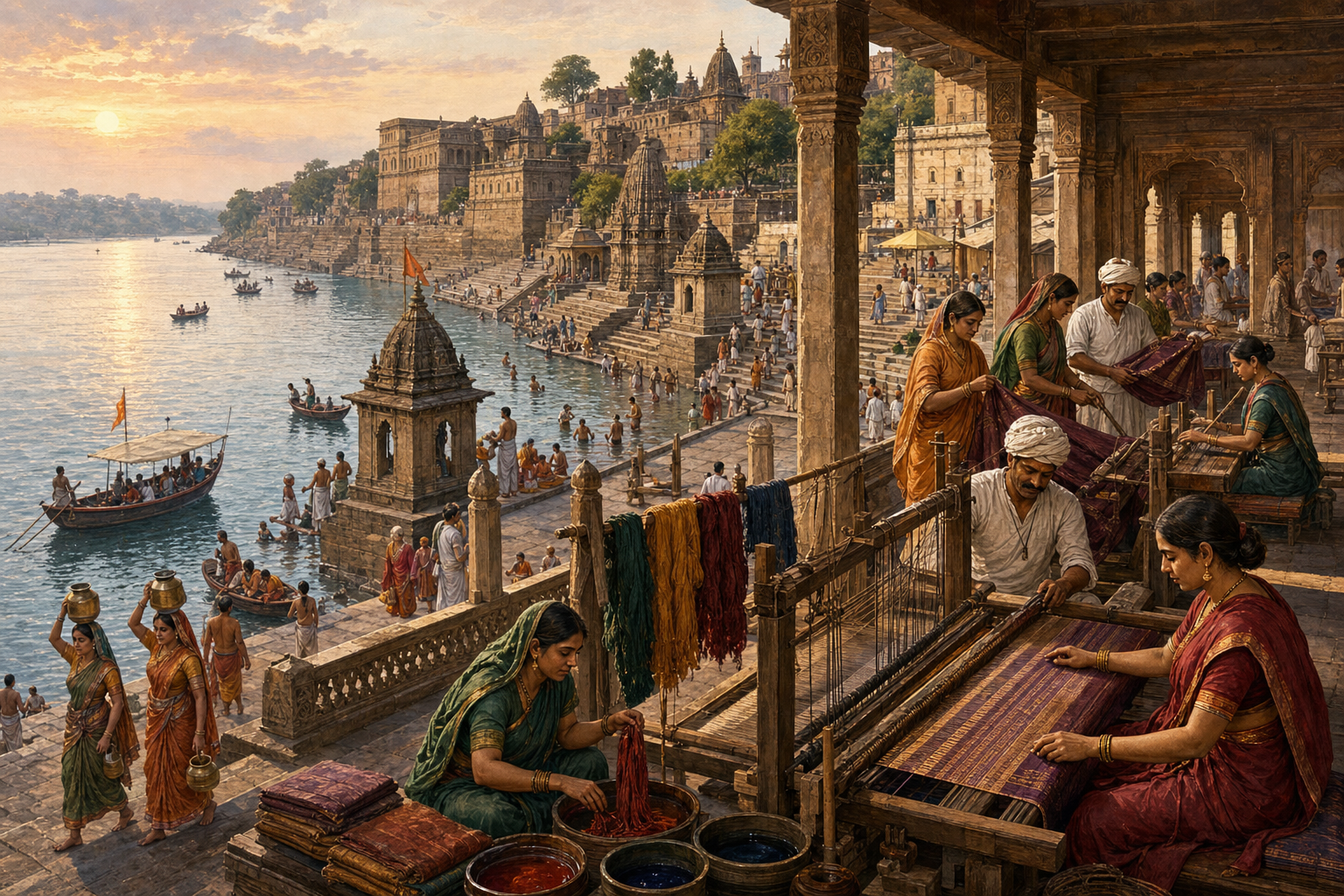
You can see the same synthesis more closely at Maheshwar. The riverside capital was not simply a royal backdrop. Its fort precinct, ghats and Ahalyeshvara Mahadeva Temple display a late-Maratha architectural language in which worship, movement and civic space meet along the Narmada.
Ahilyabai’s patronage also supported crafts and livelihoods, especially the weaving traditions later associated with Maheshwari sarees. Secured trade corridors and encouragement for artisanal guilds helped connect skilled production with markets. Cultural patronage could therefore generate employment instead of treating artisans as decorative participants invited only after construction was complete.
This is one of the most transferable lessons in her legacy. Heritage survives when living communities have a reason and the means to carry it. A weaving tradition needs skilled practitioners, apprentices, materials, buyers and fair market access. A temple precinct needs craftspeople who understand its forms, workers who maintain it and a local economy able to support regular use. Conservation that preserves the shell while displacing the people who sustain it is incomplete.
For a modern temple trust, civic group or donor, that principle changes the order of planning. Begin by mapping the people whose work already keeps the place alive: priests, flower sellers, cooks, cleaners, guides, boat operators, weavers, stoneworkers and other artisans relevant to the site. Then ask what prevents them from serving visitors well or transferring their skills. The most useful intervention may be less photogenic than a new facade, but more important to the site’s future.
A sound heritage plan should be able to answer five questions:
- Which sacred or historical feature is being preserved, and why does it matter?
- What practical facility will help worshippers, residents or travellers use the place?
- Which local crafts and livelihoods will the project sustain?
- Who will maintain the work after the inauguration?
- How will the community know that donations and responsibilities have been handled properly?
This framework is closer to Ahilyabai’s example than measuring success by size or publicity. Her model linked devotion to administration and cultural renewal to economic resilience. It treated the sacred precinct as part of a living settlement, not as an object separated from ordinary work.
Key takeaways: turn remembrance into responsible stewardship
Ahilyabai Holkar Jayanti falls on 31 May 2026. A garland, speech or social-media tribute can mark the date, but none captures her legacy as fully as a small act of well-governed seva. Use these principles to choose one:
- Measure dharmic governance by access to justice, proportionate revenue, relief in hardship and restraint in the use of power.
- Treat a temple as the centre of a civic ecosystem that includes water, shelter, food, safe access, cleanliness and maintenance.
- Protect pilgrimage infrastructure as part of the sacred geography of Bharat, not as an optional addition to a shrine.
- Connect conservation spending to the artisans and local workers who keep a tradition alive.
- Prefer a service with a clear custodian and maintenance plan over a one-day gesture that leaves no durable capacity.
- Express dharmic solidarity through shared seva while respecting the distinct practices of Hindu, Buddhist, Jain and Sikh paths.
If you are organising a Jayanti observance, begin with one local site. Walk through it as a pilgrim would. Notice where access becomes difficult, where water or rest is unavailable, where waste has accumulated, or where a traditional artisan lacks support. Speak with the institution responsible before beginning work, agree on one manageable need and identify who will maintain the result.
You could pair temple darshan or stotra recitation with an authorised cleanliness drive, annadanam, support for women’s education, or direct patronage of a traditional artisan. An educational gathering can use a simple chronological spine: her birth in 1725, the death of Khanderao in 1754, her assumption of power in 1767, the Kashi restoration in 1780, the Somnath work in 1783 and her passing on 13 August 1795. That keeps commemoration anchored in decisions and institutions rather than vague praise.
The most faithful tribute is to make devotion useful without making it merely utilitarian. Choose one sacred place, one practical obstacle and one accountable act of seva. Complete it well. That is how Ahilyabai’s example moves from remembered history into public dharma.