
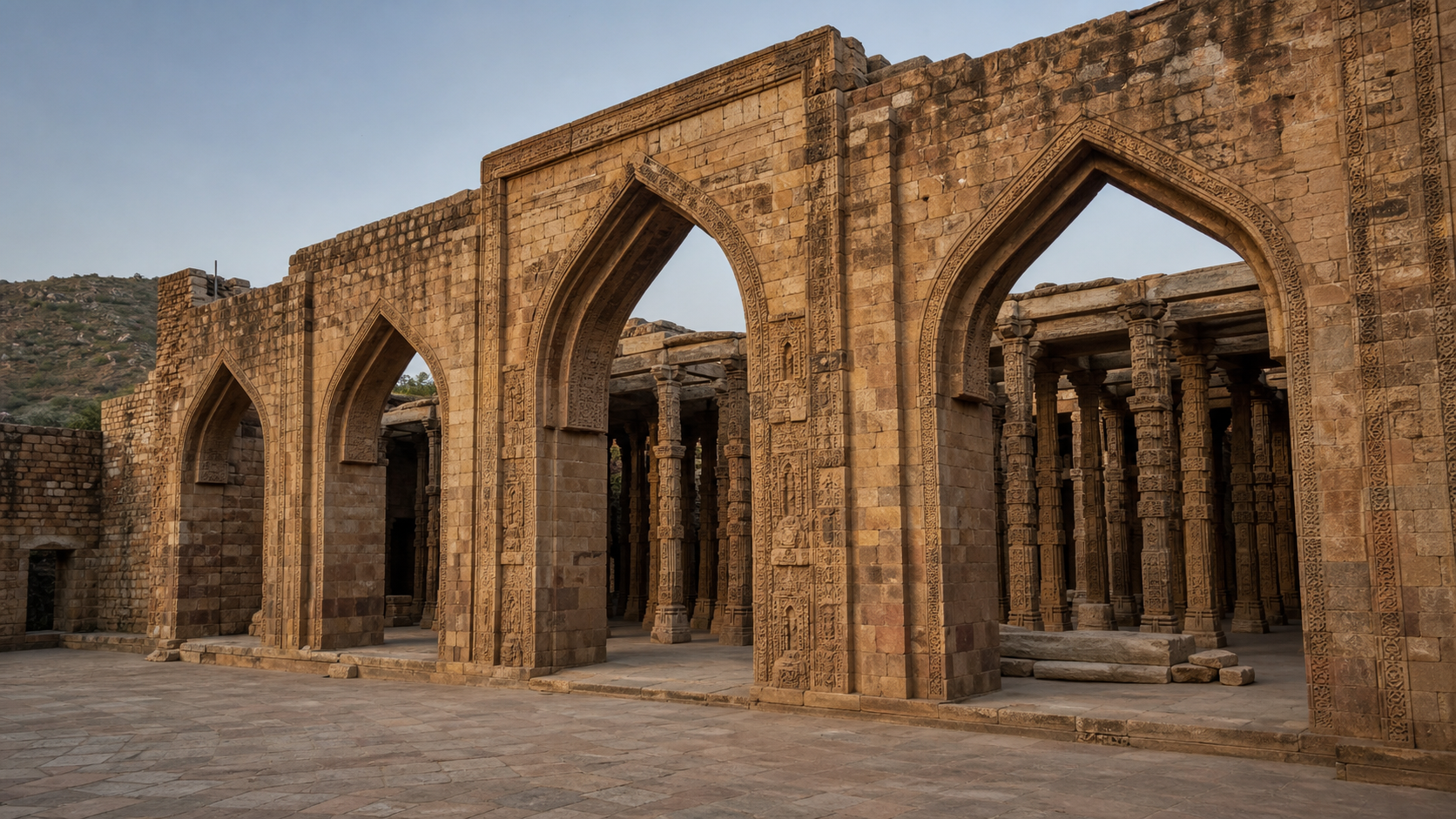
If you arrived with one question – was Adhai Din Ka Jhonpra built over a temple or Sanskrit college? – the honest answer is more precise than either a flat yes or a flat no. The standing monument belongs principally to an early Delhi Sultanate mosque phase, while its interior contains abundant architectural material from earlier Hindu and Jain structures. What remains unresolved is the original location, arrangement and institutional setting of all that reused material.
You can judge the competing claims more clearly once you separate four questions that are often collapsed into one: where the stones originated, what previously occupied the footprint, whether an educational or sacred institution operated there, and how the surviving mosque acquired its present form.
What the standing monument already establishes
Adhai Din Ka Jhonpra is not a structure from one moment. Its principal mosque-building phase belongs to the late 12th and early 13th centuries. It is commonly associated with Qutb-ud-Din Aibak, with further work under Iltutmish. The facade and its early Indo-Islamic arches belong to that history.
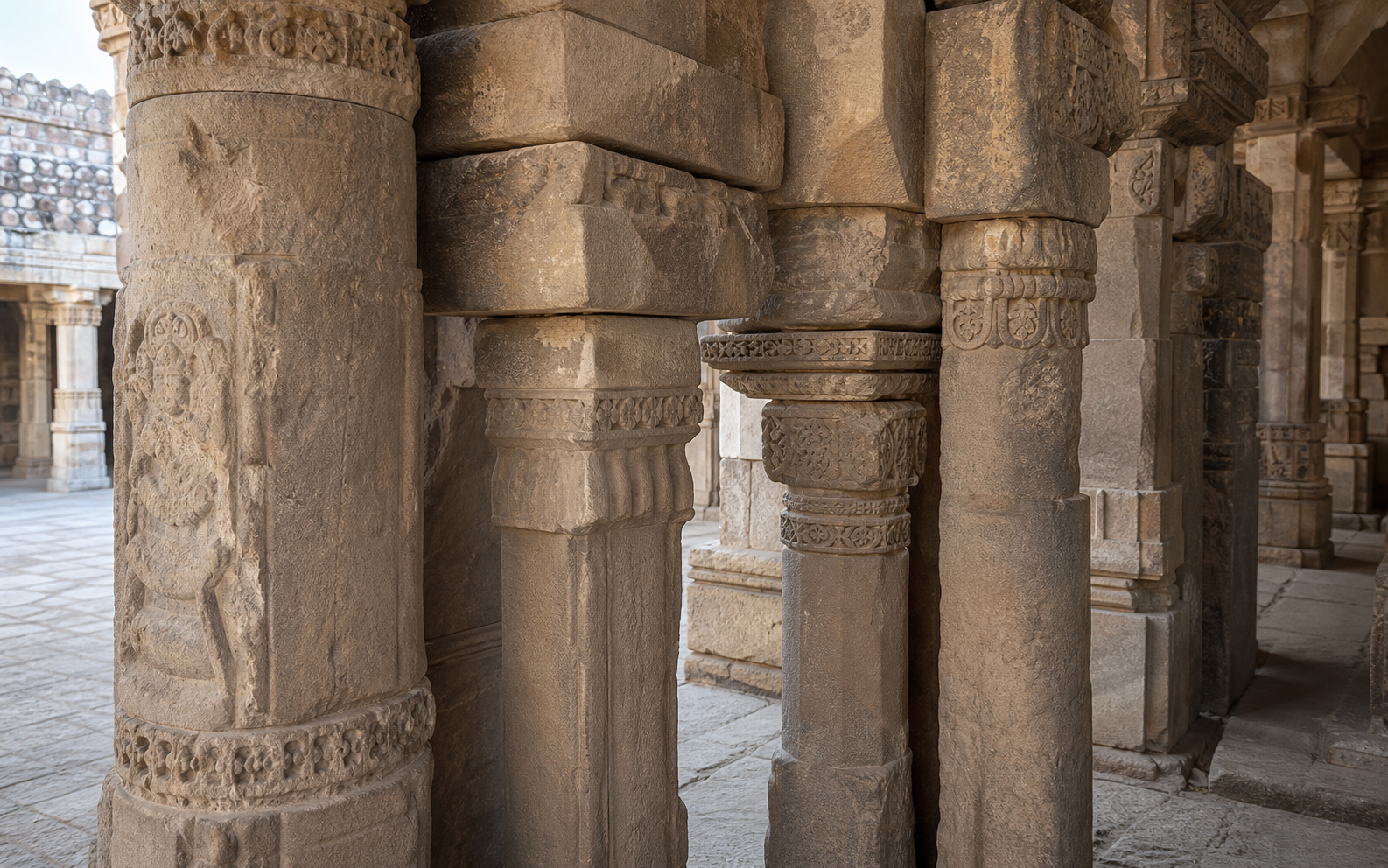
The colonnaded interior tells another part of the story. Many pillars, capitals, bases and carved fragments were not produced as undecorated components for the mosque. They are spolia: pieces taken from earlier buildings and installed in a new architectural setting.
That conclusion does not depend on a modern political reading. Lotus medallions, kirtimukhas, Jain-influenced carvings and other features belong to established Hindu and Jain artistic vocabularies. Selectively damaged figural elements also show that some components were altered as they passed into a different architectural and religious setting.
The inscriptions are just as important as the carvings. Sanskrit fragments associated with the Chahamana, or Chauhan, milieu of Vigraharaja IV, also known as Visaladeva, have been recorded within the complex. They connect part of the material record to Ajmer’s pre-Sultanate Sanskrit culture. They do not, by themselves, identify the complete plan or function of the building from which every fragment came.
The shortest defensible conclusion is therefore clear: the mosque incorporates substantial material from earlier Hindu and Jain architecture, and the complex preserves Sanskrit evidence linked to the Chahamana cultural world. The exact pre-Islamic site history remains an archaeological question.
Origin means four different things at this site
When you encounter the claim that Adhai Din Ka Jhonpra was originally a temple or college, first ask what kind of origin is being asserted. Four distinct propositions require four different kinds of proof.
- Material origin: Were the pillars and carved stones first made for Hindu and Jain structures? The visible iconography strongly supports this for a substantial part of the assemblage.
- Structural origin: Did one of those earlier structures stand on the exact footprint of the mosque? Reuse alone cannot settle this because spolia can be moved.
- Institutional origin: Was the predecessor a temple, a Jain shrine, a Sanskrit college with a temple nucleus, several buildings within a larger campus, or some combination of these? This requires contextual evidence, not merely a carved pillar.
- Construction origin: Which walls, foundations, columns, mortars and surfaces belong to each phase? Only a documented building sequence can answer this reliably.
This distinction prevents two common mistakes. One is to treat every reused stone as proof that a single temple occupied the precise location where that stone now stands. The other is to dismiss the pre-Islamic history because the surviving arrangement is a mosque. Both positions confuse the origin of the material with the origin of the present structure.
| Evidence | What it supports | What it does not establish by itself |
|---|---|---|
| Early Indo-Islamic facade and arches | A major mosque phase in the late 12th and early 13th centuries | The full history of the site before that phase |
| Reused pillars with Hindu and Jain motifs | Earlier Dharmic architectural material was incorporated into the mosque | Whether every component came from one building or from the present footprint |
| Sanskrit fragments linked to the milieu of Vigraharaja IV | A connection to the Chahamana Sanskrit cultural setting | The exact institutional function or complete plan of the predecessor complex |
| Selective damage to figural elements | Some carvings were modified during their history of reuse | The precise date, agent and circumstances of every alteration |
| Subsurface foundations, if securely identified | A possible earlier on-site construction phase | Its religious or educational identity without associated dating, plans and inscriptions |
Context is the decisive word. A carving can identify an artistic tradition. An inscription can identify a language, patron, author, ruler or institution when enough text survives. A foundation can establish that a building stood in a particular place. The strongest conclusion appears only when these independent lines of evidence converge.
What the Sanskrit college hypothesis still has to prove
The Sanskrit college hypothesis is neither an archaeological certainty nor an empty claim. It is a testable explanation for a real body of evidence: Sanskrit fragments connected with the Chahamana milieu, extensive Hindu and Jain spolia, and a location within medieval Ajmer where sacred, political and intellectual life overlapped.
Yet a Sanskrit inscription is not automatically evidence of a college. Sanskrit appeared in royal, literary, religious and commemorative settings. Likewise, a temple pillar establishes the former existence of temple architecture, but it does not tell you whether a teaching institution shared the same compound. The institutional conclusion needs evidence that is more specific than the language or decoration alone.
Five findings would materially strengthen the case for a coherent college-temple complex on the site:
- An in-situ pre-Islamic sequence. Foundations or floor levels beneath the present construction would need to be securely distinguished from the mosque phase and shown to belong to an earlier building.
- A coherent architectural assemblage. Matching dimensions, stone types, carving programs, joint patterns and workshop characteristics could indicate that many components came from one planned complex rather than unrelated buildings.
- Evidence of function. Inscriptions whose surviving content identifies teaching, teachers, students, learning, patronage or an institution would carry more weight than isolated Sanskrit words. Their find locations would also matter.
- A reliable chronology. Mortar phases, construction joints, associated sediments and inscriptions would need to form a consistent sequence connecting the pre-Islamic remains with the later mosque construction.
- A better fit than competing explanations. The college-temple model must explain the complete assemblage more convincingly than a scenario involving material collected from several Hindu and Jain shrines.
Three broad models remain possible. The first is an on-site Sanskrit learning complex with a temple nucleus that was dismantled or substantially transformed. The second is a mosque built with spolia gathered from multiple Hindu and Jain structures, whether nearby or elsewhere in the area. The third is a mixed history: an earlier sacred or educational structure on part of the footprint, supplemented with material brought from other buildings.
The third possibility deserves particular attention because layered monuments rarely obey the clean boundaries of later arguments. An earlier foundation beneath one section would not prove that every reused column came from it. Conversely, evidence that some pillars came from different workshops would not disprove an earlier structure on the site.
This is where intellectual discipline matters. A categorical denial of the Dharmic material ignores what is visibly present. A categorical identification of a complete college-temple plan outruns the currently demonstrated provenance. You do not need to choose between acknowledging the destruction or reuse of Hindu and Jain heritage and demanding exact archaeological proof. A credible account requires both.
The survey that could separate the competing histories
A scientific survey should begin with defined questions, not a predetermined verdict. Its purpose would be to establish construction phases, locate possible earlier remains, trace the provenance of reused components and improve conservation. It would not need to begin with wholesale excavation or any alteration of worship or access.
Use a non-invasive-first sequence
- Stabilize and map vulnerable fabric. Conservators should identify loose stones, fractured columns, failing mortar and other fragile areas before instruments, scaffolding or sampling are introduced.
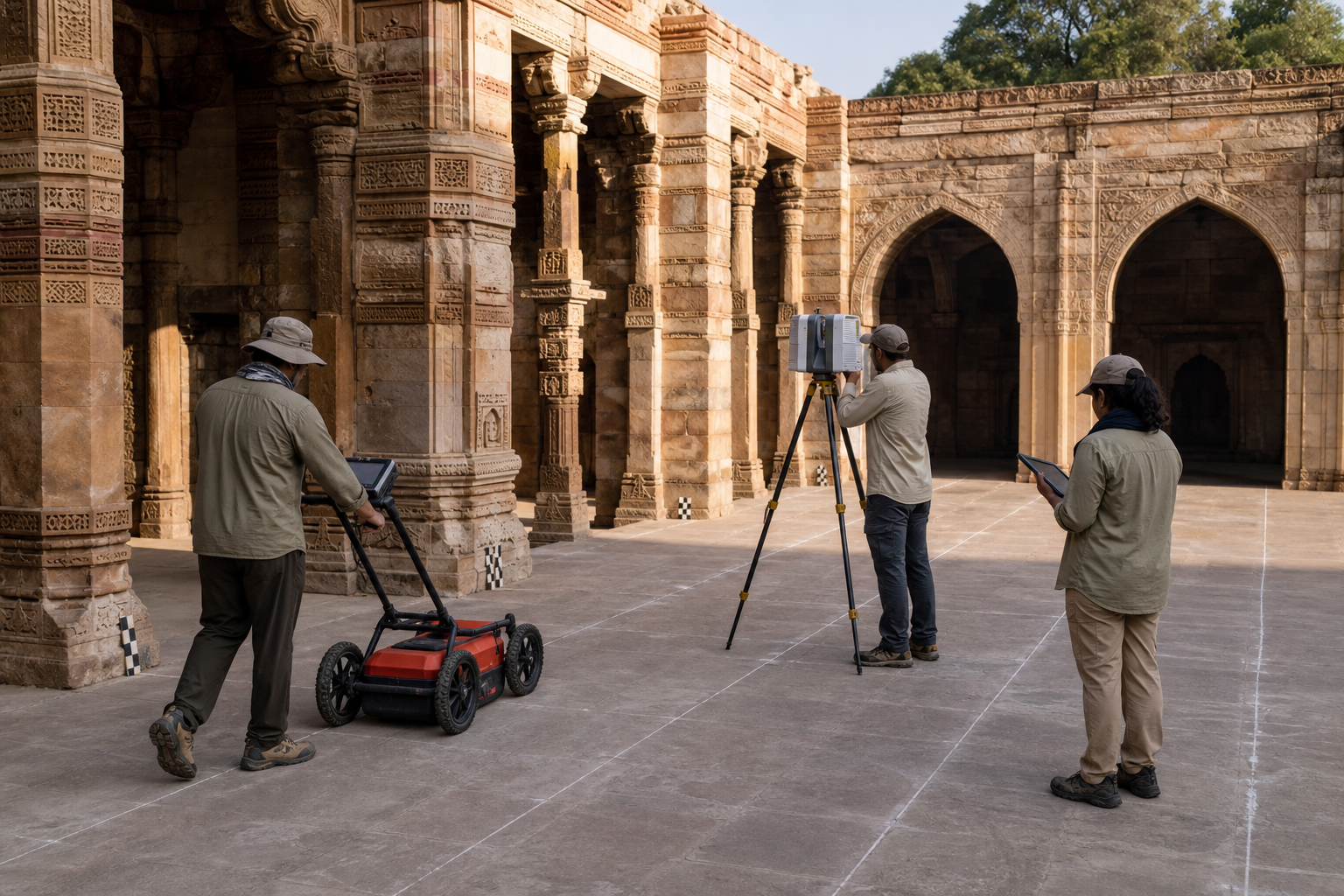
- Create a complete three-dimensional record. LiDAR, close-range photography and UAV-based photogrammetry can produce a digital twin of the monument. Each pillar, base, capital, inscription and carved fragment should receive a stable catalogue number and mapped location.
- Recover and re-read inscriptions. Raking-light photography, Reflectance Transformation Imaging and multispectral imaging can reveal worn strokes that are difficult to see under ordinary light. Sanskrit, Prakrit and Persian readings should be checked against earlier transcriptions and the new three-dimensional record.
- Map the subsurface. Ground-penetrating radar and electrical resistivity tomography can identify buried walls, voids, foundation changes and other anomalies without immediately opening the ground.
- Compare stone, plaster and mortar. Portable X-ray fluorescence, petrographic analysis and microstratigraphic examination can group materials, distinguish phases and test whether apparently related components share physical characteristics.
- Date only well-defined contexts. Where conservation rules permit sampling, carefully prepared lime-mortar fractions may be examined through accelerator mass spectrometry. Thermoluminescence or optically stimulated luminescence can contribute to the dating of suitable associated material or sediments, while Raman spectroscopy can examine surviving pigment residues.
- Integrate the results before naming a predecessor. Geophysics, epigraphy, iconography, material groups, structural joints and dating evidence should be interpreted together. No single technique can carry the entire conclusion.
The order is important. Three-dimensional documentation preserves the position and condition of every visible element before any intervention. Epigraphic imaging can improve the evidence without removing a fragment. Geophysics can then identify the few places where a tightly controlled investigation might answer a defined question. Targeted sampling becomes the last resort, not the opening move.
Know what the instruments cannot tell you
A ground-penetrating radar anomaly is not a temple, sanctum or classroom. It is a change in the subsurface that may represent masonry, a void, disturbed ground, moisture or another contrast. Its shape, depth and relationship to known foundations must be assessed before interpretation.
A matching stone composition can group fragments or point towards a shared geological source. It cannot automatically prove that those fragments belonged to one building. Workshop traits, dimensions, joints, inscriptions and archaeological context must support that next step.
A mortar date belongs to the sampled mortar and the context in which it was used. It does not directly date a reused sculpture placed beside it. This is especially important at Adhai Din Ka Jhonpra, where an old carved component may have been installed during a later construction phase.
Enhanced images can make faint letters more legible, but they do not remove every ambiguity. Proposed readings should therefore show the images, explain uncertain characters and distinguish visible text from restoration. That is how an inscription becomes verifiable evidence rather than an appealing transcription repeated without scrutiny.
Make the investigation reviewable
The survey’s terms of reference should state the hypotheses before fieldwork begins. A useful plan would ask whether earlier foundations exist, whether the spolia form one or several material groups, whether inscriptions can be tied to particular architectural components, and which phases can be dated independently.
Interim findings should distinguish observations from interpretations. The block catalogue, plans, imaging methods, sampling locations, laboratory procedures and confidence levels should be available for qualified review wherever conservation and security permit. Independent epigraphists, archaeological scientists, conservation specialists and historians of medieval India can then test whether the conclusions follow from the recorded evidence.
Conservation must remain the controlling condition. The investigation would need to comply with applicable protections under the Ancient Monuments and Archaeological Sites and Remains Act of 1958, its rules, site bylaws and relevant National Monuments Authority requirements. A minimum-intervention approach consistent with ICOMOS principles and the Nara Document on Authenticity of 1994 would put stabilization before investigation, require a reason for every sample and favor reversible procedures wherever possible.
Archaeology and ritual control are separate questions. A survey can clarify chronology and previous land use without being designed to decide present worship, ownership or conversion of the monument. Keeping that boundary explicit protects both the inquiry and the communities asked to trust it.
Key takeaways for judging the next claim
- The strongest established fact is extensive reuse: the mosque contains pillars and fragments from earlier Hindu and Jain architecture.
- Sanskrit fragments associated with the Chahamana milieu of Vigraharaja IV make the proposed Sanskrit-learning context historically meaningful, but they do not alone prove a complete college on the exact footprint.
- The central unresolved issue is provenance: whether the reused elements came from one on-site complex, several donor structures, or a mixture of both.
- Subsurface anomalies, stone matches and enhanced inscriptions are evidence to be interpreted, not self-explanatory verdicts.
- The most reliable investigation would be non-invasive first, minimally sampled, independently reviewed and explicit about uncertainty.
When a new claim or survey result appears, do not begin with its headline. Look for the mapped location of the evidence, the method that produced it, the construction phase to which it belongs and the alternative explanations that were tested. If any of those four elements is missing, the conclusion is probably stronger than the disclosed evidence.
Until a rigorous investigation supplies that context, the responsible description is straightforward: Adhai Din Ka Jhonpra is an early Sultanate mosque with extensive Hindu and Jain spolia and important Sanskrit fragments, while the precise character of its pre-Islamic site remains unresolved. A pro-Dharma account loses nothing by being exact. It gains authority by insisting that every surviving Sanskrit letter, carved pillar and buried foundation be documented carefully enough for others to verify.
If you want the origins clarified, ask for a published research design, a complete architectural inventory, non-invasive subsurface mapping and peer-reviewed results. That is the path from a contested label to a defensible history – and from a vulnerable monument to a better-preserved record of Ajmer’s layered past.
References
