

You may know how to calm yourself for a few minutes and still feel overwhelmed when you return to the examination, deadline, family problem or uncertain decision in front of you. The missing piece is usually not another technique. It is a structure that carries steadiness from practice into action.
A workable Dharmic approach has four layers: stabilize your daily rhythm, regulate the body and breath, train attention through sadhana, and convert the recovered clarity into the next right action. You do not have to install all four at once. Start with the layer that is failing today.
Build resilience around two reliable points in your day
Stress becomes harder to manage when every ordinary decision is renegotiated: when to wake, when to study, whether to eat, when to stop scrolling and how late to work. A predictable dinacharya reduces this decision load and gives the body recurring cues for activity and rest. Routine is not a demand to control every hour. It is a small set of promises that remain intact when the rest of the day moves.
Begin with two bookends rather than an ambitious timetable:
- Set the morning anchor. Wake within a consistent window, take in morning light, hydrate, and give your body a brief period of movement and unhurried breathing before opening your books, messages or work queue.
- Set the evening anchor. End your final screen session at least sixty minutes before bed. Review the effort you made that day, write one concrete next-day sankalpa, and keep your sleep window as regular as circumstances permit.
A useful sankalpa is narrow enough to recognize when it has been fulfilled. ‘I will be productive’ leaves the mind negotiating all day. ‘Before checking messages, I will revise the first topic on my list’ gives it a clear direction. Under uncertainty, reserve one protected period for the practical problem itself – applications, calls, documents, budgeting or another necessary task – so that worry does not occupy every available hour.
Keep the two anchors for one week before adding more. Mark whether you kept them, but do not punish yourself for a missed day or compensate with an extreme routine. Abhyasa is repeated return. The return after disruption is part of the training, not evidence that the training failed.
Use a safe fifteen-minute reset before demanding work

When the mind is racing, reasoning with every anxious thought can become another exhausting task. Posture, movement and breath offer a more immediate point of entry. Gentle yoga improves bodily awareness, while slower breathing can help shift you away from threat-driven arousal and toward a state in which attention is easier to direct.
This compact sequence can be used before study, concentrated work or a difficult practical task:
- Two minutes of arrival: Sit or stand with the spine comfortably upright. Feel the support beneath your feet or seat. Let the jaw, shoulders and abdomen soften. Observe several natural breaths without correcting them.
- Ten minutes of mobility and asana: Choose a modest sequence from Tadasana, Vrikshasana, Bhujangasana, Setu Bandhasana, Balasana or a moderated Surya Namaskara. Move slowly enough to notice balance, joint position and the transition between postures. You do not need to perform every pose.
- Three minutes of gentle pranayama: Use unforced Nadi Shodhana without retention, or Bhramari with a soft humming exhalation. Keep the breath nasal, smooth and quiet. Let the exhalation become slightly longer than the inhalation without squeezing out the last air.
The sequence matters. Movement gives restless energy somewhere to go; the settled posture then makes subtle breath regulation easier. Slow diaphragmatic breathing and a longer exhalation support autonomic downshifting, but strain reverses the purpose. If counting makes you tense, drop the count. If alternate-nostril breathing feels awkward, use ordinary nasal breathing or Bhramari instead.
Safety is part of the discipline. Keep the spine neutral, load joints in alignment, and avoid forcing an end range merely to reproduce the appearance of a posture. Advanced breath retention and forceful pranayama are unnecessary for stress regulation, especially for beginners. Stop if you become dizzy, breathless or unwell and return to ordinary breathing. Anyone with an acute or chronic health concern should seek guidance from a qualified healthcare professional before beginning a new movement or breath practice.
Do not judge the reset by whether all stress disappears. Ask a more useful question: can you now identify and begin the next task? Calmer physiology is valuable because it restores choice, not because calm must become a permanent mood.
Choose one sadhana and let it train your response
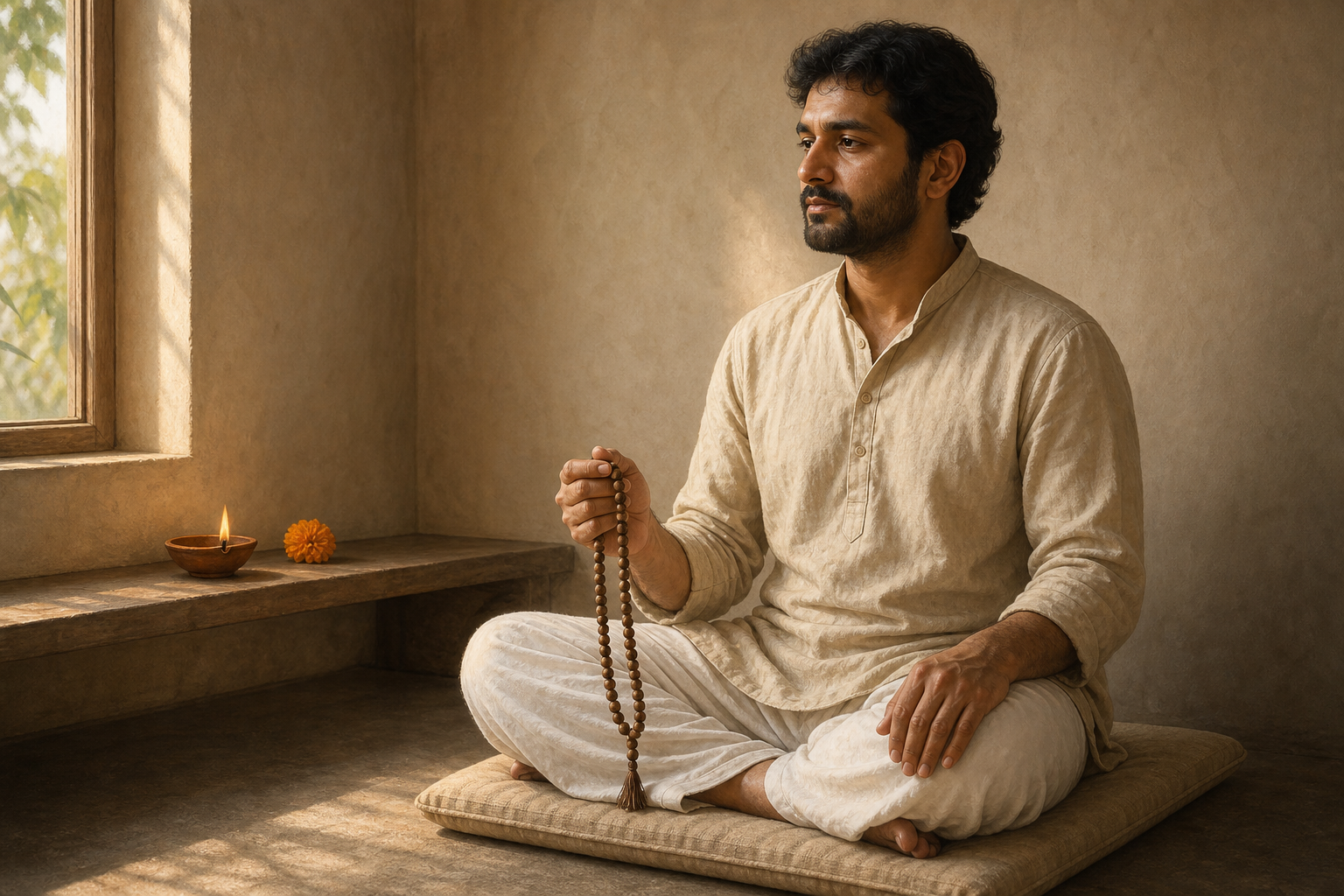
Breathwork changes your immediate state. Sadhana works on the habits of attention and conduct that meet the next stressful moment. It gives the mind one worthy object to return to and places personal pressure inside an ethical or spiritual horizon larger than the pressure itself.
Hindu, Buddhist, Jain and Sikh paths are not interchangeable, and their practices should not be stripped of their distinct meanings. Yet each offers disciplined forms of remembrance, equanimity and compassion. Choose one that is faithful to your own lineage and circumstances:
- Japa: Repeat a received mantra with attention. When the mind leaves, notice the departure and return without turning distraction into a second conflict.
- Simran: Rest attention in remembrance of the Divine Name. It may be coordinated gently with the breath, but the aim is remembrance rather than control of respiration.
- Metta contemplation: Cultivate goodwill toward yourself and progressively toward others. This is particularly useful when stress is hardening into hostility or self-contempt.
- Samayik: Set aside ordinary roles and reactions for a period of equanimity, observing where attachment, aversion or agitation is directing conduct.
Give one practice ten quiet minutes in the morning or evening. Do not rotate methods every time the mind becomes bored. Consistency allows you to notice the important change: not whether thoughts still arise, but whether you believe and obey each thought as quickly as before.
Bring the ethical quality of the practice into the next encounter. After metta, speak without adding needless injury. After samayik, delay the reactive message. After japa or simran, complete the duty in front of you without making the result your whole identity. This is where stress management becomes resilience: inner steadiness begins to alter behaviour.
Use the five elements when life itself feels unstable

A routine can be disrupted by eviction, bereavement, examination failure, financial pressure, illness in the family or another event that changes the practical ground beneath you. In those periods, the Panca Mahabhuta – earth, water, fire, air and space – can serve as a contemplative checklist. This is a practical use of the elemental lens, not a claim that every Dharmic school gives the elements identical doctrinal meanings.
- Earth, or prithvi: recover what is stable. Write down what remains dependable: a relationship, a duty, a skill, a place of worship, a walking route, a regular meal or a core value. Then preserve the smallest daily anchors you can actually keep. Apply aparigraha to possessions, commitments and information: release what consumes energy without sustaining the life you now have to manage.
- Water, or ap: let emotion move without giving it command. Name the feeling before explaining it. If useful, move through RAIN: recognize what is present, allow it to be present for the moment, investigate how it appears in the body and mind, and nurture the distressed part with compassion. A time-bounded journal entry or a conversation devoted to listening can contain emotion without requiring an immediate solution.
- Fire, or agni: convert fear into one completed action. Choose a task small enough to finish: prepare one document, make one call, revise one topic, pack one box or send one application. Use an implementation intention when avoidance is strong: ‘If it is time for my protected work period, then I will begin with this named task.’ Tapas here means continuity, not frantic intensity.
- Air, or vayu: create enough space to see choices. Slow the breath toward roughly five or six comfortable cycles per minute only if that rate remains easy. Then divide a page into what you can influence and what you cannot. Move your effort to the first column. Replace an absolute prediction such as ‘Nothing will work’ with a truthful working statement: ‘The outcome is not settled; this is the next lever available to me.’
- Space, or akasha: reconnect action with meaning. Ask which value this difficulty is inviting you to embody. Non-clinging can loosen the demand that reality follow one script. Anekantavada can reveal that your frightened interpretation is not the only possible view. Chardi kala keeps courage joined to service. Seva, prayer, community and concern for the welfare of others prevent stress from shrinking the whole field of awareness to the isolated self.
You do not have to use every element every time. Start with earth when your day has lost structure. Use water when grief or anger is being suppressed. Use air when thought is racing, fire when you are calm enough to act, and space when the problem has reduced life to a single feared outcome. The order may change, but fire works best after enough regulation has returned for action to be deliberate rather than panicked.
Measure your ability to return, not your ability to stay calm
A resilience practice can become another performance contest if you track only perfect streaks, ideal postures or uninterrupted concentration. Measure what the practice is meant to improve. For one week, make a brief evening record of the following:
- Whether you kept your chosen morning and evening anchors.
- Whether the movement, breath or sadhana left you more scattered, unchanged or steadier.
- Which necessary action became easier to begin after practice.
- What effort you made even when the outcome remained uncertain.
This record separates a method that is genuinely helping from one you merely admire. It also builds confidence from evidence you can observe: you kept a sleep window, completed a three-pose flow, returned to Nadi Shodhana, revised despite anxiety or handled a disagreement with less reactivity. Self-confidence grows through such completed acts of agency, not through trying to feel certain before acting.
Key takeaways
- Begin with two daily anchors and keep them for a week before expanding the routine.
- Use a fifteen-minute pre-work reset: two minutes of arrival, ten minutes of gentle movement and three minutes of unforced pranayama.
- Choose one lineage-consistent sadhana and practise it for ten quiet minutes rather than continually changing methods.
- During upheaval, use earth for stability, water for emotion, air for perspective, fire for action and space for meaning.
- Judge progress by how reliably you return to wise action, not by whether stress disappears.
Yoga, pranayama and sadhana can support stress regulation, but they are not substitutes for medical or psychological care. If stress persistently disrupts sleep, eating, study, work or relationships, seek help from a qualified healthcare or mental-health professional. If inward attention or breath focus increases distress, stop that method and use a grounded alternative such as gentle walking while arranging appropriate guidance.
Tonight, choose your evening anchor and write one precise sankalpa for tomorrow. Use the fifteen-minute reset before that task. After a week, keep what helped and add one ten-minute sadhana. A durable practice begins when the next small act is clear enough to do.
References
- Hindu Janajagruti Samiti – Science-Backed Calm for Haryana Students: HJS on Yoga, Pranayama and Sadhana for Stress Management
- Tiny Buddha – From Upheaval to Equanimity: A Dharmic Elemental Method to Steady Uncertain Times
