

A quotation from Siyar-ul-Mutakhkherin appears in your feed, followed by a sweeping verdict about Hindus, Sikhs, the Marathas, or an entire period of Indian history. Before you accept it, reject it, or pass it on, you need to answer a narrower question: can this wording bear the historical claim being placed upon it?
You can answer that question without becoming a specialist in Persian manuscripts. What you need is a disciplined sequence: identify the edition, reconstruct the passage, classify the claim, compare independent records, and state only the conclusion the evidence supports. That sequence protects difficult truths from denial while preventing a courtly chronicle from becoming a weapon of collective accusation.
Establish which Siyar you are actually reading
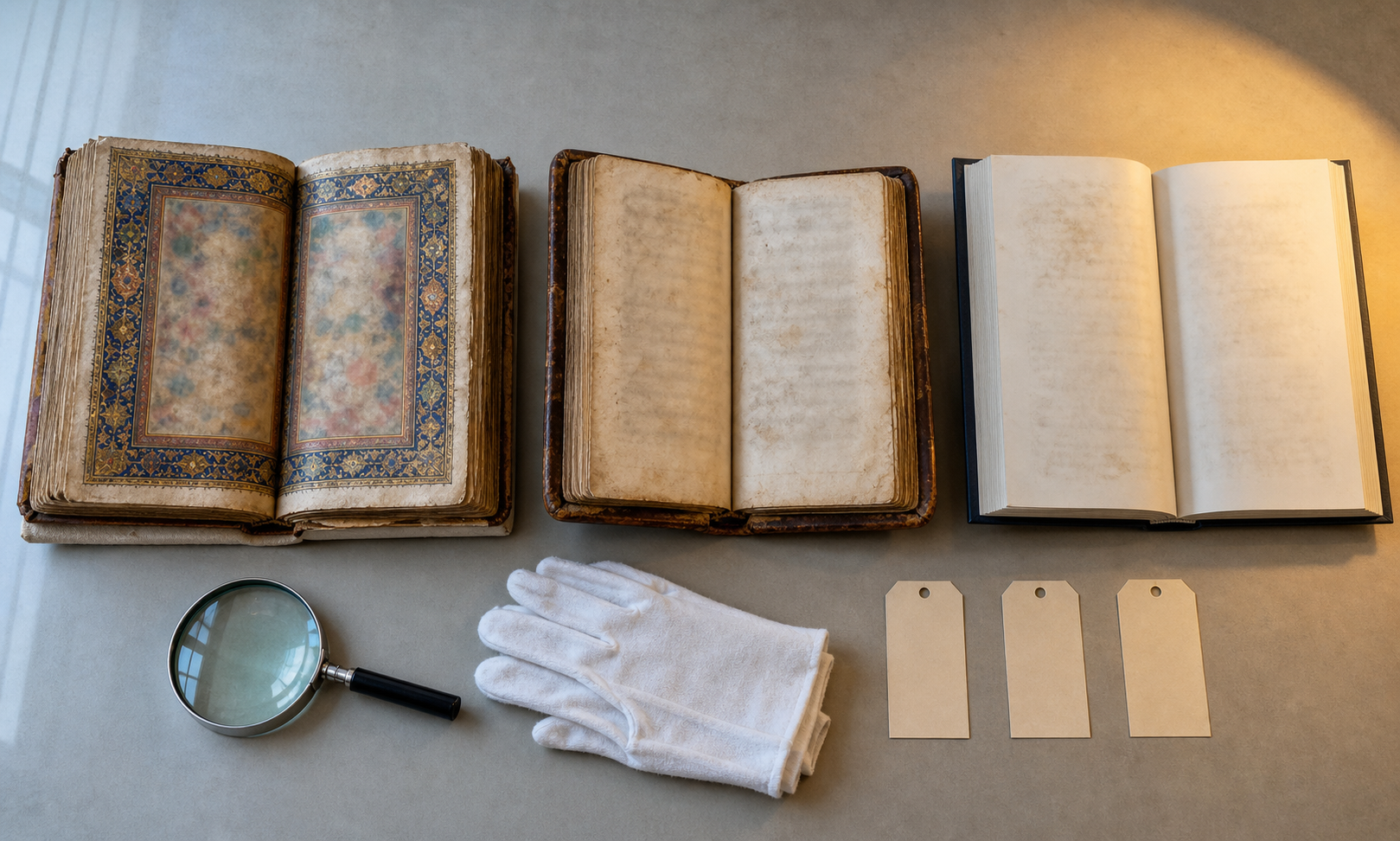
Start with provenance, not interpretation. Late-eighteenth-century Persianate court culture surrounded the chronicle’s composition, while political disorder, patronage, courtly expectations, and the expanding influence of the British East India Company affected what could be known, rewarded, emphasized, or condemned. Those conditions do not automatically invalidate a passage. They tell you which questions must be asked before treating it as neutral reportage.
The first practical complication is that Siyar-ul-Mutakhkherin is not encountered through one transparent line of transmission. English readers also met it under the title Seir Mutaqherin, while multiple manuscripts, transliteration differences, early colonial translations, abridgments, editorial cuts, and occasional mistranslations could change wording or emphasis. A quotation may therefore be genuine in one printed edition yet still fail to represent the Persian wording precisely.
| Layer | Question to ask | What can go wrong |
|---|---|---|
| Narration | Was the event witnessed, reported by another person, inferred, or retold later? | Rumour, limited access, and retrospective judgment can be mistaken for direct observation. |
| Manuscript | Which manuscript or manuscript family underlies the edition? | Copying differences can produce variant wording. |
| Editing | Was the material presented in full or abridged? | Omissions can remove qualifications, transitions, or contrary details. |
| Translation | Which Persian terms produced the English wording? | A moral, political, or communal label can acquire a stronger or flatter meaning in English. |
| Excerpt | What comes immediately before and after the quotation? | A pronoun, change of speaker, or rhetorical turn can disappear from a clipped passage. |
For any quotation you intend to use publicly, record six bibliographic details:
- The title and spelling printed in the edition.
- The language you are reading: Persian, English, or another translation.
- The editor or translator, where identified.
- The volume and page number.
- The complete paragraph, including the sentences on both sides.
- Any notice of abridgment, omission, paraphrase, or manuscript basis.
If the person sharing the quotation cannot supply those details, label it unlocated or unverified. Do not call it fabricated merely because its chain of custody is missing. Equally, do not call it reliable because the typography looks old or because many websites repeat it. Repetition establishes circulation, not authenticity.
Different spellings are not proof of fraud. Transliteration moves Persian words into another script, and different editors can make different choices. Siyar-ul-Mutakhkherin and Seir Mutaqherin may point to the same work while still leading you to materially different editions. The identity of the edition matters more than the spelling preferred by the person quoting it.
Turn rhetoric into a claim that can be tested
Premodern chronicles commonly combine event narration, attributed speech, political explanation, moral judgment, and literary flourish. Trouble begins when a reader treats every sentence as if it were a modern administrative entry. A hostile description may reveal the chronicler’s attitude with great clarity while proving much less about the conduct of the people being described.
Classify the passage before you search for corroboration. Use one or more of these labels:
- Event claim: a named or identifiable actor is said to have performed an action.
- Attributed report: the chronicler records what another person or group allegedly said.
- Causal inference: a motive or political explanation is assigned to an event.
- Moral judgment: an actor is praised, condemned, or placed within a moral scheme.
- Collective generalization: conduct is attributed to a whole community, polity, or class.
- Rhetorical quantity: a number or absolute expression conveys magnitude but may not function as a verified count.
These categories can overlap. An event may have occurred even when the accompanying motive is speculative. A speaker may really have made a statement even when the statement itself was false. A chronicler’s moral condemnation may be historically important as evidence of elite perception, but it cannot by itself prove a community’s character.
Now rewrite the passage as an atomic claim. Identify the actor, action, place, time, target, and basis of knowledge. Mark every missing element as unknown. If a passage says that a broad group behaved in a certain way, ask whether the surrounding narrative actually identifies a particular army, official, faction, town, or episode. Do not silently replace an identifiable actor with an entire people.
This narrowing is not an attempt to excuse wrongdoing. It makes wrongdoing historically demonstrable. The difference between a local force imposing a levy and a civilization being inherently predatory is not a matter of tone; it is the difference between an event claim and an identity claim. Evidence for the first does not automatically prove the second.
Watch especially for words equivalent to all, always, never, countless, or the whole community. Premodern moral and political writing could use numbers and absolutes rhetorically. Record a large figure as the chronicler’s stated quantity until an independent record supports it. Do not convert literary magnitude into a census-like count simply because the translation prints a numeral.
Context also includes narrative position. Read far enough in both directions to determine who is speaking, whether the writer approves of the statement, and whether a later sentence qualifies it. A quotation introduced as an accusation is not the same as an accusation endorsed by the narrator. A description of one campaign is not automatically a description of a permanent policy.
Triangulate across languages, interests, and record types

Triangulation is not a vote among quotations. Ten English webpages reproducing one colonial translation still represent one transmission path. Two chronicles repeating the same court rumour may also be dependent on one report. What raises confidence is convergence among records that had different access, purposes, languages, or institutional interests.
Build a comparison set around the specific event rather than around the community you hope to defend or condemn. Relevant materials can include contemporary Persian chronicles, farmans and sanads, Marathi bakhars, Sikh accounts, and early British administrative records. Each type answers a different question and carries a different limitation.
- A second Persian chronicle may confirm sequence, political vocabulary, or court perception, but shared elite networks can also transmit the same rumour.
- A farman or sanad can establish that an order, appointment, grant, or privilege was issued. It does not by itself prove that the order was fully obeyed.
- A Marathi bakhar can preserve regional actors and memories absent from a court-centred account, while still carrying its own political and literary purposes.
- A Sikh account can recover experiences, priorities, and institutional memory that an imperial narrator may marginalize.
- An early British administrative record may help with dates, revenue, diplomacy, or official observation, but it was produced within an expanding colonial enterprise rather than outside politics.
Use a claim ledger so that agreement and disagreement remain visible. One page is enough. Give it these fields:
- Exact wording in the edition you possess.
- Volume, page, language, editor, and translator.
- Your literal paraphrase without moral adjectives.
- Claim type: event, report, motive, judgment, generalization, or quantity.
- Actor, place, period, and action that can actually be tested.
- Records that agree on the core event.
- Records that differ on actor, sequence, scale, motive, or outcome.
- Details that remain unknown.
- The narrowest conclusion justified by the current evidence.
Distinguish levels of corroboration. Strong convergence means independent records agree on the core action even if they explain it differently. Partial convergence means they agree that an event occurred but disagree about scale, responsibility, motive, or consequence. Contradiction means a material element changes. Silence means only that the event has not been found in that record; silence becomes significant only when the record was well placed and expected to mention it.
Write your conclusion with the same precision. A useful form is: the occurrence is well supported, partly supported, or presently uncorroborated; the claimed scale or motive remains disputed; the broader communal generalization does not follow. That wording separates what you know from what you suspect.
Use the terms false, fabricated, or debunked only when the evidence reaches them. A quotation that cannot be located is unverified. A quotation that changes materially between Persian and English is translation-dependent. A genuine passage cut away from its qualifications is decontextualized. A recorded accusation contradicted elsewhere may be unreliable testimony without being a fabricated sentence. These distinctions prevent a correction from outrunning its own proof.
Use a Dharmic lens as discipline, not as a shortcut

A pro-Hindu reading should be more exacting, not less. Exaggerated counterclaims make sound grievances easier to dismiss, while selective denial dishonours people who actually suffered. Reclaiming Hindu history requires resistance to distortion in both directions: neither inherited courtly contempt nor present-day loyalty can substitute for evidence.
Dharmic ethical vocabularies can guide how you conduct the inquiry without predetermining its result. Jain anekantavada offers a particularly useful discipline: a standpoint may disclose something real without exhausting the whole truth. That is not relativism. Contradictory accounts do not become equally accurate; they become claims whose vantage points, access, purposes, and evidentiary support must be examined.
Dharma asks for proportion between evidence and judgment. Ahimsa cautions against turning uncertain allegations into hostility toward living people. Seva can take the form of preserving records, translating carefully, and correcting claims without humiliating those who repeated them in good faith. Hindu, Buddhist, Jain, and Sikh traditions do not define every value identically, but each gives you reasons to prefer disciplined truth-seeking over communal excitement.
The historical picture must also be wide enough to hold conflict and cooperation at once. Warfare, taxation, and diplomacy could be localized and negotiated, while trade, shared ritual spaces, pilgrimage networks, artisan activity, and administrative cooperation continued in other settings. Evidence of coexistence does not erase violence. Evidence of violence does not establish the timeless character of every person carrying a religious or political label.
Before publishing a communal conclusion, ask four final questions:
- Am I identifying the actor named by the evidence, or enlarging that actor into a whole community?
- Have I separated the occurrence of an event from the narrator’s explanation of its motive?
- Would I accept this standard of proof if the allegation targeted my own tradition?
- Does my wording preserve the victims and the uncertainty, or sacrifice one to protect the other?
This approach neither sanitizes Mughal history nor converts it into a simple civilizational morality play. It allows specific injustice, resistance, negotiation, alliance, and coexistence to remain visible at their proper scale.
Key takeaways
- A quotation without an identifiable edition, language, volume, page, and surrounding paragraph is unverified evidence.
- Siyar-ul-Mutakhkherin and Seir Mutaqherin can refer to the same chronicle while leading to different editorial and translation layers.
- Separate event narration, attributed report, inferred motive, moral judgment, collective generalization, and rhetorical quantity.
- Repeated copies of one translation are not independent corroboration.
- Compare Persian, administrative, Marathi, Sikh, and early British records by event, place, and period.
- Narrow every communal allegation to the smallest actor and action the evidence can establish.
- Use unverified, translation-dependent, decontextualized, disputed, and contradicted accurately; reserve fabricated or debunked for cases that justify those conclusions.
- A Dharmic reading preserves both moral seriousness and epistemic restraint.
The next time a sensational quotation appears, do not begin with a verdict. Ask for the edition, original language, volume, page, and full paragraph. Put the claim into a one-page ledger, compare independent records, and publish at the level of certainty you can defend. A precise conclusion may travel less dramatically than a communal accusation, but it serves Hindu history, Sikh memory, and Bharat’s civilizational integrity far better.
References
