

When your mind will not settle, the hardest question is often practical: what can you do today that does not deny the pain, feed it, or leave you alone with it? Sikh tradition offers a grounded sequence. Remember the Divine through Naam, let Gurbani examine your thoughts and conduct, accept support from sangat, and turn inward clarity into seva.
This is not a promise that prayer will remove every illness, loss, or psychological wound. Spiritual practice can accompany medical and mental-health care; it should not replace either. If distress is making ordinary life unmanageable, speak with a qualified professional. If you may harm yourself or someone else, contact local emergency or crisis support now and remain with a person you trust.
Understand healing before asking for relief
It is natural to approach prayer with a desired outcome: cure this illness, end this grief, settle this conflict, or take away this fear. Yet Sikh healing is deeper than obtaining the outcome you want. It begins by changing how you stand within suffering. Naam interrupts the mind’s claim that pain is the whole of reality. Gurbani brings your reactions under moral scrutiny. Seva prevents sorrow from closing the world around you. Sangat reminds you that you do not have to carry everything privately.
This distinction matters when you encounter Dukh Bhanjani Beri at Harmandir Sahib. Its name conveys the removal of suffering, and Sikh oral tradition associates the sacred tree and adjoining waters with Bibi Rajni’s devotion and her husband’s healing. Receive that account as an invitation to trust, humility, gratitude, and hope. Do not turn it into a clinical guarantee. Immersion, pilgrimage, or prayer does not entitle anyone to a physical cure, and continuing illness is not proof of weak faith.
A more reliable way to notice spiritual healing is to examine what suffering is producing in you. Are you becoming less ruled by anger? Can you tell the truth without cruelty? Are you able to ask for help? Can you act for another person’s welfare even while your own difficulty remains? Are fear and desire still making every decision? These questions do not minimize pain. They show whether pain is directing your character.
Inner peace, in this frame, is not a permanently pleasant mood. It is enough steadiness to meet reality without surrendering your conscience. You may still grieve, need treatment, set a boundary, or make a difficult decision. Peace becomes visible in the quality of those actions.
Build a daily rhythm around Naam and Sukhmani Sahib
A healing discipline works best when it is attached to a dependable transition in your day. Choose the period after waking or the period before sleep. Do not wait until you feel devotional; the unsettled day is precisely when a stable form is useful.
Sukhmani Sahib is especially suited to this work. Traditionally attributed to Guru Arjan Dev Ji and contained in the Guru Granth Sahib, it unfolds through 24 ashtapadis composed in Raag Gauri. Its recurring movement through Naam, humility, detachment, compassion, wise company, and ethical conduct gives the mind somewhere definite to return. The repetition is not needless duplication. It helps an idea move from something you recognize to something you remember when pressure arrives.
- Remove the nearest source of distraction. Put the phone out of reach unless you need it for the recitation, recording, transliteration, or translation.
- Listen to a reputable kirtan rendering with full attention. Let the cadence gather the mind before trying to analyse every line.
- Read a manageable passage. Use Gurmukhi if you can; otherwise place a reliable translation beside the Gurmukhi or transliteration. A complete recitation is valuable, but a selected passage contemplated carefully is better than rushing through the whole composition merely to finish it.
- Sit in silent Simran after reading. Rest attention on the Divine Name. When the mind wanders, return without scolding yourself or turning the wandering into another drama.
- Write one sentence: “Because of what I contemplated, today I will…” Complete it with a concrete action involving speech, anger, desire, humility, compassion, or service.
On a difficult day, preserve the sequence even if you cannot preserve your usual length of practice: one passage, sincere Simran, and one ethical action. This keeps devotion from becoming an all-or-nothing project. It also prevents a common mistake: treating the calm felt during recitation as the final result. The real test begins when another person frustrates you.
Do not chase a special sensation. Some periods of Simran will feel quiet; others will reveal how restless, resentful, or frightened the mind already is. Seeing that agitation clearly can itself be useful. Notice it, return to Naam, and then decide what responsible action the situation requires.
Turn recitation into ethical repair
Sukhmani Sahib does not separate spiritual insight from conduct. Remembrance of the Divine is joined to truthful speech, restraint of anger, compassion, humility, detachment from compulsive desire, and the company of the wise. If recitation soothes you but leaves a pattern of dishonesty or cruelty untouched, the practice has not yet entered the decision that needs it.
Use one teaching as a decision rule for the day. The method is simple:
- Name the point of friction without defending yourself: “I want to send an angry reply,” “I am hiding part of the truth,” or “I want recognition for doing this.”
- Connect the friction to one discipline: restraint for anger, truthful speech for concealment, detachment for craving, humility for the demand to be praised, or compassion for indifference.
- Pause for Simran before acting. The purpose is not to make the problem disappear; it is to stop the first impulse from making the decision.
- Choose an observable repair. Delay the hostile message, correct the misleading statement, apologize without adding an excuse, perform the service without advertising it, or ask a wise person for counsel.
- Return to the incident during your next period of reflection. Notice where ego recovered control and what you will do earlier next time.
This is where detachment is often misunderstood. Detachment does not mean becoming indifferent to injustice, family responsibility, health, or honest grief. It means loosening the possessive demand that events, people, and praise obey your ego before you can act well. In the same way, humility does not require accepting abuse, and seva does not require destroying your health or remaining in danger. Where a situation is unsafe, seek safety and competent help; self-erasure is not spiritual maturity.
You can also use a recurring conflict as a measure of progress. Do not ask only, “Was I calm?” Ask, “Did I cause less harm? Did I speak more truthfully? Did I make repair sooner?” Those questions keep inner peace connected to dharma rather than mood.
Let seva, sangat, and sacred space share the burden
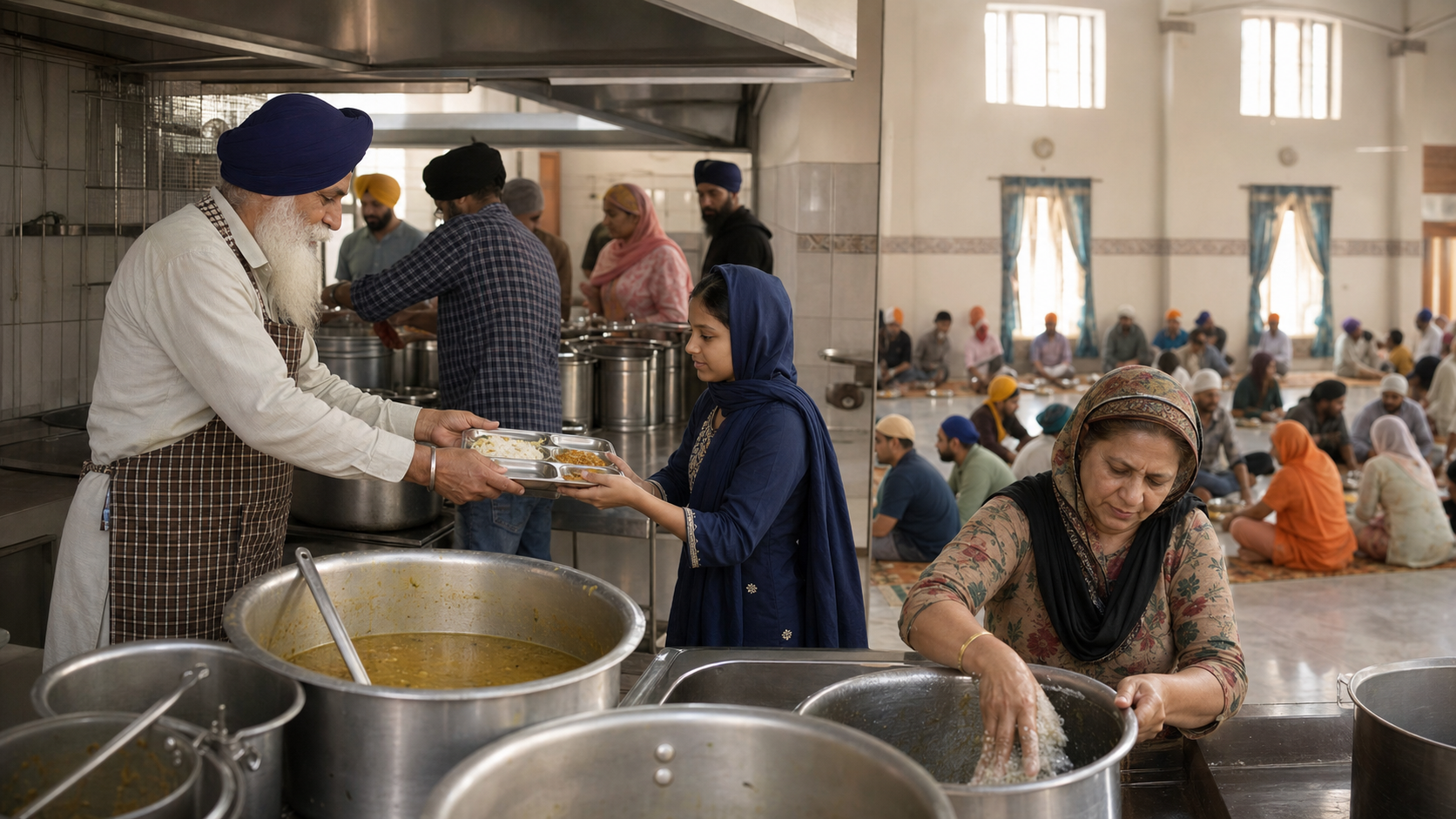
Suffering can make your attention contract until every thought circles the same injury. Seva opens that circle. It gives devotion a bodily form and returns you to a world in which other people also need care. The act need not be dramatic. Help with langar, clean a shared space, listen patiently to someone who is isolated, carry a family responsibility without seeking praise, or contribute to a community need within your actual capacity.
Choose service that is regular enough to shape you, modest enough to sustain, and quiet enough not to become a performance. If you are ill or exhausted, service may mean a message, a prayer for sarbat da bhala, or a small task you can complete safely. The value of seva does not depend on ignoring your limits.
Sangat answers a different problem: the belief that you must solve suffering alone before you are fit to join others. Go to the gurdwara before you have found the perfect words. Sit with kirtan. Participate in an appropriate seva. Tell a trustworthy member of the community that you are struggling and need company or practical help. Sangat cannot perform the work of a doctor or therapist, but it can provide presence, routine, prayer, meals, and human accountability alongside professional care.
Sacred place can also steady attention. Near Dukh Bhanjani Beri, devotees may sit quietly, listen to kirtan, and undertake parikrama beside the Amrit Sarovar. The physical setting gathers memory, prayer, community, and reverence into one experience. If you visit, cover your head, protect the devotional silence, maintain cleanliness, and do not pluck leaves or disturb the tree. Care for the place is part of the offering.
A journey to Amritsar can be meaningful, but healing should not be postponed until travel becomes possible. A local gurdwara can give you the essential pattern: Gurbani, Simran, sangat, and seva. Even at home, you can establish a clean and undistracted period for attentive listening, contemplation, and the ethical action that follows. The place supports the discipline; it does not replace it.
Questions that arise when you begin
Must you recite all of Sukhmani Sahib?
No. A complete recitation gives you the composition’s full progression, while selected passages can support a regular morning or evening discipline. Choose honestly. If attempting the whole recitation makes you rush, perform, or abandon the practice, begin with a passage you can hear, understand, and carry into the day. Increase the scope as familiarity and capacity grow.
Can you begin if you do not read Gurmukhi?
Yes. Begin by listening to a careful rendering while following transliteration and a reliable translation. Listening preserves cadence and pronunciation; translation helps you contemplate meaning. Neither should become an excuse to remain passive. Learn gradually, ask for guidance where needed, and keep connecting what you understand to conduct.
How can you tell whether the practice is helping?
Look beyond the emotional state of the recitation itself. Notice whether you recover from anger without feeding it, admit fault sooner, tolerate uncertainty without becoming dishonest, ask for support before reaching collapse, and serve without demanding recognition. Also notice whether daily functioning is worsening. Spiritual sincerity and professional treatment are compatible; persistent deterioration is a reason to seek more help, not to intensify private practice in isolation.
How does this relate to other Dharmic paths?
There are genuine resonances. Simran can be placed in conversation with dhyana and Buddhist contemplative attention; compassion and restraint from harm meet the civilizational ethic of ahimsa; seva belongs beside the broader discipline of selfless action. These affinities can deepen mutual respect without flattening the traditions. The Sikh pathway remains anchored in the Guru’s wisdom, Naam, Gurbani, sangat, seva, humility, and the welfare of all.
At your next fixed transition, put away the distraction, listen to or read one passage of Sukhmani Sahib, sit with Naam, and write down one repair or act of service. Complete that action before seeking a more elaborate practice. Inner peace becomes durable when remembrance and conduct are no longer separate parts of your life.



References
- SikhNet – Sukhmani Sahib: A Timeless Pathway to Inner Peace, Compassion, and Dharmic Unity
- SikhNet – Dukh Bhanjani Beri at Harmandir Sahib: A Sacred Tree of Healing, Faith, and Unity
